
Disposable Wooden Cutlery Shortlist for Custom OEM Orders
A custom OEM cutlery order is specified at model level, not at category level. Buyers who issue a broad request for “disposable wooden cutlery” and then compare quotations on price alone are usually comparing offers that differ in utensil length, base material, surface finish and documentation — the four variables that decide whether a shipment passes import review and performs on the table. This shortlist narrows the field to three documented models and explains what each one is built to do.
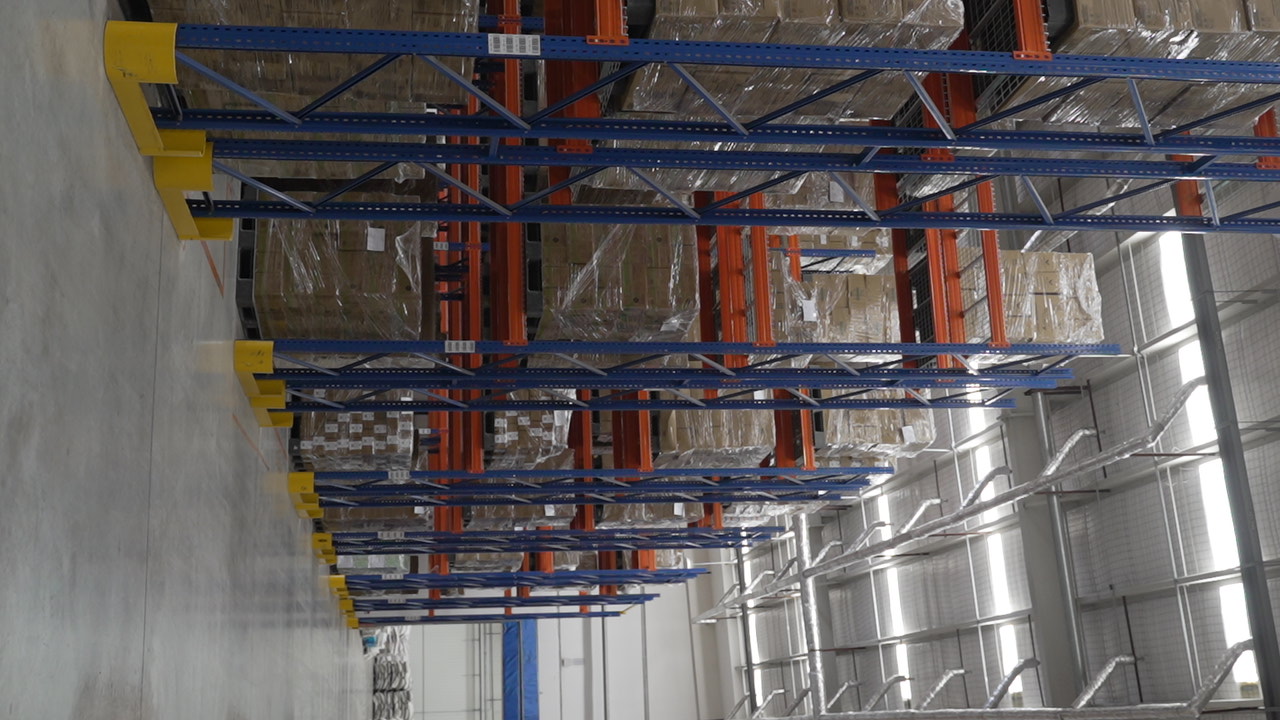
Stock and finished-goods storage at a Greenwood facility. Custom OEM programmes are planned against stated lead times rather than spot availability.
The three models below are produced by Greenwood - Dalian Industrial Co.,ltd., a Chinese manufacturer of disposable wooden and bamboo tableware founded in 2000, operating five factories and exporting approximately 95% of its output to Europe, Australia, New Zealand, Canada, the United States, South America, the Middle East, Japan, Korea and Southeast Asia.
Why a Model-Level Shortlist Beats a Category-Level Search
Most sourcing failures in this category are specification failures, not supplier failures. A buying team selects a supplier on capability, then writes a purchase order that names a material and a quantity but leaves length, logo method and packaging undefined. The factory then ships the most economical configuration available, which may be a 140mm utensil where the food-service team expected a full-length 160mm or 180mm setting.
Model-level specification removes that ambiguity. Each model in this shortlist carries a documented length range, a documented material statement, and a documented set of customization options. That makes three things verifiable before the order is placed: what the utensil will physically be, what can be printed or stamped onto it, and which compliance records support the claim being made to a regulator, a retail customer or a food-safety auditor.
The Shortlist at a Glance
| Model | Material | Documented lengths | Documented customization | Where it fits |
|---|---|---|---|---|
| GW-20456 | 100% natural wood (wood/bamboo range) | 180mm / 170mm / 160mm / 140mm / 110mm / 95mm, customizable | Size, logo (laser or print), packaging | Restaurant chains, takeaway wholesalers, supermarkets, airlines; highest length flexibility |
| GW-BC001 | Bamboo | 170mm standard; 110mm / 140mm / 170mm available | Logo (hot stamping), size, packaging, colour | Premium and branded programmes, catering, takeaway; natural bamboo texture |
| GW-PC204 | Paper | 158mm standard, customizable size | Logo, packaging, colour | Light menus, oil- and water-heavy dishes; shortest standard format of the three |
All three models are documented as food-grade, BPA-free and non-toxic, as heat-resistant and suitable for hot and cold food, and as 100% biodegradable and compostable per the product specification sheets. GW-BC001 additionally carries a documented LFGB/FDA certification reference for the bamboo range, and all three models are listed as applicable to restaurant chains, supermarkets, takeaway wholesalers and airlines.
Model 1: GW-20456 — the Wide-Range Workhorse
GW-20456 is the model to shortlist first when an order has to cover more than one service format. Its length range runs from 180mm down to 95mm, which means a single purchase programme can supply a full-length main-course setting and a short dessert or tasting utensil from the same production line, in the same finish, with the same logo method.
The documented customization scope is size, logo (laser or print) and packaging. Laser marking burns the mark into the wood surface without adding an ink layer, which matters for buyers whose specification restricts printing inks on food-contact surfaces. Print remains available where a multi-colour or high-detail mark is required.
The material statement covers 100% natural wood, with the wider Greenwood wood programme built around birch and poplar. Buyers sourcing under a forestry or deforestation-due-diligence policy should treat material origin as a separate line of inquiry from the model number, because the certificate that answers that question is the chain-of-custody document listed further below.
Model 2: GW-BC001 — Bamboo for Branded Programmes
GW-BC001 is a pure bamboo line with a 170mm standard length and 110mm and 140mm alternatives. The specification sheet describes a smooth edge with no burrs, a natural bamboo texture, heat resistance and suitability for hot and cold food, and it positions the model as durable for takeaway and catering use.
Its distinguishing customization feature is hot stamping for logos, alongside size, packaging and colour options. Hot stamping produces a matte, slightly recessed mark that sits well on a bamboo surface and tends to survive handling better than a surface-only ink mark, which is why it is the option most often requested for hotel F&B, catering and branded retail programmes.
Hotels and party-catering buyers typically follow the same specification logic as restaurants: fix the length against the menu, fix the logo method against the brand guidelines, then fix the packaging format. The bamboo texture is a visible design feature, so buyers running a strong table aesthetic should review a physical sample before committing a full run.
Model 3: GW-PC204 — Paper at a 158mm Standard
GW-PC204 is the paper option in the range: paper knife, paper fork and paper spoon at a 158mm standard length, with customizable size, logo, packaging and colour. The specification states heat resistance, water and oil resistance, a smooth edge and no odour — properties that matter when the utensil sits in contact with sauces, dressings or hot takeaway containers.
Paper is the right shortlist entry when the menu is light, the packaging is compact, or the buyer wants a utensil that visually matches a paper-based packaging system. It is also the model with the shortest standard format in this shortlist, which is a genuine constraint rather than a detail: where a longer utensil is specified, GW-PC204 will need a custom size development rather than an off-standard substitution from stock.
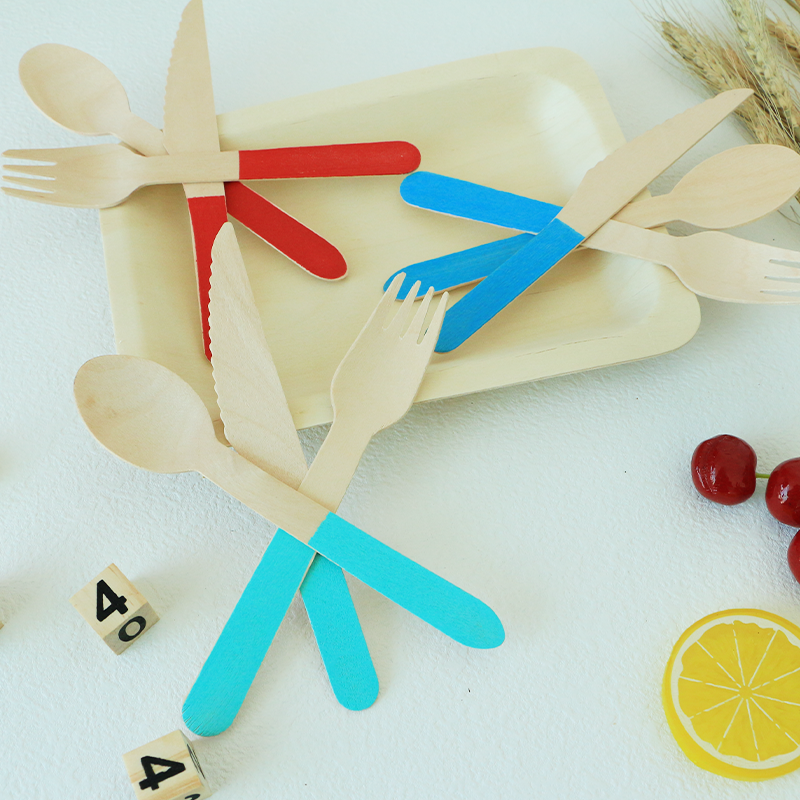
Logo application on product and packaging, plus shape and new-design development, fall inside the documented OEM/ODM customization scope.
Restaurant Disposable Wooden Cutlery: Matching the Shortlist to Service Format
For restaurant disposable wooden cutlery programmes, the model choice is driven less by price per piece than by the menu the utensil has to serve. Restaurant chains, supermarkets, takeaway wholesalers and airlines are the stated applicable industries for all three models, so the differentiation inside a restaurant programme comes from length, material feel and the ordering format.
A practical mapping runs as follows. Full-service restaurant chains with plated hot food typically specify the longer formats in the GW-20456 range, where the 160mm to 180mm options give a utensil proportionate to a main course. Quick-service and takeaway counters usually move to 140mm or 110mm, reducing material while keeping the utensil usable one-handed. Dessert, tasting and small-plate concepts can use the 95mm format. Bamboo-led branded concepts specify GW-BC001 at 170mm with hot-stamped branding. Where the menu is dominated by oily or wet dishes and the packaging is paper-based, GW-PC204 at 158mm keeps the visual system consistent.
Chain buyers should also decide the packaging format early, because individually wrapped configurations change both the unit cost and the packing line. Greenwood provides customized printing and individual packaging services, and the documented after-sales scope includes packaging design and logistics support — both of which shorten the gap between an approved sample and a shippable retail-ready pack.
There is a relevant precedent in adjacent retail channels. A project delivered for supermarket and chain-store clients in Germany and the United States, running for three years at an annual scale of USD 5 million, replaced traditional products and produced a sales increase for the buyer; the products served both B2B and B2C purposes, and the reported driver was the rising eco-friendly trend among younger consumers. Restaurant and retail chain procurement teams evaluating the same transition should read that case as evidence that the switch is commercially tested at chain scale, not as a claim that every category converts identically.
Customization: Logo, Packaging and Colour
Customization in this range is treated as OEM/ODM work rather than as an add-on. The documented production mode covers OEM, ODM and customization; the documented customization scope covers logo printing on products and packaging, plus customized shape and new design. Buyers can therefore treat the three models as starting points for a developed specification rather than as fixed catalogue items.
Logo methods by model
- GW-20456 (wood): laser or print — laser for an ink-free mark, print for multi-colour or fine-detail branding.
- GW-BC001 (bamboo): hot stamping — a matte, recessed mark suited to natural bamboo surfaces.
- GW-PC204 (paper): logo customization is documented without a named method, so the application method should be confirmed during sampling.
Packaging and colour
Packaging customization is documented across all three models, and colour customization is documented for GW-BC001 and GW-PC204. For a wholesale disposable wooden cutlery programme — whether the destination is a restaurant chain, a takeaway wholesaler, a hotel group or a camping and outdoor supplier — packaging is where the order most often diverges from a standard SKU. Inner wrapping, bundle counts and outer carton print are all part of the specification discussion, and the practical recommendation is to lock packaging before locking logo artwork, because pack dimensions can change how the printed utensil presents on shelf or in a delivery bag.
Length Selection Logic: 180mm to 95mm
Length is the single specification field most often left blank on a purchase order, and it is the field with the largest cost and usability impact. The GW-20456 range covers six documented lengths; GW-BC001 covers three; GW-PC204 has one standard length with custom sizing available.
| Length | Available on | Selection logic for buyers |
|---|---|---|
| 180mm | GW-20456 | Longest format in the range; for plated main-course service where the utensil should match full-size tableware proportions. |
| 170mm | GW-20456, GW-BC001 (standard) | The bamboo standard; also the crossover length for buyers running wood and bamboo lines side by side. |
| 160mm | GW-20456 | Full-length general service; frequently specified where a single length must cover most of the menu. |
| 158mm | GW-PC204 (standard) | Paper standard; shortest standard format in this shortlist. |
| 140mm | GW-20456, GW-BC001 | Takeaway and delivery formats where compactness and material efficiency matter more than table presence. |
| 110mm | GW-20456, GW-BC001 | Small-portion, side-dish or children’s menus; also used where packaging depth is constrained. |
| 95mm | GW-20456 | Shortest documented format; dessert, tasting and small-plate service. |
The decision rule is straightforward: choose the longest length the menu genuinely requires, then move down only where packaging or portion size justifies it. Specifying a longer utensil than the menu needs adds material cost to every unit in the order, and that cost compounds across a wholesale volume.
Compliance Evidence Behind the Shortlist
A shortlist is only actionable if the documentation supports it. The following records are held against the wooden and bamboo cutlery range. Buyers should request the current certificate copies and confirm validity dates at the time of quotation, since validity windows move.
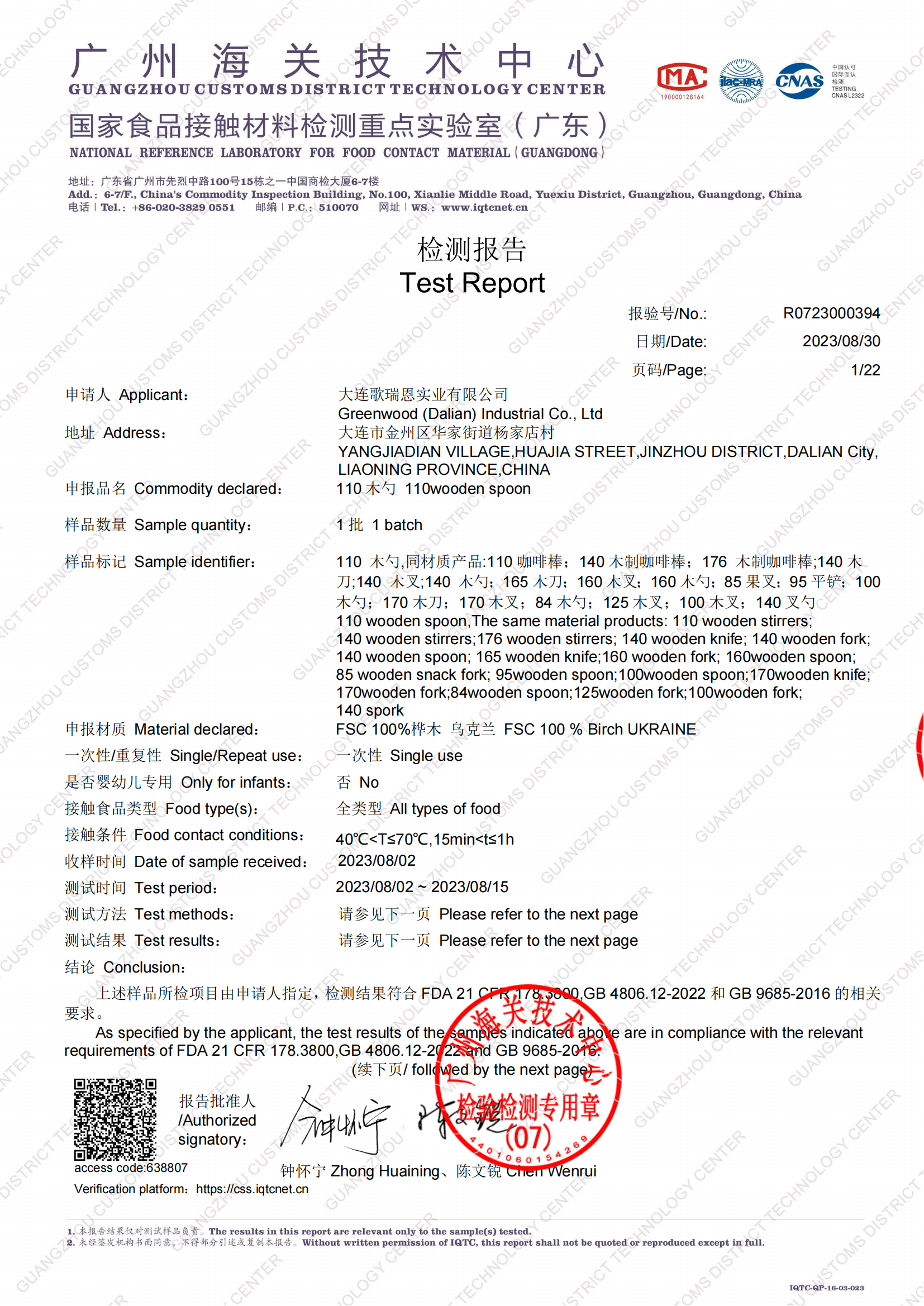
Food-contact documentation for the wooden range references FDA 21 CFR 178.3800 alongside GB 4806.12-2022 and GB 9685-2016.
| Record | Number | Issued by | Valid through |
|---|---|---|---|
| BRCGS Global Standard for Packaging Materials | 10000305214-MSC-ACCREDIA-CHN | DNV | 2027-05-02 |
| ISO 9001 (quality management) | 02024E1883R0M | BeijingZhongDaHuaYuan Certification Center Co.,Ltd | 2027-12-04 |
| ISO 14001 (environmental management) | 02024E1883R0M | BeijingZhongDaHuaYuan Certification Center Co.,Ltd | 2027-12-04 |
| ISO 45001 (occupational health and safety) | 02024E1883R0M | BeijingZhongDaHuaYuan Certification Center Co.,Ltd | 2027-12-04 |
| FSC Chain of Custody | SA-COC-013128 | Soil Association | 2028-04-02 |
| FDA 21 CFR 178 (food-contact material testing) | R0723000394 | National Reference Laboratory for Food Contact Material (Guangdong) | Open-dated on the certificate record |
| LFGB | 7216006083-2 | TUV SUD China | Open-dated on the certificate record |
| Sedex / SMETA | ZS405156174 | SMETA | Open-dated on the certificate record |
| amfori BSCI | 24-0289038 | amfori | Record dated to 2026-09-12 — confirm current status before tender use |
Two compliance points deserve specific attention from buyers. First, “EUDR certified” is a common search phrase but not a certification: the EU Deforestation Regulation (Regulation (EU) 2023/1115) is a due-diligence obligation requiring geolocation and risk assessment for wood products placed on the EU market. An FSC chain-of-custody certificate such as SA-COC-013128 supports that obligation but does not replace it. The application deadline for large operators was postponed, with the latest council agreements pointing to December 2026; importers should confirm the operative date with their own legal advisors rather than rely on a supplier statement. Second, in the EU a utensil may only be marketed as “compostable” if it meets EN 13432 for industrial compostability. The product specification for these models states 100% biodegradable and compostable; buyers who need a specific home-compostability claim should ask which standard the claim rests on and request the corresponding certificate number.
Where This Shortlist Meets Its Limits
A shortlist that only lists advantages is not usable for procurement. Four boundaries apply to this range and should be planned around rather than discovered later.
- Order size. The documented minimum order quantity for customization is 100,000 pieces. Custom OEM work in this range is not designed for small trial quantities or one-off event orders; buyers testing a format should expect to commit at that level or validate through samples first.
- Lead time. The documented production lead time is 20 days. That is a planning figure, not an emergency figure — buyers managing promotional calendars or seasonal peaks should build buffer around it.
- Paper length. GW-PC204’s standard format is 158mm, shorter than the longest wood options. Where a long utensil is specified, paper requires custom size development rather than a straight substitution.
- Documentation burden. Wood and bamboo attract deforestation and compostability rules that paper and plastic alternatives do not. FSC chain of custody, geolocation data and a correctly worded compostability claim are part of the order, not optional extras.
Against traditional plastic, the trade-off is different in kind. Plastic remains inexpensive and dimensionally uniform, and it is still widely available; the pressure on it is regulatory and reputational, particularly in markets where single-use plastic bans have been introduced. Wood and bamboo compete on compliance fit and on consumer perception, not on lowest unit cost. Buyers should compare total landed cost including documentation effort, not ex-works piece price alone.
Market Context: Why This Category Is Moving
The demand-side signals behind this shortlist are measurable. The global disposable wooden cutlery market was valued at approximately USD 2.8 billion in 2025 and is projected to reach USD 5.2 billion by 2034, according to Dataintelo. Asia Pacific led the market in 2025 with a 38.6% share, supported by urbanisation and plastic restrictions in countries including China and India. China remains the world’s largest exporter of wood tableware and kitchenware under HS 4419, with export values of roughly USD 1.38 billion to USD 1.5 billion in 2024 according to OEC and WITS data.
Product mix matters to buyers planning a multi-SKU programme. Spoons are the largest single product segment, accounting for roughly 32.5% to 47.2% of the market depending on the reporting agency — a wide range that reflects differing scope definitions between Dataintelo and Future Market Insights. The practical implication is that published segment shares should be used for direction, not for forecasting a specific SKU line; buyers are better served by their own menu or basket data.
On the regulatory side, the direction of travel is toward documentation. EUDR due diligence, EN 13432 compostability criteria and market-specific single-use plastic restrictions all push buyers toward suppliers who can produce certificates on request rather than on explanation. That is the strongest argument for evaluating suppliers and models together, on the same evidence sheet.
Future Outlook for Custom OEM Cutlery Buyers
Three shifts are likely to shape the next procurement cycle. First, specification will move earlier: instead of selecting a supplier and then specifying a product, buyers will shortlist models first and test supplier capability against a defined specification. Second, documentation will become a scored criterion rather than a checkbox, particularly for wood-based products entering the EU. Third, packaging will separate otherwise identical products commercially, because individually wrapped and retail-ready formats are where brand differentiation is cheapest to achieve.
Within this range, the most flexible starting point for a first custom OEM order remains GW-20456, because six documented lengths allow one specification to serve several service formats. GW-BC001 answers premium and branded briefs, and GW-PC204 covers paper-based systems where a shorter, oil- and water-resistant format is acceptable. A shortlist of three, tested against a written specification, is a faster route to a stable supply relationship than an open category search.
FAQ
How do I choose between GW-20456 and GW-BC001 for a restaurant programme?
Choose on material feel and branding method rather than on function. GW-20456 is a natural wood range with six documented lengths from 180mm to 95mm, which allows one programme to cover multiple service formats. GW-BC001 is pure bamboo with a 170mm standard length and 110mm and 140mm options, and its documented logo method is hot stamping. If the brand call is for a visible bamboo texture and a stamped mark, specify GW-BC001; if the call is for a wide length spread under one specification, specify GW-20456.
What length should a takeaway or delivery cutlery order specify?
Takeaway formats generally use the shorter documented lengths. GW-20456 and GW-BC001 both offer 140mm and 110mm, which reduce material while remaining usable one-handed. Restaurant chains, takeaway wholesalers, supermarkets and airlines are the stated applicable industries for the range, so the deciding factor is the dish and the packaging depth rather than the channel. Lock the length before the logo, because length changes packaging dimensions.
Is disposable wooden cutlery suitable for hot food?
The product specifications for GW-20456, GW-BC001 and GW-PC204 all state heat resistance and suitability for hot and cold food. GW-PC204 additionally states water and oil resistance, with a smooth edge and no odour. Buyers with unusually high-temperature applications or extended holding times should validate the configuration through a pre-production sample rather than relying on the general specification line.
Which logo methods are available for custom-branded cutlery?
The documented methods differ by model. GW-20456 supports logo application by laser or print. GW-BC001 supports hot stamping. GW-PC204 documents logo customization without naming the application method, so the method should be confirmed at sampling. The wider customization scope also covers logo printing on packaging, customized shape and new design, which means artwork can be carried across both the utensil and the pack.
Which certifications should a buyer verify before confirming a custom OEM order?
The range holds BRCGS Global Standard for Packaging Materials (10000305214-MSC-ACCREDIA-CHN, DNV, valid to 2027-05-02), ISO 9001, ISO 14001 and ISO 45001 (02024E1883R0M, valid to 2027-12-04), FSC Chain of Custody (SA-COC-013128, valid to 2028-04-02), FDA 21 CFR 178 testing (R0723000394), LFGB (7216006083-2, TUV SUD China) and Sedex/SMETA (ZS405156174). The amfori BSCI record (24-0289038) is dated to 2026-09-12, so current status should be confirmed before it is cited in a tender.
How does EUDR affect wooden cutlery orders into the EU?
EUDR is a due-diligence regulation, not a product certification. Regulation (EU) 2023/1115 requires geolocation data and risk assessment for relevant wood products placed on the EU market. FSC chain of custody, such as SA-COC-013128, supports that work but does not by itself discharge the obligation. The compliance deadline for large operators was postponed, with the latest council agreements pointing to December 2026; importers should confirm the operative date with their own advisors.
What are the minimum order quantity and lead time for customization?
The documented minimum order quantity for customized production is 100,000 pieces, and the documented lead time is 20 days. Third-party inspection is used for quality control, and the documented after-sales scope includes packaging design and logistics support. Buyers running seasonal or promotional programmes should build buffer into the 20-day figure rather than treating it as a deadline.
Can the cutlery be marketed as home compostable?
The product specification states 100% biodegradable and compostable. Claims of this type are regulated, and in the EU a utensil may only be marketed as compostable if it meets EN 13432 for industrial compostability. Home compostability is a separate claim with separate criteria. Buyers should ask which standard the claim is based on and request the corresponding certificate number before printing the claim on packaging or listing it online.
Additional specification detail, including product parameters and packaging options, is available in the Greenwood product brochure (PDF). Company reference: woodencutlery.cn.
Third-party market and regulatory references: Dataintelo (disposable wooden cutlery market, 2025–2034); Future Market Insights (wooden cutlery segment share); OEC / WITS (HS 4419 export values, 2024); European Commission (Regulation (EU) 2023/1115); CEN (EN 13432).
¿Tiene preguntas o necesita más detalles?
Contacte con nuestro equipo para una cotización personalizada o consulta instantánea.
Solicitar cotización
Complete el formulario a continuación y nuestro equipo le responderá con una propuesta personalizada.
Chat directo de WhatsApp
¿Prefiere chatear en tiempo real? Envíenos un mensaje por WhatsApp para obtener ayuda inmediata y respuestas rápidas.
- Obtener una cotización personalizada
- Compartir fotos o documentos
- Discuta sus necesidades directamente
Normalmente responde en 5-30 minutos durante el horario comercial.