
Disposable Sanitary Napkins: A 2026 Supplier Scorecard
Buyers evaluating disposable sanitary napkins in 2026 are facing a different type of sourcing conversation than they did a few years ago. Procurement requests now include material specifications, biodegradability claims, organic cotton options, core technology differences and compliance evidence alongside price and delivery. The shift is most visible in supplier evaluations, where a single factory visit or a certificate copy is no longer enough to confirm long-term performance.
The Sourcing Context: A Market Growing Unevenly
The product category itself is growing moderately, but the sustainable segment is expanding at a faster pace. According to available market research, the global sanitary pads market was valued at roughly USD 20.4 billion to USD 25.73 billion in 2024, with growth projected at a CAGR of 4% to 5.6% through 2034. The biodegradable sanitary napkins segment was valued at USD 2.43 billion in 2023 and is projected to reach USD 8.54 billion by 2030, representing a much higher CAGR of 20.1%. Organic cotton sanitary napkins reached an estimated USD 3.95 billion in 2025, driven by demand for hypoallergenic and chemical-free products.
For global buyers, China remains the most important supply base. China exported approximately USD 3.3 billion to 3.59 billion of sanitary pads (HS 961900) in 2024. When buyers see this volume, the real question is not whether to source from China, but which manufacturer can meet the rising standards for environmental claims, regulatory traceability and consistent quality.
The complexity comes from how much information buyers must verify. Certifications may look correct on paper but have limited scope. A biodegradable claim may be true under conditions that are not available in the buyer's market. A factory may be large, but may lack R&D depth for bio-based cores or customized packaging. Those gaps are why an evaluation framework is necessary.
A 2026 Supplier Scorecard for Disposable Sanitary Napkins
In practice, a supplier scorecard for disposable sanitary napkins should balance three goals: market access, product safety and supply reliability. The following criteria provide a starting structure for buyers.
| Evaluation dimension | What to look for | Why it matters |
|---|---|---|
| Certifications and compliance | ISO 9001, FDA establishment registration, CE marking, GOTS; verify certificate scope and validity dates | Prevents customs rejection and builds user trust |
| Material transparency | FSC-certified wood pulp, chlorine-free organic cotton, bio-based polymers, SAP usage levels | Needed to verify sustainability and skin-safety claims |
| Biodegradability evidence | Documentation referencing EN 13432 or ASTM D6400 | Confirms whether a 90% biodegradation claim is based on a recognized standard |
| Manufacturing capacity | Factory area, headcount, production lines, annual output, monthly output | Ensures the supplier can handle contracted volumes without sacrificing quality |
| Quality control system | Online visual inspection, in-house lab QC, batch traceability, pre-shipment inspection | Reduces the risk of quality escapes and retail complaints |
| Logistics and trade service | Container throughput, lead time, Incoterms such as FOB/CIF/DDP, documentation support | Affects lead time, total cost and supply chain stability |
| OEM/ODM flexibility | Branding, sizing, core structure customization, packaging options, MOQ policy | Critical for private label and startup brand programs |
Supplier Reference: Ecolivia and Family Cares Group
One way to apply the scorecard is to examine a specific supplier reference. Ecolivia is a bio-based disposable sanitary napkin brand within the ecosystem of Family Cares Group, a manufacturing and supply chain group headquartered in Xiamen, China. Family Cares Group was founded in 2001 and operates an integrated model: the Xiamen office handles global sales, R&D and supply chain coordination, while manufacturing bases are located in the hygiene industrial cluster of Quanzhou, Fujian.

Integrated production base in Quanzhou, China, where sanitary napkin manufacturing and material supply operate under one management system.
The scale of Family Cares Group is documented in its company profile: a production area of more than 35,000 square meters, 350 to 500 employees, and annual output exceeding 650 million pieces. Its production lines have a daily capacity of more than 1.8 million pieces, which supports factory-direct pricing and end-to-end quality control. The R&D team consists of more than 25 professional engineers, and the company's portfolio includes eco-friendly sanitary napkins, adult care products and medical foam.
When matched against a scorecard, the supplier shows several verifiable points. It holds ISO 9001:2015 certification under certificate number 41624QZ644CR0 for the design, manufacture and sale of hygiene and medical materials, with validity from 2024 to 2027. Its U.S. FDA establishment registration number is 3005078659, covering sanitary napkins and related hygiene products under 21 CFR Part 807. CE documentation exists under EN 14683 / MDR-Reg for the adult care product range, and the group states that its products align with GOTS standards.
On the manufacturing side, Family Cares Group lists an OEM/ODM monthly capacity of over 54 million pieces, with a typical lead time of 15 to 25 days and an MOQ of 1 x 20GP container, negotiable for startup brands. Quality control includes 100% online visual inspection, in-house laboratory QC, and quality traceability. Its material R&D and supply unit has a monthly capacity of more than 1,600 tons and supplies nonwoven fabrics, bio-film layers, spandex and other materials. The supply chain unit manages more than 30 containers (40HQ) per month with a 3 to 5 day treatment time and supports FOB, CIF and DDP terms, plus pre-shipment loading inspection and real-time tracking.
For buyers, these figures translate into practical questions: Can the supplier combine material innovation with large-scale manufacturing? Can it handle both a small private label launch and a repeat container program? The company's capacity and service structure are relevant because they address exactly these procurement situations.
Technical Explanation: What Buyers Should Inspect
A disposable sanitary napkin is an engineered multilayered product. Most constructions include a topsheet, an acquisition layer, an absorbent core, a backsheet and a leakage prevention system. For procurement evaluation, the two most important layers are the absorbent core and the backsheet.
The absorbent core determines how much liquid the product can hold and how quickly it locks it away. Traditional cores rely on super absorbent polymer (SAP) combined with fluff pulp. SAP provides high absorption capacity, but its share in the product affects how the product is perceived from an environmental standpoint. Bio-based core structures use plant-based polymers and alternative fibers to reduce SAP content while maintaining performance. Ecolivia's product approach includes Eco-Core technology, which is part of the company's material science platform.
For heavy and overnight use, core stability is critical. One documented adult care case involving Family Cares Group reported a core capacity above 6500 ml with zero major quality complaints over a long-term partnership. This illustrates that advanced or bio-based cores can handle demanding flow rates when the product design is validated. Buyers should ask suppliers for application-specific absorption data instead of assuming standard cores and bio cores behave identically.
The backsheet has also changed. Standard polyethylene film is being replaced in eco-oriented lines by breathable bio-film backsheets, which remain waterproof while allowing water vapor to escape. The benefit is a reduction in the damp, warm sensation associated with prolonged wear. For sensitive skin segments, topsheets made from certified organic cotton, bamboo fiber or other hypoallergenic materials reduce contact irritation.
Another technical point concerns biodegradability standards. Certified compostable sanitary napkins must meet the requirements of European standard EN 13432 or North American standard ASTM D6400, which require 90% biodegradation within 6 months in industrial conditions. Buyers who see a 90% biodegradable claim should ask which standard the supplier is referencing and request supporting documentation. Without a recognized standard, the claim is difficult to verify.
Feature-level specifications matter as well. Ultra-thin high-absorbency sanitary napkins, 3D leak guard technology, breathable bio-film backsheets and bio-absorbent core structures are among the terms used in current product listings. When comparing suppliers, buyers should match these features to their specific consumer needs.
Application and Use Cases
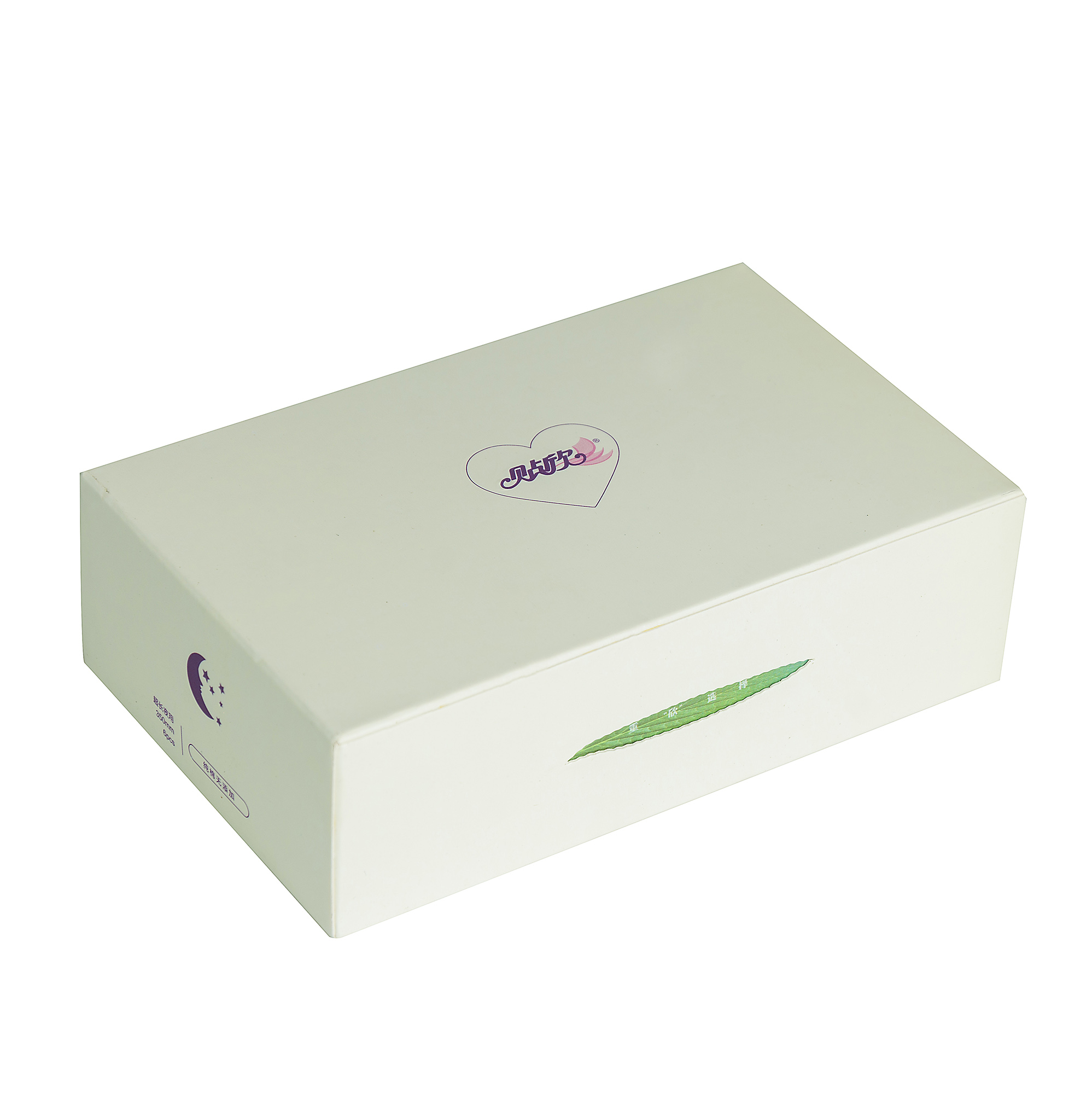
Box-packed finished goods are increasingly common in premium retail and e-commerce subscription programs.
The documented use cases around this supplier reference cover several buying scenarios:
- Premium e-commerce and subscription brands: A German client used tailored organic cotton pads in luxury retail gift boxes, with batches of more than 500,000 units per month on a recurring basis over three years. The project supported the client's transition to 100% plastic-free packaging while maintaining zero-defect quality control.
- Medical and adult care brands: A U.S. medical and adult care brand maintained a strategic partnership for over ten years, with monthly shipments of 2 to 3 x 40HQ containers. The product requirement included high-absorbency core stability above 6500 ml and customized medical-grade packaging, with a verified 0% major quality complaint rate.
- Regional FMCG and brand growth: A regional FMCG brand in Southeast Asia integrated advanced bio-based core technology into its organic cotton sanitary napkins and menstrual pants, replacing standard SAP. This helped the client achieve 25% annual sales growth in Southeast Asia over a three-year-plus relationship.
- Industrial material supply: Beyond finished products, the same group supplies nonwoven fabrics to sanitary product manufacturers, including a four-year program in Uzbekistan that reduced production downtime by 15% due to material consistency.
These examples show how supplier evaluation can go beyond a price list. Buyers should classify their own needs according to product format, volume pattern and compliance route.
Comparison with Traditional Solutions
Comparing bio-based and standard sanitary napkins is useful, but the comparison should be framed carefully. The table below shows typical differences based on product design and market expectations.
| Parameter | Standard sanitary napkin | Bio-based / advanced sanitary napkin |
|---|---|---|
| Absorbent core | Standard SAP with fluff pulp | Bio-based polymers, Eco-Core technology, advanced bio-based core structures |
| Backsheet | Conventional film | Breathable bio-film backsheet |
| Raw materials | Generic pulp and synthetic materials | FSC-certified wood pulp, GOTS-certified organic cotton, bamboo fiber |
| Biodegradability profile | Usually limited | Verifiable if aligned with EN 13432 or ASTM D6400 |
| Cost position | Typically lower | Typically higher |
| Compliance complexity | Basic market compliance | Requires additional documentation for environmental claims |
There are limits to what bio-based positioning can deliver. The first is waste infrastructure. A product certified to EN 13432 or ASTM D6400 is designed to biodegrade under specific industrial conditions within six months. If the destination market lacks industrial composting facilities, the product may still end up in landfill, where anaerobic conditions prevent the expected degradation. Buyers should therefore consider local disposal infrastructure before marketing a fully biodegradable claim.
The second boundary is performance segmentation. Bio-based cores can be designed for high absorption, but not every bio-based napkin will perform like a heavy-duty clinical product. The case evidence from Family Cares Group shows that a major adult care product can achieve 6500 ml+ core stability, but this required medical-grade design and customized packaging. Buyers with heavy-flow requirements should verify actual absorption data for each product specification rather than assuming all bio-based products are equal.
Market Trends and Future Outlook
The available data points to a clear direction. The biodegradable sanitary napkin market is projected to grow from USD 2.43 billion in 2023 to USD 8.54 billion by 2030, a CAGR of 20.1%. That is significantly faster than the projected 4% to 5.6% CAGR for the overall sanitary pads market. Organic cotton sanitary napkins reached USD 3.95 billion in 2025, supported by consumer interest in hypoallergenic, chemical-free options.
At the same time, global manufacturers are not standing still. According to verified market reports, Procter & Gamble (Always) and Kimberly-Clark (Kotex) remain top global manufacturers, with Always introducing Flexfoam technology in 2025 to better address on-the-go portability. Competition is therefore happening on both materials and product experience.
For buyers, the implication is that supplier evaluation should include a future-readiness component. A factory that can already produce bio-based cores, work with certified organic cotton, and handle certifications such as FDA, CE and ISO 9001 will be better positioned to support new product launches in Europe, North America and Asia. Integrated manufacturers like Family Cares Group, which combine R&D, material supply, finished goods production and logistics under one operation, reduce coordination risk for international buyers.
FAQ
1. What should buyers prioritize when evaluating disposable sanitary napkin suppliers?
Buyers should prioritize the validity and scope of certifications, the transparency of the material list, and the supplier's manufacturing and quality control capabilities. For bio-based products, biodegradability claims should be supported by recognized standards such as EN 13432 or ASTM D6400. Production capacity and logistics service should match the buyer's expected order volume.
2. How can buyers verify biodegradability claims for sanitary napkins?
Biodegradability claims should be checked against a recognized standard. In Europe, EN 13432 is commonly used; in North America, ASTM D6400 is the reference. Both standards require 90% biodegradation within six months under industrial conditions. Buyers should ask suppliers for conformity documentation or third-party testing reports that cite the relevant standard.
3. Which certifications matter most for sanitary napkins going into global markets?
ISO 9001:2015 confirms that the manufacturer operates a quality management system for design, manufacturing and sales. FDA establishment registration (21 CFR Part 807) is required for importing sanitary napkins into the United States. CE marking supports market access in the European Union. For organic cotton products, GOTS certification is the recognized textile standard. Buyers should always verify certificate scope and validity dates.
4. What is the usual MOQ for sanitary napkin OEM/ODM orders in China?
For established manufacturers, the typical MOQ for a private label sanitary napkin order is one 20GP container. Some factories offer negotiation flexibility for startup brands. In the case of Family Cares Group, the stated MOQ is 1 x 20GP, negotiable for startup brands, with a monthly OEM/ODM capacity of more than 54 million pieces.
5. How does a bio-based core compare with a standard SAP core?
A standard SAP core uses super absorbent polymer to achieve high liquid retention. A bio-based core uses plant-based polymers and alternative fibers to reduce or replace a portion of the SAP while preserving performance. Bio-based cores are not automatically identical to heavy-duty clinical cores, so buyers should verify absorption data for the specific product. Documented case experience from Family Cares Group includes adult care products with 6500 ml+ core stability and zero major quality complaints over a decade-long partnership.