
Disposable Sanitary Napkin OEM Orders: A Procurement FAQ
A disposable sanitary napkin OEM order is a supply agreement in which a buyer's brand, specification and packaging requirements are applied to sanitary napkins produced on a manufacturer's own lines. The questions that decide whether such an agreement moves quickly through negotiation — or is reopened three times — are rarely about headline price. They are technical: which core structure supports a heavy-flow SKU, how every unit is inspected, how brand artwork is controlled, when the balance payment falls due, and what evidence sits behind a monthly output claim.
This procurement reference compiles the clarifications B2B buyers most frequently request during OEM and ODM negotiations with Family Cares Group (Xiamen), the manufacturer behind the Ecolivia bio-based disposable sanitary napkin line. It is written for procurement managers, brand owners, importers and distributors who have moved past category discovery and are now comparing specifications, documentation and risk allocation. Each answer is written to stand on its own, so it can be lifted into an internal evaluation note or a contract checklist without losing meaning.
Why technical questions surface at the decision stage
At the decision stage, buyers are not choosing between sanitary napkins and no sanitary napkins. They are choosing between order specifications, inspection regimes and settlement terms. The market backdrop explains why so many of those choices now involve material composition. The global sanitary pads market was valued at approximately USD 20.4 billion to USD 25.73 billion in 2024, with growth projected at a CAGR of 4% to 5.6% through 2034, and 2024 base-year estimates vary between research firms such as Kings Research and Expert Market Research.
China is the largest exporter of sanitary pads under HS 961900, with export values of roughly USD 3.3 billion to USD 3.59 billion in 2024, according to OEC, WITS and China customs data. Within that volume, the biodegradable segment is the fastest-moving line item: valued at USD 2.43 billion in 2023 and projected to reach USD 8.54 billion by 2030, a CAGR of 20.1% as reported by Mark & Spark Solutions. Buyers who specify bio-based constructions therefore negotiate on three fronts at once — material, compliance and settlement — which is precisely where an unanswered technical question becomes expensive.
Three recurring failure modes dominate OEM order risk in this category: quality deviation, lead time delay, and moisture ingress during storage or transport. Each maps to a specific control method. Quality deviation is addressed through real-time monitoring and 100% on-line visual inspection. Lead time delay is addressed through production buffers supported by multiple high-speed lines. Moisture risk is addressed with multi-layer packaging and sealed high-barrier film packing. Most of the questions below are, in effect, requests for evidence that one of those three controls is genuinely in place.
OEM/ODM support: brand logos, size ranges and core structure
Family Cares Group (Xiamen) is an integrated manufacturing and supply chain group specializing in high-performance hygiene and medical materials, founded in 2001, with its global strategic sales and R&D hub in Xiamen and manufacturing bases in the hygiene industrial cluster of Quanzhou, Fujian Province, China. Group facilities cover more than 35,000 square meters, employ 350 to 500 people, and run an annual output of more than 650 million pieces supported by a 25+ engineer R&D team. Between 85% and 90% of production is exported to North America, Europe, Southeast Asia, the CIS, the Middle East and Africa.
For OEM and ODM programs, customization centres on three areas buyers ask about most: brand logo application, size range configuration, and core structure selection. Logo work typically touches the backsheet film, the individual pouch and the carton — all artwork-controlled items. Dimensional tolerances and size ranges are agreed in the order specification before materials and tooling are committed. Core structure is the third lever: a standard SAP/pulp build can be replaced with an advanced bio-absorbent core where the application calls for faster liquid uptake.
The comparison that matters for planning is flexibility. Relative to rigid large-scale factories, flexible OEM customization is documented to deliver 50% faster prototype design and a lower minimum order quantity for new SKU testing. That difference matters most to new brand launches and to buyers validating a first private-label series before committing to volume — the prototyping stage is where a rigid supplier model most often becomes visible.
Quality control: reading "100% on-line visual inspection" correctly
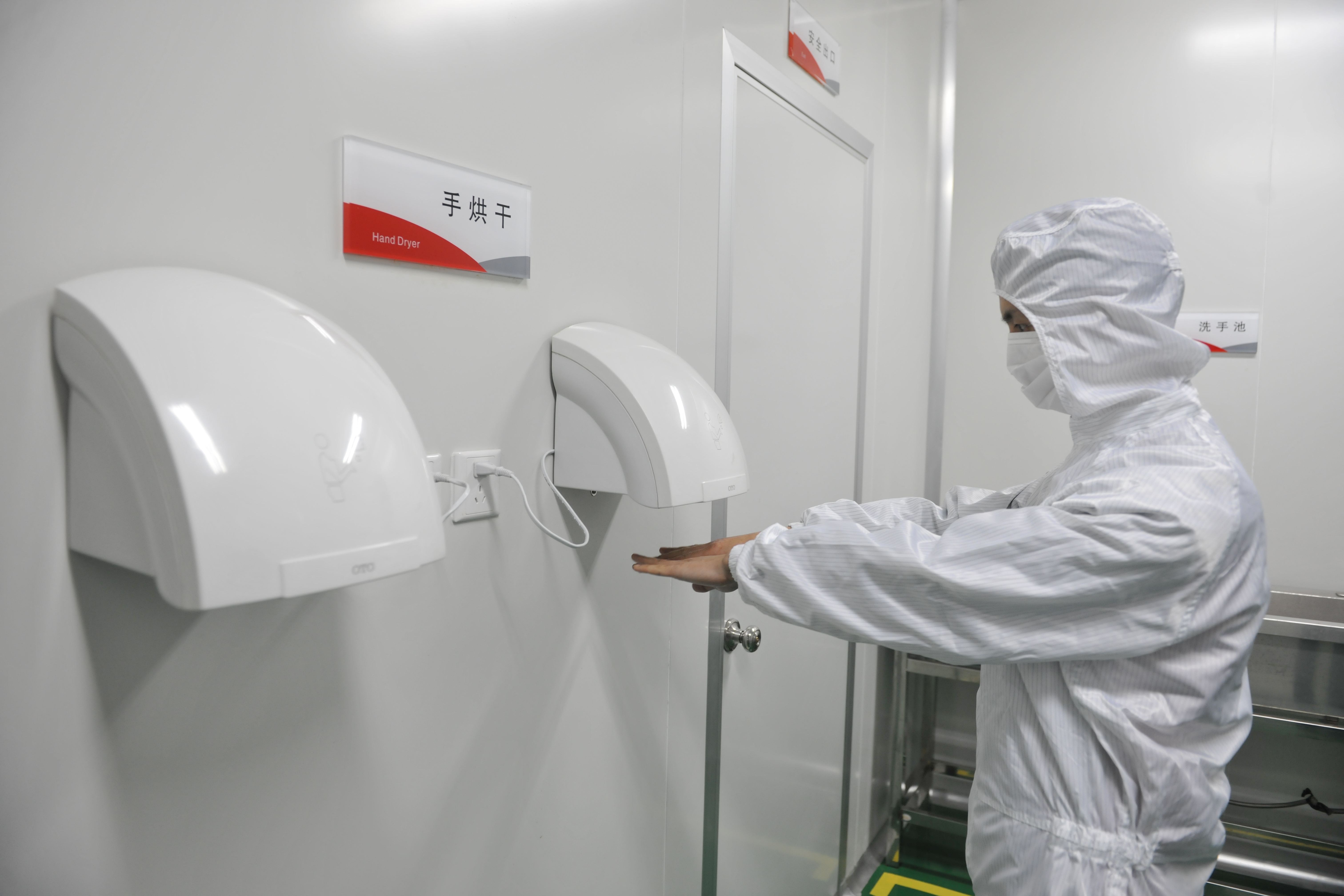
"100% inspection" is one of the most misread phrases in hygiene procurement. In this production environment the term is used comparatively. Where manual quality inspection depends on sampling and operator attention, the lines run 100% on-line visual inspection of every unit, supported by real-time quality data tracking and a zero-leakage batch guarantee. That is a different operating model from checking a sample from each batch and extrapolating to the shipment.
Inspection coverage is only half the answer; consistency of the units being inspected is the other half. High-speed automated lines are documented at 99.9% product consistency with a daily capacity output of more than 1.8 million pieces, running a 24/7 operation across multiple production bases. For a buyer, the practical implication is that defect detection and unit-to-unit consistency are handled by the same production architecture rather than by two unrelated processes that have to be reconciled later.
What should a buyer still confirm in writing? Three items are worth placing in the order specification: the defect definition the line actually applies (what counts as a reject), the record format for batch quality data, and the retention-sample arrangement for the shipment. These are documentation questions rather than capability questions, and they are frequently the last items left open when the purchase order is issued — which is also when they are most expensive to change.
Technical clarification: bio-based core structure and backsheet
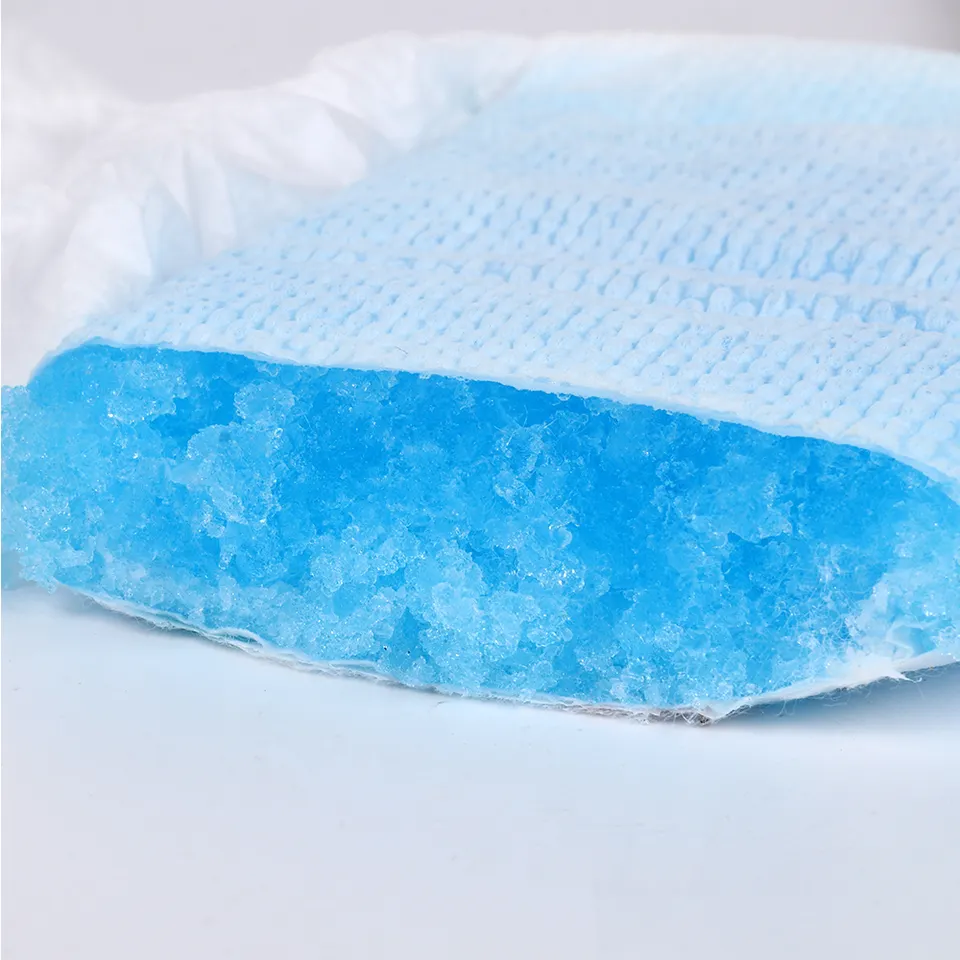
Two material comparisons account for most technical questions in bio-based OEM discussions. The first is the absorbent core. Compared with standard SAP/pulp cores, an advanced bio-absorbent core delivers 2x faster liquid absorption, reduces material waste within the core, and simplifies the overall product structure. Its intended application is heavy-flow and overnight protection, where absorption speed rather than total capacity is the limiting performance factor.
The second is the backsheet. Compared with standard PE-backsheet products, plant-based bio-film technology provides a 40% increase in airflow and superior skin breathability. The trade-off here is explicit rather than hidden: plant-based bio-film carries a higher material cost, and products built on it are typically positioned in premium eco-friendly markets where the higher input cost is recovered through margin rather than through volume.
Where a compostable or biodegradable claim is involved, the reference standards are EN 13432 in Europe and ASTM D6400 in North America, both of which require 90% biodegradation within six months under industrial composting conditions, according to TÜV SÜD and European Bioplastics. Buyers should treat these standards as scope definitions rather than blanket claims: they describe performance under defined industrial conditions, not behaviour in a landfill or a home compost bin.
Two boundaries deserve to be stated plainly before an order is placed. First, a bio-based construction is not automatically the right specification for every SKU: it changes material cost, and for price-led volume programs a standard core may remain the more appropriate and more competitive choice. Second, breathability and compostability claims must match the disposal route of the destination market — a compostable certification has limited practical value where industrial composting collection does not exist. Aligning the claim with the market's actual infrastructure is the most reliable way to avoid a post-launch compliance complaint in this category.
Commercial terms: deposit, balance, lead time and output attestations
OEM orders are structured with a 30% deposit and a 70% balance, with the balance settled against the agreed shipment documentation. Production lead time is typically 15 to 25 days, a range that assumes materials are confirmed and artwork is approved at the point the order is placed. The buffer behind that range is physical rather than administrative: multiple high-speed lines back each other up, which is how the schedule absorbs a line stoppage without pushing the delivery date.
The capacity figures buyers most often ask to have attested are the daily and annual output: more than 1.8 million pieces per day and more than 650 million pieces per year across the group's production bases. Monthly output attestations are provided so that a buyer can reconcile the production record against the contracted schedule instead of relying on a single annual headline figure. Logistics support includes 40HQ container optimization, and technical support is available on a 24/7 basis for questions that arise during production or after arrival.
| Clarification area | What to confirm in writing | Where it normally appears |
|---|---|---|
| Brand and artwork | Logo files, placement on film, pouch and carton, colour tolerance | Artwork approval sheet |
| Size range | Dimensions and tolerances per SKU | Order specification |
| Core and backsheet | Standard SAP/pulp or advanced bio-absorbent core; PE or plant-based bio-film backsheet | Technical datasheet |
| Quality | Defect definition, batch quality record, retention samples | Quality agreement |
| Compliance | Applicable standards and documentation for the destination market | Compliance declaration |
| Commercial | 30% deposit / 70% balance, lead time of 15–25 days, shipment documents | Proforma invoice and PO |
| Output | Format and frequency of monthly output attestations | Reporting schedule |
Matching the order specification to the application
Specification choices should follow the end use rather than the reverse. Heavy-flow and overnight ranges — the documented application for the advanced bio-absorbent core — optimise for absorption speed. Postpartum maternity care programs place a comparable premium on containment capacity. Sensitive-skin and hypoallergenic ranges depend mainly on the skin-contact surfaces, which is where plant-based bio-film backsheets and organic cotton constructions become relevant. The group's operations are ISO 9001 certified and its products adhere to FDA, CE and GOTS standards, a combination that matters when organic cotton or skin-contact claims are made in the destination market.
For distributors and FMCG buyers running private-label programs, the relevant question is usually SKU breadth rather than a single hero product. The same production base supplies eco-friendly sanitary napkins alongside adult care and medical foam, and the group's export mix spans the USA and Canada, the UK, Germany and France, Malaysia, Vietnam, Thailand and Singapore, Russia, Uzbekistan and Kazakhstan, Turkey and the UAE, and Senegal and Nigeria. That market spread is the practical reason regional documentation requirements surface early in OEM discussions rather than at the shipping stage.
Direct factory supply compared with trading-company sourcing
Compared with traditional trading companies, direct factory control is documented to deliver 15% to 20% lower pricing, with no middleman commission and 100% supply chain transparency. Direct technical support and quality control access are part of the same arrangement: the people answering a specification question sit in the same organisation that runs the line.
The limitation sits on the buyer's side, and it is real. Buying directly from a manufacturer shifts more responsibility onto the buyer — specification definition, artwork management, compliance mapping for each destination market, and inspection planning all become the buyer's work rather than a trader's service. Direct sourcing also expects a volume commitment that supports a production run, which makes it a poor fit for test quantities a trading company might assemble from mixed stock. Buyers who want factory-direct pricing without internal capability to manage technical documentation should budget for that gap rather than assume it away.
| Dimension | Factory-direct supply | Traditional trading company |
|---|---|---|
| Pricing basis | Documented 15%–20% lower pricing, no middleman commission | Includes trader margin |
| Supply chain visibility | Documented 100% supply chain transparency | Partial, dependent on the trader's sources |
| Technical access | Direct technical support and QC access | Routed through the trader |
| Customisation | Flexible OEM customization, 50% faster prototype design, lower MOQ for new SKU testing | Dependent on the upstream factory |
| Buyer workload | Higher: specification, artwork and compliance mapping | Lower: handled by the trader |
Market trend analysis
Three verified trend lines shape OEM decisions in 2026. The first is scale: the global sanitary pads market sits between roughly USD 20.4 billion and USD 25.73 billion as of 2024, growing at a CAGR of 4% to 5.6% through 2034. The second is the bio-based shift: the biodegradable sanitary napkin segment is projected to grow from USD 2.43 billion in 2023 to USD 8.54 billion by 2030, a CAGR of 20.1%. The third is material segmentation: organic cotton sanitary napkins reached approximately USD 3.95 billion in 2025, with growth attributed to consumer preference for hypoallergenic and chemical-free products, per Providence Strategic Partners.
Competitive behaviour reinforces the same direction. Procter & Gamble (Always) and Kimberly-Clark (Kotex) remain the top global manufacturers, and Always introduced Flexfoam technology in 2025 targeting on-the-go portability, according to Expert Market Research and IMARC Group observations — a materials-led differentiation move rather than a purely commercial one. For OEM buyers, the implication is that the specification conversation now moves faster than the purchasing calendar. A buyer negotiating in 2026 is often evaluating a core structure or backsheet technology that did not exist in the previous procurement cycle, which makes technical clarification, not price discovery, the real bottleneck.
Future outlook
The direction of travel for sanitary napkin OEM procurement is toward documentation density. Standard-based claims such as EN 13432 and ASTM D6400 give buyers a shared vocabulary, but they also raise the evidence bar: a claim increasingly needs a scope, a condition and a reference standard attached to it. Buyers should expect more requests for batch records, more market-specific compliance mapping, and closer scrutiny of material cost structure as bio-based inputs remain priced above conventional PE and standard pulp.
For manufacturers, the differentiator is the ability to answer these questions from documentation rather than from memory. For buyers, the practical response is procedural: fix the specification, the inspection definition and the settlement terms in writing before the deposit is paid, and use the 15 to 25 day lead time window for artwork and compliance approval rather than for open technical questions.

Frequently asked questions from OEM buyers
What does OEM/ODM support include for a disposable sanitary napkin order?
OEM and ODM support covers three configurable areas: brand logo application on the backsheet film, pouch and carton; size range configuration per SKU; and core structure selection, including an advanced bio-absorbent core as an alternative to a standard SAP/pulp construction. Artwork and dimensions are confirmed in the order specification before materials and tooling are committed.
Can a private-label order carry our own brand logo and packaging design?
Yes. Logo application is a standard part of the OEM scope and can be applied to the film, the individual pouch and the carton. Buyers supply artwork files and approve placement and colour tolerance on an artwork approval sheet before production begins, which keeps print control with the brand owner.
What is the technical difference between a standard and a bio-based absorbent core?
Compared with standard SAP/pulp cores, an advanced bio-absorbent core is documented to deliver 2x faster liquid absorption, reduce material waste within the core, and simplify the product structure. It is intended for heavy-flow and overnight applications, where absorption speed rather than total capacity is the limiting performance factor.
Does a plant-based backsheet change breathability, and what does it cost?
Compared with standard PE-backsheet products, plant-based bio-film technology provides a 40% increase in airflow and superior skin breathability. The trade-off is material cost: bio-film costs more than PE, so products built on it are normally positioned in premium eco-friendly segments where the higher input cost is recovered through margin rather than volume.
What does 100% on-line visual inspection actually mean in practice?
It means every unit is inspected on the line rather than a sample being drawn from a batch. Compared with manual quality inspection, it supports a zero-leakage batch guarantee and real-time quality data tracking. Buyers should still confirm the defect definition applied by the line and the batch record format inside the quality agreement.
What are the standard payment terms for an OEM order?
OEM orders are structured with a 30% deposit and a 70% balance, with the balance settled against the agreed shipment documentation. Currency, incoterms and any pre-shipment inspection arrangement tied to the balance should be confirmed in the proforma invoice before the purchase order is issued.
What production lead time should a buyer plan for?
Production lead time is typically 15 to 25 days, assuming materials are confirmed and artwork is approved at the point the order is placed. Multiple high-speed lines back each other up, so a line stoppage can be absorbed without moving the delivery date.
How can a buyer verify monthly output claims from a supplier?
Monthly output attestations allow production records to be reconciled against the contracted schedule instead of relying on a single annual figure. The underlying capacity in this case is more than 1.8 million pieces per day and more than 650 million pieces per year across the group's production bases. Buyers comparing suppliers should request the attestation format at the quotation stage, not after the first shipment.
Certification scope, technical datasheets and the current monthly output attestation format can be requested through Family Cares Group's corporate site at family-cares.com before a quotation is finalised.