
Disposable Bamboo Cutlery: Constraints Buyers Should Verify
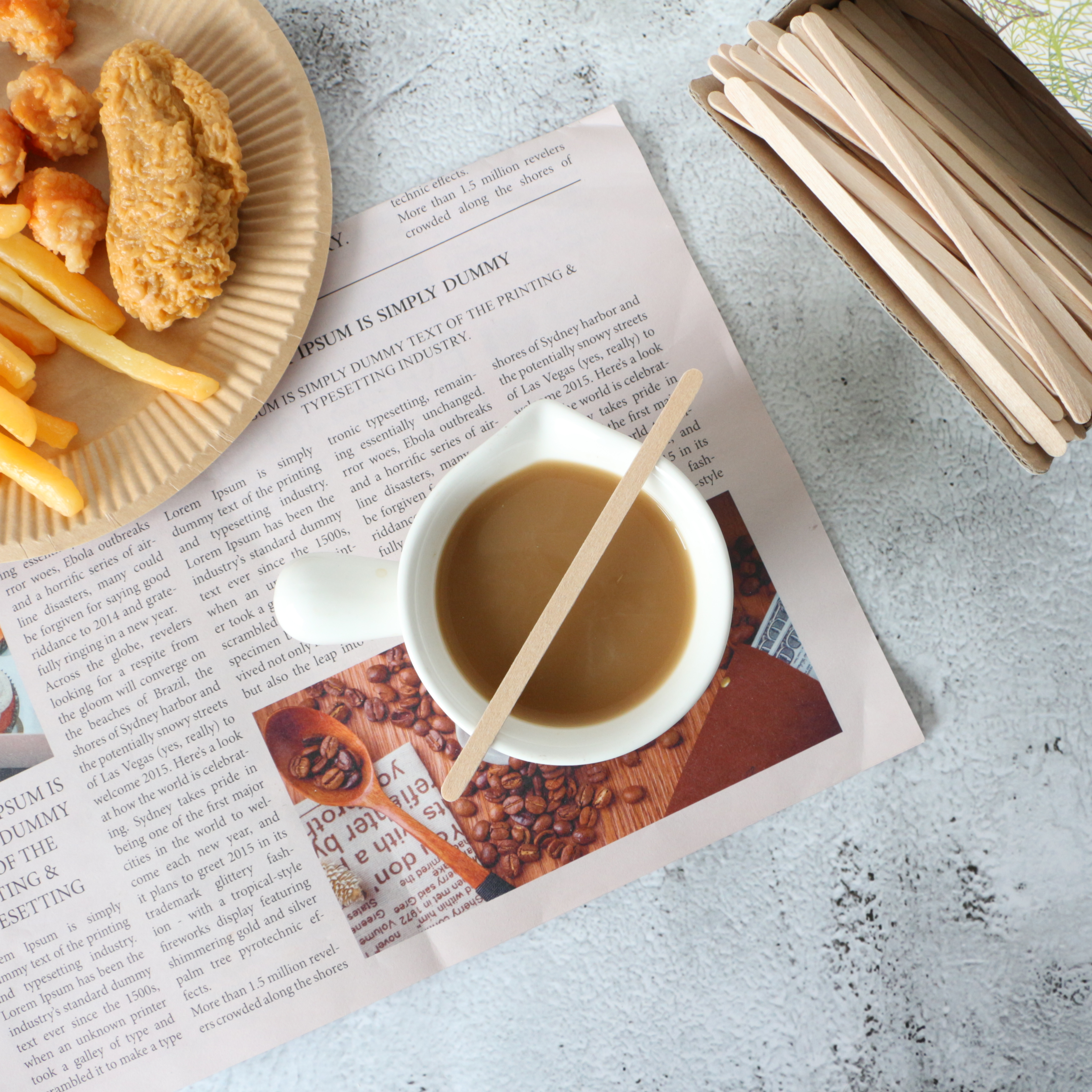
Bamboo cutlery in a café and takeaway setting, where certification scope, dimensional fit and packaging format meet in a single purchase decision.
Disposable bamboo cutlery becomes a reliable purchase only after two constraint questions are answered: which certifications apply to the material that will actually be shipped, and which dimensional, finish and packaging parameters are fixed before sampling. Buyers who settle those two questions first generally run shorter approval cycles, because order quantity, lead time, artwork and carton format can then be negotiated against a stable technical baseline.
Where the material is bamboo rather than moulded plastic, the constraint set widens. Bamboo is a natural fibre product. Surface preparation, edge finishing, moisture behaviour and the absence of coatings all influence how a fork or knife performs in contact with hot, wet or oily food, and each of those characteristics has to be demonstrated rather than assumed. The sections below set out the certification set, the specification parameters and the procurement boundaries that a buyer of disposable bamboo cutlery should verify before committing to a sampling round.
Why certification belongs on the specification side of the table
Certification for food-contact disposables is not a marketing artefact appended after production. It is a constraint that decides which markets an order can be shipped to, which claims can be printed on a retail pack, and which test reports a buyer is entitled to request. Two bamboo forks with identical dimensions can carry entirely different market access depending on whether migration testing was performed under EU or US protocols.
Bamboo also introduces a sourcing dimension that moulded plastic does not have. Chain-of-custody documentation ties finished cutlery back to certified fibre, and that link is what allows a retail customer to make a sourcing claim without transferring the exposure to the buyer. For a foodservice operator, the equivalent constraint is hygienic manufacturing: a documented management system behind the production line is what makes batch-to-batch consistency auditable rather than promotional.
Greenwood - Dalian Industrial Co.,ltd. is a manufacturer of disposable wooden and bamboo tableware founded in 2000, operating five major factories with 500 employees and a nine-engineer R&D team, and exporting approximately 95% of output to Europe, ANZ, Canada, the USA, South America, the Middle East, Japan and Korea, and Southeast Asia. Its bamboo cutlery range, model GW-BC001, is documented as LFGB and FDA certified. Behind that summary sits a specific certificate set that a buyer can verify line by line.
The certification set that covers disposable bamboo cutlery
The table below reflects the certified scope as recorded for Greenwood's wooden and bamboo tableware production. Read it as a verification checklist rather than a claim list: the question for a buyer is not whether a supplier holds certificates, but whether each document names the material and the product family being ordered.
| Certificate / scheme | Issuing body | Reference | What it constrains in a purchase |
|---|---|---|---|
| LFGB | TUV SUD China | 7216006083-2 | Scope covers all wood and bamboo tableware; the EU food-contact document most European retail and foodservice buyers request first. |
| FDA 21 CFR 178 | National Reference Laboratory for Food Contact Material (Guangdong) | R0723000394 | US food-contact compliance for wood and bamboo articles; tested against FDA 21 CFR 178.3800, GB 4806.12-2022 and GB 9685-2016. |
| BRCGS Global Standard for Packaging Materials, Issue 6 | DNV | 10000305214-MSC-ACCREDIA-CHN | Manufacturing scope includes disposable wooden and bamboo tableware; certification recorded to 2 May 2027 under the unannounced audit scheme. |
| FSC Chain of Custody | Soil Association | SA-COC-013128 | Fibre sourcing traceability; recorded to 2 April 2028. |
| ISO 9001, ISO 14001, ISO 45001 | Beijing ZhongDaHuaYuan Certification Center Co.,Ltd | 02024E1883R0M | Quality, environmental and occupational health and safety management systems for wooden production; recorded to 4 December 2027. |
| amfori BSCI | amfori | 24-0289038 | Social compliance audit with a scope covering wooden and bamboo products. |
| SEDEX SMETA | SMETA | ZS405156174 | Four-pillar audit covering labour standards, health and safety, environment and business ethics. |
Certification records as documented for Greenwood wooden and bamboo tableware. Buyers should confirm scope wording and current validity against the document supplied with the quotation.
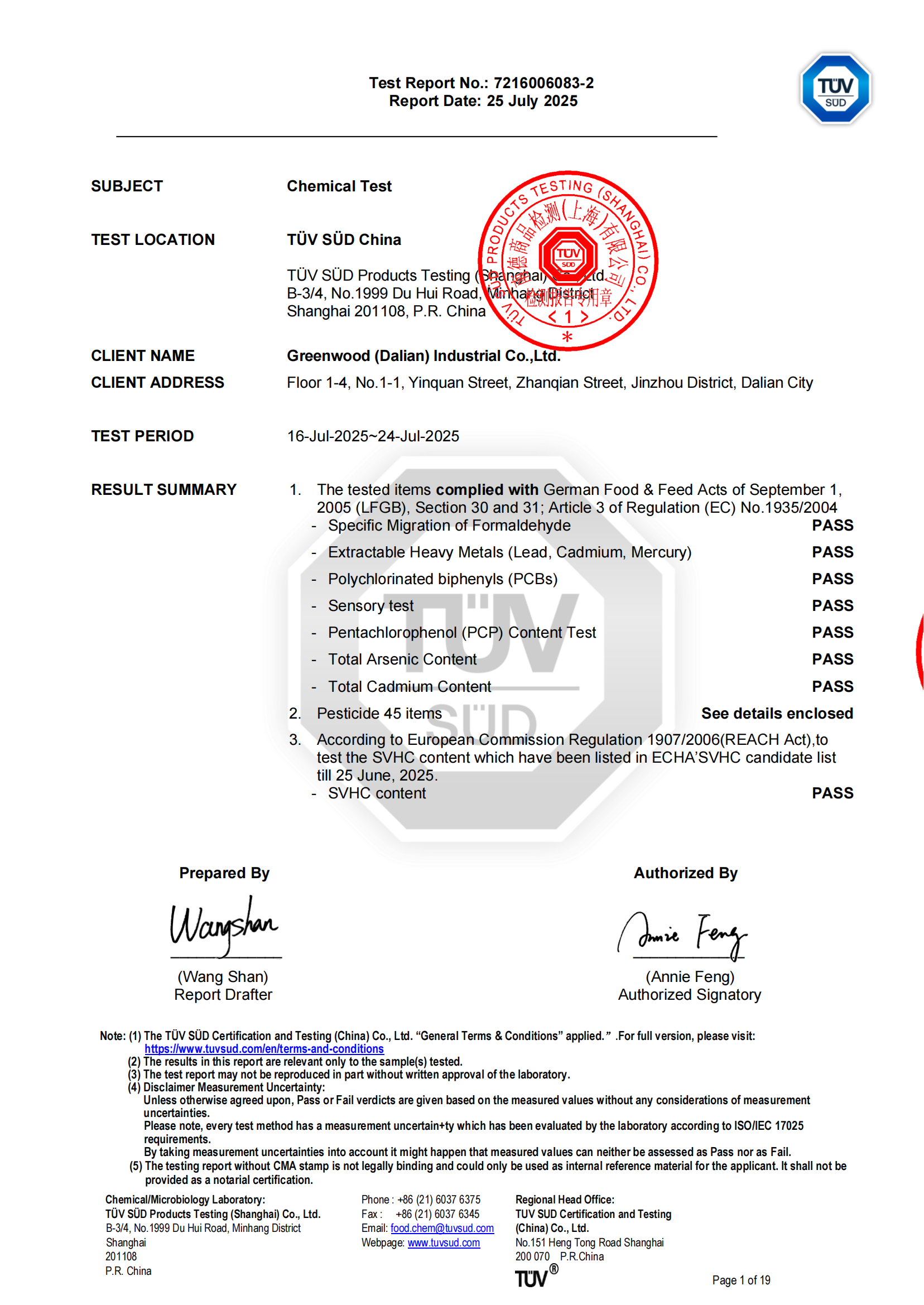
The LFGB certificate held for wood and bamboo tableware, issued by TUV SUD China — one document in a set that a buyer should verify individually rather than as a group.
Two practical rules follow from that set. First, scope wording matters more than certificate presence: a management-system certificate that names wooden products does not automatically cover a bamboo order unless the scope line says so, and the scope should therefore be read against the actual SKU. Second, validity cycles differ by document type. Social and ethical audits run on shorter renewal cycles than food-contact and chain-of-custody certificates, so the current audit report — not a reference number alone — is what belongs in the purchase file.
Specification constraints: length, finish and material grade
Model GW-BC001 covers bamboo knives, forks, spoons, coffee stirrers and bamboo skewer sticks. The standard length is 170 mm, with 110 mm and 140 mm versions also available and further sizes open to customization. Declared product characteristics are food-grade, BPA-free and non-toxic material; heat resistance suitable for hot and cold food; a smooth edge described as free of burrs; and a natural bamboo texture finished without paint or wax, consistent with the food-contact requirement recorded for the range.

A bamboo fork from the GW-BC001 range, produced at a 170 mm standard length with 110 mm and 140 mm alternatives available.
Those parameters matter because they determine what the cutlery can be paired with. A 170 mm fork sits differently in a shallow takeaway box than in a deep catering tray, and the difference shows up as a customer complaint rather than as a specification error. Buyers assembling individually wrapped bamboo cutlery, cutlery sets or bamboo food sticks should fix the length and the accompanying container before the sampling round, not after.
Bamboo, wood and paper formats compared on documented parameters
Greenwood produces three disposable material families that are frequently quoted against each other. The comparison below uses only the parameters recorded for each model, which is the correct basis for a first screening — it does not resolve which format suits a given menu, but it does narrow the field.
| Parameter | Bamboo (GW-BC001) | Wood (GW-20456) | Paper (GW-PC204) |
|---|---|---|---|
| Standard length | 170 mm; 110 mm and 140 mm available; further sizes customizable | 180 / 170 / 160 / 140 / 110 / 95 mm, customizable | 158 mm, customizable |
| Items in range | Knife, fork, spoon, coffee stirrer, bamboo skewer sticks | Knife, fork, spoon, ice cream stick, coffee stirrer | Knife, fork, spoon |
| Declared material claims | Food-grade, BPA-free, non-toxic, LFGB / FDA certified | Food-grade, BPA-free, non-toxic | Food-grade, BPA-free, non-toxic, waterproof and oil-proof |
| End-of-life claim | 100% biodegradable and compostable | 100% biodegradable and compostable | 100% biodegradable and compostable |
| Finish characteristics | Smooth edge, no burrs, natural bamboo texture, heat-resistant | Smooth surface, no burrs, heat-resistant | Smooth edge, no smell, heat-resistant |
| Customization recorded | Logo by hot stamping; size, packaging and colour | Size; logo by laser or print; packaging | Logo, packaging and colour |
Parameters as documented per model. Length choice should be matched to the container and menu, not to a generic preference.
Packaging and customization constraints
Customization at Greenwood is recorded as OEM / ODM with logo printing on products and on packaging, plus customized shapes and new designs. After-sales support covers packaging design and logistics. In practice, packaging format is often the constraint that separates two otherwise comparable quotations, because it changes line speed, hygiene assurance and unit cost at the same time.
Individually wrapped bamboo cutlery is the format most often specified by airline catering and by foodservice operators who need a sealed unit per cover. Bulk-packed sets change carton cube and retail presentation instead. For retail packaged bamboo cutlery, the constraint set extends to artwork approval, barcode placement and the claims that certification will actually support — a compostability statement, for example, should match the disposal route the retail market provides. For takeaway bamboo cutlery sets distributed through wholesale channels, the recurring constraint is consistency: the same fork has to perform identically in the tenth container as in the first.
Where these constraints meet real applications
Documented applications for the range are restaurant chains, supermarkets, takeaway wholesalers and airlines, in ambient-temperature food-contact conditions, indoors and outdoors — restaurants, takeaway, picnics, banquets and exhibitions. The cutlery is used alongside food containers, takeaway boxes, packaging trays and catering trays, which means the dimensional fit between fork, spoon and lid is part of the specification rather than a detail resolved at packing stage.
Recorded end markets include the US, Australia, Canada, the UK, Italy, France, Spain, Finland, Japan, South Korea, Singapore and a further set of European, Middle Eastern, African, Latin American and Southeast Asian destinations. The practical consequence is that one production specification frequently has to satisfy two or three regulatory frameworks at once. That is the reason the certificate scope review described earlier belongs at the beginning of the project rather than at the point of artwork sign-off.
How bamboo compares with wood, paper and plastic
Against moulded plastic, bamboo cutlery generally carries a higher unit cost and a heavier logistics footprint per piece, and it does not deliver the dimensional uniformity of an injection-moulded part. Natural colour variation between batches is normal. Buyers who need exact colour matching across reorders should specify a tolerance band rather than a fixed tone, because a fixed tone cannot be guaranteed by a natural-fibre process.
Against paper cutlery, bamboo performs better on wet, oily and hot contact, while paper formats can be more economical where the application is light and dry. Against wooden cutlery, the two are close: bamboo typically offers higher density and a tighter grain, while birch and poplar formats suit markets where a pale, uniform appearance is the priority. Neither family is universally better; the menu, the container and the market's documentation requirements decide.
Compostability deserves a precise statement rather than a general one. Bamboo cutlery in this range is declared 100% biodegradable and compostable, but the rate at which that happens depends on the disposal environment, and industrial composting conditions differ from home composting and from landfill. Buyers who print an end-of-life claim on pack should state the disposal route their market actually offers, and should expect a technically literate customer to ask for it.
Procurement constraints to fix before sampling
Documented commercial parameters for OEM bamboo cutlery are a minimum order quantity of 100,000 pieces and a lead time of 20 days, with third-party inspection available and production capacity stated at 10 million pieces per day across five factories. Those numbers set the shape of a viable project. A single-store trial or a short seasonal promotion may not clear the minimum quantity, and a 20-day production window needs a planning buffer on the retail or foodservice side.
Logistics support is recorded through warehouses in Bangladesh, Ukraine and the United States, which serves order flow into Europe, the Americas and the Middle East. On the demand side, Greenwood's recorded supermarket and chain-store accounts in Germany and the US represent USD 5 million per year over a three-year relationship across B2B and B2C channels — a reference point for buyers assessing whether a supplier is set up for repeat retail programmes rather than one-off shipments.
Market signals behind the documentation push
The recorded outcome from those retail accounts is that eco-friendly products are a rising trend and are popular among the younger generation, with the substitution of traditional disposable products used to support sales. Read as a qualitative signal rather than a forecast, it explains a shift in buyer behaviour: certification scope and disposal-route wording are now requested at the first meeting rather than at artwork approval.
Restrictions on single-use plastic in a number of markets continue to move foodservice operators toward fibre-based formats. For suppliers, the binding constraint in that shift is rarely demand; it is documentation. A buyer comparing two bamboo cutlery quotations that differ by a few percent in unit price will usually find that the more consequential difference sits in which certificate covers which material, and in whether the packaging format is genuinely compatible with the operator's service line.
Outlook
Three developments are likely to shape procurement over the next planning cycle. Certification review will continue to move earlier in the buying process, which favours suppliers who can present scope-specific documents quickly rather than a consolidated certificate list. Packaging will keep gaining weight as a differentiator, because individually wrapped and retail-ready formats carry their own hygiene and compliance logic. And traceability will become routine rather than exceptional, as chain-of-custody expectations extend from fibre sourcing into the finished disposable article.
For buyers, the practical implication is straightforward: treat certification scope and specification parameters as the fixed part of the negotiation and the commercial terms as the variable part. That sequence produces fewer surprises at customs, at the packing line and at the customer complaint desk.
Frequently asked questions
Which certifications should a buyer verify for disposable bamboo cutlery?
Verification should cover food-contact testing for each destination market, manufacturing and management-system certification, fibre sourcing traceability, and social compliance. For European destinations the reference document is LFGB; for the United States it is FDA 21 CFR 178. Manufacturing scope is typically evidenced through BRCGS and ISO 9001, fibre sourcing through FSC Chain of Custody, and labour conditions through amfori BSCI or SEDEX SMETA. In each case the scope wording should name bamboo, not only wood.
Does Greenwood hold LFGB and FDA documentation for bamboo cutlery?
Yes. Model GW-BC001 is documented as LFGB and FDA certified. The LFGB certificate, reference 7216006083-2, was issued by TUV SUD China with a scope covering all wood and bamboo tableware. The FDA 21 CFR 178 report, reference R0723000394, was issued by the National Reference Laboratory for Food Contact Material (Guangdong) and tested against FDA 21 CFR 178.3800, GB 4806.12-2022 and GB 9685-2016.
What lengths and items are available in the bamboo cutlery range?
Model GW-BC001 includes bamboo knives, forks, spoons, coffee stirrers and bamboo skewer sticks. The standard length is 170 mm, with 110 mm and 140 mm options available and further sizes open to customization. Size, packaging and colour can be customized, and logos are applied by hot stamping.
What minimum order quantity and lead time apply to OEM bamboo cutlery?
The recorded minimum order quantity is 100,000 pieces and the recorded lead time is 20 days. Production runs in OEM / ODM mode with logo printing on products and packaging, customized shapes and new designs, and third-party inspection available. After-sales support covers packaging design and logistics.
Is bamboo cutlery suitable for hot food and for takeaway service?
The GW-BC001 range is described as heat-resistant and suitable for both hot and cold food, with a smooth edge free of burrs and a natural bamboo texture finished without paint or wax. It is documented as durable for takeaway and catering use, and is applied in restaurant chains, supermarkets, takeaway wholesaling and airline catering alongside food containers, takeaway boxes and catering trays.
Does biodegradable bamboo cutlery compost in home conditions?
The material is declared 100% biodegradable and compostable, but composting rate depends on the disposal environment. Industrial composting conditions differ from home composting and from landfill, so a buyer printing an end-of-life claim should state the disposal route available in that market. The material claim and the disposal infrastructure are two separate verification points.
Greenwood's full product and capability documentation, including the bamboo and wooden cutlery ranges, is available in the company brochure: download the Greenwood brochure (PDF).
¿Tiene preguntas o necesita más detalles?
Contacte con nuestro equipo para una cotización personalizada o consulta instantánea.
Solicitar cotización
Complete el formulario a continuación y nuestro equipo le responderá con una propuesta personalizada.
Chat directo de WhatsApp
¿Prefiere chatear en tiempo real? Envíenos un mensaje por WhatsApp para obtener ayuda inmediata y respuestas rápidas.
- Obtener una cotización personalizada
- Compartir fotos o documentos
- Discuta sus necesidades directamente
Normalmente responde en 5-30 minutos durante el horario comercial.