
Display Rack Supplier Scorecard: Certification, Capacity, Continuity
Display Rack Supplier Scorecard: Certification, Capacity, Continuity
A retail fixture program that runs for three to five years is a supply relationship, not a purchase repeated many times. The risks that decide whether it succeeds — a certificate that lapses mid-program, a re-order that queues behind a larger account, a finish or component that is no longer available in year three — are invisible in a quotation and only partly visible in a sample.
This analysis sets out an evaluation framework for buyers who are committing display racks to multi-store rollouts, refurbishment cycles or recurring seasonal programs. It scores candidate partners across five weighted dimensions: certified management systems, production continuity, quality control evidence, order-size and lead-time compatibility, and after-sales support. Where the reference supplier for this analysis, Redman Corporation, publishes verifiable evidence, that evidence is mapped to each dimension so the framework can be tested rather than simply described.
Entity note. Redman Corporation is a manufacturer of custom POP displays and store fixtures based in Zhangjiagang, Jiangsu, China, founded in August 2002, operating roughly 550,000 sqft (51,097 m²) of production facilities and a warehouse in Los Angeles used for assembly, packaging and drop-shipping.
Why Single-Order Evaluation Fails Multi-Year Programs
A one-off purchase rewards a buyer for finding the lowest compliant quote. A multi-year program rewards a buyer for finding a supplier whose compliance, capacity and support still hold in year three. The two are not the same test, and the difference shows up in four predictable places.
The first is documentation continuity. A management-system certificate has an expiry date. If the certificate that supported the original award lapses while the program is still running, the buyer inherits an audit finding through no fault of their own.
The second is capacity priority. Fixture programs are seasonal by nature: retail chains refresh stores ahead of peak trading windows, and every buyer in that window is competing for the same production slots. A supplier that quoted comfortably against a pilot order may not be able to absorb a 400-store rollout in the same quarter.
The third is specification stability. Colour, finish, hardware and material substitutions are the quiet cause of visual inconsistency across a store fleet, which is precisely the outcome a fixture program exists to prevent.
The fourth is after-sales drag. A damaged unit in store ten weeks after installation is a minor service event if the supplier has a documented response path and a serious operational problem if it does not.
Commercial context reinforces the case for longer-term planning. Dataintelo's 2026 retail shelving report values the global retail shelving market at USD 12.4 billion in 2025 and projects USD 25.6 billion by 2034 at a CAGR of 8.9%. The same source reports that steel accounted for 48.6% of retail shelving and display rack market share in 2024. Growth of that scale usually means longer supplier lead-times and more competition for qualified capacity, not less.
The Continuity Scorecard: Five Weighted Dimensions
The scorecard below weights each dimension according to how much continuity risk it removes over a multi-year horizon. The weights are an editorial planning tool, not an industry standard; buyers should adjust them to their own program profile.
| Dimension | What is actually being assessed | Weight |
|---|---|---|
| 1. Certified management systems | Which certificates exist, what their scope covers, who issued them, and when they expire | 25 |
| 2. Production continuity | Monthly capacity by material line, overall facility scale, engineering depth | 25 |
| 3. Quality control evidence | Inspection coverage, test types, third-party inspection availability | 20 |
| 4. Lead time and order-size fit | Quoted production windows, minimum order quantities, small-batch options | 15 |
| 5. After-sales and fulfillment | Technical support route, response commitment, overseas inventory services | 15 |
A workable interpretation of the total score is straightforward: below 60 indicates a supplier that should not carry a multi-year commitment; 60 to 79 indicates a supplier that can be shortlisted with written remediation on the weak dimensions; 80 and above indicates a supplier worth a factory audit and a pilot order. The score itself matters less than the discipline of scoring every candidate on the same evidence before price is discussed.
Dimension 1: Certified Management Systems (25 Points)
Buyers frequently treat certification as a binary check — present or absent — and miss the information that actually matters: scope, issuer and validity window. A certificate whose scope covers the design, production and sale of custom POP displays and store fixtures is materially stronger evidence than one held by a trading entity that outsources all production.
For the three Redman product lines referenced in this analysis, the documented certification set is as follows.
| Certificate | Standard | Certificate number | Issuer | Issued | Expires |
|---|---|---|---|---|---|
| Quality management system | GB/T19001-2016 / ISO9001:2015 | 04623Q16735R0M | Beijing Head International Certification Co.,Ltd. | 2023-12-18 | 2026-12-17 |
| Occupational health and safety | GB/T45001-2020 / ISO45001:2018 | 04623S13846R0M | Beijing Head International Certification Co.,Ltd. | 2023-12-18 | 2026-12-17 |
| Environmental management | GB/T24001-2016 / ISO14001:2015 | 04623E13894R0M | Beijing Head International Certification Co.,Ltd. | 2023-12-18 | 2026-12-17 |
| Energy management | GB/T 23331-2020 / ISO 50001:2018 | 0350124En20050R0M | XINGYUAN CERTIFICATION CENTER CO.,LTD. | 2024-04-07 | 2027-04-06 |
| FSC Chain of Custody | FSC-STD-40-004 V3-1 | BV-COC-122126/BV-CW-122126 | Bureau Veritas Certification China | 2024-09-23 | 2029-08-18 |
The scopes are not interchangeable. The ISO9001 certificate covers design, R&D, production and sales of custom POP displays and store fixtures together with related quality management services. The ISO45001 and ISO14001 certificates cover occupational health and safety and environmental management across that same design-to-sales process. The ISO50001 certificate addresses energy consumption control and energy management across the production process. The FSC Chain of Custody certificate covers control of forest raw material procurement, production and sales of wooden POP displays and wooden store fixtures.
How the certificates map to the product lines
All three reference products are covered by the four ISO certificates: RM-POP-001 (Custom Metal POP Display), RM-SF-001 (Custom Wood Store Fixture) and RM-PD-001 (Custom Plastic Display Rack) are each documented as being within the ISO9001, ISO45001, ISO14001 and ISO50001 scope. FSC Chain of Custody is the differentiating certificate, and it applies to the wood-based line — most directly RM-SF-001, whose primary materials are MDF, solid wood and plywood — rather than to the all-metal RM-POP-001 or the ABS/PS/acrylic RM-PD-001.
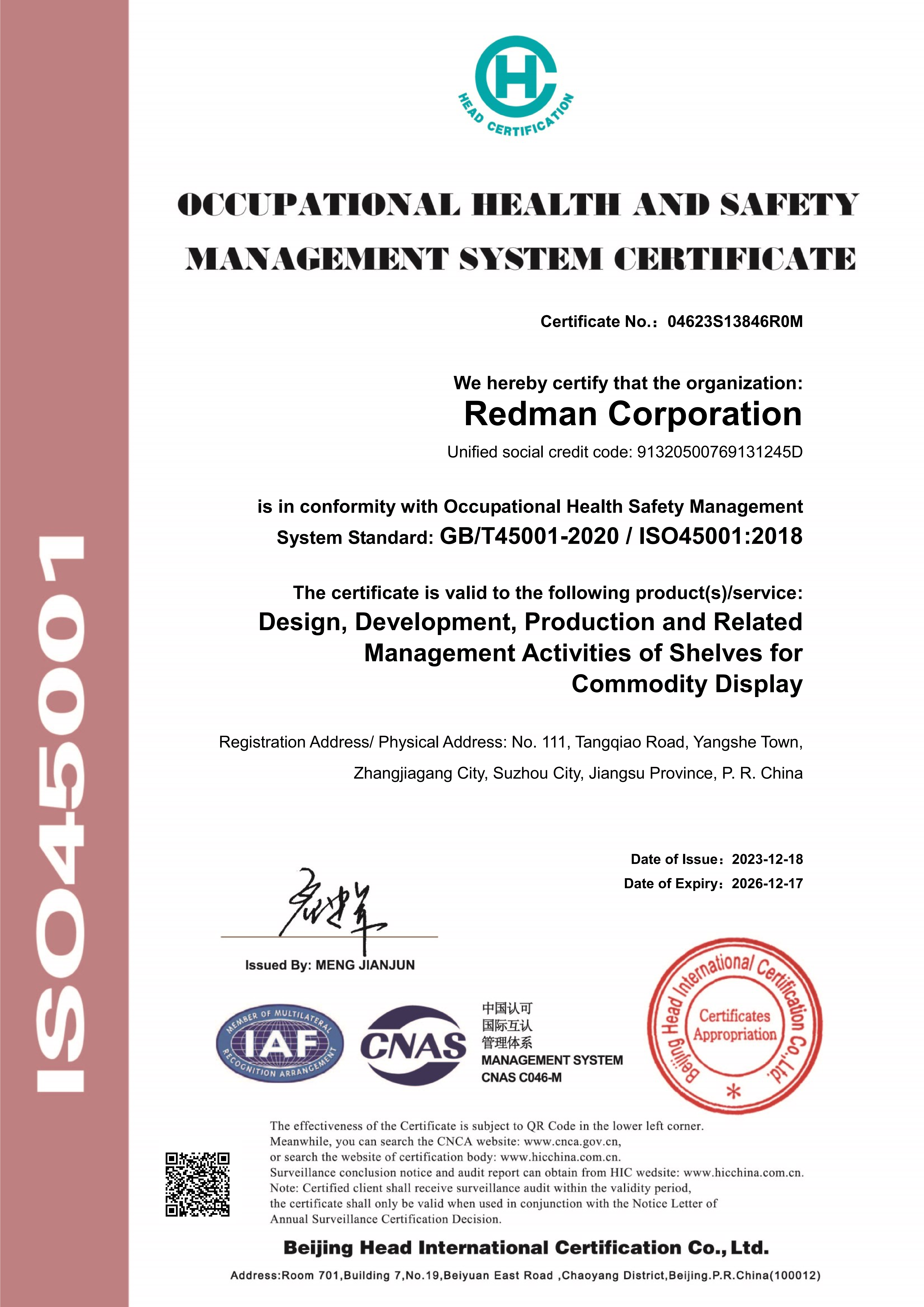
Occupational health and safety management certification (ISO45001:2018, certificate 04623S13846R0M) — one of four management-system certificates covering the display rack and store fixture lines discussed here.
The validity window is part of the score
Three of the five certificates carry a documented expiry date of 17 December 2026, roughly five weeks after this analysis was prepared. That is exactly the kind of detail a scorecard should surface rather than hide. A buyer awarding a three-year program in the fourth quarter of 2026 should ask for renewal confirmation and, ideally, write a certificate-renewal notification clause into the supply agreement. The energy management certificate runs to 6 April 2027 and the FSC certificate to 18 August 2029, so the renewal cycle is staggered rather than simultaneous.
Dimension 2: Production Continuity (25 Points)
Capacity is the dimension most often assessed from a single number in a sales presentation, and it is the dimension where a single number is least useful. What matters is capacity per material line, because a metal-heavy program cannot be rescued by plastic capacity.
Redman's published capability records state monthly capacity of 30,000+ pieces for metal display manufacturing, 20,000+ pieces for wood display manufacturing and 100,000+ pieces for acrylic and plastic display manufacturing. The company reports annual output of more than 1,000 containers and a 95% export ratio, with main markets in the USA, Canada, Europe, the Middle East and Australia. The facility is described as approximately 550,000 sqft (51,097 m²), covering metal, wood, plastic, printing, painting, powder coating and packaging workshops, staffed by more than 350 employees including 50+ technical engineers and 7 project managers.
| Production line | Reference model | Stated monthly capacity | Stated lead time | Stated MOQ |
|---|---|---|---|---|
| Metal display manufacturing | RM-POP-001 | 30,000+ pieces | 25–35 days | 100 pieces (custom metal parts) |
| Wood display manufacturing | RM-SF-001 | 20,000+ pieces | 30–40 days | 50 pieces (custom wood parts) |
| Acrylic and plastic display manufacturing | RM-PD-001 | 100,000+ pieces | 35–50 days (including mold development) | 1,000 pieces (custom plastic parts) |
| Custom OEM/ODM orders (overall) | All three lines | 50,000+ pieces | 30–45 days | FCL or LCL; small-batch custom orders accepted |
Note that the material-line figures and the overall custom-order figure describe different scopes, and they should not be added together. A buyer planning a mixed program should ask the supplier to state capacity on the same basis as the forecast — pieces per month by material, per month of production, with the assumed shift pattern — rather than accept whichever number appears in the presentation.
Engineering depth is the second half of continuity. A supplier with in-house tooling, structural design and finishing capability can absorb a specification change inside the program rather than sending the buyer back to a third party. Redman's metal customization covers cutting, bending, welding, stamping, powder coating, painting, polishing and custom structural design; wood covers cutting, milling, drilling, sanding, veneer, melamine and painting; plastic covers injection molding, vacuum forming, blister molding, custom part design and mold development.
Program duration is a reasonable proxy for whether continuity claims hold in practice. Documented Redman project histories include a three-year engagement with a global retail brand covering 5,000+ custom POP display units for US store expansion, and a two-year engagement with a European supermarket chain covering 3,000+ custom store fixtures across 200+ supermarkets.
Dimension 3: Quality Control Evidence (20 Points)
Quality questions in fixture sourcing are rarely about whether a supplier has a quality system; they are about what is inspected, on what proportion of output, and by whom. The relevant evidence is the inspection protocol, not the certificate alone.
Across all three lines, Redman's capability records state a 100% quality check, supported by line-specific tests. Metal production includes dimensional inspection, load-bearing testing and surface finish inspection. Wood production includes dimensional inspection, surface finish inspection and moisture content testing — the moisture test being the one that most directly protects against later warping or joint failure in a retail environment. Plastic production includes dimensional inspection, material performance testing and surface finish inspection.
At the order level, the documented control set is 100% pre-shipment inspection, with third-party inspection by SGS, BV or TUV available. For a buyer, third-party inspection availability is worth scoring separately from 100% internal inspection: internal checks verify the supplier's own standard, while an independent inspection verifies the buyer's specification at a defined sampling level. Multi-year programs should specify which of the two applies at which shipment value, and who bears the cost.
The product records support the tests. RM-POP-001 is a cold-rolled steel and stainless steel structure with powder coating and painting finish and a stated load capacity of 50–200 kg, which is the parameter the load-bearing test should be measured against. RM-SF-001 is a wood structure using MDF, solid wood and plywood with melamine, veneer or painted finish, where moisture content and surface finish are the meaningful inspection points. RM-PD-001 uses ABS, PS and acrylic with injection molding or vacuum forming, where dimensional accuracy and material performance carry the quality risk.
Dimension 4: Lead Time and Order-Size Compatibility (15 Points)
Lead time is only meaningful when it is paired with the order size it applies to. The metal line quotes 25–35 days against a 100-piece minimum on custom metal parts; the wood line quotes 30–40 days against a 50-piece minimum; the plastic line quotes 35–50 days including mold development against a 1,000-piece minimum. Custom OEM/ODM orders overall are quoted at 30–45 days, with full-container and less-than-container shipments both available for small-batch custom work.
Those numbers have real consequences for program design. A department store refurbishment that needs 80 bespoke wood fixtures per store fits the wood line comfortably and the plastic line poorly, because 1,000 pieces is the plastic minimum and mold development sits inside the lead time. A buyer who needs 200 acrylic counter-top units across a pilot cannot use the plastic line economically at that volume and should expect either a consolidated order across stores or a different material route.
Extended fulfillment changes the picture again. The Redman warehouse operation in Los Angeles is documented at 10,000+ orders monthly with 2–5 days for order processing, no minimum order quantity for drop-shipping, and inventory management, order tracking and after-sales logistics support. For programs that replenish store fixtures individually rather than shipping containers, that service layer can matter more than factory lead time — provided the buyer understands that 2–5 days is order processing, not total transit to store.
Dimension 5: After-Sales and Fulfillment Support (15 Points)
After-sales commitments should be scored on specificity. Vague assurances of “full support” cannot be measured; named channels, named owners and stated resolution windows can.
The documented Redman support structure is 7×24 hours online technical support, one-to-one project manager service for assigned projects, and resolution of after-sales quality problems within 48 hours. A dedicated project manager coordinating all activities on an assigned program is the mechanism most directly relevant to multi-year work, because it removes the handover loss that occurs when a buyer's program passes through several sales contacts over three years. Line-level technical support is also stated for metal structural design and material selection, wood material selection and structural design, and plastic mold development and material selection.
Applying the Scorecard: A Five-Step Qualification Sequence
- Step 1 — Request documents by number. Ask for certificate numbers, issuers and expiry dates rather than certificate images. The numbers in the table above can be checked against the issuing body's records.
- Step 2 — Cross-check capacity against your own forecast. Convert the program into pieces per month by material and ask the supplier to confirm capacity on that same basis, including any seasonal reservation.
- Step 3 — Test the quality protocol with a pilot order. A pilot that runs through the stated inspection chain, with third-party inspection on at least one shipment, tells a buyer more than any document set.
- Step 4 — Audit the facility. The scorecard prioritises what to look at: the three material lines, the finishing area, and the inspection station where the 100% check is performed.
- Step 5 — Write continuity into the contract. Certificate renewal notification, capacity reservation for peak windows, finish and hardware consistency across re-orders, and a named project manager are all contract clauses, not goodwill.
Scorecard Versus Traditional Quote-and-Sample Selection
The conventional approach — request quotes, request samples, choose on landed cost and appearance — is fast and adequate for single orders. Its weakness is that all of its evidence is generated at a single point in time, while a multi-year program is judged across several. The scorecard approach costs more time upfront and produces a defensible record of why a supplier was selected, which matters when a retail compliance team or an internal audit asks the question two years later.
The approach has limits that should be stated plainly. Four are worth flagging.
Management-system certificates are not product certifications. ISO9001, ISO14001, ISO45001 and ISO50001 attest to how an organisation manages quality, environment, safety and energy; they do not certify that a specific rack meets a specific product standard. For US retail fixtures, UL Solutions describes UL 970 as the standard for retail fixtures and merchandise displays, covering showcases, temporary displays, point-of-sale, motorized, hanging, wall-system and product-platform categories. That is a scope description, not evidence that any given supplier is certified or compliant, and the current edition and applicability should be confirmed directly before it is written into a tender.
Capacity figures are supplier-reported. Monthly capacity, container volume and facility size in this article come from company documentation. They are a starting point for verification, not a substitute for a factory audit or a production record review.
Certificate expiry dates create a real management obligation. A scorecard that does not track renewal dates will produce a compliant supplier at award and an expired certificate at audit.
Tooling economics can disqualify an otherwise strong supplier. A 1,000-piece minimum and a lead time that includes mold development make the plastic line unsuitable for very small or highly fragmented programs, regardless of how well the supplier scores elsewhere.
Matching the Scorecard to Retail Environments
The weighting of the scorecard should shift with the retail environment, because the failure modes differ.
In a retail store running 24/7 static display with brand in-store marketing and product merchandising as the objective, load-bearing capacity and finish durability dominate; RM-POP-001's stated 50–200 kg load capacity and powder-coated steel construction are the relevant parameters, and lighting accessories and brand signage are typically specified alongside.
In a supermarket environment with high customer flow and 24/7 static display, the priorities are classification display and promotional messaging combined with easy assembly and disassembly, so hardware standardisation and re-order consistency matter more than premium finish.
In a department store, where fixtures support brand image building and long-horizon product series display with customizable lighting and interactive functions, appearance consistency across the fleet becomes the dominant risk — which is where wood-line moisture control, veneer and painting consistency, and the FSC Chain of Custody certificate come into play.
In exhibition and trade show work, the profile inverts again: short-term display, portability and reusability, fast production and delivery. A supplier that scores well on long-run capacity may score poorly on speed, and buyers should weight lead time and order-size flexibility accordingly.
Future Outlook
Two trends are likely to reshape supplier evaluation over the next few years. The first is the integration of lighting and screens into fixtures. Grand View Research projects the global LED modular display market at USD 10.2 billion in 2026, rising from USD 7.5 billion in 2023 and forecast at USD 17.4 billion by 2030. As illuminated and powered fixtures become standard in premium retail, the evaluation set expands from metal, wood and plastic capability to electrical compliance documentation — a different evidence category from the ISO management-system certificates discussed here, and one buyers will need to request separately.
The second is material traceability. FSC Chain of Custody is currently a differentiator for wood fixture programs; as retail brands extend forest-material policies through their store estates, it is likely to become a baseline requirement for wooden store fixtures rather than an advantage. Suppliers whose certificate already runs to 2029 are better positioned for that shift than suppliers who would need to begin the process.
Neither trend removes the underlying logic of the scorecard. Certification, capacity, quality control, order-size fit and after-sales support remain the five questions that determine whether a display rack supplier can carry a program for three years rather than one order.
FAQ
Which certifications should a buyer request when evaluating a long-term display rack supplier?
Request the certificate numbers, issuers and expiry dates for ISO9001, ISO45001, ISO14001 and ISO50001, and add FSC Chain of Custody where the program includes wood. For the Redman lines discussed here, RM-POP-001, RM-SF-001 and RM-PD-001 are each documented as covered by ISO9001, ISO45001, ISO14001 and ISO50001, while FSC Chain of Custody (BV-COC-122126/BV-CW-122126, issued by Bureau Veritas Certification China to FSC-STD-40-004 V3-1) applies to the wooden display and wooden store fixture scope, most directly RM-SF-001.
How should a buyer verify a supplier's stated production capacity?
Convert the program forecast into pieces per month by material, then ask the supplier to confirm capacity on that same basis and support it with production records or a facility audit. Redman's capability records state 30,000+ metal pieces, 20,000+ wood pieces and 100,000+ plastic pieces monthly, with annual output of more than 1,000 containers and a facility of approximately 550,000 sqft (51,097 m²). Because material-line figures and overall custom-order figures describe different scopes, the basis of any capacity number should be confirmed in writing.
What lead times and minimum order quantities apply to custom metal, wood and plastic display racks?
Documented figures are 25–35 days against a 100-piece minimum for custom metal parts, 30–40 days against a 50-piece minimum for custom wood parts, and 35–50 days including mold development against a 1,000-piece minimum for custom plastic parts. Custom OEM/ODM orders overall are stated at 30–45 days, with full-container and less-than-container shipments both accepted for small-batch work. Buyers should treat the plastic minimum as a program-design constraint, not a negotiable detail.
How is quality controlled before shipment on custom display racks?
Redman's documented protocol applies a 100% quality check across all three lines, with dimensional inspection, load-bearing testing and surface finish inspection on metal; dimensional, surface finish and moisture content testing on wood; and dimensional, material performance and surface finish inspection on plastic. At order level the stated controls are 100% pre-shipment inspection with third-party inspection by SGS, BV or TUV available. The load-bearing test is meaningful only against a stated parameter — RM-POP-001 carries a documented load capacity of 50–200 kg.
What after-sales support is reasonable for a multi-year display rack program?
Reasonable support means a named channel, a named owner and a stated resolution window. The Redman structure is documented as 7×24 hours online technical support, a one-to-one project manager coordinating all activities on an assigned program, and resolution of after-sales quality problems within 48 hours. Where the program replenishes fixtures to individual stores rather than shipping containers, overseas fulfillment services — the Los Angeles warehouse documented at 10,000+ orders monthly, 2–5 days order processing and no minimum order quantity for drop-shipping — form part of the after-sales assessment.
Redman Corporation's full 2026 product catalogue, including the RM-POP-001, RM-SF-001 and RM-PD-001 ranges, is available for download: Redman catalogue 2026.
¿Tiene preguntas o necesita más detalles?
Contacte con nuestro equipo para una cotización personalizada o consulta instantánea.
Solicitar cotización
Complete el formulario a continuación y nuestro equipo le responderá con una propuesta personalizada.
Chat directo de WhatsApp
¿Prefiere chatear en tiempo real? Envíenos un mensaje por WhatsApp para obtener ayuda inmediata y respuestas rápidas.
- Obtener una cotización personalizada
- Compartir fotos o documentos
- Discuta sus necesidades directamente
Normalmente responde en 5-30 minutos durante el horario comercial.