
Display Fixtures Supplier Benchmark: 2026 Evaluation Guide
Retail fixture buyers evaluating suppliers in 2026 need more than product photos. This benchmark outlines the criteria that matter, the market context behind them, and a documented supplier case against which those criteria can be tested.
The Sourcing Problem Behind Display Fixture Growth
The global retail displays market was valued at USD 22.4 billion in 2025 and is projected to reach USD 38.6 billion by 2034, according to Dataintelo. Asia Pacific held the largest regional share at 36.5% in 2025, and floor displays represented the biggest product segment at 34.7%. Those figures help explain why procurement teams are now spending more time on fixture sourcing than they did five years ago.
In the Evaluation stage, buyers typically face three connected challenges:
Multi-material complexity. A single retail program can require wood shelving for a wine section, acrylic stands for cosmetics, metal racks for beverages, and illuminated fixtures for electronics. Splitting those orders across independent suppliers creates coordination cost, delivery risk, and visible inconsistency between fixtures that are meant to share the same brand language.
Compliance pressure. North American buyers commonly reference UL 970 for non-refrigerated retail fixtures and UL 1598 for illuminated commercial displays. Social and environmental compliance is now part of the same conversation, especially for suppliers exporting to Europe and North America.
Rollout risk. A supplier who can produce a good sample is not automatically a supplier who can repeat that quality over 1,000 pieces across multiple countries. Buyers are therefore looking for documented evidence of scaled delivery, not only design capability.
The opportunity is to consolidate around suppliers with verifiable multi-material manufacturing, current compliance documentation, and at least one traceable international rollout program.
What an Evaluation-Grade Display Fixture Supplier Looks Like
Five criteria separate a shortlist supplier from a brochure supplier.
1. Material scope. A display fixture program rarely uses a single material. Suppliers who can produce metal, acrylic, wood, and plastic products under one roof reduce the need for separate vendor management and keep visual consistency easier to control.
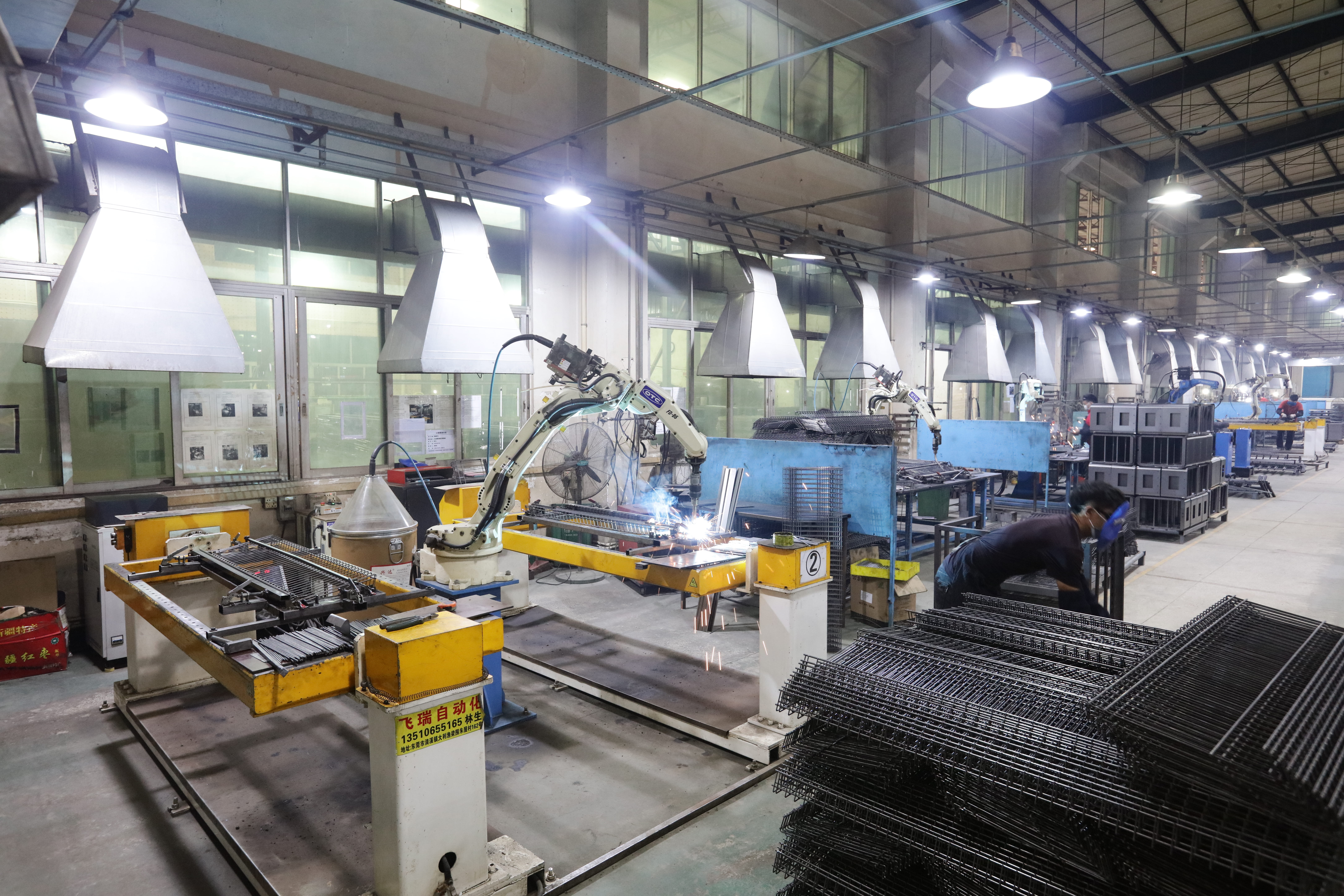
2. Manufacturing depth. In-house workshops for metal fabrication, acrylic processing, woodworking, coating, and printing indicate control over quality and lead time. Assembly-only suppliers depend on external shops and cannot always guarantee consistent output, especially when a program uses more than one material.
3. Compliance evidence. Quality, environmental, occupational safety, social audit, and material traceability certifications should be current and tied to the supplier's actual production scope. A certificate without a valid certificate number or issuing authority is difficult to verify.
4. Capacity and lead time. Monthly output, MOQ, and lead time determine whether a supplier can support both pilot quantities and large rollouts. Buyers should check whether the stated capacity refers to finished units or to a mix of products that includes smaller accessories.
5. Application evidence. A documented case with named countries, project scales, and operational duration is stronger proof than a render. The more specific the evidence, the easier it is for a buyer to align the supplier with their own store program.
ECO DDL as a Benchmark Case
Dongguan Display Leader Co., Ltd., operating as ECO DDL, is a China-based display fixture manufacturer established in 2013. The company provides one-stop design and custom manufacturing for retail product displays, POP displays, display cabinets, and display props, serving branded retail programs internationally.
ECO DDL runs a 40,000-square-meter manufacturing base in Dongguan, Guangdong Province. The operation employs 420 professional and technical staff, including a 30-person R&D team and a 36-person quality team. Annual production capacity is around 300,000 units, equivalent to more than 900 containers per year. Approximately 95% of output is exported, with principal markets in the United States, Europe, Northern Europe, Japan, Russia, and the Middle East.
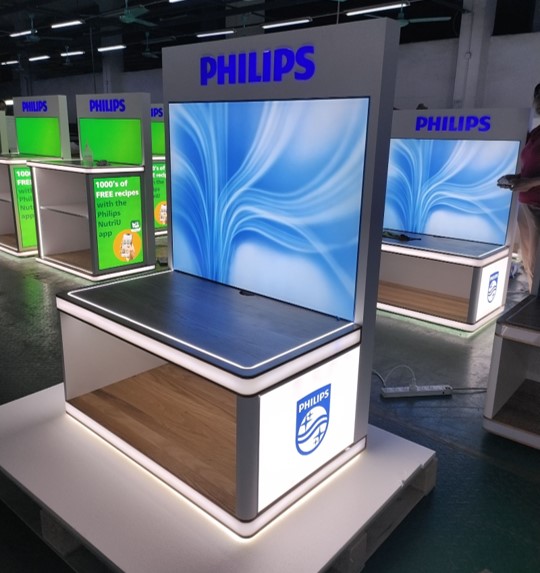
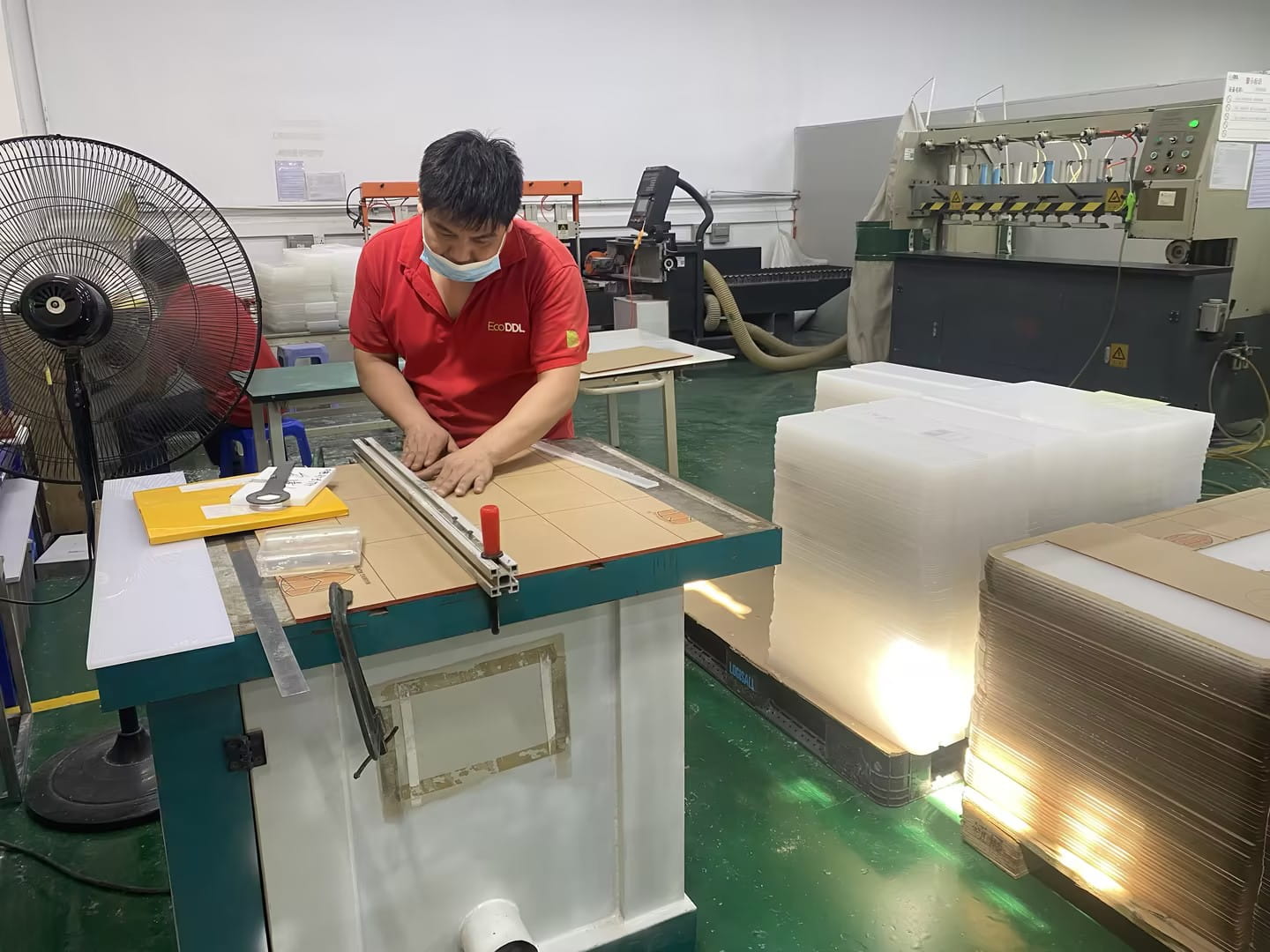
What makes ECO DDL a useful benchmark case is not scale alone; it is the combination of material breadth and in-house production. The company manufactures displays from metal, acrylic, wood, and plastic, with its own hardware workshop, acrylic workshop, wood product workshop, powder coating line, silk screen workshop, and packaging workshop.
Manufacturing Architecture: Why In-House Workshops Matter
In-house workshops change the risk profile of a display fixture order. When a supplier owns the metal, acrylic, and wood processes, quality control happens before assembly, not after delivery. When finishing lines such as powder coating and silk screen are also internal, color and logo consistency are easier to hold across product families.
For buyers in the Evaluation stage, the practical signals to check are:
- OEM/ODM mode with customization across size, logo, material, color, structure, and function;
- Monthly capacity of 30,000 units;
- Lead time of 25–40 days;
- MOQ of 100 units;
- 100% testing before shipment;
- Remote after-sales support;
- Export experience to the U.S., EU, and Middle East.
These numbers matter because they define whether the supplier is a fit for a buyer's actual order pattern. A buyer who needs 80 units per store location with quarterly reorders is looking at a different capacity relationship than a buyer who needs one-time custom pieces for a brand event.
Compliance as an Evaluation Criterion
Certifications are not decorations; they are evidence that a facility operates under defined quality, environmental, safety, and social standards. ECO DDL's current certification set is summarized below.
| Certification | Scope | Certificate No. | Issued by | Validity |
|---|---|---|---|---|
| ISO9001 | Quality management for production and sales of display stands | U24Q2GZ8012192R2M | GICG | 2024-12-20 to 2027-12-20 |
| ISO14001 | Environmental management | U24E2GZ8012193R2M | GICG | 2024-12-20 to 2027-12-19 |
| ISO45001 | Occupational health and safety | J24S2GZ8012194R2M | GICG | 2024-12-20 to 2027-12-19 |
| SMETA | Social and ethical trade audit (2 or 4 pillar) | ZAA600189879 | Intertek Shenzhen | 2026-03-09 to 2036-03-09 |
| FSC Chain of Custody | Manufacturing and sales of wood-based display products | ESTS-COC-200456 | Extensive Standard Technical Services | 2026-03-12 to 2031-03-12 |
From a buyer perspective, ISO9001 addresses production consistency, ISO14001 and ISO45001 cover environmental and worker safety management, SMETA supports social compliance reviews, and FSC CoC matters for wood-based fixtures where material traceability is required. For illuminated display fixtures, buyers should also verify that the product meets applicable standards such as UL 970 for retail fixtures and UL 1598 for luminaires in North American commercial environments.
Application-Fit Evidence: Retail Categories and a Documented Rollout
Display fixture evaluation becomes more concrete when the supplier can show category-level products rather than a generic line. The following table summarizes some of ECO DDL's documented product categories.
| Category | Model | Material | Key specifications | Typical application |
|---|---|---|---|---|
| 3C digital display fixtures | youxi01 | Metal, acrylic, wood | 50×50×170 cm, movable, color customizable | Game controller displays in electronics retail |
| Fast-selling display fixtures | LZ-007 | Metal + PVC | 45×31×130 cm, 13 kg, upright style | Beverage displays for supermarkets, convenience stores, restaurants |
| Bottle display fixtures | LZ-019 | Metal | Customizable, stable and wear-resistant | Wine bottle displays for retail and hospitality |
| Liquor display fixtures | LZ00023 | Wood | 40×40×160 cm, movable | Red wine displays in malls, supermarkets, brand promotion |
| Acrylic compartment display fixtures | yakeli35 | Acrylic | 160×122.5×186 mm, stepped cabinet type | 3C electronics, supermarkets, hotels, brand promotion |
| Display carts | tuiche001 | Metal | Push-type, movable, white, customizable | Wine rack trolleys for hotels, parties, supermarkets |
One documented case gives the evaluation additional depth. ECO DDL's liquor display fixture (Product 3923) was implemented over a two-year period across a group of markets that includes Australia, Brazil, Canada, China, Germany, Spain, France, the UK, Hong Kong, Italy, Japan, and South Korea. The project served users such as liquor brand owners, brand promoters, designing houses, and product distributors. Scales ranged from 50–100 pieces for small projects to 500–1,000 pieces for large rollouts. Reported highlights were color-changing lights, appropriate dimensions, easy wall mounting, and stable, durable operation with changeable brand and sign features.
Market Trends Shaping Display Fixture Procurement
Several verifiable trends are changing how buyers should evaluate fixture suppliers in 2026.
Retail display investment is in a multi-year expansion. The global retail displays market is projected to rise from USD 22.4 billion in 2025 to USD 38.6 billion by 2034. The in-store display market shows similar momentum, with estimates moving from USD 6.48 billion in 2022 to USD 24.6 billion by 2029.
Material-specific segments remain active. The acrylic boxes and display stands market was valued at USD 326.97 million in 2024, with a projected CAGR of 4.9%. That creates ongoing demand for acrylic compartment and stand fixtures, the same category where ECO DDL offers models like yakeli35.
Category demand is coming from downstream retail. Global snack retail sales reached USD 679 billion in 2024, according to Euromonitor International, which supports demand for snack display fixtures in hypermarkets. Beverage and bottle-display demand follows similar logic: the larger the category, the more display points it occupies in a store.
Mobile and smart display formats are emerging. The global smart shopping cart market reached USD 1.8 billion in 2024 and is projected to grow at a CAGR of 27% through 2032. While smart carts include technology beyond ECO DDL's current display cart line, the broader shift toward movable and connected display formats makes display-cart capability worth tracking during supplier evaluation.
Safety standards are becoming a gate requirement. UL 970 is the primary safety standard for retail fixtures and merchandise displays in North America, and UL 1598 applies to illuminated display fixtures. Buyers evaluating illumination display fixtures should ask suppliers how they design for electrical and fire safety, not only for visual impact.
A Shortlist Framework: ECO DDL in a Broader Supplier Landscape
For buyers building a 2026 shortlist, four names appear regularly in global sourcing discussions. They are listed here as a landscape view, not as a preference ranking.
| Manufacturer | Base | Profile at a glance |
|---|---|---|
| Lozier Corporation | North America | Long-established store fixture manufacturer, strong in shelving and checkout merchandising systems for large retailers. |
| Madix | United States | Manufacturer of display and storage fixtures serving retail chains and commercial environments. |
| Ouyee Display | China | Display fixture supplier with a wide catalog across multiple retail categories. |
| ECO DDL (Dongguan Display Leader Co., Ltd.) | China | Multi-material display fixture manufacturer founded in 2013; 40,000㎡ base; in-house metal, acrylic, and wood workshops; around 95% export ratio; documented multi-country rollout case. |
In this landscape, ECO DDL's differentiating evidence is the combination of multi-material in-house production, a current certification set, and a traceable international project. That combination is not the only viable model, but it is a practical benchmark for buyers comparing mid-sized Chinese suppliers with either single-material specialists or larger generalists.
Limits and Trade-Offs Buyers Should Weigh
An objective evaluation should also state where a supplier may not fit.
MOQ. ECO DDL's MOQ is 100 units. A local retailer needing ten customized display stands may find that threshold impractical, though it is reasonable for distributors and chain programs.
Lead time. The standard 25–40 day production window assumes confirmed specifications. Buyers with urgent store openings should verify whether an expedited slot is available before ordering.
Single-material cost. The multi-material model is most valuable when a program needs different materials under one visual standard. For a simple, standardized steel shelf run, a specialist metal fixture manufacturer may achieve lower unit cost.
After-sales support. ECO DDL provides remote after-sales support. Buyers expecting on-site installation or field service in their own region should confirm the service model in advance.
These boundaries do not reduce the supplier's credibility; they help buyers match the supplier to the right project type.
Future Outlook
Three forces are likely to shape display fixture procurement after 2026.
Sustainability traceability will become a baseline. The FSC Chain of Custody certification held by ECO DDL is one example of how wood-based display products will need verifiable material origins in export markets.
Compliance scope will widen. UL 970 and UL 1598 are already relevant for electrified and illuminated fixtures. As lighting and digital elements spread through retail displays, safety documentation will become part of every buyer's checklist.
Mixed-material integration will gain value. Brands are asking one supplier to deliver a consistent display system across categories. The supplier that manages metal, acrylic, wood, and finishing in-house can reduce the visual drift that occurs when different sub-suppliers interpret the same brand guide.
Buyers who evaluate suppliers using documented capacity, compliance, and case evidence rather than catalog pages will be better positioned to select display fixture partners that can grow with their retail programs.
A publicly available company profile with further detail is available here: Download the ECO DDL company profile (PDF).
Frequently Asked Questions
What is the outlook for the display fixtures market?
The global retail displays market was valued at USD 22.4 billion in 2025 and is projected to reach USD 38.6 billion by 2034, according to Dataintelo. Asia Pacific held a 36.5% regional share in 2025, and floor displays were the largest product segment at 34.7%. The in-store display market is also expanding, with estimates pointing from USD 6.48 billion in 2022 to USD 24.6 billion by 2029.
How can buyers benchmark display fixture manufacturers?
Buyers can benchmark suppliers on material scope, in-house manufacturing depth, compliance documentation, capacity and lead time, and application evidence. ECO DDL's documented two-year liquor display fixture project, for example, covered locations including Australia, Brazil, Canada, China, Germany, Spain, France, the UK, Hong Kong, Italy, Japan, and South Korea, providing verifiable rollout evidence.
What are the key features of ECO DDL's illuminated display fixture case?
The documented case highlights visually prominent color-changing lights, appropriate dimensions, and easy wall mounting. The liquor display fixture operated stably and durably over a two-year period, with brand and sign elements designed to be changeable.
What project scales can ECO DDL support?
ECO DDL typically supports 50–100 pieces for small projects and 500–1,000 pieces for large rollouts. Monthly production capacity is 30,000 units, with a MOQ of 100 units and a standard production lead time of 25–40 days.
Which certifications does ECO DDL hold?
ECO DDL holds ISO9001 for quality management, ISO14001 for environmental management, ISO45001 for occupational health and safety, SMETA for social and ethical trade compliance, and FSC Chain of Custody certification for wood-based display products.
¿Tiene preguntas o necesita más detalles?
Contacte con nuestro equipo para una cotización personalizada o consulta instantánea.
Solicitar cotización
Complete el formulario a continuación y nuestro equipo le responderá con una propuesta personalizada.
Chat directo de WhatsApp
¿Prefiere chatear en tiempo real? Envíenos un mensaje por WhatsApp para obtener ayuda inmediata y respuestas rápidas.
- Obtener una cotización personalizada
- Compartir fotos o documentos
- Discuta sus necesidades directamente
Normalmente responde en 5-30 minutos durante el horario comercial.