
Dirt Ebike Supplier Capability: Freego's Mid-Drive Lineup
A dirt ebike sourcing decision usually fails in one of three places: the certification document does not match the model being ordered, the battery voltage does not match the destination market's vehicle classification, or the quoted lead time does not match the supplier's real production calendar. None of those failures is caused by a weak product. They are caused by a supplier whose capability was never inspected at the level where constraints actually live.
Product segmentation is one of the few supplier disclosures that cannot be produced cheaply. A company that publishes five distinct mid-drive platforms — from a 2,500W compact unit to a 15,000W pro-grade machine — and five hub-motor all-terrain platforms is exposing motor sourcing, battery architecture, brake and suspension tiering, frame material selection, and controller design as separate engineering workstreams. This article reads Freego USA Inc.'s published dirt ebike portfolio in that way: as capability evidence a B2B buyer can convert into purchase terms, acceptance criteria, and a vendor shortlist.
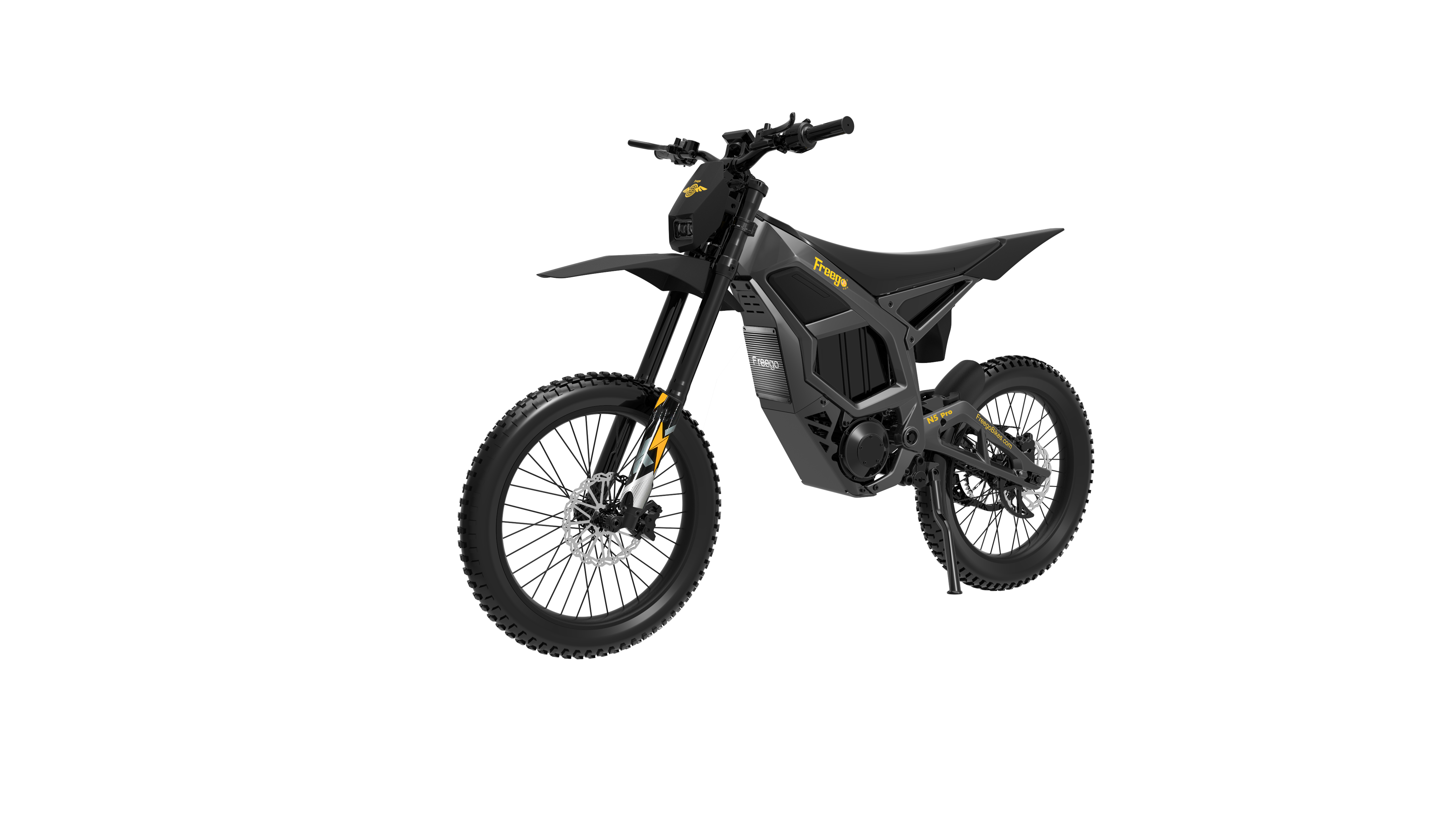
Freego Nova 5 pro, the 15,000W mid-drive platform at the top of the brand's all-terrain dirt ebike lineup. Image: Freego.
Why Dirt Ebike Buyers Now Ask for Capability Evidence
The electric dirt bike category is moving out of the enthusiast niche and into channel planning. Third-party market research published by Dataintelo places the global electric dirt bike market at approximately USD 2.8 billion in 2025, with growth expectations to USD 7.6 billion by 2034. The same source estimates that Asia Pacific accounted for USD 1.02 billion of 2025 demand, or 36.4% of total global revenue.
Growth of that shape changes what buyers need from a supplier. At small volumes, a technically credible product and a responsive sales contact were sufficient. At fleet, dealer, and distribution volumes, the questions shift: can the supplier hold a specification across batches, is the certification file model-specific, and do the commercial terms — MOQ, lead time, warranty split, spare parts path — survive contact with an actual purchase order?
Freego is a Chino, California-headquartered electric mobility company founded in 2012, operating a 3,000 m² factory with a 10+ engineer R&D team and an export ratio of approximately 90% across more than 40 countries and regions. Its stated annual sales are approximately 20,000 vehicles, with cumulative global sales reported above 1 million vehicles. Those are portfolio-level facts. The more useful evidence for a dirt ebike buyer sits one level down, in the product segmentation itself.
Reading Manufacturing Breadth From the Mid-Drive Lineup
Freego's dirt ebike range separates into two drivetrain families. The mid-drive family — Nova 5 pro, Nova 5, Nova 4, Nova 3, and Nova 5 MINI — spans a 2,500W to 15,000W peak motor band. The hub-motor family — X3, X2 Pro, X2, X1, and X0 — spans 3,600W to 8,000W. Higher tiers in both families use 21700 lithium-ion cells, and both families appear in the brand's parts and service documentation.
| Mid-drive model | Peak motor | Battery | Top speed | Range / load | Brake / climbing |
|---|---|---|---|---|---|
| Nova 5 pro | 15,000W mid-drive | 72V, 40Ah, 21700 cells | 62 MPH street-legal / 56 MPH off-road | 70 MI; 150 kg (330 lbs) | 4-piston hydraulic disc, 203mm rotor; KKE hydraulic front and rear |
| Nova 5 | 8,000W mid-drive | 72V, 40Ah, 21700 cells | 53 MPH | 70 MI; 150 kg (330 lbs) | 4-piston hydraulic disc; climbing capacity ≥45% slope |
| Nova 4 | 6,000W mid-drive | 60V, 30Ah, 21700 cells | 28 MPH Eco / 45 MPH Sports | 50 MI Eco / 25 MI Sports; 120 kg (264 lbs) | 4-piston hydraulic disc; ≥40% slope; inverted suspension fork |
| Nova 3 | 3,000W mid-drive | 60V, 25Ah, 21700 cells | 28 MPH kid-safe / 40 MPH turbo | 50 MI Eco / 20 MI Sports; 120 kg (264 lbs) | 2-piston hydraulic disc, 220mm rotor; ≥40% slope; 2-stage reduction chain drive |
| Nova 5 MINI | 2,500W mid-drive | 48V, 21Ah | 37 MPH | 35 MI; 100 kg (220 lbs) | Hydraulic disc brake; hydraulic front and rear shock absorbers |
Table 1. Freego mid-drive all-terrain dirt ebike platforms as published in the brand's product specifications.
Five platforms inside one drivetrain family is a manufacturing signal, not a marketing one. Each power tier requires its own controller calibration, thermal management, and drivetrain reduction ratio. Nova 3 uses a two-stage speed-reduction chain drive, while the higher tiers step up to 4-piston hydraulic brakes and KKE-brand hydraulic suspension on the Nova 5 and Nova 5 pro. Nova 4 pairs an inverted suspension fork with a mid-drive brushless motor that carries a two-level speed deduction. Nova 5 pro combines the 15,000W motor with a 150A/400A high-power brushless motor controller.
The hub-motor family answers a different requirement set — predominantly dual-mode, street-legal platforms with a defined urban speed limit and an off-road mode.
| Hub-motor model | Peak motor | Battery | Top speed | Range / load |
|---|---|---|---|---|
| X3 | 8,000W hub | 72V, 40Ah / 50Ah, 160 pcs 21700 cells | 28 MPH urban / 56 MPH off-road | 110 MI; 150 kg (330 lbs); ≥30° climbing |
| X2 Pro | 6,000W hub | 60V, 30Ah, Panasonic/LG 21700 cells | 28 MPH urban / 50 MPH off-road | 56 MI city / 20 MI off-road; 120 kg (264 lbs) |
| X2 | 6,000W hub | 60V, 30Ah, 21700 cells | 28 MPH urban / 50 MPH off-road | 56 MI; 120 kg (264 lbs); ≥25° climbing |
| X1 | 3,600W hub | 60V, 25Ah, automotive-grade 21700 cells | 28 MPH urban / 40 MPH off-road | 50 MI Eco / 20 MI Sports; 120 kg (264 lbs) |
| X0 | 3,600W hub | 60V, 23Ah, 21700 cells | 40 MPH | 50 MI; 100 kg (220 lbs); 14-inch spoke wheels |
Table 2. Freego hub-motor all-terrain dirt ebike and mini bike platforms.
Read together, the two tables describe a supplier able to package a 100 kg, 14-inch-wheel compact machine aimed at teen and adult dual-use riding (X0, Nova 5 MINI) alongside a 150 kg, 70/100-19 heavy-duty platform (X3, Nova 5) from the same production organization. For a buyer, that breadth determines whether a single supplier can cover a multi-SKU programme — a rental fleet needing lightweight compact bikes plus a dealer programme needing pro-grade machines — without splitting the order across vendors.

Freego OEM production line. Manufacturing breadth is only one half of supplier capability; the other half is documented process control. Image: Freego.
Certification and Parameter Constraints: Defining the Buyable Set
For a constraints-led buyer, the first question is not which model has the highest peak power. It is which models are legally sellable in the destination market, and under which document. Certification, not specification, defines the buyable set.
The document that matters most for Freego's dirt ebikes is the UL 2849 test report numbered LTR24100903HS, issued by Guangdong Lintek Certification Group Co., Ltd. on 10 October 2024 against standard UL 2849:2020+R:2022-06+R:2022-12, covering electrical systems for eBikes in the US market. Its associated product list names nine dirt ebike models: Nova 5 pro, Nova 5, Nova 4, Nova 3, Nova 5 MINI, X3, X2 Pro, X2, and X1.
Freego's wider compliance file also contains two SGS North America Certificates of Compliance to ANSI/CAN/UL 2849-2022 — SGSNA/24/SZ/00058, covering electric bike electrical systems with a stated expiry of 1 June 2028, and SGSNA/24/SZ/00059, covering electric bikes — plus a Supplier's Declaration of FCC Conformity to FCC Part 15 Subpart B numbered HK2210194593E issued by HUAK (Shenzhen HUAK Testing Technology Co., Ltd.), and a Verification of FCC Conformity numbered POCE15101614GF issued by POCE (Shenzhen POCE Technology Co., Ltd.) to FCC Part 15 Subpart B: 2014.
This is where a buyer has to read carefully, because the SGS certificates and FCC declarations in the file relate to other Freego product families — fat-tire e-bikes, urban commuting bikes, and scooters — rather than to every dirt ebike SKU. The dirt ebike coverage sits with the UL 2849 test report. A supplier that presents a stack of certificates without a model-to-certificate map has not answered the question.
| Document | Issuing body | Standard | Number | Scope in the file |
|---|---|---|---|---|
| Test report | Guangdong Lintek Certification Group Co., Ltd. | UL 2849:2020+R:2022-06+R:2022-12 | LTR24100903HS | Nine dirt ebike models, US market |
| Certificate of Compliance | SGS North America Inc. | ANSI/CAN/UL 2849-2022 | SGSNA/24/SZ/00058 | Electric bike electrical systems; stated expiry 2028-06-01 |
| Certificate of Compliance | SGS North America Inc. | ANSI/CAN/UL 2849-2022 | SGSNA/24/SZ/00059 | Electric bikes |
| Supplier's Declaration of Conformity | HUAK (Shenzhen HUAK Testing Technology Co., Ltd.) | FCC Part 15 Subpart B | HK2210194593E | Electric bikes; issued 2022-10-26 |
| Verification of Conformity | POCE (Shenzhen POCE Technology Co., Ltd.) | FCC Part 15 Subpart B: 2014 | POCE15101614GF | Self-balancing scooters and electric mobility devices |
Table 3. Certification documents in Freego's compliance file and the product scope each one states.
Market classification adds a second constraint layer. In the United States, e-bikes are commonly described through a three-class system in which Class 1 and Class 2 are limited to 20 mph and Class 3 to 28 mph, with vehicles exceeding those limits generally regulated as off-road motor vehicles. In the European Union, electric motorcycles fall under Regulation (EU) No 168/2013, where L1e covers moped-equivalent vehicles up to 45 km/h and 4 kW, and L3e covers motorcycle-equivalent vehicles without that speed restriction. Freego's published dual-mode description for its X-Man series addresses exactly this split: a City Mode positioned as Class 3 compliant at 28 mph and 750W, and an unrestricted Off-Road Mode.
The procurement consequence is a rule rather than a preference: for any dual-mode or high-power dirt ebike, the acceptable top speed is a function of the destination market, and the acceptance criteria in the purchase contract should name the mode, the speed, and the certificate — not just the model.
Drivetrain Choice as a Procurement Variable
Mid-drive versus hub-motor is often treated as a rider preference. Commercially it is closer to a service-model decision. Third-party technical comparisons, including material published by GYROOR, note that mid-drive motors are increasingly preferred for off-road dirt bikes because of superior weight distribution and torque multiplication through the bike's gear system compared with hub motors. That is a trend observation from a technical source, not a universal rule — but it explains why supplier portfolios increasingly split along this line.
Freego's mid-drive evidence is mechanical and specific. Nova 3 pairs a 3,000W mid-drive brushless motor with a two-stage speed-reduction chain drive and lists a ≥40% slope climbing capacity. Nova 4 uses a mid-drive brushless motor with a two-level speed deduction, an inverted suspension fork, and a ≥40% slope figure. Nova 5 states ≥45% slope capability with KKE hydraulic suspension and a 72V, 40Ah pack built on 21700 cells. Nova 5 pro pairs a 15,000W motor with a 150A/400A controller — the highest current configuration in the published lineup.
The hub-motor side is specified differently. X2 uses a high-power brushless motor controller rated 100A/300A with ≥25° climbing capacity. X2 Pro specifies Panasonic/LG 21700 cells and KKE hydraulic front and rear suspension. X3 uses 160 pieces of 21700 cells to support a claimed 110-mile range. For buyers, the practical point is that chain-drive mid-drive systems and hub systems have different consumable profiles, different service training requirements, and therefore different warranty-consumable assumptions. Those differences belong in the contract, not in the brochure.
From Product Evidence to Purchase Terms
The clearest test of supplier capability is whether the product lineup is backed by stated commercial terms. Freego publishes four engagement models with distinct MOQ, lead time, and quality-control commitments.
| Engagement model | MOQ | Lead time | Capacity and quality control |
|---|---|---|---|
| OEM | 50 units per model; mixed orders within the same series calculable | 45–60 days custom production from China; 3–8 business days for spot logo or packaging work from the US warehouse | 2,000 units/month regular, 3,000+ in peak season; ISO 9001 system compliance, 100% incoming inspection of core parts, in-process patrol inspection, 100% full-function ex-factory inspection, third-party UL/CE/SGS inspection supported |
| ODM | 100 units per model | 15–20 days design and prototyping; 50–70 days mass production after custom design confirmation | 1,500 units/month regular, up to 2,500+ at custom mass-production peak; third-party UL 2849/CE certification, frame fatigue testing, IPX6 waterproof testing |
| IoT solution | 100 units for standard IoT modules | 30–45 days for custom IoT solution development | 5,000 modules/month; network connectivity stability testing, GPS positioning accuracy checks, remote battery health monitoring |
| US warehouse distribution | 12 units / 1 pallet | 3–8 business days spot direct delivery from the US local warehouse | 20,000 units/year; local USA warehouse PDI (Pre-Delivery Inspection) |
Table 4. Freego engagement models, MOQ, lead times, and stated quality-control commitments.
Warranty structure differs by model as well. OEM orders carry a 2-year limited warranty split as 2 years on the frame and 1 year on core electrical components. ODM programmes carry a 2-year limited warranty that also covers custom modules, plus a 1-year free upgrade for custom systems and functions, and lifetime technical docking for custom design. Distribution orders placed from the US local warehouse carry a 2-year limited warranty with access to a network of 200+ local authorized service centers and local spare parts shipping.
Benchmarking Suppliers on Four Verifiable Dimensions
Vendor shortlists in this category are usually built on reputation. A more defensible approach is to score suppliers on four dimensions where documents either exist or do not: technical R&D depth, certification coverage per SKU, market and after-sales footprint, and industry solution capability. The table below applies that scorecard, with one deliberate restriction — Freego's column contains facts published in this article, and the peer columns contain only publicly attributable statements.
| Dimension | Freego | Sur-ron | Talaria | Stark Future |
|---|---|---|---|---|
| Technical R&D depth | 10+ engineers; two drivetrain families; five mid-drive platforms from 2,500W to 15,000W; a UL 2849 test report naming nine dirt ebike models | Publicly identified as a primary competitor in the high-performance electric dirt bike segment (RideApart / Visordown, 2026); model-level R&D data not verified in this article | Publicly identified as a primary competitor in the same segment; model-level R&D data not verified in this article | Publicly identified as a primary competitor; reported profitability in 2026 with a 3% global market share target |
| Certification coverage per SKU | UL 2849 report LTR24100903HS; SGS COC SGSNA/24/SZ/00058 and 00059; FCC SDoC HK2210194593E; FCC verification POCE15101614GF | Request model-to-certificate map per SKU | Request model-to-certificate map per SKU | Request model-to-certificate map per SKU |
| Market, service and supply footprint | ~90% export ratio; 40+ countries and regions; ~20,000 units annual sales; >1 million cumulative vehicles; 200+ US authorized service centers under the distribution model | Not assessed in this article | Not assessed in this article | Not assessed in this article |
| Industry solution capability | OEM, ODM, IoT fleet management, and US distribution models; applied scenario references spanning rental and ride-sharing, urban commuting, and powersports in the US, EU, Middle East, Latin America, and Asia | Not assessed in this article | Not assessed in this article | Not assessed in this article |
Table 5. Four-dimension supplier screening scorecard. Peer columns contain only publicly attributable statements; no competitor specifications have been estimated.
The table is intentionally asymmetric. Sur-ron, Talaria, and Stark Future are recognized players in the high-performance segment, and the absence of verified data here is a limit of this article, not a judgment about those suppliers. The operational conclusion is a screening rule rather than a ranking: a supplier that cannot produce a model-to-certificate map, a written quality-control protocol, and an explicit warranty split has not yet reached the evidence threshold for a bulk dirt ebike order, regardless of how its machines perform in reviews.
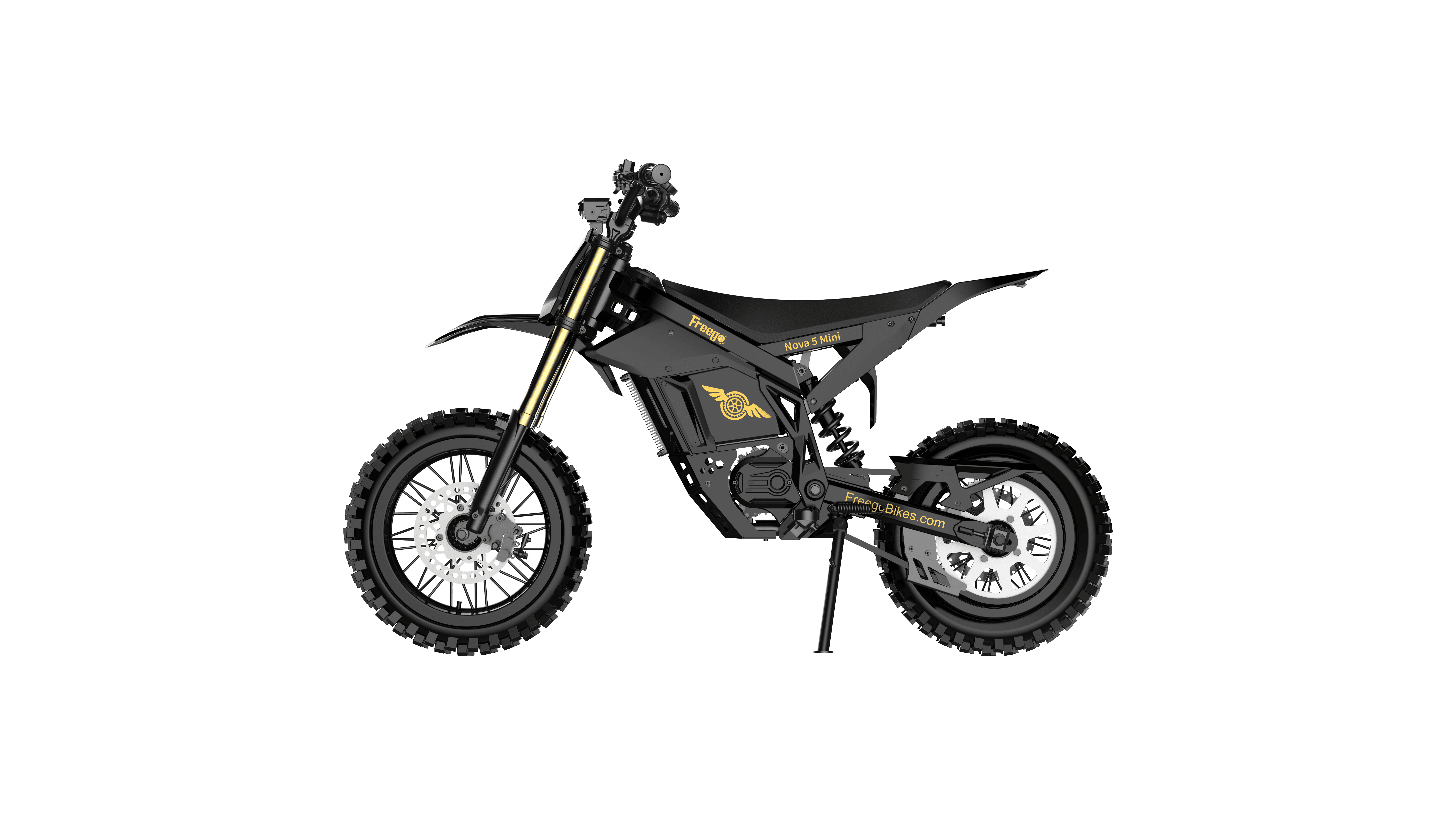
Freego Nova 5 MINI, the 48V compact mid-drive platform used in multi-SKU programmes alongside full-size all-terrain models. Image: Freego.
Matching Models to Project Types
Product segmentation becomes procurement value only when it maps onto project requirements. Freego's published scenario data documents three recurring dirt ebike operating contexts.
Rental and ride-sharing. The documented operating conditions are high-frequency public use, outdoor 24/7 exposure, and varied rider behaviour, across markets including the United States, Germany, Poland, Sweden, the UAE, Mexico, and Korea. The stated special requirements include commercial-grade durability, real-time GPS tracking, swappable battery operation, and remote fault diagnosis, with IoT modules, a cloud management platform, multi-unit charging docks, and real-time battery monitoring as matched equipment. Compact mid-drive platforms such as Nova 5 MINI and entry-level Nova 3, together with the X0 mini bike, sit naturally in this context.
Urban transportation and commuting. The documented conditions are mixed traffic, wet and rainy streets, and night riding, with street-legal compliance, anti-theft design, a range above 50 miles, and low operating noise as stated requirements. The dual-mode street-legal models — X1, X2, and X2 Pro — correspond to this use pattern, with X2 Pro specifying Panasonic/LG 21700 cells and a 5–8 hour charging window.
Powersports and outdoor recreation. The documented conditions include off-road trails, sand, mud, and inclines above 25°. Stated requirements include UL 2849/ANSI safety certification, a high-torque motor, 4-piston hydraulic brakes, and puncture-resistant motorcycle-grade tires. Nova 5, Nova 5 pro, X3, and X2 Pro address this tier. Buyers running wet or dusty programmes should also note that IPX6 waterproof testing appears as part of Freego's ODM quality-control protocol rather than a blanket claim across every SKU.
Limitations and the Boundaries of This Evidence
A supplier reference that lists only advantages is not usable for procurement. The boundaries below follow directly from the same documents cited above.
MOQ floors shape pilot design. OEM orders start at 50 units per model and ODM at 100 units per model, with a 100-unit minimum for standard IoT modules. Small validation programmes may need to consolidate around fewer SKUs rather than testing the full lineup.
Lead time is a function of the engagement model, not the catalogue. The 3–8 business day figure applies to spot customisation such as logo or packaging work from the US local warehouse. Custom production from China runs 45–60 days under OEM terms, and ODM mass production runs 50–70 days after design confirmation, following a 15–20 day design and prototyping phase.
Capacity is finite and seasonal. Regular OEM capacity is stated at 2,000 units per month rising to 3,000+ in peak season, and ODM capacity at 1,500 units per month rising to 2,500+ at custom mass-production peak, within a 3,000 m² facility and a workforce of 50+ people that can reach 100+ during peak season. Buyers planning peak-season launches should treat this as a scheduling constraint.
Certification scope is model-specific. The UL 2849 test report names nine dirt ebike models, while the SGS and FCC documents in the same file relate to other product families. In addition, the Supplier's Declaration of FCC Conformity is dated 26 October 2022, and buyers whose compliance policies require recent documentation should request current evidence.
Charging and load ceilings vary by tier. The 72V platforms list a 5–10 hour charging time on Nova 5 pro and 5–8 hours on X2 Pro, which affects fleet duty cycles. Maximum load is 150 kg on Nova 5, Nova 5 pro, and X3, but 100 kg on Nova 5 MINI and X0, which limits heavier dual-rider configurations.
Not every model is street-legal, and not every model is mid-drive. Mid-drive is concentrated in the Nova family; the X-series uses hub motors with dual-mode speed limits. Buyers who want mid-drive consistency across an entire programme will find the lineup segmented by design.
Cost positioning needs independent validation. Freego's dealer case file reports a cost position approximately 40% below peer high-end products. That is a first-party commercial statement rather than an independent benchmark, and it should be validated against landed cost, duty, and after-sales burden before it is used in a business case.
Market Outlook for Dirt Ebike Sourcing
The category trajectory described by third-party research — from approximately USD 2.8 billion in 2025 toward USD 7.6 billion by 2034, with Asia Pacific already contributing USD 1.02 billion, or 36.4% of 2025 revenue — has two consequences for supplier selection. First, category growth attracts suppliers whose compliance documentation lags their sales material, which raises the value of a model-to-certificate check. Second, as volume scales, channel economics become the deciding factor in distribution decisions.
Freego's channel case files give a directional view of those economics, though they remain first-party records. One dealer case reports annual volumes of 500+ units per dealer, 5+ year relationships, and a 95% dealer retention rate. A local e-bike shop case reports cooperation with more than 120 US shops at 10–20 units monthly, an annual total above 12,000 units, store-level annual e-mobility sales growth above 45%, stable 30% store profit margins, a consumer positive review rate above 98%, a repeat purchase rate above 35%, and zero batch quality complaints. A powersports retailer case describes strategic stocking of the Nova and X-man series over 2–3 years aimed at attracting gas-to-electric transition customers.
Read against the technical trend toward mid-drive preference in off-road applications, the direction of travel is toward specification depth rather than peak-power marketing. The differentiator between suppliers in the next cycle is likely to be documentation completeness: whether a buyer can trace a serial number to a model, a model to a certificate, and a certificate to a market.
Frequently Asked Questions
Which certifications should a buyer verify before placing a bulk dirt ebike order?
Verify a model-to-certificate map rather than a certificate count. For US market electrical systems, the standard referenced in Freego's dirt ebike file is UL 2849, covered by test report LTR24100903HS issued by Guangdong Lintek Certification Group Co., Ltd. against UL 2849:2020+R:2022-06+R:2022-12, which lists nine models including Nova 5 pro, Nova 5, Nova 4, Nova 3, Nova 5 MINI, X3, X2 Pro, X2, and X1. FCC Part 15 Subpart B coverage appears in the same file as a Supplier's Declaration of Conformity numbered HK2210194593E and a Verification numbered POCE15101614GF, which relate to other product families. Buyers should confirm which SKU appears on which document, and check issue and expiry dates against their own compliance policy.
How do mid-drive and hub-motor dirt ebikes differ in procurement terms?
Technically, mid-drive motors concentrate torque multiplication through the drivetrain, while hub motors place drive at the wheel. Industry technical comparisons published by GYROOR note that mid-drive motors are increasingly preferred for off-road dirt bikes because of weight distribution and torque multiplication through the bike's gear system. In Freego's lineup, the mid-drive Nova family spans 2,500W to 15,000W and includes a two-stage speed-reduction chain drive on Nova 3 and a 150A/400A controller on Nova 5 pro, while the hub-motor X-series is positioned around dual-mode 28 MPH street-legal limits with off-road modes. Commercially, the choice changes spare parts, service training, and warranty-consumable assumptions, so it should be treated as a service-model decision as much as a performance one.
What MOQ and lead times apply to Freego dirt ebike programmes?
Under OEM terms, the MOQ is 50 units per model with mixed orders within the same series calculable, and lead time is 45–60 days for custom production from China, or 3–8 business days for spot customisation such as logo or packaging from the US local warehouse. Under ODM terms, the MOQ is 100 units per model, with 15–20 days for design and prototyping and 50–70 days for mass production after custom design confirmation. Standard IoT modules carry a 100-unit MOQ with a 30–45 day development lead time, and US warehouse distribution orders start at 12 units or one pallet with 3–8 business day delivery.
What voltage and battery configurations are available across the lineup?
The published range spans 48V, 21Ah on Nova 5 MINI; 60V, 23Ah to 30Ah across X0, X1, Nova 3, Nova 4, X2, and X2 Pro; and 72V, 40Ah on Nova 5, Nova 5 pro, and X3, with X3 also listed at 40Ah/50Ah. Higher tiers use 21700 lithium-ion cells, X2 Pro is specified with Panasonic/LG 21700 cells, and X3 lists 160 pieces of 21700 cells to support a claimed 110-mile range. Voltage choice interacts directly with market classification, so it should be selected alongside, not after, the certification decision.
How should a buyer evaluate production capacity and quality control?
Ask for the protocol in writing. Freego's OEM terms state ISO 9001 system compliance, 100% incoming inspection of core parts, in-process patrol inspection, 100% full-function ex-factory inspection of finished products, and support for third-party UL/CE/SGS inspection with an official report. Capacity is stated at 2,000 units per month regular rising to 3,000+ in peak season for OEM, 1,500 units per month regular rising to 2,500+ at custom mass-production peak for ODM, and 5,000 IoT modules per month. ODM terms add third-party UL 2849/CE certification, frame fatigue testing, and IPX6 waterproof testing. Physical footprint — a 3,000 m² factory and 50+ employees, up to 100+ in peak season — is a useful cross-check on those figures.
What after-sales and warranty terms should be verified?
Warranty structure differs by engagement model. OEM orders carry a 2-year limited warranty split as 2 years on the frame and 1 year on core electrical components, with original spare parts supplied from the US local warehouse, remote technical guidance, and maintenance at offline authorized service centers. ODM programmes carry a 2-year limited warranty that also covers custom modules, lifetime technical docking for custom design, a 1-year free upgrade for custom systems and functions, and an exclusive technical team for custom projects. Distribution orders carry a 2-year limited warranty with access to 200+ local authorized service centers and fast local spare parts shipping. Buyers should confirm which structure applies to their order type before comparing quotes.
Download the Reference Specification Set
Freego publishes a consolidated product brochure containing the platform specifications, model segmentation, and engagement terms summarised in this article. Buyers preparing a vendor shortlist can download it here: Freego product brochure (PDF). Verifying each figure against a current model-to-certificate map remains the buyer's own step.