
Dirt Ebike Battery Shipping: UN38.3 Questions Buyers Must Ask
A dirt ebike leaves the factory as a regulated lithium-ion battery first and a vehicle second. UN38.3 is the United Nations test standard that a lithium-ion pack must pass before most carriers will accept it for air freight — and the documentation behind it is frequently the item that no one checks until a forwarder asks for it, usually days before a container is due to sail.
For buyers in the Research and Evaluation stage of a dirt ebike programme, the practical question is rarely “does the bike have enough torque.” It is “can this shipment legally move, and who is holding the paperwork.” This reference sets out what UN38.3 is, what it is not, which documents a buyer should request before booking freight, and where Freego’s published pack configurations fit into that picture.
Why the battery question usually arrives after the purchase order
Procurement conversations about electric dirt bikes concentrate on the specifications that riders can feel: mid-drive versus hub motor, 60V versus 72V architecture, four-piston hydraulic brakes, suspension travel. Those are the right questions, but they are not the questions that stop a shipment.
Lithium-ion cells and batteries are classified as dangerous goods for transport. That classification does not disappear because the pack is installed in a finished bike or because the bike is described as consumer electronics. Once a purchase order crosses a border, the shipment is governed by transport rules tested under UN38.3, documented through a safety data sheet and a dangerous goods declaration, and accepted or refused at the discretion of the carrier and the origin and destination authorities.
The commercial consequence is asymmetric. A specification mismatch can often be negotiated after arrival. A missing transport document at the point of booking can hold a pallet at origin, force a re-route, or move the shipment into a different and more expensive handling category. In the evidence set assembled for this category, battery and transport documentation was explicitly flagged as an unresolved procurement dimension — meaning it is a gap buyers should close themselves, not assume away.
What UN38.3 actually covers
UN38.3 refers to section 38.3 of the United Nations Manual of Tests and Criteria, which defines the test regime for lithium metal and lithium-ion cells and batteries before they are offered for transport. It is a design-type test regime: a sample of a specific cell and pack design is subjected to a sequence of abuse conditions, and the resulting report is what carriers and forwarders review.
The regime is generally described as eight tests:
- T.1 Altitude simulation — low-pressure exposure comparable to air cargo conditions.
- T.2 Thermal test — cycling between high and low temperature extremes.
- T.3 Vibration — a defined vibration profile simulating transport.
- T.4 Shock — mechanical shock representative of handling and impact.
- T.5 External short circuit — a controlled short at the terminals.
- T.6 Impact / crush — mechanical abuse of the cell or battery.
- T.7 Overcharge — charging beyond the specified limit.
- T.8 Forced discharge — forced discharge through the pack.
A pack that passes the sequence without disassembly, rupture or fire is treated as having met the UN38.3 requirement for that design. What the buyer receives afterwards is normally a test report plus a test summary document, and the summary is the sheet that forwarders and carriers typically ask to see attached to a booking. Since the test summary requirement took effect in the air transport rules, a supplier that can only produce a photograph of a certificate — and not the summary with the tested design details — is a supplier that has not finished the paperwork.
The document set a buyer should request before booking freight
The most reliable way to reduce shipping risk is to convert a vague assurance (“yes, the battery is certified”) into a document list that is checked line by line before the deposit is paid. The table below reflects the documents that buyers in this category typically need to assemble, and the gaps that most often appear.
| Document | Issued by | What it establishes | Common failure point |
|---|---|---|---|
| UN38.3 test report | Testing laboratory employed by the cell or pack manufacturer | The tested pack design passed the T.1–T.8 sequence | Report names a different pack, cell format, or capacity than the one being ordered |
| UN38.3 test summary | Manufacturer, derived from the test report | Traceable summary of the tested design for carrier review | Not supplied at all; only a certificate image is sent |
| Safety Data Sheet (SDS / MSDS) | Pack or cell manufacturer | Hazard identification, handling, storage and emergency information | Out-of-date revision, or a generic sheet not matching the shipped chemistry |
| Dangerous goods declaration | Shipper or appointed forwarder | Correct UN number, packing instruction and package count for the consignment | Prepared from the wrong packing instruction for the way the pack is packed |
| Packing instruction reference | Shipper, per the air or sea rule set used | Whether the pack travels alone, with equipment, or inside the vehicle | Assumed to be identical for standalone spare packs and installed packs |
| State-of-charge and package integrity statement | Shipper / manufacturer | That the consignment meets the charge-level and packaging conditions of the applicable rule | Treated as a formality and not confirmed in writing |
Two nuances are worth stating plainly. First, the UN number that applies depends on how the battery travels: a standalone spare pack and a pack contained in the finished vehicle are documented under different entries, and spare packs are generally the stricter case. Second, the SDS and the UN38.3 report serve different audiences — the SDS travels with the goods for handling and emergency response, while the test report and summary are what the carrier evaluates at booking. Sending one in place of the other is a common and avoidable delay.
Where Freego’s published pack configurations sit in that picture
Freego USA Inc. is a Chino, California–headquartered electric mobility company founded in 2012, with a 3,000 m² production facility, a 10+ engineer R&D team, an export ratio of roughly 90%, and distribution in more than 40 countries and regions. Its product families include the Nova and X-man electric dirt bike series, the Shotgun fat-tire series, Cityflow and FreeMove commuter bikes, the E-KICK SCOOTER line, and the FlexTrike three-wheeled series.
Across that portfolio, pack configurations span 48V, 60V and 72V architectures. The dirt ebike range sits at the higher end of that spread, which matters directly for freight: higher-voltage, higher-capacity packs are the ones that attract the closest carrier scrutiny and the ones where documentation errors are least forgivable.
| Model | Pack configuration (as published) | Cell format stated |
|---|---|---|
| Nova 5 pro | 72V, 40Ah | Lithium-ion 21700 |
| Nova 5 | 72V, 40Ah | Lithium-ion 21700 |
| X3 | 72V, 40Ah / 50Ah | High-capacity 21700 (160 cells stated) |
| Nova 4 | 60V, 30Ah | Lithium-ion 21700 |
| X2 / X2 Pro | 60V, 30Ah | 21700 (X2 Pro: Panasonic/LG 21700) |
| Nova 3 / X1 | 60V, 25Ah | Lithium-ion 21700 |
| X0 | 60V, 23Ah | Lithium-ion 21700 |
| Nova 5 MINI | 48V, 21Ah | Not specified in published source |
Elsewhere in the catalogue, 48V packs appear in the 15Ah, 18Ah, 20Ah, 22.5Ah, 25Ah and 30Ah configurations used across the commuter, fat-tire and FlexTrike lines — for example, a 48V 20Ah pack on the City Model E7, a 48V 25Ah pack on the Cityflow B1 and FlexTrike Swing, and a 48V 30Ah pack on the FlexTrike Pro. These lower-voltage packs illustrate the same structural issue at smaller scale: each distinct pack design is its own testing subject, and a document for one does not cover another.
UL 2849, FCC and UN38.3 are three different conversations
Confusion between these document families causes a large share of avoidable shipping friction, because a supplier can be fully compliant on one axis and silent on another.
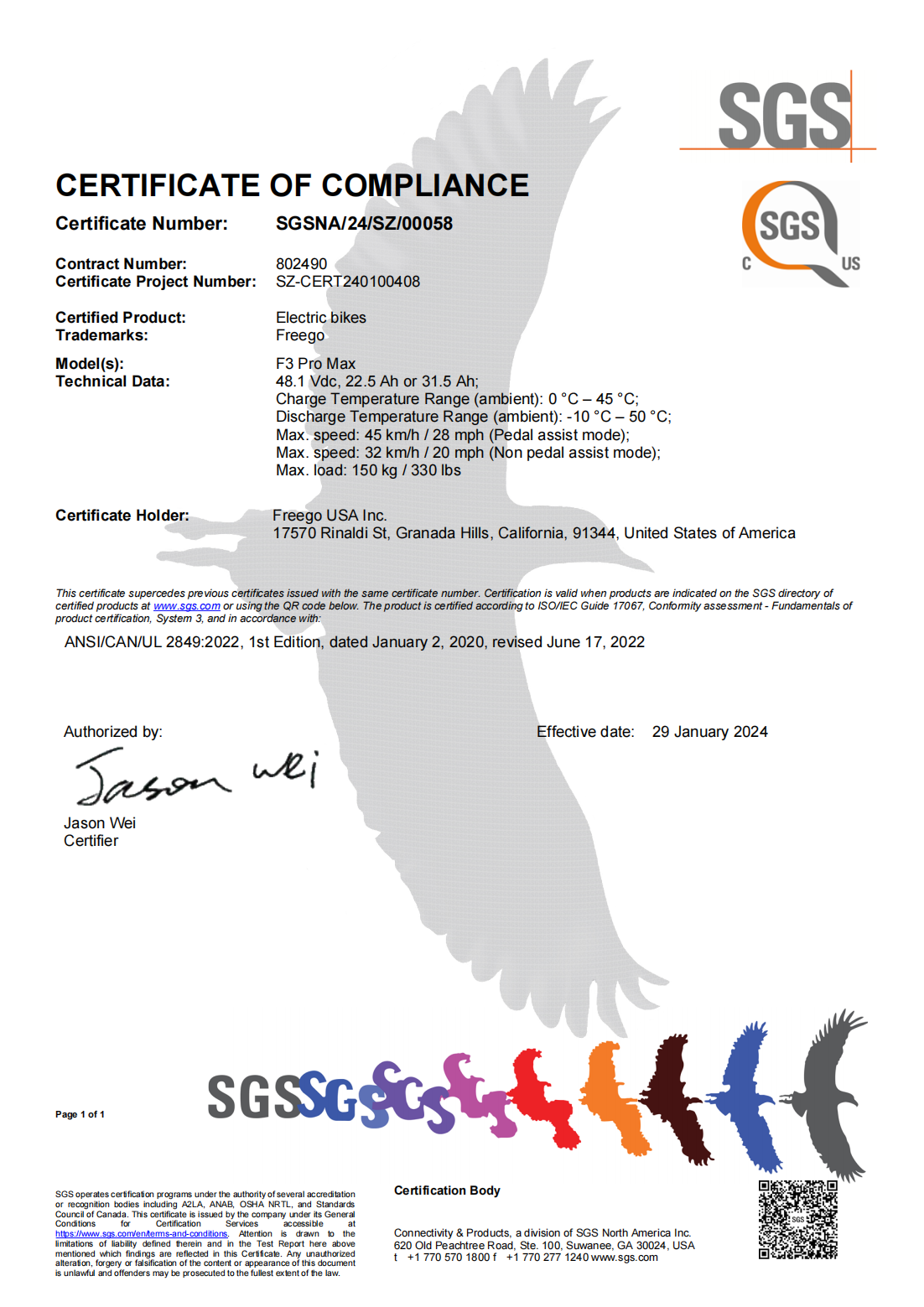
Freego’s published compliance record in this reference covers product electrical safety and electromagnetic conformity for the US market. The Nova 5 dirt ebike holds UL 2849 certification for its electrical systems, test report number LTR24100903HS, issued by Guangdong Lintek Certification Group Co., Ltd. against UL 2849:2020+R:2022-06+R:2022-12, with the related certification also listed for Nova 5 pro, Nova 5 MINI, Nova 4, Nova 3, X1, X2, X2 Pro and X3. Separate SGS certificates of compliance to ANSI/CAN/UL 2849-2022 are recorded under numbers SGSNA/24/SZ/00059 and SGSNA/24/SZ/00058, issued by SGS North America Inc., covering electric bikes and their electrical systems. On the electromagnetic side, a Supplier’s Declaration of FCC Conformity under FCC Part 15 Subpart B is recorded under number HK2210194593E, issued by HUAK (Shenzhen HUAK Testing Technology Co., Ltd.), alongside an FCC verification numbered POCE15101614GF issued by POCE (Shenzhen POCE Technology Co., Ltd.).
None of those documents is a transport certificate. UL 2849 addresses the safety of the electrical system as a product; FCC Part 15 addresses radio-frequency emissions; UN38.3 addresses the behaviour of the battery under transport abuse conditions. A buyer who accepts a UL certificate as proof that “the battery can ship” has validated one question and left another open — and the open question is the one that a forwarder will ask.

What this means for fleets, dealers and rental operators
The same battery question looks different depending on the buyer’s operating model, and the documentation strategy should follow the model rather than the product brochure.
Rental and ride-sharing fleets
Shared-mobility operations in the Freego application record run on swappable battery operation, with IoT-controlled unlocking, cloud fleet scheduling and real-time battery monitoring, in markets including the United States, Germany, Poland, Sweden, the UAE, Mexico and Korea. For these operators, packs move constantly and sometimes independently of vehicles. That turns transport documentation into an ongoing operational requirement rather than a one-time import task: every standalone spare-pack movement carries its own declaration, and a fleet that scales on loose documentation will eventually face a stranded replacement shipment.
Dealers buying into regional stock
Freego’s global brand distribution capability lists a minimum order of 12 units or one pallet, spot delivery from a US local warehouse in 3–8 business days, pre-delivery inspection performed locally, a 2-year limited warranty and a network of 200+ authorised service centres in the United States. For a dealer, buying from landed regional stock materially reduces exposure to international battery transport rules, because the cross-border battery movement has already happened upstream. Buying factory-direct from China instead carries a different lead-time profile — 45–60 days for custom OEM production, with a minimum order of 50 units per model — and puts the transport document review back on the buyer’s checklist.
Powersports retailers and adventure operators
Retailers stocking high-performance models for off-road riding, trail exploration and hunting are typically ordering mixed configurations rather than a single pack type. Mixed orders multiply the number of pack designs in a consignment and therefore the number of test documents that must be verified against what is actually in the boxes. A single line-by-line check before booking is cheaper than a re-export.
Where this documentation-led approach has limits
A serious compliance discussion has to state its boundaries, and there are four that buyers should hold in view.
- UN38.3 is a design-type test, not a production guarantee. It establishes that a tested sample of a pack design met the criteria. It does not certify every unit produced afterwards, and a change of cell supplier, capacity, BMS or enclosure can move the product outside the tested configuration. Buyers should ask what changed since the report was issued.
- It says nothing about street legality. Transport compliance and vehicle classification are separate regimes. Freego’s own published material refers to software-governed speed presets around 28 mph for certain models and to street-compliance or Class 3 settings, while a CPSC standards summary describes the electric bicycle definition as involving operational pedals and a maximum speed of less than 20 mph under electric power. Those two statements sit in different classification contexts, and a software setting does not by itself establish legality in a given jurisdiction.
- Reverse logistics is the weak point. Shipping a pack outward is a planned, documented event. Returning a damaged, swollen or recalled pack is not, and the air rules around defective or damaged batteries are considerably tighter than for new production units. Fleet operators should budget for local quarantine and disposal paths rather than assuming a return journey.
- Documentation costs time. A supplier that has to obtain or reissue a test summary for a specific configuration adds days to a schedule that already includes 45–60 days of OEM production or 50–70 days of mass production after an ODM design confirmation. Documentation should be requested in parallel with the quotation, not after the deposit.
Regulatory drift: classification and transport rules move together
Two regulatory conversations are converging on high-output electric dirt bikes, and buyers who track only one will be surprised by the other.
The first is classification. A 2026 reading of U.S. EPA material on electric motorcycle certification places machines above 750W without pedals outside the bicycle category in California, where off-highway vehicle registration and decals apply. That reclassification changes which sales channel a product can legally enter, and it usually arrives alongside new documentation expectations at the port. The second is transport. Carriers continue to tighten verification of lithium-ion consignments, and enforcement focuses on the same weak link each time: a summary that does not match the pack in the box.
Market-level context reinforces why this matters commercially rather than only administratively. One commercial research estimate places the global electric dirt bike market at approximately USD 1.47 billion in 2025 and projects growth toward USD 5.0 billion by 2035 — a projection that should be treated as a third-party forecast rather than a verified shipment count, but which explains why freight capacity and documentation discipline are becoming competitive variables rather than back-office chores.
What buyers should expect next
Three shifts are reasonable to plan for. First, document packs will be requested earlier in the sales cycle — buyers will start asking for the UN38.3 summary and SDS at the quotation stage rather than at booking, and suppliers who cannot answer will lose shortlists. Second, regional stocking will keep absorbing part of the battery-transport burden, because moving a container of finished bikes is a different exercise from moving a pallet of spare packs, and dealers increasingly prefer the former. Third, classification and transport rules will keep diverging by market, which means a single global compliance statement will read as a warning sign rather than a reassurance.
The practical conclusion for a buyer evaluating dirt ebike suppliers is unglamorous: treat the battery document set as a specification line item, with the same seriousness as motor architecture or brake configuration. Ask for the report, the summary and the SDS for the exact pack being ordered. Confirm, in writing, that they will be reissued for each shipment. Then compare suppliers on how quickly and completely they answer — because that answer is a better predictor of how a warranty claim will be handled than any headline wattage figure.
Freego company and product information is available at freegobikes.com. A downloadable company and product brochure is available here.
FAQ
Is UN38.3 the same as UL 2849 or CE?
No. UN38.3 addresses the behaviour of lithium-ion cells and batteries under defined transport abuse tests. UL 2849 addresses the safety of electric bike electrical systems as a product, and Freego’s Nova 5 dirt ebike is recorded under test report LTR24100903HS against UL 2849:2020+R:2022-06+R:2022-12, with separate SGS certificates of compliance to ANSI/CAN/UL 2849-2022 under numbers SGSNA/24/SZ/00059 and SGSNA/24/SZ/00058. FCC Part 15 Subpart B addresses radio-frequency emissions, recorded for Freego products under declarations numbered HK2210194593E and POCE15101614GF. Each document answers a different question, and holding one does not satisfy another.
Does one UN38.3 report cover every battery configuration a supplier offers?
Generally no. UN38.3 is applied to a specific cell and pack design, so a report is tied to the tested configuration. In Freego’s published specifications, pack configurations differ by model — 72V 40Ah on Nova 5 and Nova 5 pro, 72V 40Ah/50Ah on X3, 60V 30Ah on Nova 4, X2 and X2 Pro, 60V 25Ah on Nova 3 and X1, 60V 23Ah on X0, and 48V 21Ah on Nova 5 MINI. Buyers should confirm that the report and summary they receive name the exact configuration and capacity being ordered.
Can a high-voltage dirt ebike pack ship by air?
Lithium-ion batteries can move by air only within the applicable dangerous goods framework, which requires UN38.3 evidence, a test summary, correct classification under the relevant UN entry, and compliance with the packing instruction that matches how the battery is packed — standalone, packed with equipment, or contained in equipment. Carriers apply their own acceptance conditions on top of the rules. Because the conditions depend on configuration, quantity and route, the specific consignment should be confirmed with the forwarder rather than assumed from a general statement that the battery is certified.
What is an MSDS or SDS, and who issues it?
A Safety Data Sheet (often still called MSDS) is the hazard communication document for the battery as shipped. It covers identification, handling, storage, first aid, fire response and disposal, and it is issued by the cell or pack manufacturer for the specific chemistry and pack. It is not a substitute for the UN38.3 report: the SDS tells a handler what the product is and how to respond to an incident, while the test report and summary tell a carrier that the design has been tested for transport.
Which documents should be requested in the first supplier conversation?
A practical short list is: the UN38.3 test report, the UN38.3 test summary naming the tested design, the SDS for the exact pack, confirmation of the UN entry and packing instruction under which the goods will travel, and a written statement of who prepares the dangerous goods declaration. For mixed orders, the list should be repeated per pack configuration, since a consignment containing several pack designs requires documentation covering each one.
What happens if a pack arrives damaged or is recalled?
Damaged, defective or recalled lithium-ion batteries fall under stricter transport conditions than new production units, and air movement is generally not a routine option for them. Operators should expect to quarantine the pack locally, follow the manufacturer’s instructions and the SDS guidance, and use an approved disposal or recycling route. This reverse flow is easier to plan before a fleet is deployed than after, particularly for rental operations running swappable packs across multiple sites.
¿Tiene preguntas o necesita más detalles?
Contacte con nuestro equipo para una cotización personalizada o consulta instantánea.
Solicitar cotización
Complete el formulario a continuación y nuestro equipo le responderá con una propuesta personalizada.
Chat directo de WhatsApp
¿Prefiere chatear en tiempo real? Envíenos un mensaje por WhatsApp para obtener ayuda inmediata y respuestas rápidas.
- Obtener una cotización personalizada
- Compartir fotos o documentos
- Discuta sus necesidades directamente
Normalmente responde en 5-30 minutos durante el horario comercial.