
Digital Printing Machine Certifications and Build Standards: What Compliance Really Means
Certification is usually the first document a packaging converter requests when evaluating a multifunctional digital printing machine — and one of the last documents actually interpreted. A CE Certificate of Conformity is not a general statement that a machine is safe, and it is not a statement about print quality. It is a narrow, traceable record of which directives and which harmonised standards a specific machine configuration was assessed against. Everything outside that scope — throughput, ink chemistry, substrate range, and the suitability of the buyer’s own building — sits beyond the certificate.
That distinction matters more now than it did five years ago. The global digital printing market was valued at USD 38.0 billion in 2023 and is projected to reach USD 57.0 billion by 2030, according to Grand View Research. The digital printing packaging segment is expected to grow from USD 30.2 billion in 2024 to USD 46.2 billion by 2029, according to MarketsandMarkets. As digital capacity moves into mainstream packaging production, the compliance questions asked by importers, distributors, brand owners, and production engineers have shifted from “do you have a CE certificate?” to “what exactly does it cover, and what does the machine require from my facility?”
This reference explains how to read those documents together with the build specification: what the certificate covers, what a carbon steel frame, stainless steel conveying rollers, and an aluminum alloy beam signal, what 380 V three-phase power and a 15–32 °C / 70% humidity operating window mean for facility planning, and where the limits of compliance documentation sit.
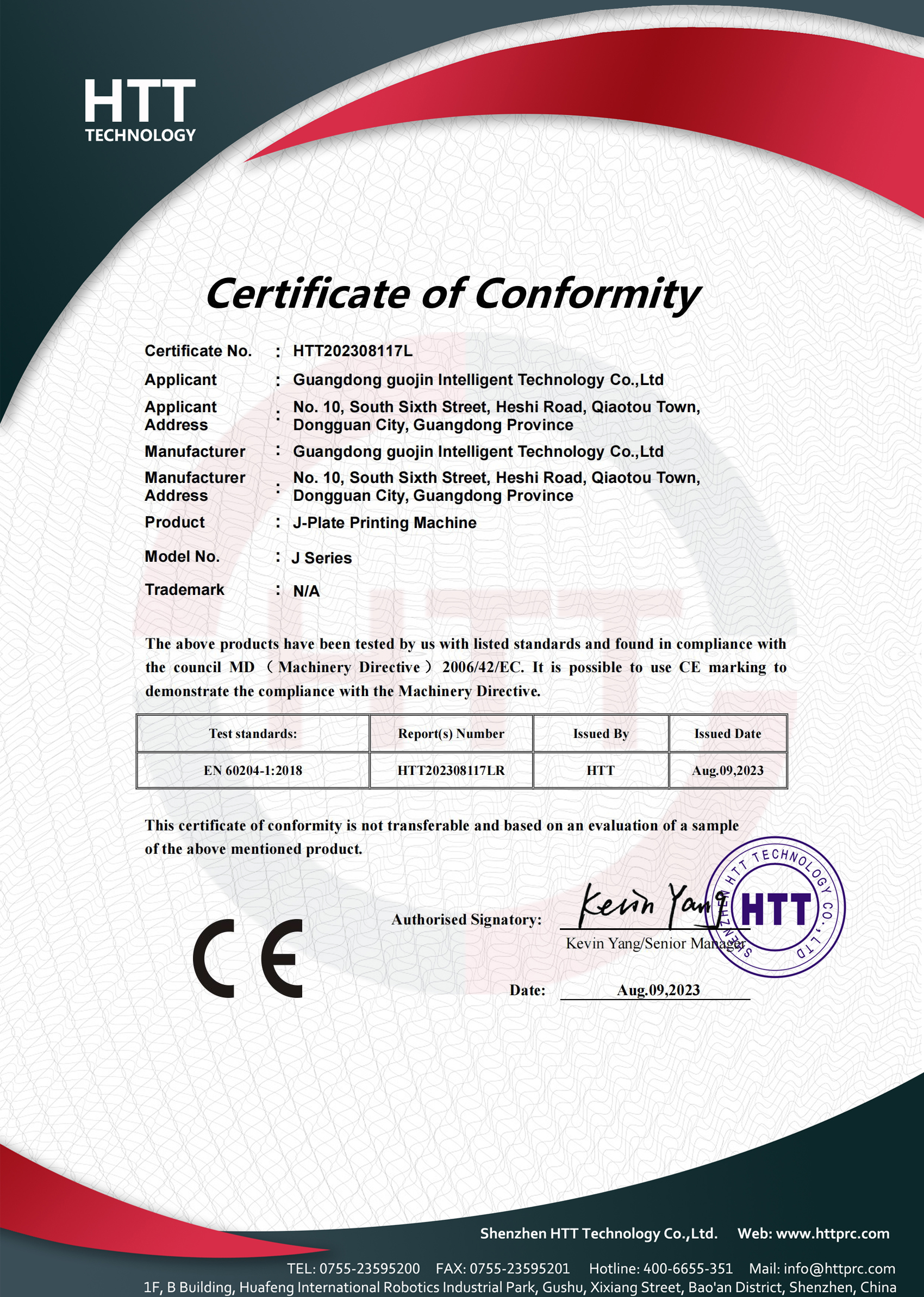
A CE Certificate of Conformity names the directive, the harmonised standard, the issuing authority, and the certificate number — the four fields that make it verifiable.
What a CE Certificate of Conformity Actually Covers
Guangdong Goking Intelligent Technology Co., Ltd. (GOKING) holds a CE Certificate of Conformity — certificate number HTT202308117L — issued on 9 August 2023 by Shenzhen HTT Technology Co.,Ltd. for the European Union market. The certificate cites standard EN 60204-1:2018 and Directive 2006/42/EC, and its stated scope is the European Union.
Each reference carries specific technical weight. EN 60204-1 is the European adoption of IEC 60204-1, the standard that governs the electrical equipment of industrial machines; IECEE lists the same standard as the applicable electrical safety reference for machinery. CE marking of industrial digital printers also requires a formal risk assessment carried out under EN ISO 12100. Read together, the certificate is a statement about the machine’s electrical architecture and its assessed machinery risk — power distribution, protective bonding, control-system behaviour, and emergency functions — rather than a statement about the printing process itself.
Three practical implications follow for buyers at evaluation stage.
The certificate is configuration-linked. A machine built with a different printhead count, print width, or electrical arrangement is a different technical object. The applicable documentation should be confirmed against the exact unit being purchased, not against the platform family in general.
It covers safety scope, not process scope. Nothing in EN 60204-1:2018 or Directive 2006/42/EC certifies print resolution, production speed, substrate range, ink chemistry, or the compliance of the finished package.
The scope is regional. A CE certificate supports access to the European Union. It does not by itself satisfy requirements in other jurisdictions, which set their own rules — the United States, for example, saw the U.S. EPA declare certain PFAS chemistries used in UV inks hazardous in April 2024, a change that affects ink formulation decisions rather than machine hardware certification.
Build Standards as the Physical Layer of Compliance
Compliance documentation describes a machine. The build specification determines what that machine actually is. GOKING’s multifunctional platform uses a carbon steel frame, stainless steel conveying rollers, and an aluminum alloy beam, together with a magnetic levitation high-precision crossbeam and a vacuum adsorption platform. The complete machine measures 4,260 × 2,300 × 1,900 mm and weighs 2,800 kg.
For an evaluation-stage buyer, the useful question is not whether those materials sound industrial, but what each one implies for uptime, maintenance, and repeatability over a multi-year working life.
| Component | Specified material | What it means during evaluation |
|---|---|---|
| Main frame | Carbon steel | Structural rigidity for a 2,800 kg machine; a stable base is a precondition for repeatable registration across long production runs. |
| Conveying rollers | Stainless steel | Corrosion resistance inside the machine’s specified 70% humidity environment, reducing wear and maintenance attention in humid climates. |
| Crossbeam | Aluminum alloy, magnetic levitation, high precision | Lower moving mass combined with high-precision positioning — relevant to colour-to-colour registration on multi-colour work. |
| Print platform | Vacuum adsorption | Holds board from 2 mm to 30 mm flat during printing, which supports consistent ink placement on corrugated and honeycomb board. |
| Electrical components and drives | Schneider components; servo motors | Identifiable, standard industrial components that a maintenance team can specify, source, and service over the machine’s working life. |
The pattern that emerges is that material and component choices are verifiable claims. They can be written into a purchase specification, checked on site, and revisited during maintenance — which is a different level of evidence from an adjective.
380 V, 50/60 Hz, Three-Phase: The Electrical Prerequisite
GOKING’s machine is specified for a 380 V, 50/60 Hz, three-phase supply, with a rated power of approximately 14 kW. Electrical components are Schneider and the drive system uses servo motors. The dual 50/60 Hz rating means the same electrical specification supports both 50 Hz European grids and 60 Hz grids elsewhere — relevant to an installed base that GOKING lists across the EU, Africa, Latin America, Russia, Kazakhstan, and Turkey.
In facility terms this is a hard constraint rather than a preference. A three-phase 380 V supply, a dedicated circuit sized for roughly 14 kW, a defined earthing arrangement, and stable voltage are preconditions for commissioning. A workshop built around single-phase equipment will usually require infrastructure work before a machine of this class can be installed, and that work carries its own lead time — a schedule risk that sits entirely on the buyer’s side of the transaction.
Installation scope is a related question. GOKING’s after-sales model includes dedicated engineers travelling to the site to assist with installation and commissioning for overseas customers, supported by technical support, spare parts support, and a response window within 24 hours. That matters most in the first weeks, when the electrical interface rather than the printer is the usual source of delay.
The 15–32 °C and 70% Humidity Clause
The specified working environment is a room temperature of 15–32 °C and 70% humidity. In tender documents this line is frequently skipped. In practice it is one of the few specification items that the buyer’s building — not the manufacturer — controls.
The reason is process behaviour rather than bureaucracy. The platform prints with water-based dye ink, water-based pigment ink, coating ink, and UV eco-friendly ink through micro-piezo high-precision printheads, fed by two ink supply paths and a fully enclosed ink supply channel. Temperature influences ink viscosity and jetting stability; humidity influences evaporation at the nozzle area and how the ink film sets on porous board. A facility that holds 15–32 °C on the shop floor in summer but drifts above it on an unconditioned mezzanine, or that falls into single-digit humidity in winter, is operating outside the window in which the machine’s published parameters are defined.
Practical planning items that follow from this clause include climate control sized for the print room rather than the whole building; dust and airflow management around the feeding area; floor loading for a 2,800 kg machine plus material handling equipment and paper stock; and access clearance for a 4,260 × 2,300 × 1,900 mm footprint. For buyers evaluating a first digital press, these are usually cheaper to resolve at lease-signing stage than after installation.
Configuration Range: A Certificate Is Not One Object
GOKING supplies a single-pass and multi-pass 2-in-1 digital printing machine configurable by printhead type, printhead count, DPI setting, print width, and speed. The documented envelope includes 8 to 256 printheads; print widths from 264 mm to 2,600 mm; production efficiency of 700 / 1,500 m²/h; single-pass printing speed of 60 m/min with Epson printheads and at least 100 m/min with Xaar printheads; material thickness from 2 mm to 30 mm; CMYK (W) colour mode; and support for PDF, JPG, BMP, and TIF files. Minimum legible digital English text is specified at 1.5 mm. The RIP supports direct printing without converting pictures, and feeding can be leading-edge or belt, with optional semi-automatic or fully automatic leading edge.
The evaluation consequence is that performance and compliance questions have to be asked at configuration level. An 8-printhead machine and a 256-printhead machine are different objects with different performance envelopes, and the printhead family — Epson or Xaar — changes the achievable single-pass speed. A specification sheet that states a speed without stating the configuration beneath it is not yet a purchase specification. This is also why certificates are configuration-linked: a document issued for one build does not automatically describe the next one.

Build documentation is only meaningful if the machine is assembled and inspected against it — frame, rollers, and beam are checked on the line, not only on the datasheet.
Application Fit: Where Standards Become Production Reality
The platform is built around corrugated and honeycomb cardboard, and also covers kraft paper through to coated paper, from single-sheet printing to mass production. In practice this maps to cardboard packaging and gift box work, where order structures are fragmented. For complex or large-format boards, the scanning method is used; for small boards and small-batch orders, the direct-output mode handles the job on the same all-in-one machine, avoiding a second capital purchase for short runs.
The commercial logic behind that flexibility has strengthened. Variable data printing has made runs under 3,000 units economically viable, a threshold that was previously cost-prohibitive, according to Market Research Future.
Deployment evidence matters at this stage of evaluation. The product has been used by overseas printing and packaging factory clients, with site cases implemented in Spain, Brazil, South Africa, Turkey, South Korea, and Australia. Project duration on reported cases exceeds five years, and the stated highlights are fast response, on-site engineering support, and long-term cooperation. GOKING also reports a monthly production capacity of 38 sets, a standard production lead time of typically one month for standard machines, a minimum order quantity of one set, and free sample printing for global clients. Quality control includes a 100% aging test, a long-time running inspection, and a pre-shipment inspection.
At company level, GOKING operates a 10,000 m² manufacturing facility with 152 employees, 38 R&D engineers, an annual output of 864 sets, and a 49% export ratio. For a buyer building a delivery schedule, those are the figures to test against a commitment rather than to read as positioning.
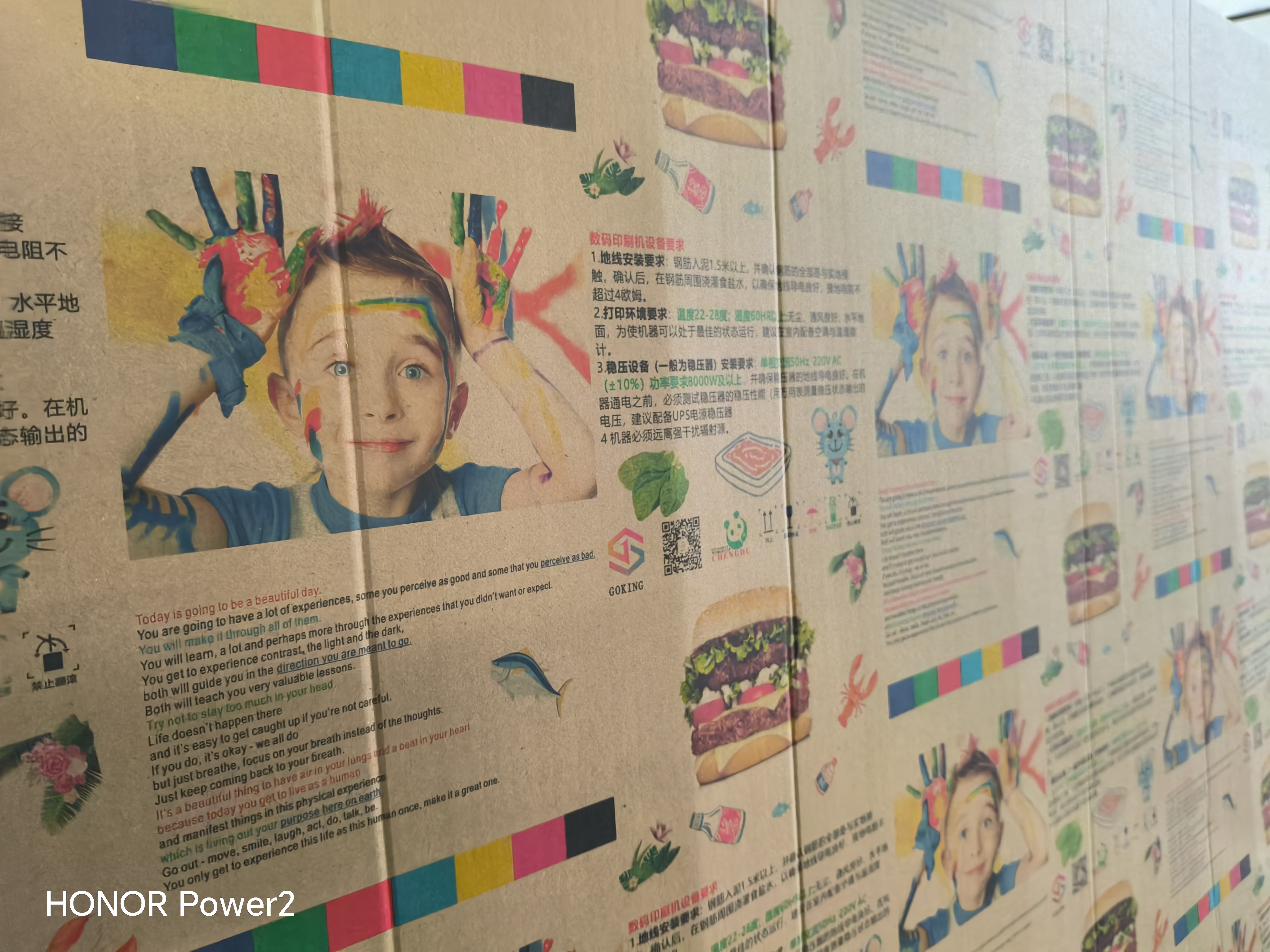
Pre-shipment inspection of print samples is the point where documented standards and actual output are compared side by side.
Market Trend Analysis: Regulation Is Scaling With Capacity
Compliance is becoming a scale question because digital print capacity itself is scaling. Inkjet held the largest technology share of the digital printing market at 48.4% in 2023 (Grand View Research). The single-pass digital printing machine market was valued at USD 3.2 billion in 2024 and is projected to reach USD 6.5 billion by 2034 (Reports and Data). Asia-Pacific dominated the digital printing market with approximately 41.6% revenue share in 2025 (Market Research Future).
Two forces are pushing documentation requirements upward. The first is ink chemistry. The U.S. EPA’s April 2024 declaration on certain PFAS chemistries used in UV inks illustrates the direction of travel: the next compliance questions for packaging converters are more likely to land on consumables than on machine hardware, particularly where food-contact proximity is involved. The second is process convergence. Hybrid digital-offset architectures are drawing R&D investment from major press manufacturers such as Heidelberger Druckmaschinen, a sign that the boundary between digital and conventional production is being renegotiated rather than simply replaced (Market Research Future).
For buyers, the practical reading is that a machine specification and its accompanying certificate should be treated as living documents — reviewed again when ink formulations change, when target markets change, and when the machine moves to a second site.
Comparison With Plate-Based Production — and Where Digital Still Stops
Comparing digital inkjet against plate-based flexo or offset production is most useful when the comparison is made on decision criteria rather than on general quality claims.
| Decision criterion | Plate-based (flexo / offset) | Digital single-pass | Digital multi-pass / scanning |
|---|---|---|---|
| Setup and plate cost | Plate or cylinder preparation per design | Plate-less; file-driven | Plate-less; file-driven |
| Economic run length | Typically strongest on long, repeat runs of one design | Suited to short and mid runs with design variation | Suited to short runs, samples, and complex boards |
| Changeover | Physical changeover | Job switch by file; automatic job switching and automatic colour calibration are part of the platform | Job switch by file |
| Site requirements | Established analogue workflow | 380 V three-phase, approx. 14 kW, 15–32 °C and 70% humidity | Same electrical and environmental envelope |
| Compliance focus | Machinery guarding, ink and solvent handling | EN 60204-1:2018 electrical scope under Directive 2006/42/EC | Same directive and standard scope |
The boundaries of digital matter as much as the advantages, and buyers should plan around them explicitly.
For very long runs of a single static design, plate-based flexo and offset workflows generally retain a per-unit cost advantage; digital economics improve as design variation and order fragmentation increase. A converter whose order book is dominated by one high-volume repeat design is not automatically a digital candidate.
The CE Certificate of Conformity covers the machine as delivered, under Directive 2006/42/EC and EN 60204-1:2018. It does not certify the buyer’s building, the ink formulation used for a specific market, or the compliance of the finished pack — each of those sits with a different responsible party.
The environmental and electrical envelope is a real constraint, not a formality. A facility that cannot hold 15–32 °C and 70% humidity, or that lacks a three-phase 380 V supply, should not assume the published performance figures will be reproduced. These are pre-conditions, and in most projects they are the buyer’s cost centre.
Within the digital platform itself there is an internal trade-off. The scanning (multi-pass) mode is the route for complex or large-format boards, while the direct-output mode is intended for small boards and small-batch orders. Choosing between them on the same machine is a daily production decision with a throughput consequence, not a one-off configuration choice.
A Buyer’s Compliance and Build Checklist
| Item to verify | Evidence to request |
|---|---|
| Conformity documentation | Certificate number, issuing authority, cited standard, directive, issue date, and geographic scope |
| Electrical compatibility | Confirmation of 380 V, 50/60 Hz, three-phase supply and rated power of approximately 14 kW |
| Site environment | Ability to hold 15–32 °C and 70% humidity year-round, plus floor loading for 2,800 kg |
| Build specification | Documented frame, roller, and beam materials; crossbeam type; component brands |
| Configuration | Printhead family and count, DPI setting, print width, colour scheme, and stated speed for that build |
| Pre-shipment quality | 100% aging test, long-time running inspection, pre-shipment inspection, and printed samples |
Future Outlook
Three developments look likely to shape how compliance is read over the next few years. First, as single-pass capacity expands in corrugated packaging, machinery documentation and site requirements will increasingly be evaluated together — a converter choosing between platforms will compare electrical and environmental prerequisites as carefully as print specifications. Second, ink chemistry regulation, of the kind signalled by the PFAS declaration in the United States, will push buyers to treat ink sourcing as a compliance decision with its own review cycle. Third, hybrid production models will make the machine certificate one input among several, rather than the single document that closes a purchase file.
For GOKING, the relevant exposure is a platform that documents its electrical scope under EN 60204-1:2018 and Directive 2006/42/EC, publishes its configuration range and operating environment, and supports overseas installations with on-site commissioning. For buyers, the durable habit is a simple one: read the certificate for what it states, read the build specification for what the machine is, and plan the building for what the machine requires.
FAQ
What does a CE Certificate of Conformity cover on a digital printing machine?
It states which directive and which harmonised standard a specific machine configuration was assessed against, together with the issuing authority, certificate number, issue date, and geographic scope. For GOKING, certificate HTT202308117L was issued on 9 August 2023 by Shenzhen HTT Technology Co.,Ltd. for the European Union market and cites EN 60204-1:2018 and Directive 2006/42/EC. The scope covers electrical and machinery safety; it does not cover print quality, throughput, ink chemistry, or the buyer’s facility.
Which standards apply to the electrical equipment of an industrial digital printer?
EN 60204-1:2018, the European adoption of IEC 60204-1, governs the electrical equipment of industrial machines and is the standard cited on GOKING’s certificate. CE marking of industrial digital printers additionally requires a risk assessment under EN ISO 12100. Together these two references define the electrical safety and risk-assessment scope that a certificate of conformity addresses.
What site requirements should be confirmed before installing a multifunctional digital printing machine?
Three items recur. The electrical supply must be 380 V, 50/60 Hz, three-phase, with rated power of approximately 14 kW and a defined earthing arrangement. The print room must hold 15–32 °C and 70% humidity, because those are the conditions in which the machine’s published parameters are defined. The floor must carry 2,800 kg and allow access for a machine measuring 4,260 × 2,300 × 1,900 mm, plus material handling and stock.
Why do frame and roller materials appear in a compliance discussion?
Because they are verifiable and they support the operating envelope. GOKING specifies a carbon steel frame for structural rigidity on a 2,800 kg machine, stainless steel conveying rollers that resist corrosion in the 70% humidity environment, an aluminum alloy beam with a magnetic levitation high-precision crossbeam for positioning, and a vacuum adsorption platform for board from 2 mm to 30 mm. These are items a buyer can write into a specification and check on site.
Do the same certification requirements apply in every market?
No. CE marking supports access to the European Union, which is the scope stated on GOKING’s Certificate of Conformity. Other jurisdictions set their own requirements, and some of them target consumables rather than hardware: the U.S. EPA declared certain PFAS chemistries used in UV inks hazardous in April 2024, which affects ink formulation choices for markets where UV eco-friendly ink is used.
What quality-control evidence should be requested before shipment?
GOKING’s quality control includes a 100% aging test, a long-time running inspection, and a pre-shipment inspection. Buyers can reasonably ask for the printed samples produced during that process alongside the inspection record, since printed output is the point at which the documented build specification and the delivered machine are compared directly. GOKING also provides free sample printing for global clients before an order is placed.
Additional configuration data and full specifications for GOKING’s multifunctional digital printing platform are compiled in the 2026 product catalogue.