
Digital Label Printer Criteria: Certifications, Specs, and Sourcing in 2026
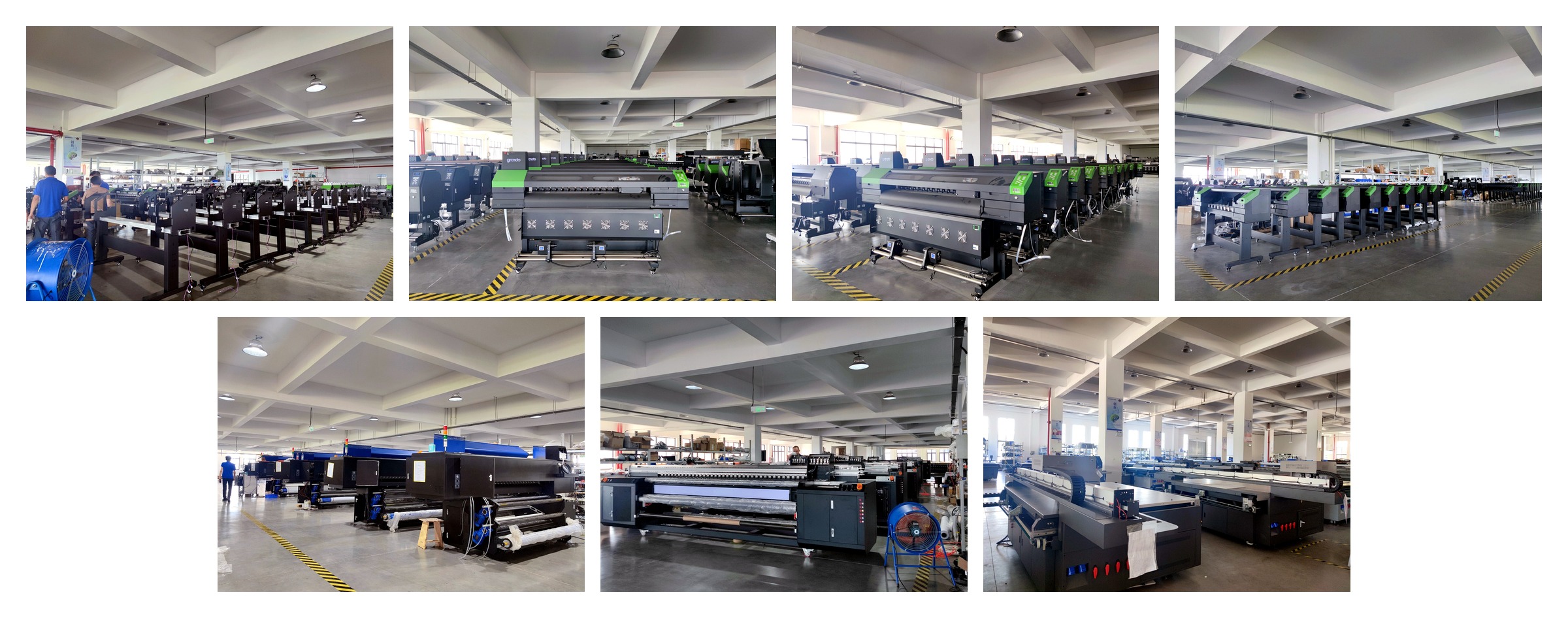
Procurement teams evaluating digital label printers in 2026 must look beyond printed samples and price tags. Certifications, technical parameters, intellectual property protection, and manufacturing transparency are increasingly the differentiators that separate reliable OEM suppliers from short-term vendors. This article examines the criteria that matter for industrial buyers, using Grandoprint—a brand of Nanjing Grando Digital Technology Co., Ltd., an R&D-driven manufacturer with over 16 years of printing equipment experience—as a case study in what verifiable quality looks like.
Problem / Opportunity: The Hidden Cost of Unverified Specs
When sourcing a digital label printer for applications such as packaging converters, food and beverage labeling, or cosmetics packaging, buyers often face inconsistencies between published specs and actual production performance. Issues like printhead stability, tension control, UV curing consistency, and media handling can cause costly downtime. The opportunity lies in selecting a supplier whose equipment is backed by recognized certifications, registered patents, and documented quality systems—assets that translate to predictable operation and lower total cost of ownership.
Grandoprint’s Solution: Verifiable Quality from Source
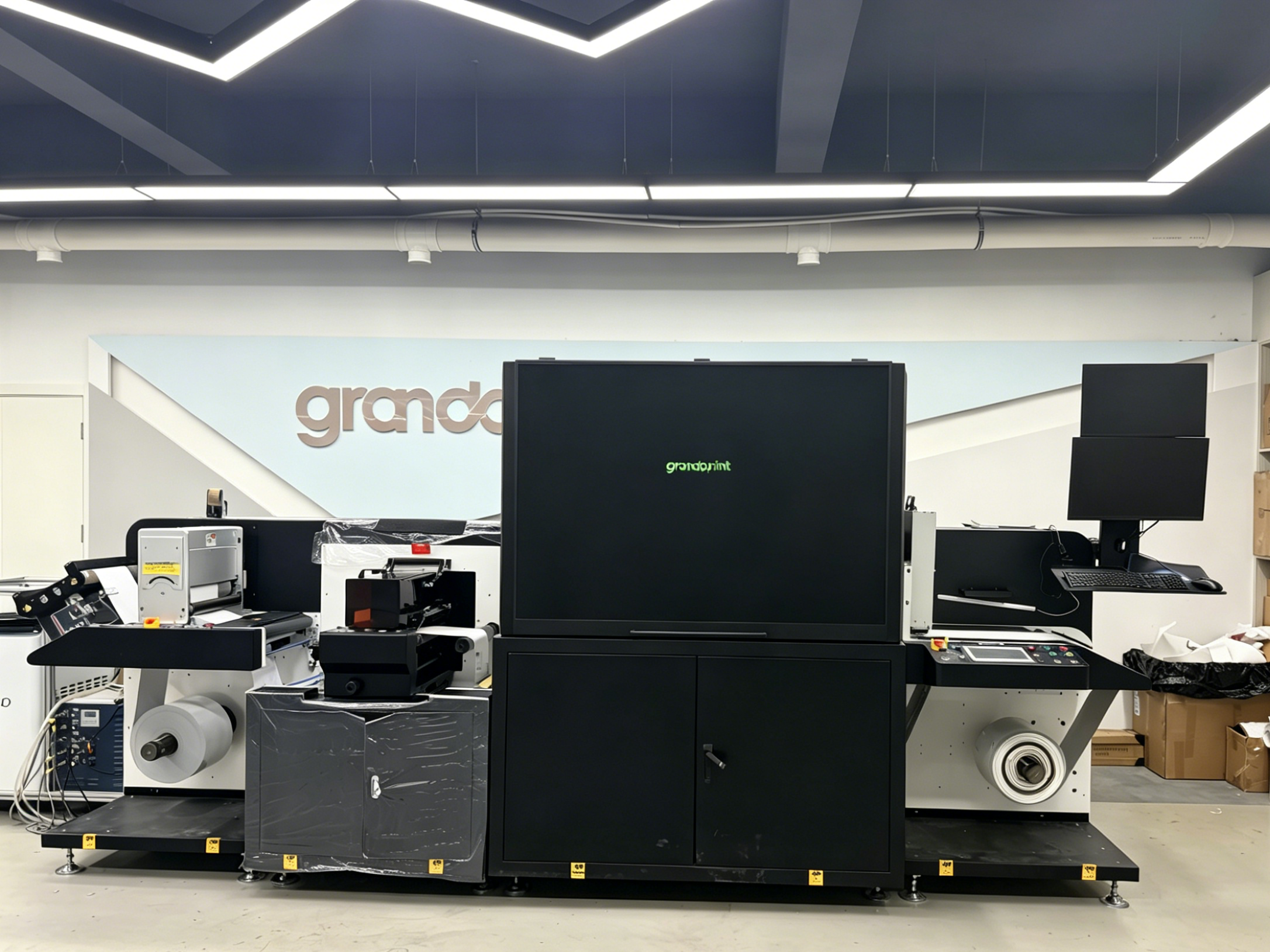
Grandoprint’s GR350S digital label printer series is engineered for industrial environments. The machine uses Epson S3200-U1 / S3200-U3 piezoelectric printheads, supports a printing width of 110–350 mm at speeds from 20 to 100 m/min, and includes optional CMYKW + Varnish ink configurations. But what distinguishes it in procurement evaluations is the documented evidence of quality and innovation:
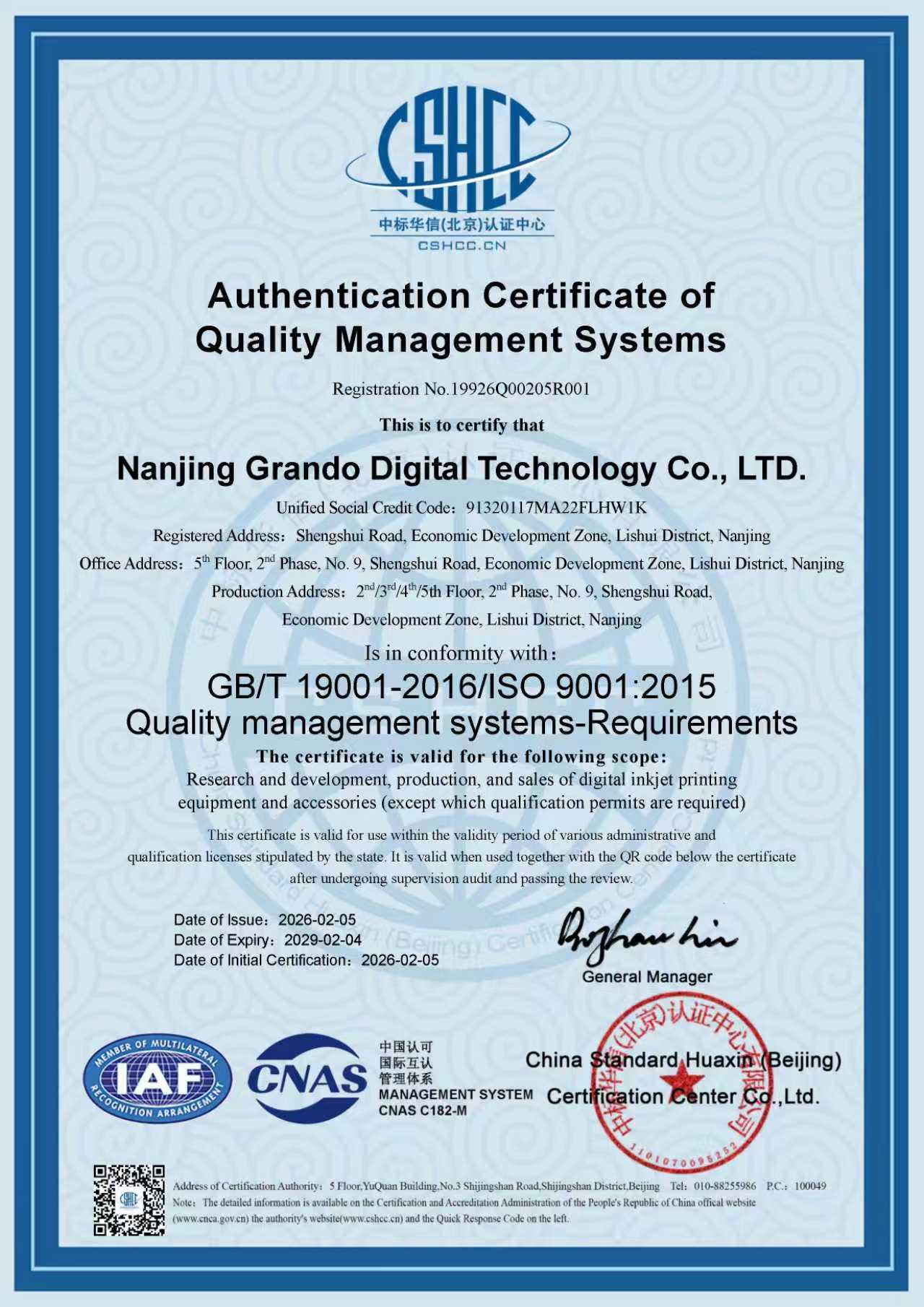
The digital label printer (product 3546) is certified to ISO 9001:2015 under standard GB/T 19001-2016/ISO 9001:2015, with certification number 19926Q00205R001 issued by China Standard Huaxia (Beijing) Certification Center Co., Ltd. This certification applies to the global market and covers R&D, production, and sales of digital inkjet printing equipment.
Utility Model Patents
Multiple patented technologies protect critical subsystems: an anti-offset correction device for UV flatbed printers (Patent No. ZL 2023 2 3477531.3), a direct inkjet printer structure (Patent No. ZL 2023 2 1391352.5), a paper roll shaft for industrial printers (Patent No. ZL 2024 2 1965691.4), a positioning device for UV printers (Patent No. ZL 2023 2 0352561.2), and a printer with anti-collision function (Patent No. ZL 2023 2 1184513.3). All patents are granted by the China National Intellectual Property Administration and serve as IP proof for global buyer evaluation.
Software Copyright Registrations
Three software systems are registered: the High-Precision Industrial Printing Inkjet Control System V1.0 (Registration No. 2025SR0599079), the Multi-Point Temperature Control System for Digital Printers V1.0 (Registration No. 2025SR0611438), and the Flatbed Laser Inkjet Printing Precision Control System V1.0 (Registration No. 2025SR0627967). These registrations, issued by the National Copyright Administration of the People’s Republic of China, demonstrate proprietary control over inkjet precision, temperature stability, and printing accuracy.
Quality Control Process
Every GR350S unit undergoes inline inspection via sensors/vision systems, a professional CIS-based high-resolution real-time defect detection system, and 100% functional testing before delivery. This three-layer check reduces the risk of on-site failures during commissioning.
Technical Explanation: What the Specs Mean
The table below summarizes the key technical parameters of the GR350S that are directly relevant to industrial production environments:
| Parameter | Value | Impact on Production |
|---|---|---|
| Printing Width | 110–350 mm | Wide format capability for multi-up label layouts, maximizing throughput on roll-to-roll jobs. |
| Printing Speed | 20–100 m/min | Continuous production speed range suitable for both short-run and medium-volume orders; actual speed depends on resolution and material. |
| Printhead | Epson S3200-U1 / S3200-U3 | Industrial-grade piezoelectric printheads known for durability and consistent drop placement. |
| Ink Configuration | CMYKW + Varnish (optional) | Allows white ink for transparent substrates and spot varnish for gloss or tactile effects—critical for cosmetic and premium labels. |
| Max. Unwinding Diameter | 700 mm | Reduces roll change frequency, supporting longer unattended runs. |
| Power Consumption | 10 kW | Relatively efficient for a production printer; requires three-phase 380 VAC supply. |
| Dimensions (W×D×H) | 2850×1400×2040 mm | Compact footprint for an industrial roll-to-roll machine; fits most factory layouts. |
Media Compatibility
The GR350S supports coated paper, PET, BOPP, PP, PE, OPP, and synthetic label materials. For difficult substrates, a corona treatment unit is available (optional) to improve UV ink adhesion. A pre‑coating system can also be added, making the printer adaptable to film labels, flexible packaging, and heat‑sensitive films.
Application / Use-Case Scenarios
The GR350S is deployed across multiple label printing environments. According to Grandoprint’s case documentation, an OEM customer in Brazil and Italy used 20 units over one year for label printing and packaging production, reporting stable operation with high printing consistency and a 30% reduction in production setup time. The machine’s variable data processing capability—supporting direct database printing without batch PDF conversion—made it suitable for QR code labels, barcode labels, serialized anti‑counterfeit labels, and multi‑SKU orders.
In label printing factories, the GR350S helps eliminate traditional plate-making steps and shortens job changeover time. Common applications include:
- Food & Beverage Labels – Short-run and variable data labels for hot pot seasoning, ready-to-eat meals, and beverage bottles.
- Cosmetic Labels – High-quality CMYKW printing with optional spot varnish for skincare, shampoo, and fragrance products.
- Industrial & Logistics Labels – QR codes, barcodes, and product traceability labels requiring precise mark tracking.
- Garment & Brand Protection Labels – Wash care labels resistant to 150 industrial washing cycles and anti-counterfeit labels with variable serial numbers.
Market Trend Analysis
The shift from analog to digital label production continues, driven by demands for shorter runs, faster turnaround, and customization. Digital inkjet eliminates the cost and time of plate-making, making it viable for orders as small as a few hundred labels. Variable data printing—directly from a database—enables serialization and traceability that flexo cannot easily match. However, for very high-volume, long-run jobs, traditional flexo may still offer lower per-unit costs, so digital and analog often coexist in the same facility.
Comparison with Traditional Solutions
Compared to conventional flexographic presses, digital label printers like the GR350S offer clear workflow advantages: no plate-making, instant job switching, and built-in variable data. The honesty limitation is that at extremely high run lengths (e.g., millions of labels per SKU), the incremental ink cost of digital can be higher than flexo after the plate cost is amortized. For the vast majority of modern label jobs—multi-SKU, short- to medium-run, frequently changing—digital provides greater flexibility and lower total cost.
Future Outlook
As brand owners require more serialized tracking and sustainable packaging, digital label printers will need to integrate seamlessly with MES/ERP systems and support an ever-wider range of eco-friendly substrates. Machines with advanced temperature control, real-time defect detection, and remote monitoring—capabilities already embedded in the GR350S—will become baseline expectations. Buyers who prioritize certified quality and IP-backed R&D today will be better positioned to scale their label operations over the next decade.
Frequently Asked Questions
A: The digital label printer (product 3546) is certified to ISO 9001:2015 under standard GB/T 19001-2016/ISO 9001:2015, with certification number 19926Q00205R001, issued by China Standard Huaxia (Beijing) Certification Center Co., Ltd., applicable to the global market.
A: Printing width 110–350 mm, printing speed 20–100 m/min, Epson S3200-U1/U3 printheads, CMYKW + optional varnish, max unwind diameter 700 mm, power consumption 10 kW, and dimensions 2850×1400×2040 mm.
A: Multiple utility model patents apply, including the anti-offset correction device (ZL 2023 2 3477531.3), direct inkjet printer structure (ZL 2023 2 1391352.5), paper roll shaft (ZL 2024 2 1965691.4), UV printer positioning device (ZL 2023 2 0352561.2), and anti-collision function (ZL 2023 2 1184513.3). All are issued by the China National Intellectual Property Administration.
A: Every machine undergoes inline inspection via sensors/vision systems, a professional CIS-based high-resolution real-time defect detection system, and 100% functional testing before delivery.
A: The printer is used for food and beverage labels, cosmetic labels, daily chemical labels, industrial labels, QR code/barcode labels, anti-counterfeit labels, and short-run packaging labels across label printing factories and packaging converters.
For a comprehensive overview of Grandoprint’s product specifications, factory capabilities, and after‑sales service, download the corporate brochure:
Download Brochure (PDF)