
Diesel Generator Rankings: A Buyer's R&D, Capacity and Service Framework
Diesel Generator Rankings: A Buyer's R&D, Capacity and Service Framework
Diesel Generator Rankings: A Buyer's R&D, Capacity and Service Framework
A diesel generator ranking is a compressed judgment, not a measurement. Most published lists fold four unrelated things — technical R&D, production capacity, service reach and application fit — into a single ordinal position, then present that position as though it were a property of the supplier. For a buyer in the research-to-evaluation stage, the productive move is not to select a rank. It is to rebuild the criteria and test each candidate against them.
This article sets out that framework and works through it using BAIFA POWER (WUXI) LTD., a generator-set manufacturer based in Wuxi, Jiangsu Province, founded in 1992. Caterpillar, Cummins, Kohler and Generac appear here as reference points that buyers habitually cite — not as entries in a scored table. The aim is to separate claims that can be audited from claims that cannot, and to identify what a supplier should be able to produce when a buyer asks.

Why Most Diesel Generator Rankings Break Down Under Review
Three compressions cause most of the damage. Each is common, each is understandable, and each is fixable if the buyer knows to look for it.
Compression 1: Engine brand read as set brand
A Cummins-powered generator set is not a Cummins-built generator set. In the set-building segment, the engine and the alternator are sourced from specialist manufacturers, and the set builder integrates them with a control system, enclosure, protection scheme and — increasingly — a paralleling architecture. BAIFA's product portfolio illustrates the pattern: BF-C series powered by CUMMINS, BF-V powered by VOLVO, BF-M powered by MTU, BF-P powered by PERKINS, BF-SM powered by SME, BF-DW powered by DOOSAN and BF-BD powered by BAUDOUIN. When a ranking column reads "Cummins," it is usually describing the engine, not the entity that assembled, tested and warranted the set. Buyers who conflate the two end up evaluating a component supplier and contracting with a systems integrator.
Compression 2: Product range read as production capacity
A stated coverage of 8 kW to 3200 kW describes what a manufacturer is prepared to configure. It says nothing about how many units leave the facility in a month, how many can leave in the same month, or how the schedule behaves when two large projects overlap. Range is a catalogue property; capacity is an operational one.
Compression 3: Certificate presence read as certificate scope
"CE certified" is a statement about a document, not about a model. A CE certificate carries a number, an issuing body, a listed standard set and a defined scope. BAIFA's CE certificate 3427/IST/23, issued by SGS Supervise Gozetme Etud Kontrol Servisleri A.S., references EN ISO 12100:2010, EN 60204-1:2018 and EN ISO 8528-13:2016, and its scope is stated as "BAIFA DIESEL GENERATING SET." The scope wording matters more than the logo, because the buyer's question is always whether that scope reaches the exact model and rating being purchased.
Four Dimensions That Survive Due Diligence
A ranking that can withstand review is built from dimensions where the underlying evidence is either producible or absent. Four qualify.
- Technical R&D. Verifiable form: named engineering headcount, a described set of configurable deliverables (voltage, frequency, connection type, protection degree, control system, paralleling options), and project references where those deliverables were actually exercised.
- Production capacity. Verifiable form: facility area, workshop area, stated monthly output, and at least one documented instance of a concentrated multi-unit delivery.
- Service. Verifiable form: a stated service scope (remote support, on-site installation, commissioning, maintenance) plus installations with documented operating years.
- Application solutions. Verifiable form: a matched-equipment list per scenario — ATS, paralleling switchgear, fuel systems, exhaust silencers, remote monitoring — and site constraints that the configuration actually addresses.
Everything else that appears in a ranking — brand familiarity, advertising presence, dealer count, exhibition footprint — is either a proxy for these four or a substitute for them. Proxies are not worthless, but they should be labelled as proxies.
A Comparison Framework Buyers Can Apply
The table below converts each dimension into an auditable evidence requirement and a corresponding RFQ question. It is deliberately written so that it can be applied to any supplier, including the reference brands buyers most often name.
| Dimension | Evidence that can be audited | Common substitute claim | Question to put in the RFQ |
|---|---|---|---|
| Technical R&D | Engineering headcount; list of configurable parameters; references where paralleling or high-voltage control was delivered | "Advanced technology" / "innovative design" | How many engineers work on control and paralleling logic, and which delivered project demonstrates it? |
| Production capacity | Facility and workshop area; monthly unit output; a documented multi-unit delivery within a stated window | "Large-scale production base" | What monthly output can you commit to if we reserve capacity across twelve months? |
| Service | Stated service scope; installed projects with operating years; commissioning and maintenance arrangements | "Global service network" | Which installations in our region can we contact as references, and how long have they run? |
| Compliance | Certificate number, issuing body, listed standards, scope wording, validity | "CE certified" / "ISO approved" | Does the certificate scope explicitly cover the model and rating we are buying? |
| Application fit | Matched-equipment list per scenario; site constraints addressed by the configuration | "Suitable for all applications" | What changes in the configuration for our altitude, ambient temperature and noise limit? |
Reading Technical R&D From the Outside
In the generator-set business, R&D is predominantly configuration engineering rather than engine design. The engines come from Volvo, Cummins, MTU, Perkins, Mitsubishi, Doosan, Baudouin, Scania and Weichai-class suppliers; the set builder's engineering work sits in matching engine and alternator, sizing protection, designing the enclosure and fuel system, and making the control and paralleling architecture behave correctly at the destination site.
BAIFA's disclosed position on this dimension is a 25-engineer R&D team inside a company founded in 1992, with more than 30 years of operating history. The product scope that team is expected to support spans industrial diesel and gas generator sets from 8 kW to 3200 kW, marine generator sets in the BF-CM series from 50 kVA to 1438 kVA, four types of lighting towers, LV and HV switch panels up to 35 kV, and transformers up to 110 kV.
What this supports: a plausible capability to handle non-standard voltage and frequency combinations, paralleling and droop control, high-voltage arrangements, and the auxiliary options buyers commonly request — ATS, PMG, oil-water separator, anti-condensation heater, float charger for the starting battery, and control-system substitution.
What it does not support: any claim about test-bench capability, type-testing depth, or the ratio of engineers to delivered projects. Headcount is an input. It becomes meaningful only when paired with the outputs it produced, and those outputs are visible in project records rather than in an organisation chart.
Production Capacity: The Number That Needs a Second Number
A monthly capacity figure is inert until it is paired with a delivery window and a concurrency assumption. BAIFA reports a facility of more than 60,000 square metres, including a 34,000 square metre sheet metal and assembly workshop, a workforce of 180+, monthly capacity of 400–500 units, annual output in the 5000–6000 unit band, and lead times of 25–60 days.
The more persuasive evidence is not the monthly figure but the concentrated deliveries behind it. Documented installations include 73 units supplied to a Russian mining operation within a one-year horizon, 88 high-voltage 800 kW containerised sets for a power plant rental project in Botswana configured as a paralleled high-voltage output station, 66 units delivered to a construction client in Saudi Arabia, and 40 units auto-paralleled for prime power at a mining site in Madagascar.
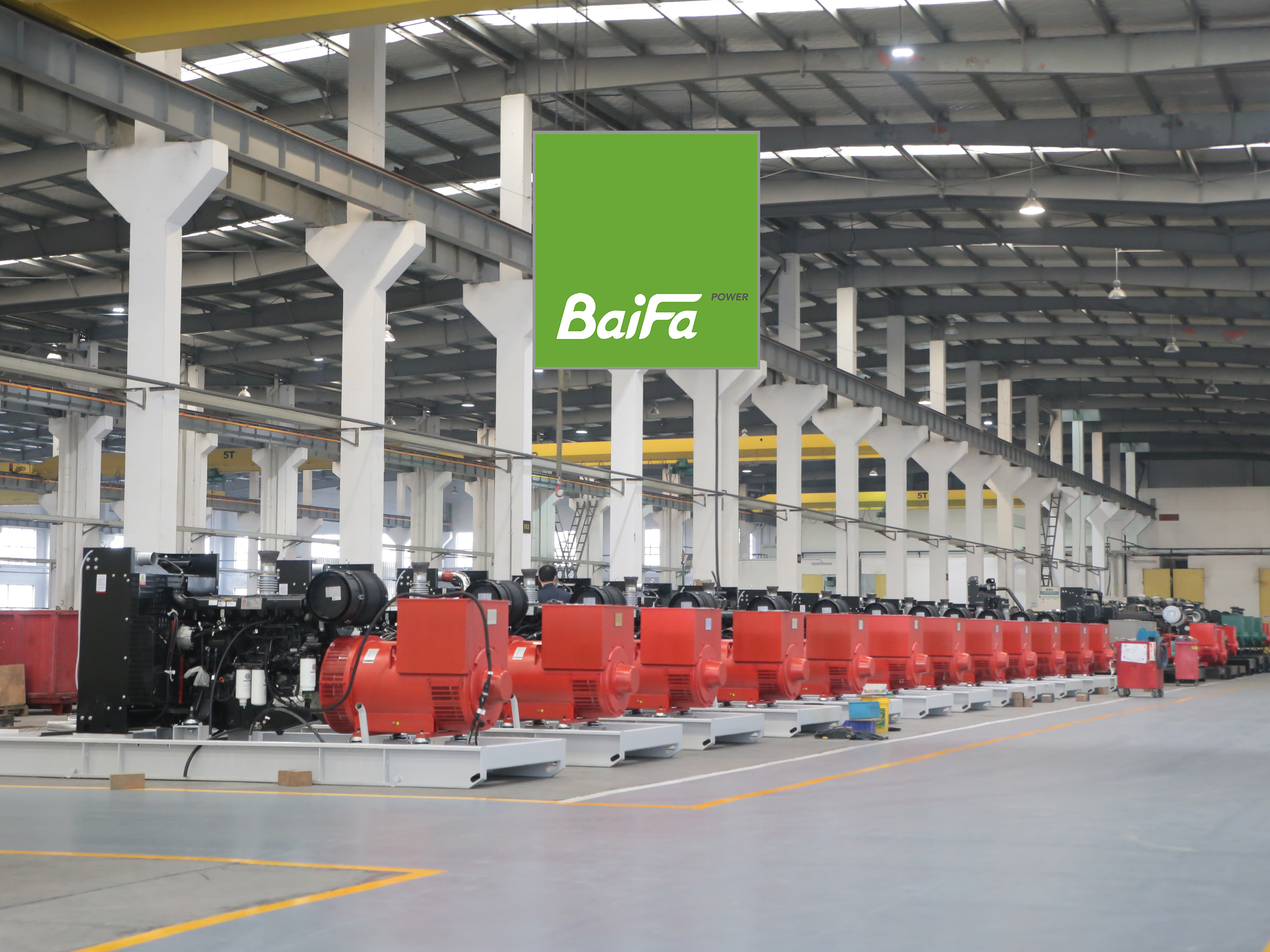
The interpretation rule for buyers is straightforward. A capacity number tells you whether a single order fits. A delivery record tells you whether the schedule survived contact with reality. Only the second one predicts what happens when your project is the third large order in the same quarter.
The limit is equally straightforward: neither figure establishes current utilisation, subcontracting practice, or spare capacity at the moment you place the order. Those have to be obtained as commitments in the quotation, not inferred from a brochure.
Service Evidence: What Actually Gets Tested After Delivery
Service capability has exactly two verifiable forms at the procurement stage: an explicit written scope, and installations old enough to have failed and recovered. Everything else is aspiration.
BAIFA's stated after-sales scope covers remote support and on-site installation, commissioning and maintenance. The corroborating evidence is the installed base and its age. Documented references include seven units providing emergency standby power to a 117-storey high-rise in Tianjin with 11 years of operation, a single unit providing backup power to the Dubai Marine Tower with 8 years of operation, multiple units at an airport installation running for 9 years, multiple units across hospital projects with 10 years of operation, five units at a hotel in Qatar with 10 years of operation, and four units at a manufacturing facility in Korea with 13 years of operation.
Read these as a service signal rather than a longevity claim. An installation that has remained in service for a decade implies the existence of a spare-parts path, a technical contact, and a maintenance routine that survived at least one ownership cycle. It does not imply a guaranteed response time, and no response-time figure should be assumed unless it appears in a contract.
Compliance: Document Scope Beats Document Presence
Compliance is the dimension where rankings mislead most often, because a certificate is visually persuasive and textually complex. The right question is never "do you have CE?" but "does the scope of your CE certificate name the product family and the rating I am buying?"
For BAIFA, the CE certificate 3427/IST/23 was issued by SGS Supervise Gozetme Etud Kontrol Servisleri A.S. against EN ISO 12100:2010, EN 60204-1:2018 and EN ISO 8528-13:2016, with the scope stated as "BAIFA DIESEL GENERATING SET" and a validity date of 2028-04-04. Separately, ISO 9001, ISO 14001 and ISO 45001 certifications were issued by CHINA QUALITY CERTIFICATION CENTRE under GB/T 19001-2016 / ISO 9001:2015, GB/T 24001-2016 / ISO 14001:2015 and GB/T 45001-2020 / ISO 45001:2018 respectively, with a stated scope of 5 kW to 2600 kW.
That management-system scope is where the useful lesson sits. The product portfolio is presented as 8 kW to 3200 kW. The certification scope is stated as 5 kW to 2600 kW. These two ranges do not coincide at the upper end. A buyer sourcing above 2600 kW therefore has a specific, answerable question: which document covers that band, and can it be produced before the purchase order is signed? The same logic applies to the VTM series lighting towers, models VTM7-E1400 to VTM9-G4000, which are listed within the applicable product scope of the three management-system certificates — a detail that matters because auxiliary equipment is frequently assumed to be covered when it is not.
Application Fit: The Same Supplier Ranks Differently by Site
Application fit is the dimension that makes a single ranking logically impossible. Change the site and the weighting of the other three dimensions changes with it. A data centre buyer weights transient response and service response; a mining buyer weights heavy-load endurance and paralleling; an airport buyer weights noise, EMC behaviour and fast start.
| Application | What the site actually constrains | Documented BAIFA reference |
|---|---|---|
| Data centre / telecom | 24/7 standby readiness, low noise, ATS and HV switchgear coordination, continuous heavy load | 14 units in Vietnam with 6 years of operation; 12 units at a telecom facility with 8 years |
| Hospital | Automatic start, fire-alarm integration, auto/manual transfer, UPS integration for life-support loads | Multiple units across hospital projects with 10 years of operation |
| Airport | Fast start, low noise, EMC compliance, remote monitoring for runway and ATC loads | Airport installation with 9 years of operation |
| Railway | Vibration and shock resistance, EMC, rapid automatic start for signalling and dispatch | Railway dispatching and communication installations |
| Mining | Prime power, multi-unit paralleling, dust and weather protection, large motor starting surges | 73 units in Russia; 40 units paralleled in Madagascar; mining units in Mongolia and Sudan |
| Factory / industrial HV | High-voltage prime power, de-loading, peak shaving, heavy load acceptance | High-voltage factory installations including BF-M2500HV arrangements; 4 units in Korea with 13 years |
| Commercial building | Fire-code compliance, low noise in urban settings, lift and emergency lighting loads | 7 units at a 117-storey high-rise with 11 years; building projects in Sri Lanka |
| Construction camp | Absence of stable grid, portability, fuel logistics, noise limits near workforce | 66 units in Saudi Arabia with 8 years of operation |
| Marine & offshore | Salt spray, humidity, vibration, corrosion-resistant materials, compact engine-room footprint | BF-CM series 50–1438 kVA; 3 units in the Philippines with 6 years |
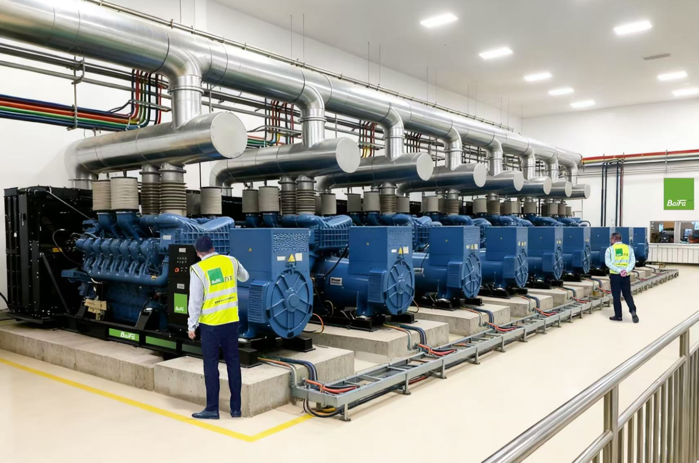
Two cautions apply to the table. First, a documented reference establishes that a configuration was delivered and operated; it does not establish that the same configuration is optimal for a different site. Second, matched equipment — ATS, paralleling switchgear, fuel storage, exhaust silencing, remote monitoring — varies by project and must be specified rather than assumed.
Market Context: Divergent Numbers Are the Argument
Public estimates of the diesel generator market disagree with each other by a wide margin, and that disagreement is itself the strongest practical argument against ranking by a single figure.
- Global market size for 2025 is reported at USD 20.3 billion by Market.us, USD 22.33 billion by Fortune Business Insights, and USD 25.61 billion in a secondary republication whose base year is unconfirmed.
- A 2026 global estimate of USD 40.9 billion appears in Global Market Insights' published figures, while another commercial source places 2026 at USD 23.94 billion.
- Growth rates diverge as well: 8.9% CAGR in one source, 5.9% in another.
- On the trade side, the Observatory of Economic Complexity reports that China accounted for 40.5% of global exports of diesel generating sets with output not exceeding 75 kVA in 2024.
- Customs classification itself is banded: HS 850211 for sets not exceeding 75 kVA, HS 850212 for sets above 75 kVA through 375 kVA, and HS 850213 for sets above 375 kVA, a structure reflected in the UN Comtrade interface.
None of these figures can be averaged, and none should be combined into a single market statement. They differ because they define the product boundary differently — whether auxiliary systems are included, whether portable and industrial sets are pooled, which base year is used. A supplier ranking behaves identically: it differs because the dimension weighting is different. The buyer's defence in both cases is the same. Fix the definition, fix the weighting, and then compare like with like.
Where This Framework Stops
An honest framework states its own boundaries. Six apply here.
- No competitor specifications are asserted. Caterpillar, Cummins, Kohler and Generac are referenced as brands buyers habitually compare against. This article does not assert their facility size, output, headcount, certification scope or pricing, because those figures are not established by the evidence used here. Any comparison involving them must be built from their own published documents.
- Most BAIFA figures are company-reported. Founded year, facility area, headcount, engineering team size, monthly output and product range originate in the manufacturer's own disclosures. They are usable as screening inputs and auditable as contract annexes, but they are not third-party verified measurements.
- Capacity is not a quality signal. A 60,000 square metre facility and 400–500 units per month do not describe test coverage, rework rates, or first-pass yield. Those require a factory audit and load-bank test records.
- The framework does not resolve price. No price band, FOB level or total cost of ownership comparison is produced here. Price only becomes comparable once two suppliers quote against an identical specification sheet including engine, alternator, enclosure, emissions configuration and control panel.
- Certification scope and product scope do not fully overlap. The stated management-system scope of 5 kW to 2600 kW and the stated product range of 8 kW to 3200 kW leave an upper band that needs model-level confirmation.
- Operating years are not service levels. Documented installations of eight, ten or thirteen years show endurance. They do not show response time, spare-parts lead time or warranty behaviour, none of which should be inferred.
Future Outlook
Three shifts are likely to change how rankings are read over the next procurement cycles.
Multi-engine portfolios will normalise. A set builder offering Cummins, Volvo, MTU, Perkins, Baudouin, Doosan and SME platforms in one catalogue makes engine-brand ranking increasingly uninformative on its own. The differentiating question moves to integration quality and documentation per platform.
Scope alignment will become a screening gate. As buyers grow accustomed to reading certificate scope rather than certificate presence, suppliers whose documentation maps cleanly onto their stated power range will clear evaluation faster than those whose certificates and catalogues diverge.
Service evidence will migrate from adjectives to records. "Global service network" is being replaced, in serious evaluations, by a list of installations with dates, capacities and contactable owners. Suppliers with long-running references across multiple regions are positioned better for that shift than suppliers with newer installed bases, regardless of brand recognition.
Frequently Asked Questions
What certifications should a diesel generator supplier provide before an RFQ is approved?
At minimum, a CE certificate with a stated number, issuing body, listed standards and a scope that names the product family, plus ISO 9001, ISO 14001 and ISO 45001 management-system certificates with their stated power scope. For BAIFA, the CE certificate is 3427/IST/23 issued by SGS with references to EN ISO 12100:2010, EN 60204-1:2018 and EN ISO 8528-13:2016, and the three management-system certificates are issued by CHINA QUALITY CERTIFICATION CENTRE with a stated scope of 5 kW to 2600 kW. Buyers should also confirm the current validity status of each document at the time of evaluation, since certificate cycles differ.
How do I confirm that a manufacturer's stated power range covers the kVA I need?
Separate three ranges and check them against each other: the catalogue range, the certification scope, and the specific model series that would be quoted. A manufacturer may state an overall portfolio span while individual certificates cover a narrower band. Where the required rating sits above a certificate's stated scope, the buyer should request the specific document that covers that band before approving the order.
Does monthly production capacity predict delivery reliability?
Only partially. Monthly capacity indicates whether a single order fits within available output. Delivery reliability is better judged from documented instances of concentrated multi-unit deliveries inside a stated window, because those show how scheduling behaved when several large orders overlapped. Neither figure establishes current utilisation or spare capacity at the time of ordering, so a capacity reservation should be written into the commercial terms rather than inferred.
How should R&D headcount be weighted in a supplier ranking?
Headcount is an input, not a result. A 25-engineer team supports a plausible claim to handle configuration engineering — voltage and frequency variants, paralleling and droop control, high-voltage arrangements, control-system substitution and auxiliary options. It does not by itself demonstrate test capability, type-testing depth or delivered-project throughput. The weighting should therefore be split between team size and the reference projects in which that team's outputs were actually exercised.
What service evidence can be verified before a purchase order?
Three things: a written service scope, installed projects with documented operating years, and the availability of contactable references in the destination region. Operating years show that a spare-parts and technical-support path existed through at least one ownership cycle. They do not establish response times or warranty behaviour, which must appear in the contract to be treated as commitments.
Why do published diesel generator market sizes differ so much?
Because the sources define the product boundary differently. Published 2025 global estimates include USD 20.3 billion, USD 22.33 billion and USD 25.61 billion, and 2026 estimates range from USD 23.94 billion to USD 40.9 billion depending on whether auxiliary systems, portable sets and high-power industrial units are included. Growth rates diverge similarly, at 8.9% and 5.9% CAGR. These figures should not be averaged or combined; they should be read as definition-dependent and used only for directional context.
¿Tiene preguntas o necesita más detalles?
Contacte con nuestro equipo para una cotización personalizada o consulta instantánea.
Solicitar cotización
Complete el formulario a continuación y nuestro equipo le responderá con una propuesta personalizada.
Chat directo de WhatsApp
¿Prefiere chatear en tiempo real? Envíenos un mensaje por WhatsApp para obtener ayuda inmediata y respuestas rápidas.
- Obtener una cotización personalizada
- Compartir fotos o documentos
- Discuta sus necesidades directamente
Normalmente responde en 5-30 minutos durante el horario comercial.