
Diesel Generator Price vs. TCO: An OEM Comparison for 2026
Industrial buyers comparing diesel generator quotations in 2026 face a recurring problem: price lists from global brands, Chinese original equipment manufacturers (OEMs), and local assemblers can vary by a wide margin, even for sets using the same engine. The difference usually lies not in the engine nameplate but in the cost structure, assembly quality, testing depth, and after-sales support behind each quotation. For buyers at the decision stage, understanding that structure is more valuable than negotiating the lowest purchase price.
The Real Cost of a Diesel Generator Is Not on the Invoice
Beyond the Initial Price
Purchase price captures only one part of the diesel generator lifecycle. Fuel consumption, scheduled maintenance, unplanned downtime, spare parts availability, and resale value together determine the total cost of ownership (TCO). A generator set that consumes 12 percent less fuel under full load or requires 25 percent less maintenance frequency can offset a higher upfront price within a few years of operation.
Why the Same Engine Does Not Mean the Same Generator
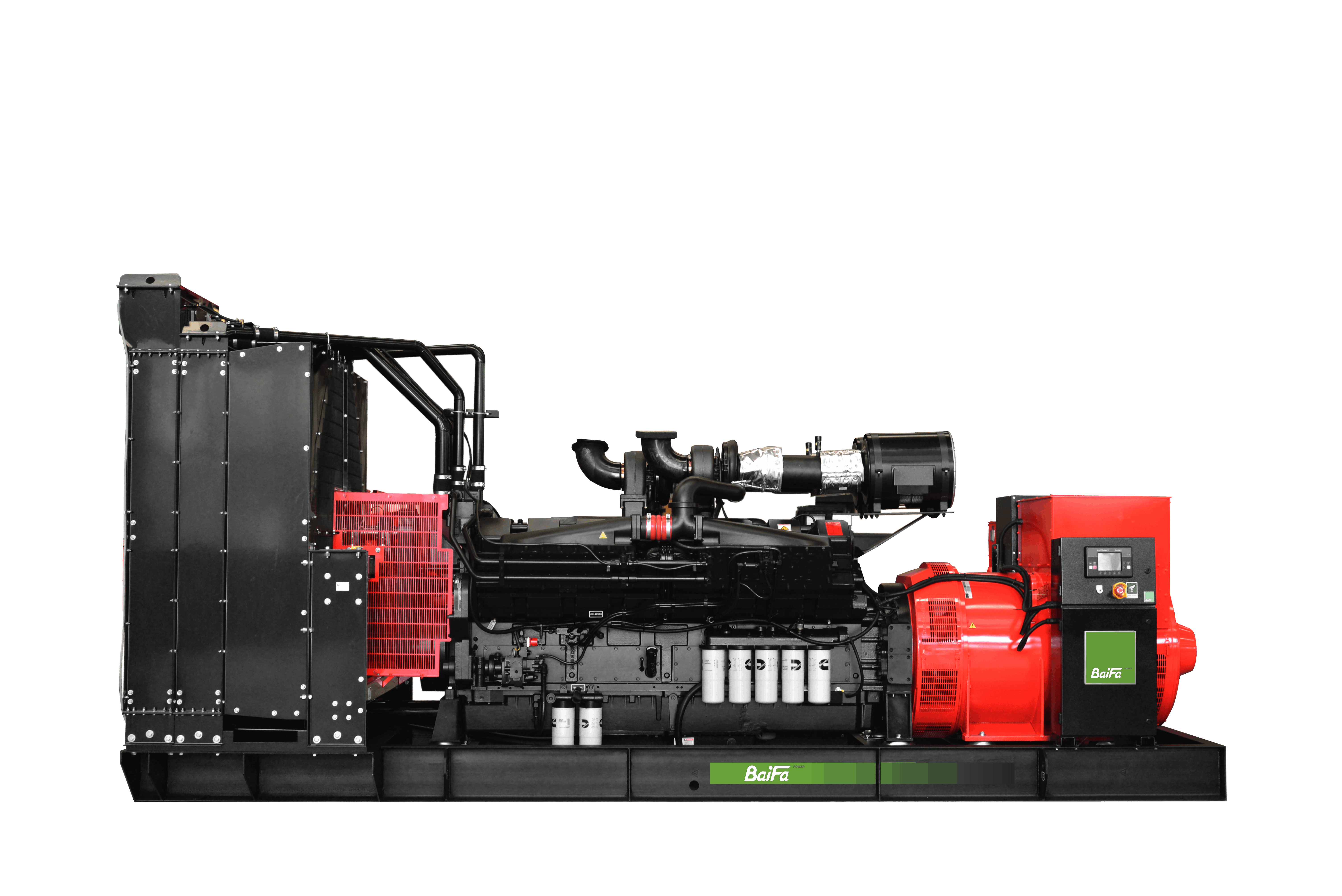
Industrial diesel generator sets are engineered systems. The engine—whether Cummins, Perkins, Volvo Penta, MTU, Mitsubishi, Baudouin, or Scania—defines the prime mover, but the complete set includes the alternator, control panel, cooling system, base frame, enclosure, and monitoring equipment. An authorized OEM such as BAIFA Power (Wuxi) Ltd. sources engines directly from these manufacturers and integrates them with alternators from Stamford, Leroy-Somer, AVK, or MECC Alte. The quality of that integration determines real-world performance.
Building a TCO Comparison for Diesel Generator Procurement
Fuel Efficiency and Load Characteristics
Fuel is typically the largest operating expense for a diesel generator over its lifetime. When comparing quotations, buyers should ask for specific fuel consumption data at 25, 50, 75, and 100 percent load rather than relying on a single nominal figure. Sets with intelligent fan control and optimized combustion parameters can lower power consumption at full load; in BAIFA's comparison data for its S/SA/SE/SAE enclosed series, the mute enclosure version achieves 12 percent higher fuel efficiency and 10 percent lower power consumption under full load compared with a standard unit.
Maintenance Intervals and Downtime Costs
Maintenance frequency directly affects operating cost. BAIFA reports that its enclosed generator sets require 25 percent less maintenance frequency than standard open sets, reducing both labor expense and production interruption risk. For industrial facilities that run generators as prime or continuous power, the cost of one unplanned shutdown can exceed the entire annual maintenance budget.
Enclosure, Environment, and Installation Costs
Site conditions often matter more than the generator itself. In noise-sensitive locations—urban construction sites, residential areas, hospitals, schools, hotels, and data centers—a silent canopy is not optional. BAIFA's S/SA/SE/SAE canopy series is designed with high chassis strength, high enclosure strength, high anti-corrosion protection, flame-retardant sound-absorbing material, and sufficient maintenance space. Compared with a standard unit, the enclosure reduces noise by 10 dB and costs roughly 8 percent more upfront, but BAIFA estimates 18 percent lower long-term operating costs from extended service life and reduced maintenance. For buyers, this is a clear example of how a slightly higher initial price can reduce TCO.
Compliance and Certification
Certification is another cost component that buyers sometimes overlook. A CE certified diesel generator must meet EU directives and, where applicable, ISO 8528 standards—specifically Part 13 for safety and Part 10 for noise emission. Compliance testing adds to manufacturing cost, which is why very low quotations often come with incomplete certification documentation.
Original Brand vs. Chinese OEM: A Decision Framework
At the decision stage, buyers typically face two paths: purchasing a complete generator set from a global brand's own factory, or sourcing from that brand's authorized OEM in China. Both can use the same engine, but the price structure, customization flexibility, and lead times differ substantially.
| Comparison Dimension | Global Brand Direct Purchase | Chinese OEM Partnership (e.g., BAIFA) |
|---|---|---|
| Engine sourcing | Same major brands (Cummins, Perkins, Volvo Penta, MTU, etc.) | Direct from same manufacturers under authorized partnerships |
| Cost structure | Higher manufacturing overhead and brand premium | Local manufacturing cost base; flexibility in specification |
| Customization | Standardized configurations, limited project tailoring | Project-level customization available |
| Certification | Full compliance documentation as standard | Compliance achievable; buyers verify model-specific documents |
| Service network | Global subsidiaries and authorized dealers | Partner network in exporting regions; after-sales coordination through OEM |
| Lead time | Longer for built-to-order | Generally shorter for export-standard sets |
| Procurement involvement | Lower | Higher—requires factory audit, inspection, warranty negotiation |
Cost Structure Differences
The cost gap between an original global brand unit and a Chinese OEM unit typically comes from manufacturing location, assembly labor, overhead, distribution, and brand premium—not from the engine itself. A 1,000 kVA diesel generator set built with a Cummins or Volvo engine at an OEM facility in Wuxi has a different cost base than the same engine assembled at a factory in the United States or Europe. This is the fundamental logic behind global OEM partnerships in the power generation industry.
Quality and Testing
China's export-oriented generator manufacturers have invested heavily in production capacity. BAIFA's facility covers more than 60,000 square meters, including a 34,000-square-meter assembly workshop, and produces 5,000 to 6,000 generator sets annually. The company employs 25 engineers and exports roughly 70 percent of its output to Latin America, Southeast Asia, and the Middle East. Cumulative exports exceeded USD 800 million through 2023, across more than 80 countries.
A Realistic Limitation of the OEM Route
Despite these advantages, the Chinese OEM route has a genuine boundary: global brand recognition and service network depth. For multinational companies operating under centralized global supply agreements, standardizing on a single worldwide brand may offer easier cross-border service coordination. A buyer choosing a Chinese OEM—even one with long-standing authorized partnerships—needs to verify factory capability, request third-party inspection, and clarify warranty execution across regions. These steps are manageable, but they require a higher level of procurement involvement than buying from a global brand's local subsidiary.
Application Scenarios That Change the Comparison
Industrial and Construction Sites
Factory diesel generator and construction diesel generator buyers often prioritize delivery speed, fuel efficiency, and ruggedness. A standard open-set or a silent enclosed set from a Chinese OEM can be tailored to site voltage, frequency, and connection requirements without the long lead times of a fully built-to-order international unit.
Marine Applications
The marine diesel generator set market reached USD 2.94 billion globally in 2024, according to Intel Market Research. Marine installations place different demands on generator sets—corrosion resistance, classification society compliance, and compact installation. BAIFA offers marine generator sets from 40 kW to 1,100 kW, which allows shipbuilders and vessel owners to source multiple power ranges from one supplier.
Harsh Environments
Operating conditions in high-temperature or cold-weather regions require specific engineering choices. For high-temperature operation, BAIFA recommends models with turbocharging and intercooling, and upgrading to a 50°C ambient capacity radiator to maintain thermal stability. In cold weather, the company specifies antifreeze rated for the ambient temperature and adds a water jacket heater. Temperature sensors provide operators with early warning signals in both scenarios.
Market Context in 2026
The commercial environment for diesel generators remains favorable. Spherical Insights valued the global diesel generator market at approximately USD 22.33 billion in 2025, although other research firms estimate the market between roughly USD 19 billion and USD 22 billion, depending on scope and methodology. China's diesel generator market is projected to grow at a CAGR of 9.3 percent from 2023 to 2030. On the trade side, China exported USD 923 million worth of diesel generating sets with output below 75 kVA in 2024, according to OEC. These figures indicate that both domestic and export demand remain strong, and Chinese manufacturing continues to play a central role in global supply.
A Sourcing Checklist for Decision-Stage Buyers
- Define the duty cycle: prime power or standby power?
- Compare the full system—not just the engine. Specify alternator brand, control panel, cooling package, and enclosure.
- Ask for fuel consumption data at partial and full load.
- Verify certification documents: CE, ISO 8528-13, ISO 8528-10, and any target-market approvals.
- Review maintenance intervals and spare parts availability.
- Evaluate enclosure and environmental protection levels against your site conditions.
- Inspect the factory or use a third-party inspection service.
- Clarify warranty responsibility across regions before signing.
Future Outlook
Looking ahead, diesel generator procurement will become more TCO-driven. Rising fuel prices and tightening emission regulations will push buyers toward higher-efficiency sets and alternative fuel options. BAIFA already includes green fuel generator sets and renewable fuel generator sets in its product range, alongside gas generator sets, which suggests that Chinese OEMs are moving beyond diesel-only offerings. Buyers who evaluate suppliers today on engineering depth, partnership structure, and environmental adaptability will be better placed for the next procurement cycle.
FAQ
How should buyers compare diesel generator prices across manufacturers?
Buyers should compare total cost of ownership rather than purchase price alone. This includes fuel consumption at typical load levels, maintenance intervals, spare parts availability, certification compliance, and expected service life. For example, a silent enclosure can raise initial cost by approximately 8 percent but lower long-term operating costs by an estimated 18 percent through reduced maintenance and extended service life.
Why do Chinese OEM diesel generator sets often cost less than international brand sets?
The price difference is driven by manufacturing location, labor costs, scale, and distribution structure, not by the engine brand. Chinese OEMs such as BAIFA Power source engines directly from the same global manufacturers—Cummins, Perkins, Volvo Penta, MTU, Mitsubishi, Baudouin, and others—and integrate them locally. This allows buyers to access well-known engine technology at a different cost base.
What does CE certified diesel generator mean for international projects?
A CE certified diesel generator meets European Union safety, health, and environmental protection requirements. For noise-emitting equipment, EU Directive 2000/14/EC and ISO 8528 Part 10 govern noise limits, while ISO 8528 Part 13 covers safety. Buyers should ask for documented certification tied to the specific model, not generic claims.
What is the difference between an authorized OEM and an independent assembler?
An authorized OEM has a formal partnership with the engine and alternator manufacturers, which supports genuine parts supply, technical documentation, and warranty coordination. BAIFA Power, for example, maintains long-term partnerships with Volvo, Cummins, Stamford, Leroy-Somer, MTU, Perkins, Mitsubishi, Scania, Baudouin, and Weichai. Independent assemblers may source engines from the open market but do not have equivalent manufacturer support.
How important is the alternator brand in a generator set?
The alternator converts mechanical power into electrical output and plays a major role in voltage stability, motor-starting capability, and overall reliability. Global diesel generator manufacturers typically pair engines with established alternator brands such as Stamford, Leroy-Somer, AVK, or MECC Alte. Buyers should confirm the alternator brand and model in the quotation, because it significantly affects performance and long-term service.