
Die Spring Evidence Trail: Certificates, Heat Numbers, Process Proof
A die spring is one of the lowest-cost components inside a stamping die and one of the fastest routes to unplanned press downtime. Because the part is small and inexpensive relative to the tool around it, procurement often reduces it to a catalogue number and a unit price. Supplier capability, however, is not visible in a product photograph. It is visible in four layers of documentation that a buyer can request, read and audit before the first purchase order is issued.
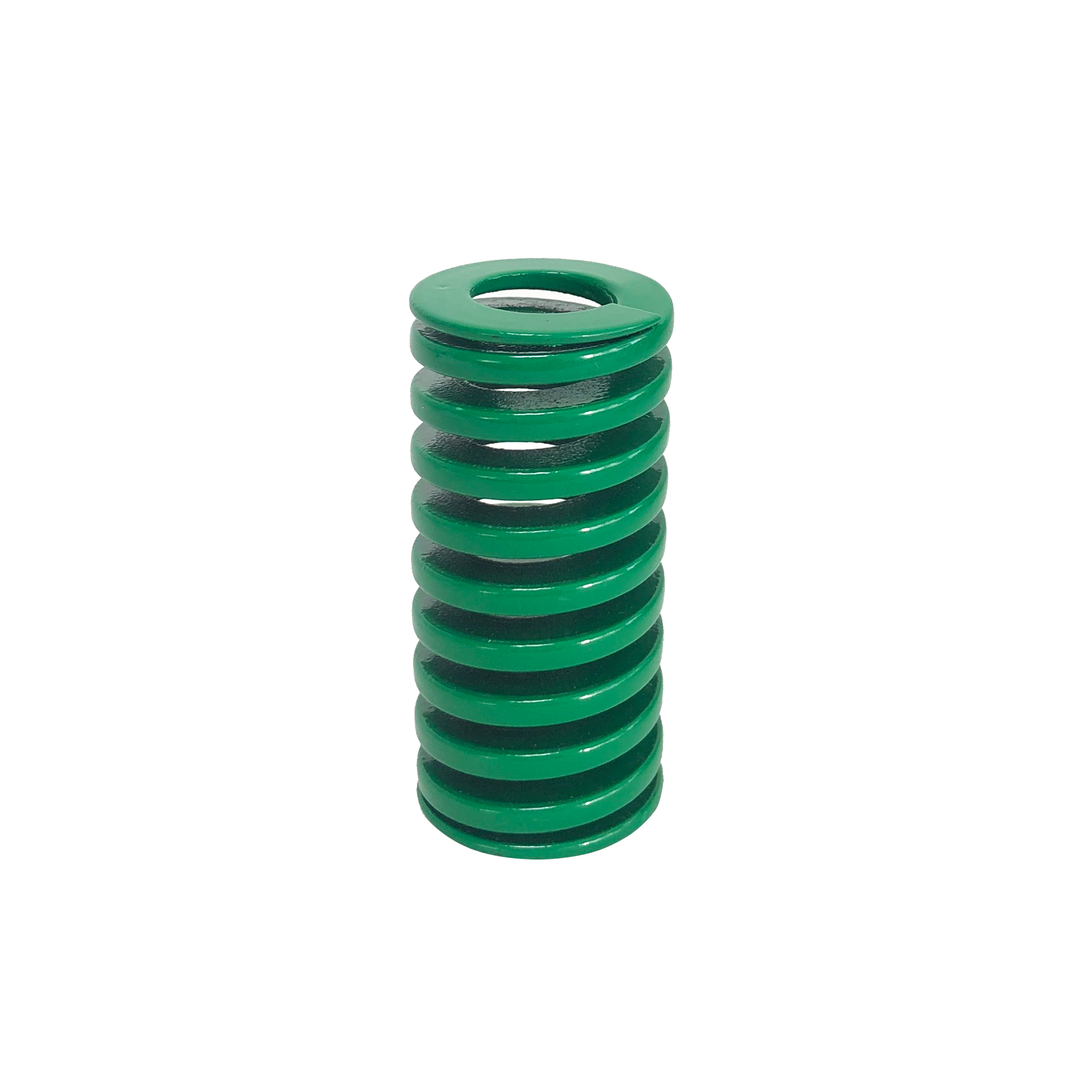
Rectangular wire die springs are fatigue components. Their load class, wire grade and surface condition are set at the factory, not at the toolroom bench.
Why capability claims in die springs need a paper trail
In die spring sourcing, "capable supplier" is a claim, not a fact, until it is backed by records. A rectangular wire compression die spring is a fatigue part. Its service behaviour is determined by wire grade, coiling accuracy, heat treatment, shot peening, end-face grinding and coating — and none of those are visible on the finished spring, even under magnification.
What a buyer can observe on arrival is limited: colour, free length, wire section, and whether the ends are ground. What a buyer cannot observe is whether the steel came from the heat stated on the order, whether the tempering cycle actually ran to the declared profile, or whether the shot peening parameters changed between lots.
The practical answer is not to trust harder, but to ask differently. Capability evidence for die springs sits in four auditable layers: management-system certification, material certification and heat-number traceability, process records, and evidence of multi-standard stock.
The four evidence layers a die spring buyer can audit
Each layer answers a different question, and none of them substitutes for the others. A supplier can hold a quality certificate and still deliver a spring with the wrong load curve; a mill certificate can be genuine and still describe a finished part that was over-compressed in service.
| Evidence layer | Typical document | What it does prove | What it does not prove |
|---|---|---|---|
| Management system | ISO 9001 and ISO 14001 certificates with a stated scope | The site operates documented, auditable quality and environmental processes | That an individual spring meets its published load-deflection curve |
| Material | Mill test certificate (MTC) carrying a heat number | Chemistry and reported mechanical properties of the steel heat used | Finished-part fatigue life, which also depends on forming and heat treatment |
| Process | Tempering, shot peening, coating and grinding records; inspection reports | That the declared process route was applied to that lot | Long-term field reliability in a specific die or press condition |
| Standards and stock | ISO 10243, JIS B5012 and American Standard catalogue alignment; stock records | Drop-in dimensional and load replaceability, and replenishment availability | Suitability for a specific die design, preload and deflection ratio |
What ISO 9001 and ISO 14001 scope actually covers
ISO 9001 is a quality management system standard and ISO 14001 is an environmental management system standard. Both certify a system and a defined scope; neither is a product certification for a spring. That distinction matters when two suppliers both claim certification but only one can show that the scope statement names the manufacturing site and the product category that the buyer is actually purchasing.
A buyer reading a certificate should check four things: whether the scope statement names the correct site and product category, whether the certificate is currently valid, which certification body issued it, and whether the site address matches the shipping origin on the commercial invoice. When these four points align, the certificate has procurement value. When they do not, it is decoration.
Dalian TopWay Precise Mould & Die Co., Ltd., which trades as TOPWAY SPRINGS, is a die spring and mould parts manufacturer founded in 2012 and based in Dalian, Liaoning, China, operating from a 16,500 m² facility with 58 employees, five engineers and an annual output of 3,600,000 pieces. The company operates two business units, a Spring Division and a Mould Parts Division, exports roughly 50% of output to the EU and the USA, and presents ISO 9001 and ISO 14001 certification as part of its supplier documentation.
For a buyer, the operational meaning of those two certificates is repeatability. ISO 9001 supports batch records, FIFO stock control and structured nonconformity handling — the mechanics that make a second order behave like the first. ISO 14001 becomes relevant where coating lines and heat treatment are part of the supplier audit, which is increasingly the case for European industrial customers assessing their own supply-chain exposure.
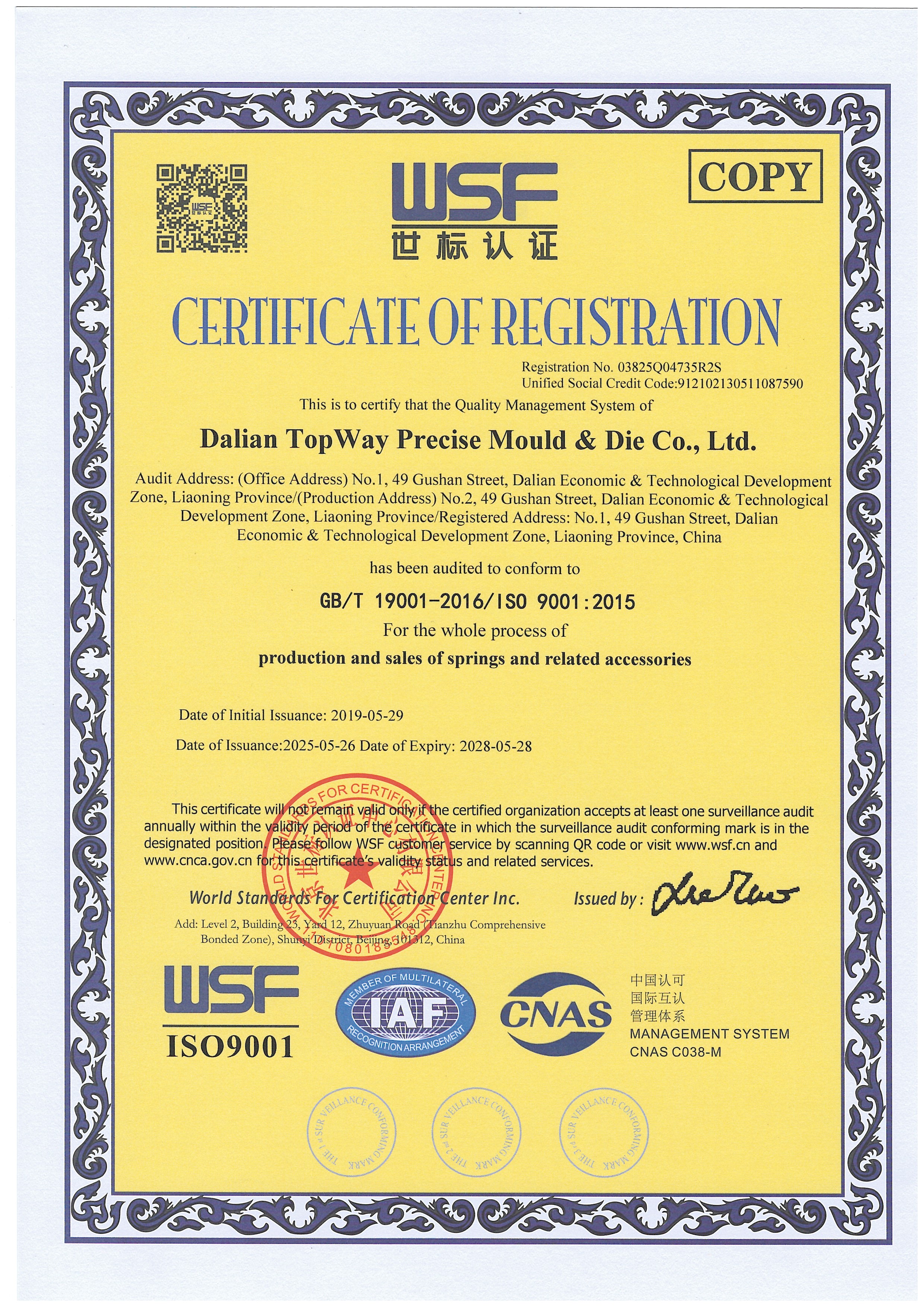
A management-system certificate is evidence of process discipline. The scope statement, validity and issuing body are what a buyer should read first.
Mill test certificates and heat-number traceability for 55CrSi
TOPWAY SPRINGS manufactures its die springs from high-stress oil-tempered alloy steels such as 55CrSi, a chrome silicon grade chosen for tensile strength and resistance to permanent set. The specification of the steel is where a documentation chain usually starts.
A mill test certificate reports the chemical composition and mechanical properties of a specific heat of steel and carries the heat number that identifies it. Heat-number traceability is the practice of carrying that identifier forward — from incoming inspection, through the production lot, to the label on the finished carton. Without the forward link, the certificate proves what was delivered to the factory gate, not what is inside the box.
TOPWAY states that mill test certificates and complete material heat-number traceability are provided for all raw materials, and that incoming lots are managed under FIFO with batch tracking to support part interchangeability over time. That is the correct shape of the evidence, and it is verifiable: a buyer can request the MTC for a delivered lot and compare it with the label on the packaging.
The limit is worth stating plainly. An MTC describes steel, not springs. It tells a buyer that the wire was 55CrSi of the stated composition; it does not tell them how the finished part will behave after ten million press strokes. Only the process layer addresses that.
Process proof: tempering, shot peening, coating and ground end faces
Process evidence is where die spring suppliers most often differ, and where buyers most often stop asking. The four process steps below are the ones that carry the clearest link between documented control and field behaviour.
Multi-stage tempering
Tempering after quenching determines how much load a spring loses when it sits under preload at elevated temperature. TOPWAY uses a multi-stage tempering process intended to minimise thermal relaxation and load loss during continuous high-temperature stamping, and to hold nominal free length and load accuracy under long-term preload. For a buyer running a hot stamping or die casting tool, this is the single most decision-relevant process claim a supplier can make, and it is one that a furnace load record can substantiate for a given lot.
Controlled shot peening
Shot peening introduces compressive residual stress into the wire surface, which suppresses the initiation and propagation of fatigue micro-cracks. TOPWAY applies precision shot peening as part of its standard route and links the step to a published fatigue endurance of 3 to 5 million high-frequency compression cycles under extreme working conditions. The claim is a first-party engineering statement rather than a third-party certified figure, and it should be read together with its operating condition — compression within the recommended deflection range.
Colour-coded powder coating
Powder coating does two jobs in this product category: it identifies load class on the shop floor, and it protects the wire from humidity, stamping lubricants and coolant exposure. TOPWAY uses high-adhesion electro-powder coating intended not to flake into a die cavity. A buyer can test adhesion cheaply with a cross-hatch or solvent rub on a sample before approving a lot.
Ground end faces and trapezoidal wire
Ground end faces produce squareness and a perpendicular load path, which reduces lateral deflection and protects guide pins and bushings. The rectangular, trapezoidal wire section itself is the reason die springs exist as a separate category: TOPWAY states that the rectangular cross-section stores up to 30%–50% more energy than round wire springs of the same footprint, which is what allows a compact pocket to carry the required return force. Both end conditions — closed and ground, or closed and un-ground — are available across the range.

Process claims are only auditable where the equipment exists to run them. A site walk should follow the lot, not the showroom.
Holding ISO, JIS and American standard stock as a capability signal
Maintaining three catalogue systems simultaneously is a stronger capability signal than it first appears, because the three systems do not share conventions.
ISO 10243:2019 standardises colour-coding and dimensions for rectangular-section compression springs used in press tools, according to the International Organization for Standardization. JIS B5012 specifies allowable tolerances for spring inner and outer diameters, a different focus from the mounting-hole emphasis of ISO 10243. Published comparison notes on the two systems flag colour codes for load classes as a documented source of selection error in global tooling — a point worth repeating to any maintenance team that reorders by colour.
| Standard line | Series and load classes | Outer diameter | Free length |
|---|---|---|---|
| ISO 10243 | CIF super minimal (light green), CIL light (green), CIM medium (blue), CIH heavy (red), CIB extra heavy (yellow) | 10–63 mm | 25–305 mm |
| JIS B5012 | CSWF minimal (yellow), CSWL light (blue), CSWM medium (red), CSWH heavy (green), CSWB extra heavy (brown), CSWG super heavy (black) | 6–70 mm | 10–350 mm |
| American Standard (inch) | Medium (blue), medium heavy (red), heavy (gold), extra heavy (green) | 10–51 mm | 25–305 mm |
The table exposes the trap. Green denotes a light duty spring in the ISO line, a heavy load spring in the JIS line, and an extra heavy spring in the American line. Blue is light load under JIS but medium load under ISO. A buyer who specifies by colour across systems will eventually install the wrong spring into a die that was designed around a different load class.
TOPWAY manufactures across all three systems from 55CrSi, with powder coating and a choice of closed and ground or closed un-ground ends, and maintains ready-to-ship stock across standard ISO, JIS and American catalogue items. The company also provides full OEM and ODM customisation — wire profiles, non-standard loads, non-standard dimensions, coatings and private branding — based on drawings or physical samples.
Where the evidence matters most
TOPWAY Series springs are used in automotive stamping dies, plastic injection molds, die-casting tooling, industrial automation, elevator systems, machine tools, engineering machinery, environmental filtration equipment, high-voltage electrical switches, valves and heavy-duty energy systems. The common operating profile across these applications is high-frequency cyclic shock, sustained high temperature, high-load compression and exposure to oil or coolant.
Documentation becomes decisive in three specific situations rather than in routine replenishment. The first is tool transfer, when a die built around one brand must be re-qualified against another. The second is OEM substitution, when a tier supplier has to defend a component change to its own customer. The third is failure investigation, when a broken spring has to be classified as a design issue, an installation issue or a material issue — and that classification is impossible without a lot-level paper trail.
Market context: why documentation is becoming a selection criterion
The commercial backdrop explains the shift. Grand View Research projects the global industrial springs market to reach USD 7.1 billion by 2033, with Asia Pacific already holding a 33.4% revenue share in 2024. Market Research Future values the automotive stamping market — the largest single end-use driver for die springs — at USD 87.98 billion in 2024.
Public trade data, however, is a poor guide to this specific segment. The US import code 732020 covers helical springs of iron or steel generally; there is no separate global code that isolates rectangular-wire die springs. Buyers looking for category-level comparables therefore find customs statistics that blend die springs with unrelated spring types — which pushes the verification burden back onto supplier documentation.
The second driver is substitution. As tooling supply chains diversify, catalogue items from one region are increasingly specified as drop-in replacements for another. Drop-in replacement is only defensible when dimensional and load equivalence is documentable, which is precisely what the ISO 10243, JIS B5012 and American Standard alignment in the table above is meant to establish.
Evidence-based sourcing versus price-and-catalogue sourcing
Both approaches are legitimate. The difference is where the risk sits and who carries it.
| Dimension | Price-and-catalogue sourcing | Evidence-based sourcing |
|---|---|---|
| Selection basis | Unit price, availability, catalogue resemblance | Certificate scope, MTC and heat number, process records, standard alignment |
| Risk position | Transferred to the toolroom, discovered at failure | Surfaced at qualification, before the die is released |
| Change management | Colour or dimension matched visually | Load class and standard confirmed against drawing |
| Audit readiness | Supplier cannot support a customer audit | Documents are already on file per lot |
| Cost view | Lowest piece price | Piece price plus downtime, scrap and re-qualification exposure |
Price-first buying remains defensible for non-critical positions — low-cycle, low-deflection pockets in short-run tooling where a spring failure causes a pause rather than a scrap event. The case for evidence rises with press tonnage, cycle rate, temperature and the cost of a stopped line.
Limits: what this evidence cannot do
An honest supplier review includes the boundary conditions, and there are several here.
- Certification is not performance. ISO 9001 and ISO 14001 describe how a site is managed. They do not certify a load curve, and two certified suppliers can still produce springs with different effective life.
- An MTC is not a fatigue test. It documents steel, not the finished component. Fatigue behaviour depends on coiling, tempering, peening and the deflection the buyer imposes in service.
- Traceability requires buyer participation. If incoming goods are re-packed and lot labels discarded, the chain breaks at the buyer's own goods-in door. The purchase order should reference lot retention explicitly.
- The fatigue claim is conditional. TOPWAY publishes 3 to 5 million compression cycles within a stated compression stroke range; the long-life band commonly cited for die springs sits around 30%–35% of free length. Operating beyond the recommended deflection shortens life regardless of documentation quality.
- Standard stock is not universal coverage. Three catalogue systems cover a wide range but not every dimension; non-standard sizes move to OEM and ODM engineering, with different lead times and different evidence requirements.
- Documentation does not replace incoming inspection. Free length, squareness and load should still be checked on receipt, particularly for the first lot from any new source.
- Never reorder by colour alone. Because load-class colours differ between ISO, JIS and American conventions, colour must be read together with the standard and part number.
Future outlook
The direction of travel in die spring procurement is toward lot-level documentation as a normal part of the commercial offer rather than a special request. Three developments support that view without requiring a forecast. First, environmental management certification is moving from a differentiator to a baseline expectation among European industrial customers, which fits a supplier base that exports heavily into the EU and USA. Second, the formalisation of ISO 10243:2019 gives buyers a stable reference for colour and dimension conventions, making cross-standard comparison easier to demand. Third, as substitution between regional suppliers becomes routine, the ability to document equivalence — not to assert it — becomes the practical definition of a capable supplier.
For buyers at the discovery and research stage, the useful next step is not a broader supplier list but a shorter question list. Ask for the certificate scope page, one MTC matched to one carton label, and the tempering record for a lot already delivered. The answers will separate suppliers faster than any brochure. A full product and specification overview is available in the Dalian TopWay brochure (PDF).
FAQ
Which international standards do TOPWAY SPRINGS die springs comply with, and can they replace other global brands?
TOPWAY manufactures springs that adhere to ISO 10243, JIS B5012 and American Standard (Inch series) specifications. Because installation dimensions, colour coding and load-deflection characteristics are controlled against those standards, the products are positioned as direct drop-in replacements without modifying existing mould designs. Buyers should still confirm the specific part number against the die drawing, since load-class colours differ between the three systems.
What material is used in rectangular die springs, and how does it differ from standard carbon steel?
TOPWAY springs are made from high-grade oil-tempered spring steel wire, primarily 55CrSi, a chrome silicon alloy. Compared with standard carbon spring steels, 55CrSi offers higher tensile strength, a higher fatigue limit, and better resistance to permanent set and thermal relaxation under cyclic heavy loading. Each raw material batch is accompanied by a mill test certificate for metallurgical traceability.
What fatigue life can be expected in continuous high-speed stamping?
When operated within recommended deflection limits, TOPWAY springs are designed for a fatigue endurance of 3 to 5 million high-frequency compression cycles. This is attributed to multi-stage tempering and precision shot peening, which introduces compressive residual stress at the wire surface to limit micro-crack propagation. The figure is conditional on the deflection ratio used in service.
Why must die springs be installed with a preload?
Installing a spring with an initial preload, typically 5% to 10% of free length, removes internal play and prevents severe shock loads caused by sudden impact during the press stroke. Operating without preload causes spring chatter, lateral buckling and earlier structural failure, independently of the spring's documentation quality.
What do the spring colours mean, and can the coating chip into the die cavity?
Colour coding follows standard industrial conventions by load class — for example within ISO 10243, green denotes light load, blue medium, red heavy, yellow extra heavy and brown ultra heavy. TOPWAY applies high-adhesion powder coating that resists moisture, stamping coolants and physical abrasion, and is intended not to chip into precision die cavities. Colour conventions differ between ISO, JIS and American lines, so colour should always be read with the part number.
Can the factory produce custom rectangular springs from drawings or physical samples?
Yes. TOPWAY offers OEM and ODM customisation covering non-standard outer and inner diameters, non-standard free lengths, specialised trapezoidal wire cross-sections, specific load rates, surface treatments and private label marking. Engineering input can be taken from 2D or 3D drawings, or reverse-engineered from a physical sample where original specifications are unavailable.
What are the lead times for standard catalogue springs versus emergency reorders?
TOPWAY maintains ready-to-ship inventory of standard ISO 10243, JIS B5012 and American standard die springs, enabling dispatch within 24 to 48 hours for stock orders. Custom engineered or bulk OEM orders typically run longer, supported by automated coiling lines and flexible scheduling rather than by buffer stock.
¿Tiene preguntas o necesita más detalles?
Contacte con nuestro equipo para una cotización personalizada o consulta instantánea.
Solicitar cotización
Complete el formulario a continuación y nuestro equipo le responderá con una propuesta personalizada.
Chat directo de WhatsApp
¿Prefiere chatear en tiempo real? Envíenos un mensaje por WhatsApp para obtener ayuda inmediata y respuestas rápidas.
- Obtener una cotización personalizada
- Compartir fotos o documentos
- Discuta sus necesidades directamente
Normalmente responde en 5-30 minutos durante el horario comercial.