
Die-Cutting Fit: CAISHENG CS-220, CS-300/320, CS-350/370/380
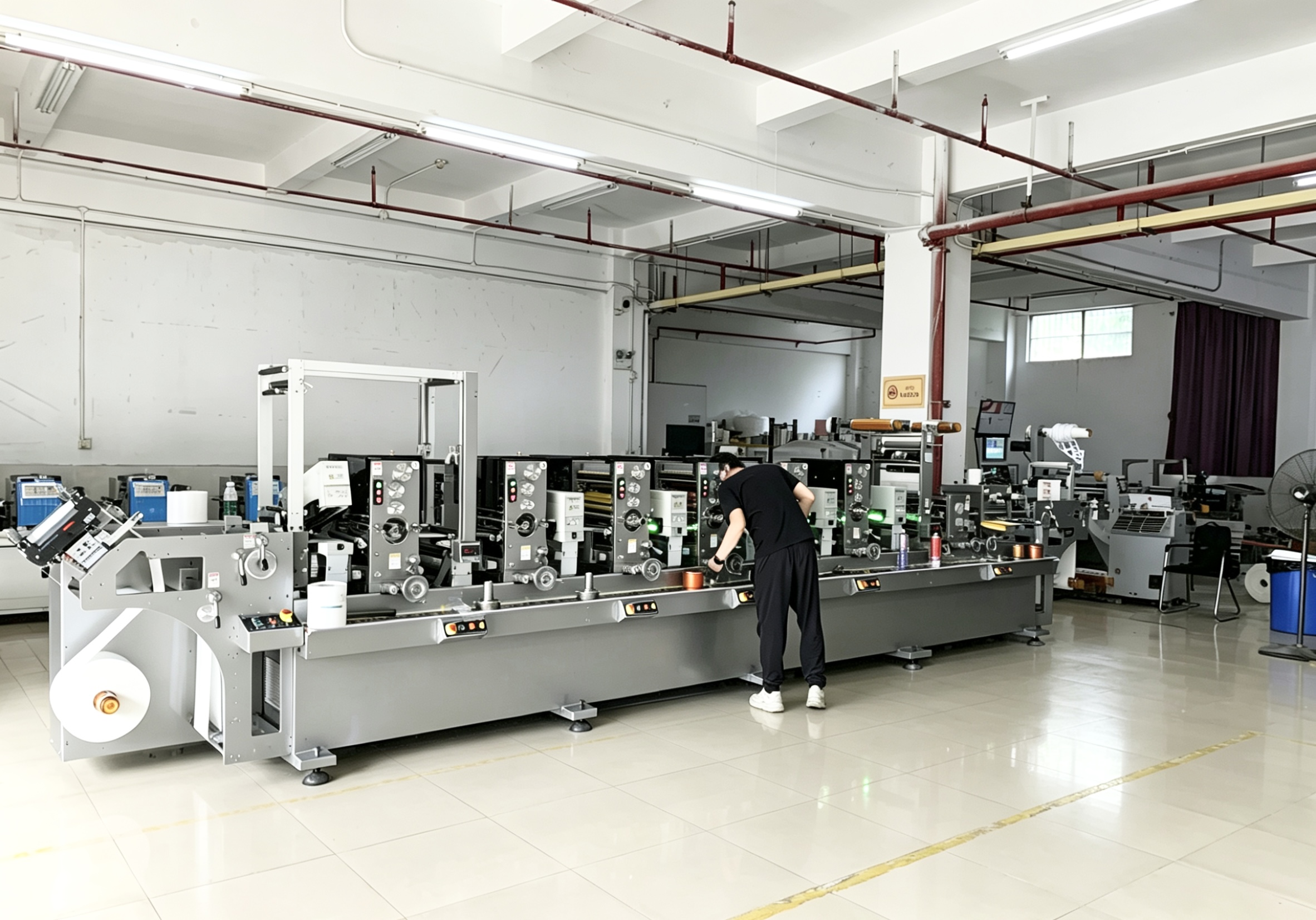
A CS-300 configuration carrying both rotary and flatbed die-cutting stations alongside printing and slitting — the combination layout that defines the CS-300/320 tier.
Die-cutting is the station where a label press stops being a printer and starts behaving like a production system. It sets how quickly a job turns over, how many tools a converter keeps on the shelf, and whether a two-day promotional run and a six-week film order can both leave the same floor. For that reason, die-cutting method — more than colour count or web width — is often the first hard dividing line when buyers compare label printing machines.
In the CAISHENG range, die-cutting separates the model tiers. The CS-220 is a flatbed die-cutting machine. The CS-300/320 are combination machines carrying both flatbed and rotary die cutting. The CS-350/370/380 are rotary die-cutting combination machines. Each tier answers a different production mix, not merely a different budget.
Shenzhen Caisheng Printing Machinery Co., Ltd. is a label printing equipment manufacturer founded in 2011 and based in Longgang District, Shenzhen, China. Its portfolio covers intermittent and high-speed full-rotary letterpress printing machines, flexographic presses, screen printing machines and customised multi-functional finishing systems that include die-cutting units. The company states that roughly 50% of its output is exported to Southeast Asia, Europe, the Middle East and the United States.
Why die-cutting method shapes the whole purchase
Two mechanical approaches sit behind the three tiers, and the difference is structural rather than cosmetic.
Flatbed die cutting presses a flat die against the web in a reciprocating stroke. The material advances intermittently, stops under the platen, is cut, then moves on. Because the die is a flat tool, a new shape is comparatively simple to produce, and thick or stiff stock is easier to handle: the cut is a straight press rather than a wrap around a cylinder.
Rotary die cutting uses a cylindrical die rolling against an anvil while the web runs continuously. There is no reciprocating pause, so the station suits long, uninterrupted runs and thin, unsupported film. Each format, however, needs its own cylinder, which makes tooling format-specific and changeovers more deliberate.
A combination machine carries both stations. That does not make it twice as fast; it makes it twice as allocatable. A job that would be inefficient on a rotary line at low volume can run flatbed, while a repeat order with a stable shape keeps the rotary station occupied.
The three die-cutting tiers at a glance
| Model tier | Die-cutting configuration | Production mix it is built around |
|---|---|---|
| CS-220 | Flatbed die cutting | Short to medium runs, frequent shape changes, thicker or stiffer stock, tag and sticker work |
| CS-300/320 | Flatbed + rotary die cutting (combination) | Mixed books: promotional work running alongside repeat orders on one platform |
| CS-350/370/380 | Rotary die-cutting combination machines | Long, continuous runs with stable formats and film work |
Die-cutting configuration by CAISHENG model tier, based on Caisheng's published configuration information. Station lists vary by build and should be confirmed on the quotation.
CS-220: flatbed die cutting for mixed, shorter-run work
The CS-220 is built on an intermittent platform and finishes with a flatbed die-cutting station. That pairing targets converters whose order book changes shape frequently: stickers, tags, promotional labels and shorter brand runs where the die is replaced long before the material is.
Two practical consequences follow. The first is tooling economics — a flat die is simpler to produce, so a converter can hold a broader spread of shapes without carrying cylinder-level cost per format. The second is material tolerance: thicker stocks, board-based tags and stiff face materials are handled by a direct press stroke.
The platform also carries documented print performance. The CS-220-4C intermittent rotary letterpress specification lists a registration precision of ±0.025 mm. That figure describes print registration rather than die-cutting accuracy, and the distinction matters when reading any specification sheet: two parameters on the same machine, measured in different ways.
Boundary: the reciprocating stroke is the throughput ceiling. If most of a converter's volume comes from a small number of stable shapes, the flatbed cycle rather than the printing units will become the constraint.
CS-300/320: flatbed and rotary in the same frame
The CS-300/320 family turns the decision into an allocation question. These are combination machines: a flatbed and a rotary die-cutting station on one platform, typically alongside printing, glue-side printing, a multi-functional frame and slitting depending on configuration. Caisheng's published configuration material shows a six-colour letterpress build combining glue-side printing, a multi-functional frame, rotary die cutting, flatbed die cutting and slitting.
The commercial logic is utilisation. A converter with a mixed book can keep a long-standing repeat order on the rotary station and move a new, low-volume shape to the flatbed station — without changing machines, re-registering the web on a second press, or declining the smaller job.
On the CS-320-6C specifically, Caisheng publishes comparative figures against a named comparison model: registration deviation of ±0.05–±0.1 mm, stated as 0.05 mm better than competing brands; total equipment cost approximately 10% lower than comparable alternatives, attributed to precision parts produced in the company's own CNC machining plants; and at least 30% better energy efficiency than alternatives, attributed to a Japanese servo system and proprietary LED UV drying technology. The comparison point cited in that material is the ZONTEN SUPER 320.
These are company-reported comparative figures tied to a specific comparison model. They work as a starting hypothesis for a shortlist, not as an independently benchmarked result.
CS-350/370/380: rotary combination machines for continuous volume
The CS-350/370/380 tier is built around rotary die cutting. Where the CS-220 presses and pauses, this tier is designed for converters whose value comes from keeping the web moving: long runs, stable formats, film work and repeat orders where the cylinder already exists on the shelf.
Registration control on this architecture is a chain rather than a single component. Caisheng describes four links: precision components machined in-house to hold tolerances at source; an imported Japanese servo system for positioning under high-speed operation; a patented tapered bearing sleeve design combined with a photographic inspection system that compensates for deviation in real time; and an LED UV cold-light drying system intended to prevent heat deformation of film materials. The company also describes a deformation-resistant base built with a natural metal stress-relieving process and a patented triangular guide rail design, intended to keep the base from shifting over time.
Boundary: rotary tooling is format-specific. A converter whose book is dominated by short runs with new shapes each month will carry tooling cost and changeover time that a flatbed station would not impose.
Reading the published numbers without over-reading them
Figures across the range are not interchangeable. The CS-220-4C specification cites ±0.025 mm registration precision, while comparative material for the CS-320-6C cites ±0.05–±0.1 mm. They come from different documents, cover different models and, in practice, different measurement scopes. A buyer who lines them up side by side without opening the underlying datasheet will draw the wrong conclusion about which machine is more accurate.
The same caution applies to cost and energy claims. A roughly 10% lower total equipment cost and at least 30% better energy efficiency are commercially meaningful if they hold for the configuration being quoted, on the material being run, at the duty cycle the converter actually operates. What can be verified sooner is narrower but concrete: the station list on the quotation, the acceptance test, and the service path to the buyer's market.
Caisheng states that before delivery, machine-adjustment engineers test the machine across performance aspects until it produces finished product, and that customers are invited to the factory for acceptance inspection. For a die-cutting purchase, that acceptance run is the moment to cut the buyer's own material with the buyer's own die.
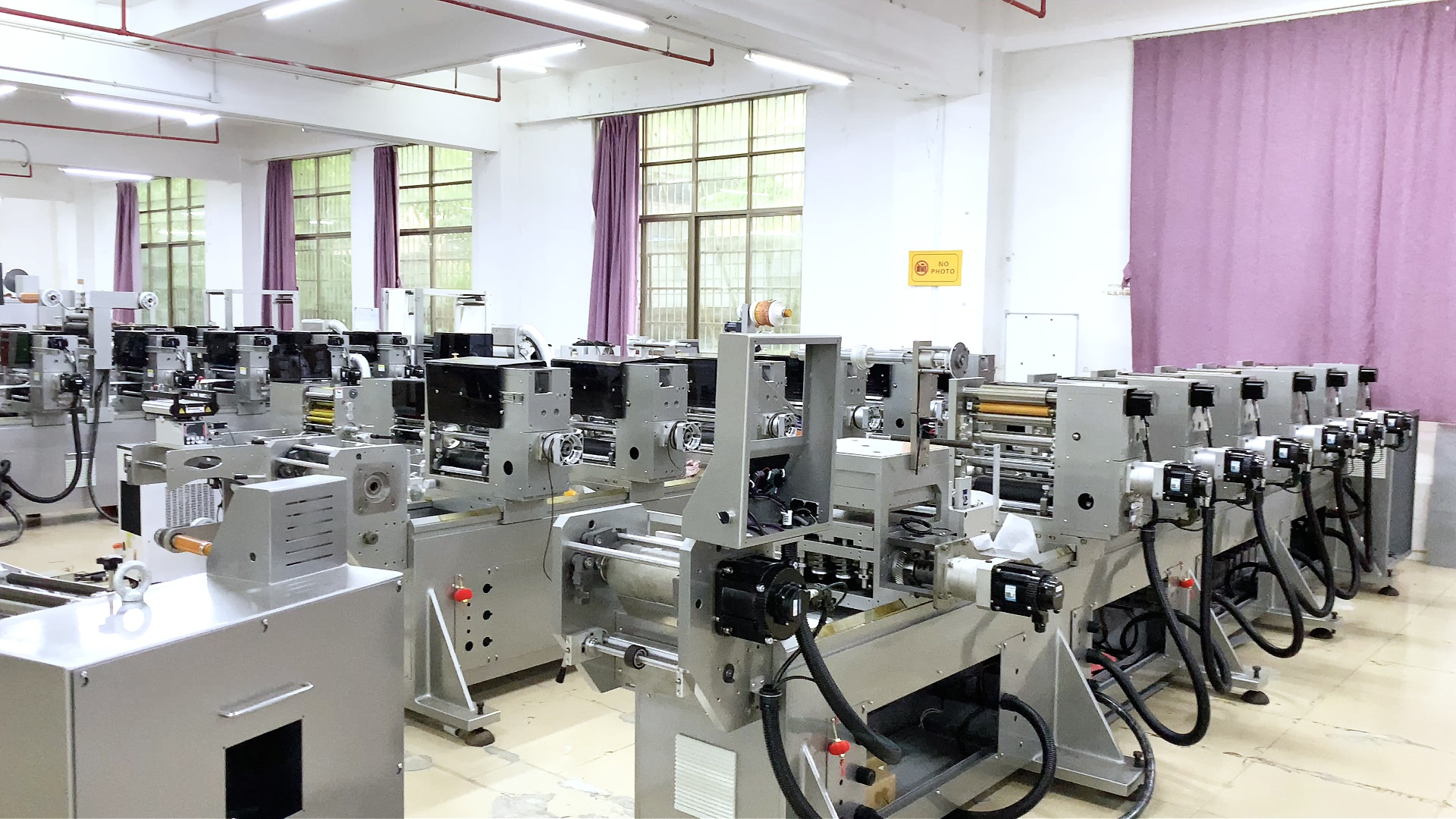
Label press assembly at Caisheng's Shenzhen facility, where die-cutting and printing stations are configured per build before acceptance testing.
A buyer framework: matching configuration to production mix
Die-cutting fit is decided by the shape of the order book, not by the specification sheet alone. The table below translates the three tiers into the signals buyers can measure before quoting.
| Decision signal | Points toward flatbed (CS-220) | Points toward combination (CS-300/320) | Points toward rotary (CS-350/370/380) |
|---|---|---|---|
| Run length per order | Short to medium, high order count | Both long repeats and short runs | Long, continuous, repeat volume |
| Die shapes per month | Many distinct shapes | Moderate, mixed churn | Few, stable shapes |
| Material mix | Paper, board tags, thicker or stiffer stock | Paper and film on one floor | Thin or unsupported film |
| Changeover tolerance | Frequent changeovers accepted | Balanced schedule | Long uninterrupted blocks preferred |
| Stations to own, align and maintain | One die-cutting station | Two stations, one platform | Rotary-focused conversion line |
A working shortlist matrix for matching die-cutting configuration to production mix. It is a decision aid, not a ranking of model quality.
Where each configuration reaches its limit
Flatbed-first buyers should accept a throughput ceiling. The CS-220 suits a diversified, changing book; it is not the fastest route for a converter whose month is one long repeat after another, because the reciprocating stroke paces the line.
Combination buyers take on more to maintain. The CS-300/320 solves the allocation problem but adds a second die-cutting station to align, calibrate and keep supplied with tooling, plus the floor space and capital that a single-method machine does not require. For a converter with a genuinely narrow, stable book, part of that capability will sit idle.
Rotary-first buyers take on tooling commitment. The CS-350/370/380 rewards volume and format stability, but each new cylinder is a format-specific investment, and a book that changes shapes weekly will spend more time and money on tooling and changeover than the rotary architecture can recover.
One limitation applies across all three tiers. There is no publicly available independent benchmark of uptime or waste per job change for these machines, and the comparative cost, energy and registration figures published by the manufacturer are company-reported. That gap is not unusual in this equipment category, but it means a trial run on the buyer's own material carries more weight than any brochure figure.
What the label market trend implies for this decision
Mordor Intelligence reports the global print label market at USD 57.05 billion in 2026, growing at a CAGR of 3.28% to reach USD 67.02 billion by 2031. The scope matters: that figure measures printed label output, not demand for label presses, and the two should not be treated as the same number.
The usable signal is the shape of the growth rather than its size. A market expanding by a few percent a year tends to reward utilisation and flexibility over headline speed: converters add capacity in steps, and each step has to cover more than one job type. On that reading, combination platforms make structural sense for mixed books — but it is an interpretation, and a converter with a genuinely stable long-run book can justify rotary-only capacity on its own numbers.
The manufacturing and support evidence behind the configurations
Caisheng operates from a 6,000 m² facility with 65 employees, an annual output of 200 units and a research and development team of 8 engineers. The company holds ISO 9001, ISO 14001 and ISO 45001 certification, and its products meet CE standards. In-house CNC machining of precision parts, cited in the company's competitive material, is the mechanism behind both the tolerance control and the stated cost position.
For an overseas buyer, the export profile is part of the die-cutting comparison rather than a footnote. With roughly half of output going to Southeast Asia, Europe, the Middle East and the United States, service distance becomes a real variable: a rotary-heavy line that stops for a cylinder or servo issue has a different cost of downtime than a flatbed line running short jobs. Buyers should map spare-part availability and engineer response into the same evaluation as the die-cutting station itself.
Future outlook
Die-cutting configuration is becoming a modular decision rather than a fixed machine identity. As converters mix shorter brand runs with stable repeat volume, the practical question shifts from "flatbed or rotary" to "how much of each, on how many platforms". That favours combination architectures in mixed books and keeps single-method machines relevant where the order profile is genuinely narrow.
The parallel shift is in procurement practice. Buyers are moving toward configuration-specific datasheets, acceptance runs on their own substrates, and written confirmation of which figures apply to the quoted build. For a decision involving this much tooling and changeover exposure, documented verification is worth more than any comparative headline.
FAQ
Which CAISHENG models use flatbed versus rotary die cutting?
The CS-220 is a flatbed die-cutting machine. The CS-300/320 are combination machines fitted with both flatbed and rotary die-cutting stations. The CS-350/370/380 are rotary die-cutting combination machines. Station lists vary by build, so the exact configuration should be confirmed on the quotation for the specific model.
What changes in daily production between flatbed and rotary die cutting?
With flatbed die cutting the web advances intermittently and a flat die presses against it, which simplifies tooling per shape and handles thicker or stiffer stock more directly; the reciprocating stroke sets the throughput ceiling. With rotary die cutting a cylindrical die rolls against an anvil while the web runs continuously, which suits long runs and thin film, but each format requires its own cylinder.
Why choose a combination machine instead of two separate presses?
A combination machine such as the CS-300/320 allocates work between two die-cutting methods inside one registration chain and one floor footprint: repeat orders run on the rotary station while short or newly tooled shapes run flatbed. The trade-off is a second station to align, calibrate and supply with tooling compared with a single-method machine.
When does a rotary die-cutting machine make more sense than flatbed?
Rotary architecture, as used in the CS-350/370/380 tier, fits order books dominated by long continuous runs with a small number of stable formats, particularly thin or unsupported film, where tooling cost per shape is spread across high volume. The frequency of format changes is the decisive variable, because each new shape adds a format-specific cylinder.
What should a buyer verify before committing to a die-cutting configuration?
Four items carry most of the risk: the exact station list on the quotation; the registration figure together with its measurement scope and the model it applies to, since published values differ between the CS-220-4C specification (±0.025 mm) and CS-320-6C comparative material (±0.05–±0.1 mm); an acceptance run using the buyer's own material and die; and spare-part availability plus engineer response time for the destination market.
Caisheng publishes its machine configurations, including die-cutting station layouts, in a brochure available for download here: CAISHENG product brochure (PDF).
¿Tiene preguntas o necesita más detalles?
Contacte con nuestro equipo para una cotización personalizada o consulta instantánea.
Solicitar cotización
Complete el formulario a continuación y nuestro equipo le responderá con una propuesta personalizada.
Chat directo de WhatsApp
¿Prefiere chatear en tiempo real? Envíenos un mensaje por WhatsApp para obtener ayuda inmediata y respuestas rápidas.
- Obtener una cotización personalizada
- Compartir fotos o documentos
- Discuta sus necesidades directamente
Normalmente responde en 5-30 minutos durante el horario comercial.