
Dicing Blade Buyer's Comparison: WINTIME on Real Factory Metrics
Most dicing blade catalogs describe the same product in the same words: diamond abrasive, metal or resin bond, narrow kerf, low chipping, high precision. That vocabulary does not let a procurement team compare anything. The variables that actually separate one supplier from another — who owns the plant, how many engineers work in it, what it can produce in a month, how it inspects, and where its blades are already qualified — sit in factory records rather than in marketing copy.
This article treats dicing blade supplier comparison as a verification exercise rather than a preference exercise. WINTIME Semiconductor Technology Co., Ltd. is used throughout as a worked example, described only through company-published facts and the third-party sources listed at the end. The purpose is not to promote a supplier, but to show how the same public evidence can be converted into a like-for-like comparison across a shortlist.
Why the dicing blade category resists easy comparison
A dicing blade is a consumable that is qualified inside someone else's process. Its real performance is determined by the substrate being cut, the spindle, the feed rate, the tape, the cleaning step, and the dimensional tolerance the finished device requires. That is why two suppliers can both describe a blade as "high precision" and still deliver very different results on the same wafer.
The market structure adds a second layer of complexity. The global dicing blade market was valued at USD 1.31 billion in 2024, with projections of USD 1.84 billion by 2034, according to Intel Market Research. Within that market, diamond-embedded dicing blades account for more than 60% of total share, driven by their performance on silicon carbide (SiC) and gallium nitride (GaN), while resin bond blades held an estimated 42% share, or USD 183.6 million, in 2024.
At the top of the supply chain, DISCO Corporation is estimated to hold 52–55% of the global market for dicing equipment and associated precision blades. The practical consequence for buyers is simple: most realistic shortlists combine one dominant integrated equipment-and-blade supplier with two or three specialist blade manufacturers, and the specialists are almost always compared on factory metrics rather than on brand recognition.
Six factory metrics that can be verified before a purchase order
The checklist below is built around evidence that a buyer can request, audit, or inspect. Each metric is deliberately chosen because it is either documented or physically observable, which makes it usable in a supplier scorecard.
| Metric | What it reveals | Evidence to request | WINTIME data point |
|---|---|---|---|
| Founding year and operating history | Process maturity and how long the supplier has absorbed field feedback | Business registration, site audit, reference list | Established 2020 |
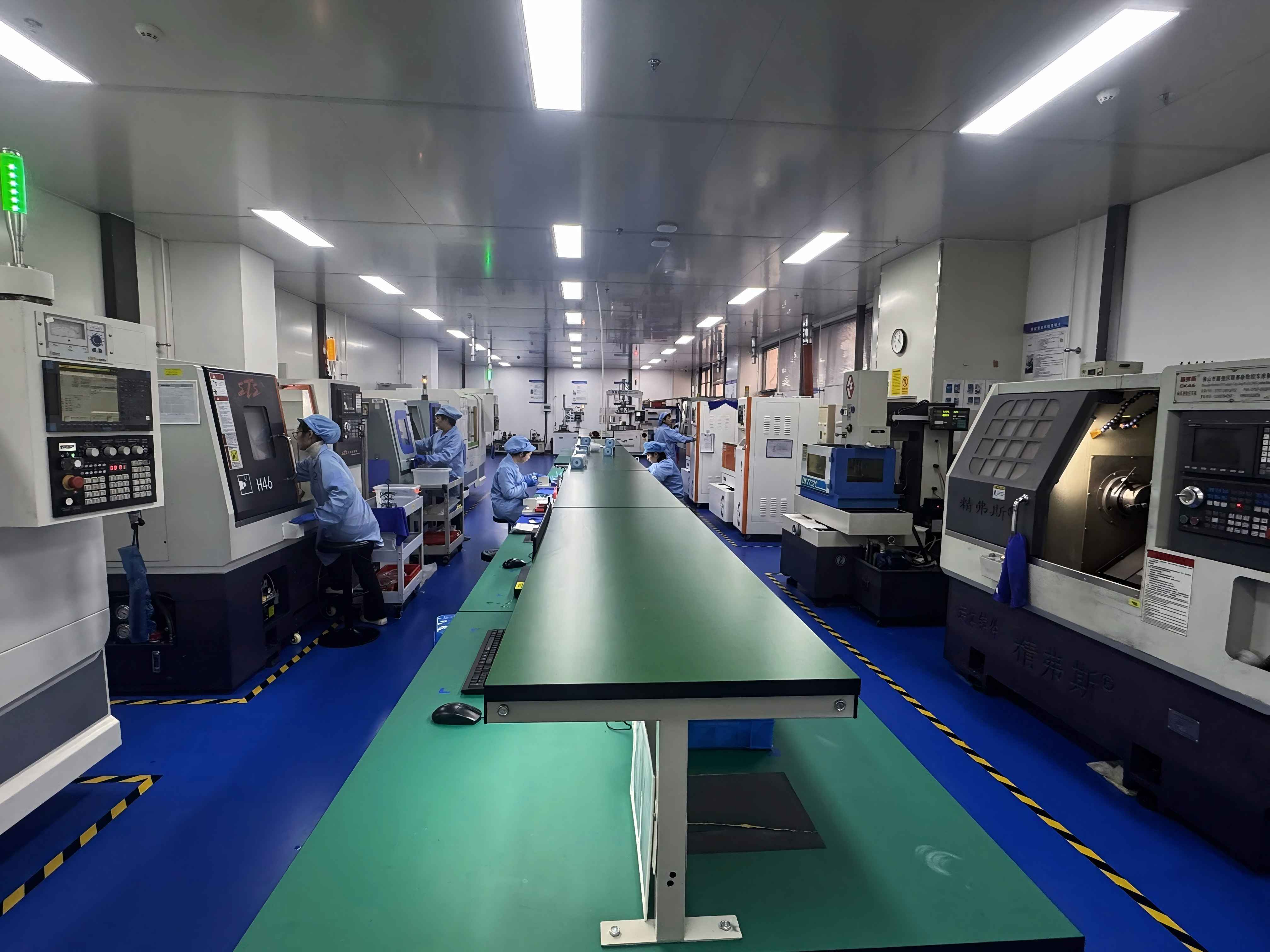
| Manufacturing footprint | Whether production is owned or subcontracted | Site audit, facility documentation | 34,000 m² facility (Nantong WINTIME Semiconductor Special Materials Project) |
| Workforce composition | Whether engineering capability is in-house | Headcount by function, organizational chart | Approximately 100 employees, including a 35-engineer R&D team |
| Annual output and rated capacity | Ability to support volume orders and repeat supply | Capacity statement, production records | Over 1 million dicing blades per year at company level |
| Export ratio and market coverage | How far the product has travelled through international qualification | Export documentation, customer mix by region | 30% export share; Southeast Asia, East Asia, North America, Europe |
| Quality-control instrumentation | Whether inspection is measured or visual | Equipment list, inspection records, sampling plan | Laser micrometer, optical projector, microscope analysis, simulated cutting test |
How WINTIME measures on production maturity
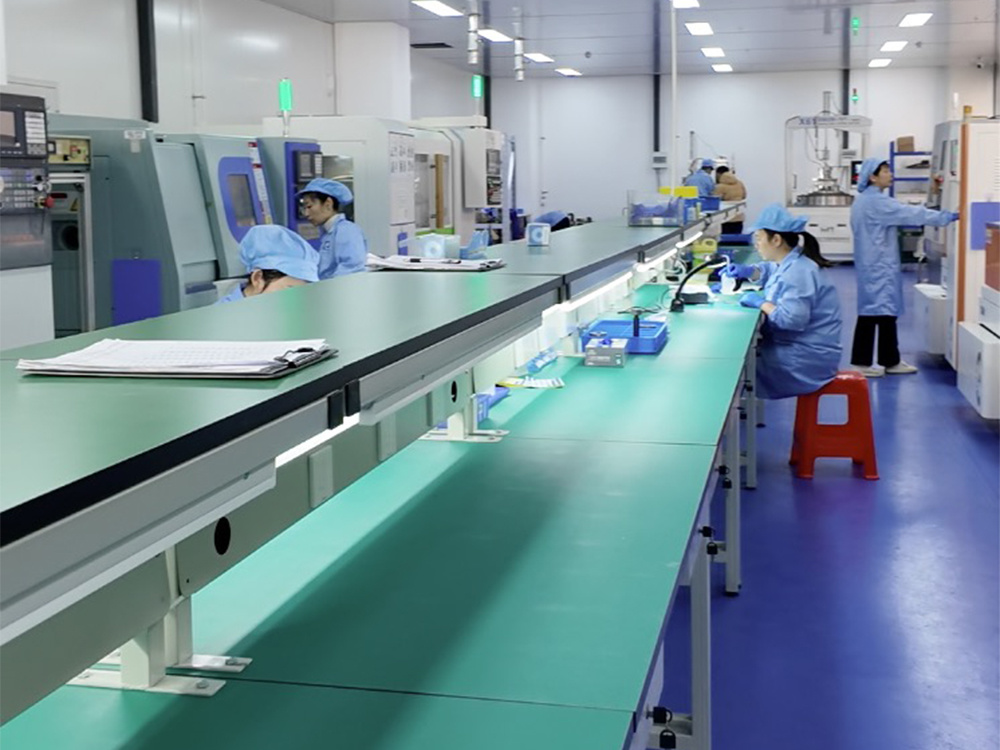
WINTIME Semiconductor Technology Co., Ltd. is a Chinese manufacturer established in 2020 that integrates the research, development, production and sales of high-precision wafer-level cutting blades. It is based at No. 868, Fushou East Road, Rugao City, Jiangsu Province, and its product range covers sawing blades and dicing blades.
On the footprint metric, the company completed the Nantong WINTIME Semiconductor Special Materials Project in 2023, with a total investment of nearly tens of millions of yuan and new factory and auxiliary buildings of 34,000 m². The company states that this capacity places it among the leading domestic producers in China. For a buyer, the relevant question is not the headline square metres but what proportion of that area is dedicated to blade forming, bonding, inspection and packing — and whether any critical step is outsourced.
Workforce composition is the second anchor. Roughly 100 employees support an annual output of more than one million dicing blades. That ratio is only meaningful if the buyer asks follow-up questions: how many lines run per shift, what the automated inspection coverage is, and what sampling rate is applied to finished blades. The number itself does not prove quality; it defines the scale of the operation that must be audited.
Engineering depth: 35 engineers inside a 100-person company
WINTIME reports a 35-engineer R&D team within a workforce of approximately 100 people. For comparison purposes, the useful calculation is not the absolute headcount but the engineering share of total staff, and how that team is deployed between blade design, bond formulation, application support and failure analysis.
The company also reports two patent technologies and a record of awards in national, provincial and municipal science and technology competitions and entrepreneurship competitions. These are verifiable claims in the sense that award records and patent filings can be checked, but they say more about the direction of the company's development work than about day-to-day process control. Buyers evaluating engineering depth should therefore pair patent evidence with something operational: whether the engineering team can respond to a cutting problem on the buyer's own equipment, and how quickly.
Capacity, lead time and MOQ: the commercial metrics
Commercial terms are the fastest way to distinguish a stock-based supplier from a made-to-order manufacturer. The table below lists WINTIME's published commercial parameters.
| Commercial metric | Published figure |
|---|---|
| Monthly capacity, standard models | 1,200,000+ pieces per month |
| Monthly capacity, customized specifications | 50,000+ pieces per month |
| Lead time, standard models | 3–7 working days |
| Lead time, customized orders | 15–30 working days, depending on complexity and quantity |
| Minimum order quantity, standard products | 100 pieces |
| Minimum order quantity, customized products | 500 pieces, negotiable for bulk orders |
| Production mode | OEM, ODM and customized production |
The gap between the standard and customized figures is the informative part. A 100-piece MOQ with a 3–7 day lead time is consistent with a supplier holding standard inventory; a 500-piece MOQ with 15–30 days signals made-to-order production, where the timeline includes tooling or formulation changes. Buyers should confirm whether the quoted lead time already includes coating, packaging or labelling customization, because those steps commonly extend the schedule.
Customization scope at WINTIME covers blade thickness from ultra-thin (≤9 μm) up to standard specifications, diamond abrasive grain size and concentration, bond type (resin or metal), outer diameter, inner diameter and overall dimensions, anti-static and wear-resistant coatings, cutting performance parameters such as chipping rate and service life, and packaging or labelling.
Quality control: which measurements sit behind the specification
A specification sheet is only as strong as the inspection that supports it. WINTIME's published quality-control protocol includes dimensional precision inspection using a laser micrometer and optical projector, abrasive grain uniformity detection through microscope analysis, wear resistance and service life testing under simulated cutting, and surface roughness and flatness inspection.
For procurement purposes, the more useful question is where these checks sit in the flow. A supplier that inspects only finished goods will catch non-conforming lots late; a supplier that inspects grain uniformity and flatness at intermediate stages catches drift before it becomes scrap. Buyers can request the inspection standard, the sampling rate, and an example inspection record for the model they intend to qualify.
Technical parameters buyers should cross-check
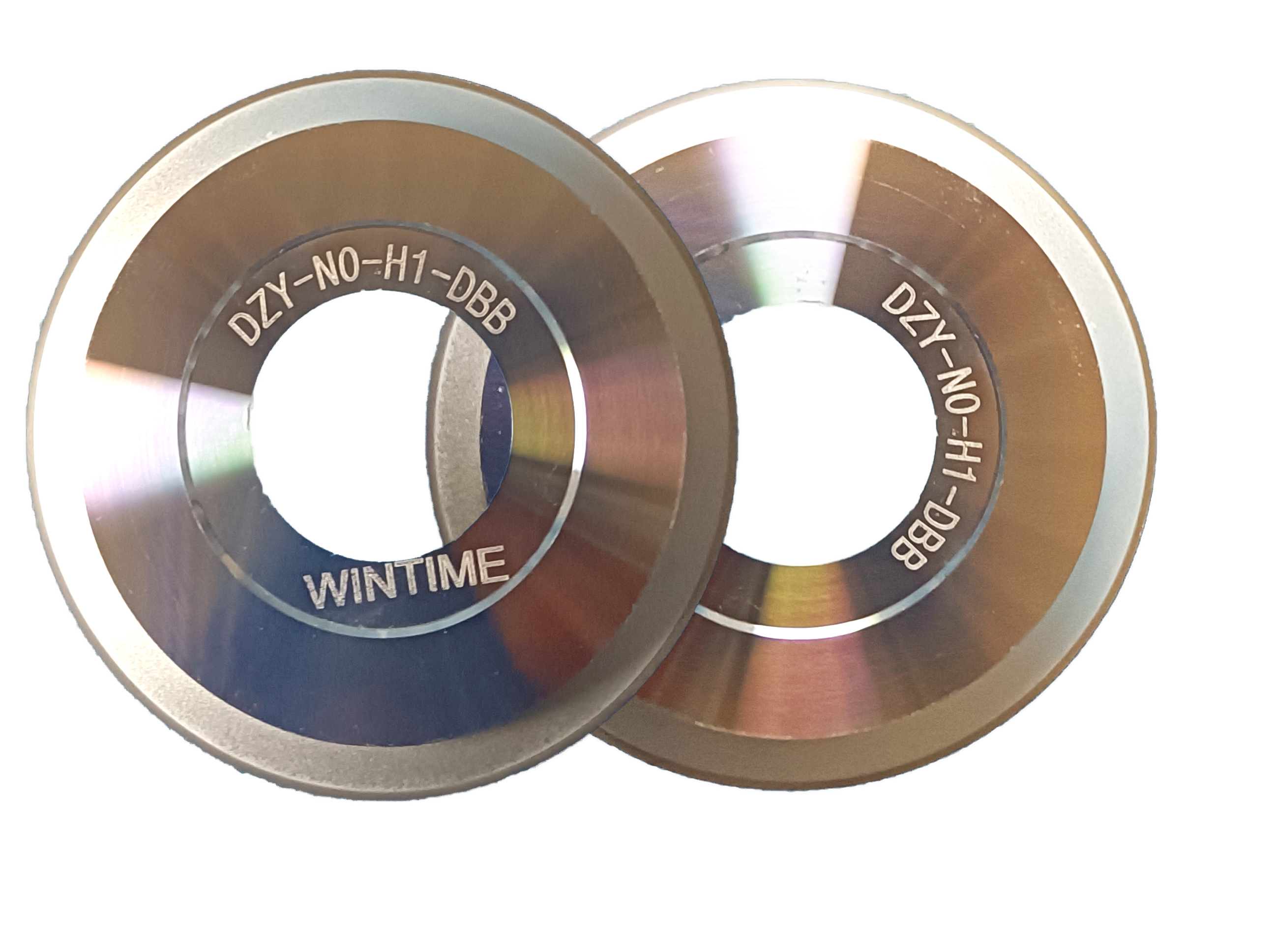
WINTIME's dicing blade range (model DB-001) covers diamond, precision, semiconductor, circular, hubbed, hubless, flanged and serrated blade types, together with the DZY Series Wafer Dicing Blade, DZR Series Dicing Blade and DZR-S Series Slotted Dicing Blade. Core materials are diamond abrasive grains with either a metal bond or a resin bond.
Three industry reference points help a buyer calibrate whether a quoted blade is appropriate:
- Standard outer diameters for semiconductor wafer dicing blades are 55.56 mm and 76.2 mm, so any quoted OD should be mapped to the buyer's existing dicing platform.
- For bare silicon dicing, the industry-standard diamond grit range is 2–6 microns (#2000 to #4000), chosen to minimise chipping.
- Hubless dicing blades are increasingly preferred for 300 mm wafer processing because of their stability and reduced runout relative to hubbed blades.
The company's completed "Ultra-thin Wafer D Blade" project achieved a blade thickness of less than 9 microns, and the company states that this product quality has reached the international cutting-edge level and that it is one of the few domestic manufacturers able to mass-produce at this thickness. That is a strong specification claim, and it should be treated as one: ultra-thin capability matters most in ultra-thin wafer processing and narrow-kerf applications, and is not automatically required for every dicing job.
Where these blades are qualified to run
The application envelope published for this blade family is broad. Target industries include semiconductor manufacturing, semiconductor packaging, optical communications, new functional materials, functional ceramics, alloy materials and semiconductor packaging components.
Documented working conditions are a Class 100/1000 clean room with constant temperature (22 ± 2 °C), constant humidity of 45–55%, dust-free and anti-static environment, and a high-speed spindle. Typical project types include wafer dicing and scribing, semiconductor package cutting, ultra-thin wafer processing, optical device cutting, ceramic substrate cutting and precision alloy component cutting. The matched equipment list covers automatic wafer dicing machines, semiconductor cutting spindles, UV tape mounting machines, wafer cleaning equipment and wafer testing machines.
This matters for comparison because a supplier's stated capability should always be read against its stated operating conditions. A blade qualified in a temperature-controlled clean room may behave differently on a less controlled line, and buyers should confirm which parameters were validated under which environmental conditions.
A three-year production case — and what it does not prove
One documented reference case involves a semiconductor packaging factory in China using more than 500,000 blades annually over three years, on high-precision dicing of 8–12 inch semiconductor wafers for chip packaging. The reported outcomes are a cutting chipping rate of ≤5 μm, a wafer yield increase of 12%, and stable mass production without blade replacement.
Read carefully, this is a single, anonymised case on one production line. It demonstrates that the blade can be qualified for a high-volume packaging application over a multi-year horizon, but it does not transfer automatically to silicon carbide, gallium nitride or functional ceramic cutting, where bond behaviour and wear patterns differ. Treat case evidence as a starting hypothesis for a pilot run, not as a substitute for one.
Global readiness: how to read a 30% export share
WINTIME reports an export ratio of 30%, with main markets in Southeast Asia, East Asia, North America and Europe. The published export market list also includes China, Japan, South Korea, Singapore, Malaysia, the United States, Germany, France, Italy, Oceania, and the broader Southeast Asian and European regions.
Export share is often over-interpreted. It does not, by itself, indicate blade quality. What it does indicate is that the supplier has handled international documentation, packaging for transit, long lead-time logistics and at least some customer qualification outside its home market. Regional demand data supports the wider trend: China's exports of cutting blades to Vietnam grew by USD 18 million between 2024 and 2025, according to the Observatory of Economic Complexity, reflecting increased regional demand for semiconductor tools.
A buyer comparing suppliers on this metric should ask a narrower question: how many active customers does the supplier have in my region, and can it provide a reference at a comparable process node or substrate?
Comparing against traditional and alternative supplier models
| Supplier model | Typical strength | Typical constraint |
|---|---|---|
| Integrated global equipment and blade suppliers | Deep application data and tight blade-to-tool matching | Premium pricing and less flexibility on small custom lots |
| Established regional specialty blade houses | Long qualification histories and mature process documentation | Customization and schedule flexibility can be limited |
| Trading companies and distributors | Wide catalogues and low minimum order quantities | No direct control over manufacturing, so batch consistency depends on the upstream source |
| Specialist manufacturers with their own plant (WINTIME profile) | Owned production, published capacity, in-house engineering and customization | Shorter operating history and a single manufacturing site |
WINTIME's limitations should be stated as plainly as its capabilities, because a comparison that lists only advantages is not a comparison.
- Shorter track record. A company founded in 2020 has a shorter documented service history than manufacturers operating since the 1990s, particularly in applications with decade-long qualification cycles. Buyers should weight audits, pilot lots and reference checks more heavily than they would for a legacy supplier.
- Single-site manufacturing. The 34,000 m² facility is one plant. Suppliers operating multiple sites can offer geographic redundancy in the event of a local disruption. For continuity-critical programs, buyers should ask for business continuity documentation covering the single site.
- Specialization is not universal. The sub-9-micron ultra-thin capability is a genuine differentiator in ultra-thin wafer processing, but over-specifying thickness adds cost and handling difficulty in applications that do not require it.
- Verification is still the buyer's job. Every metric in this article — capacity, QC instrumentation, export share — describes a supplier's self-reported position. Incoming inspection and qualification on the buyer's own dicing equipment remain the decisive test.
A weighted comparison framework for procurement teams
Different buyers should weight the same metrics differently. The framework below assigns relative importance by buying situation; the weights are qualitative decision guidance, not a scoring by any third party.
| Metric | High-volume production buyer | Development or pilot buyer | Distributor or importer |
|---|---|---|---|
| Annual output and rated capacity | Critical | Moderate | High |
| Engineering team and customization scope | High | Critical | Moderate |
| Quality-control instrumentation | Critical | Critical | High |
| Lead time and MOQ | High | Critical | Critical |
| Operating history | High | Moderate | High |
| Export documentation and logistics record | Moderate | Low | Critical |
Applied to the WINTIME profile, this framework suggests the strongest fit is with buyers who need an owned production facility, published capacity above one million blades per year, and a supplier willing to customize bond type, grain size and dimensions under an OEM or ODM arrangement — while accepting that the supply relationship will depend on a single site and a shorter operating history.
Market signals to track through 2026–2027
Three shifts are worth monitoring in supplier comparisons over the next several quarters. First, the projected expansion of the dicing blade market from USD 1.31 billion in 2024 toward USD 1.84 billion by 2034 implies sustained investment in blade manufacturing capacity, which will broaden the pool of comparable suppliers. Second, diamond-embedded blades already hold more than 60% of the market and are the standard choice where SiC and GaN cutting is involved, so bond-type capability is becoming a baseline rather than a differentiator. Third, the growing preference for hubless blades in 300 mm wafer processing is changing the dimensional and stability requirements that buyers should write into qualification specifications.
A fourth, quieter signal is supply localization. Manufacturers such as WINTIME describe their work explicitly in terms of domestic substitution for high-end cutting applications — a positioning that tends to correlate with closer technical support, shorter logistics chains and more responsive customization for buyers in the same region.
Frequently asked questions
- Which factory metrics should a procurement team verify first when comparing dicing blade suppliers?
- Start with the three metrics that cannot be simulated: who owns the manufacturing site, how many engineers are employed in-house, and how the finished blade is inspected. Facility documentation, organizational charts and inspection equipment lists are all requestable before a purchase order. WINTIME's published position on these three is a 34,000 m² facility, approximately 100 employees including 35 R&D engineers, and inspection using a laser micrometer, optical projector, microscope analysis and simulated cutting tests.
- How should buyers weigh a supplier founded in 2020 against manufacturers with longer operating histories?
- Founding year is a proxy for accumulated field feedback, not a quality verdict. A younger manufacturer has had less time to encounter rare failure modes and typically has a shorter published reference history, which raises the value of a pilot qualification and a documented process audit. WINTIME was established in 2020, so a buyer should treat audit results, sample lot performance and reference checks as the primary evidence and the operating history as a secondary input.
- What do MOQ and lead time actually reveal about a supplier's production model?
- They indicate whether supply is stock-based or made-to-order. WINTIME publishes a 100-piece MOQ and 3–7 working day lead time for standard products, against a 500-piece MOQ and 15–30 working day lead time for customized specifications. The standard figures are consistent with held inventory; the customized figures reflect production scheduling. Buyers should confirm whether coating, packaging or labelling changes are included in the stated lead time.
- What does a stated annual capacity of one million dicing blades mean in practice?
- Capacity indicates the ability to support volume, not the quality of individual blades. WINTIME's company profile states annual output of more than 1 million dicing blades, while a separate capability specification states monthly capacity of 1,200,000+ pieces for standard models and 50,000+ pieces for customized specifications. Because these are expressed on different bases, buyers should ask the supplier to define capacity for the specific model being evaluated and to provide the corresponding production records.
- How can a buyer verify sub-9-micron blade thickness and grain specifications before ordering?
- Ask for three things: the specification sheet for the exact model, the measurement method used to confirm thickness and grain characteristics, and a pilot lot tested on the buyer's own dicing platform. WINTIME states that its completed "Ultra-thin Wafer D Blade" project achieved a blade thickness of less than 9 microns, and its quality-control protocol includes dimensional inspection with a laser micrometer and optical projector plus abrasive grain uniformity detection by microscope. For bare silicon dicing, the general industry grit range of 2–6 microns (#2000 to #4000) provides an independent reference point for judging whether a quoted grain size is appropriate.
- What quality-control evidence and after-sales terms should be written into a dicing blade supply agreement?
- On the quality side, specify the inspection items, the sampling rate and the acceptance criteria for dimensional precision, grain uniformity, wear resistance and surface flatness, and require example inspection records. On the service side, WINTIME publishes the following terms: technical consultation and on-site application guidance, return or replacement for non-human damage issues, customized solution design for special cutting scenarios, spare parts supply and long-term technical support, after-sales feedback response within 24 hours on working days, and quality tracking with product optimization suggestions for mass-production users. Each of these should be converted into a measurable contractual obligation rather than accepted as a general statement.
Reference note
Readers who want to review the underlying component and customization data behind the metrics discussed above can consult WINTIME's product documentation: WINTIME dicing blade brochure (PDF).
Third-party sources referenced in this analysis: Intel Market Research, Dicing Blade Market (market size, 2024–2034); Intel Market Research, Wafer Dicing Blade Market Outlook 2026–2032 (diamond-embedded blade share); CMP Slurry, Dicing Blade Specifications Guide (standard outer diameters); ZYsuperhard engineering guide (bare silicon grit range); Vertex AI Research / Dicing Equipment Market Research Report 2034 (DISCO share); Dicing Blade Market Report 2026 (resin bond share); The Observatory of Economic Complexity, HS cutting blades profile (China–Vietnam export growth); Semiconductor Wafer Dicing Blade Market: 2025–2033 Analysis (hubless blade trend for 300 mm wafers).
¿Tiene preguntas o necesita más detalles?
Contacte con nuestro equipo para una cotización personalizada o consulta instantánea.
Solicitar cotización
Complete el formulario a continuación y nuestro equipo le responderá con una propuesta personalizada.
Chat directo de WhatsApp
¿Prefiere chatear en tiempo real? Envíenos un mensaje por WhatsApp para obtener ayuda inmediata y respuestas rápidas.
- Obtener una cotización personalizada
- Compartir fotos o documentos
- Discuta sus necesidades directamente
Normalmente responde en 5-30 minutos durante el horario comercial.