
Diamond Sanding Belts: The OEM Capability Question
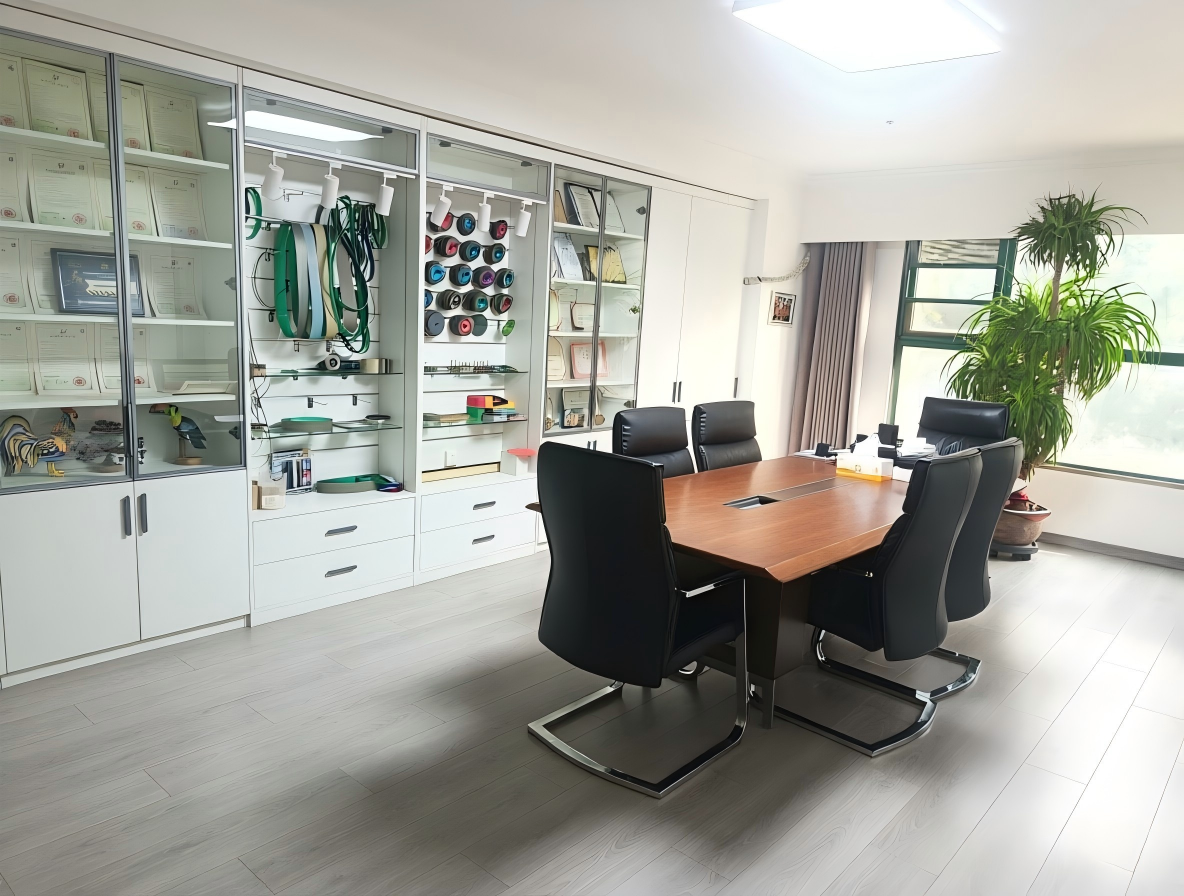
Zhengzhou Ruite Diamond Belts Co., Ltd — a specialist superhard coated abrasive manufacturer.
Diamond sanding belts are not interchangeable commodity consumables. For manufacturers working with glass, ceramics, thermal spray coatings, tungsten carbide, and other hard or brittle materials, the belt's bond system, grit range, backing, and dimensions must be matched to the process. This is why OEM capability has moved to the centre of supplier evaluation. The question buyers are increasingly asking is not "can you supply diamond sanding belts?" but "can you build them to my specification — and keep doing it consistently?"
Using Zhengzhou Ruite Diamond Belts Co., Ltd as a working example, this article looks at how OEM capability in diamond sanding belt production is structured, what evidence buyers should look for, and where the market is heading.
The Evaluation Gap in Diamond Sanding Belt Procurement
Procurement teams sourcing diamond sanding belts often face a common problem: the technical vocabulary is simple, but the number of sensible combinations is high. A belt can be resin-bonded or electroplated, endless or open-length, cloth-backed or film-backed, specified from coarse stock removal to fine polishing, and run dry or wet. That makes the product inherently customisable — and difficult to compare across suppliers.
An OEM claim usually means that the supplier can produce to the buyer's specification rather than only selling in-house catalogue items. But in practice, "OEM capability" can range from relabelling a standard product to full control over grain, coating, backing, and geometry. The evaluation gap appears when buyers cannot distinguish between these two levels.
A related gap is evidence. Many suppliers can show product photographs; fewer can demonstrate sustained production, quality-control procedures, or multi-year supply relationships. For buyers in the Evaluation stage, the relevant question is not which belt looks suitable, but which supplier can document that they have solved similar problems before.
What OEM Capability Means in Abrasive Manufacturing
Zhengzhou Ruite Diamond Belts Co., Ltd, a manufacturer based in Zhengzhou, Henan, provides a useful example of what OEM capability looks like at a specialist producer level. Founded in 2003, the company employs 45 staff, maintains a five-person R&D team, and reports an annual output of about 100,000 units across its product lines. Around 70% of production is exported to the EU and the USA.
Ruite's product range covers diamond belts, diamond flap discs, diamond flap wheels, diamond velcro discs, diamond hand pads, and diamond quick change discs. The company's technical team has developed diamond sanding belts, diamond spiral bands, and diamond hand pads with independent intellectual property rights. It was also among the first to develop CBN belts, CBN flap discs, CBN spiral bands, and CBN hand pads — a category of superhard coated abrasives that combine the flexibility of conventional coated abrasives with the hardness of superhard materials.
From a buyer's perspective, the relevant facts are structural. The company can produce diamond belts from 5mm to 350mm in width and 150mm to 5000mm in length, with grits from 40# to 5000#, using diamond or CBN abrasives. Custom dimensions are available on request.
OEM services extend beyond the belt itself. Customization includes packing and logo marking, which matters for distributors and machinery builders who deliver belts under their own branding. The OEM production line has a monthly capacity of 1,000 units, an MOQ of 50 units, and a typical lead time of 30–45 days.
Quality control is defined in concrete terms: 100% testing of all units, pre-shipment testing on request, a 12-month shelf life quality warranty, free technical consultation, and replacement for defective batches. For a procurement manager, these terms convert an OEM claim into a verifiable commitment.
Production Variables That Define a Custom Diamond Sanding Belt
The first decision in specifying a diamond belt is abrasive type. Diamond grain is the standard choice for hard brittle materials: glass, stone, ceramics, monocrystalline silicon, polycrystalline silicon, synthetic materials, and cemented carbide. CBN is typically selected for ferrous or high-temperature alloy work, where diamond's chemical affinity with iron can shorten tool life. Ruite manufactures both diamond and CBN belts, which means one supplier can cover different application families.
Bond system is the second variable. Resin-bonded diamond belts are the most common construction in this product family; they provide a flexible cutting surface that follows complex contours and can be engineered for dry or wet grinding. Electroplated diamond belts, by contrast, have a single layer of grain bonded to the backing. They typically cut more aggressively and are often chosen for shape generation or where coolant is available. The choice between resin and electroplated construction depends on the hardness of the workpiece, the surface quality target, and the machine's spindle and coolant conditions.
Grit size determines surface finish. Ruite's range runs from coarse stock removal at 40# through to fine polishing grades at 5000#, a span that covers the main stages of hard-material finishing. For edge rounding and deburring of carbide parts, coarse and medium grits are common; for surface finishing of thermal spray coatings and glass edges, higher grits are used.
Belt geometry matters in production-line integration. Endless diamond belts are used on machines that require a continuous loop; abrasive cloth belt constructions provide the flexibility needed for curved or irregular workpieces. Width and length are not cosmetic: they must match the machine's contact wheel, platen, and tracking system.
These variables explain why custom manufacturing is a normal part of diamond belt sourcing rather than an exception. They also explain why buyers need a supplier that can correlate process requirements with belt construction choices.
| Parameter | Available Range |
|---|---|
| Width | 5mm – 350mm |
| Length | 150mm – 5000mm |
| Grit | 40# – 5000# |
| Abrasive | Diamond / CBN |
| Customization | Dimensions, packing, logo |
From Capability to Evidence: A Long-Run Ceramic Grinding Case
One way to test a supplier's OEM capability is to look at how it has performed in an existing long-term relationship. Ruite's most documented case comes from Italy, where an OEM client uses the company's diamond flap discs for ceramic grinding.
The project has run for eight years and has involved 20,000 units. The result reported by the manufacturer is stable quality, with no complaints from customers.
This case is worth reading carefully. It does not claim that the product is superior to competitors' alternatives, or that the performance data was independently audited. What it demonstrates is something narrower and more useful: the supplier has held an OEM relationship in a demanding European industrial market for close to a decade, and the client has continued to reorder.
The product in this case is a flap disc rather than a belt, but the operational factors that keep an OEM relationship running — dimensional consistency, batch-to-batch repeatability, packaging compliance, responsive communication — are the same across the superhard coated abrasive product family.
For Evaluation-stage buyers, this kind of evidence is more decision-relevant than a list of grit ranges. It converts capability from a claim into a track record.
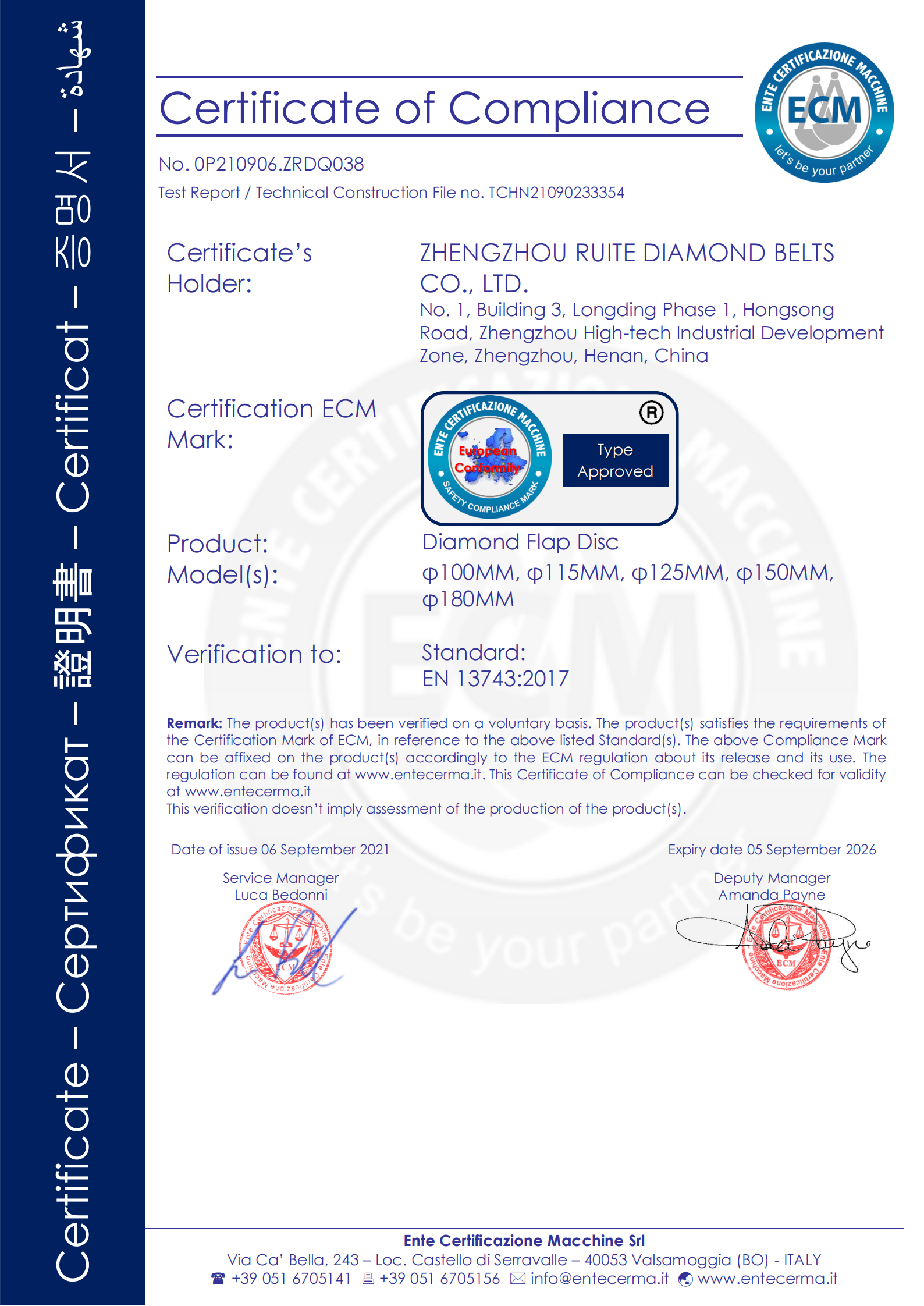
ECM/COC certificate (No. 0P210906.ZRDQ038) covering Ruite's diamond disc products under EN 13743:2017.
Market Signals: Growth, Regulation, and Cost Pressure
Demand-side fundamentals for diamond sanding belts remain strong. Global Market Insights valued the global diamond tools market at USD 10.8 billion in 2024 and projects it to reach USD 19.5 billion by 2034. The coated abrasive belt market was estimated at roughly USD 3.2 billion in 2025, with a 5.3% CAGR projected through 2033 by Cognitive Market Research. These are broad market figures, but they confirm continued industrial adoption of superabrasive and coated abrasive technologies.
More specific to diamond belt applications, Mordor Intelligence projects the thermal spray coatings market to reach USD 15.28 billion by 2031. Thermal spray coatings — especially tungsten carbide-based systems — regularly appear on the shortlist of diamond belt applications, because the coating's hardness makes conventional abrasives slow and short-lived. The same research firm identifies superabrasives as critical in post-processing for additive manufacturing, where cavitation abrasive surface finishing can lower roughness below 5 micrometres.
On the supply side, the regulatory and cost environment has shifted. From November 8, 2025, China's Ministry of Commerce implemented export controls on specified superhard material products — Announcement No. 55 of 2025 — covering certain diamond grinding wheels with defined hardness and grain-size thresholds. Diamond sanding belts may not be in the controlled category, but importers should verify the classification of any Chinese-origin superabrasive product.
More broadly, from April 1, 2026, China cancelled the export tax rebate for abrasive products, including grinding wheels, sandpaper, and abrasive cloth and belts. The rebate previously ranged from 9% to 13%. Its removal raises the effective cost base of Chinese abrasive exports and is likely to be reflected in FOB pricing.
For buyers, the practical consequence is straightforward: import pricing needs to be reassessed, and suppliers should be able to explain how their quotes handle tax and export compliance.
In North America, ANSI B7.7 remains the reference for safety requirements for abrading materials with coated abrasive systems. It is a useful item on the compliance checklist when auditing any coated abrasive supplier.
OEM Supply vs. Standard Catalogue and Global Brand Alternatives
Comparing OEM diamond belt supply with traditional channel options is not about declaring a winner. It is about matching the source to the buying situation.
Standard catalogue products usually mean off-the-shelf belts stocked by an abrasives distributor or manufacturer with a broad catalogue. Their advantage is speed: they can be ordered in small quantities, delivered quickly, and replaced with identical items. Their limitation is fit: if the ideal belt for the application is not in the catalogue, the buyer has to compromise on some variable — size, grit, or construction.
Global abrasive brands such as 3M, Saint-Gobain (Norton), KGS Diamond, Hermes Schleifmittel, and Tyrolit are the major reference players in this segment. They offer wide distribution, documented testing, and strong brand accountability, which is valuable in regulated industries. The trade-off is that customisation runs through a larger organisation, and buyers may find it harder to obtain small-lot, made-to-specification belts.
An OEM specialist like Ruite sits in a different position. It can adjust belt size, grit, abrasive type, packing, and logo without a large catalogue operation. The MOQ is 50 units, the standard production lead time is 30–45 days, and delivery terms include FOB, CIF, and DDP. Direct communication with the factory shortens the technical feedback loop when process issues arise. This makes OEM supply well suited to equipment manufacturers, distributors with their own brand, and factories with defined processes.
The boundaries should be stated clearly. OEM supply is not designed for emergency replace-a-belt situations: the minimum order and lead time create a natural buffer, and buyers need to hold safety stock. The standard payment term is 100% prepayment, which suits a low-volume relationship but differs from the credit terms common in distributor channels. Buyers with very low volumes or immediate needs may therefore find a catalogue purchase more practical, even if the technical fit is slightly worse.
What the Next Phase of Diamond Belt Supply Looks Like
Several signals suggest that OEM collaboration will become more important in diamond belt supply rather than less.
First, automation and robotic finishing are pushing demand for belts with narrow dimensional tolerances. An endless diamond belt that is slightly off-specification can create tracking problems on automated equipment; buyers will increasingly expect suppliers to guarantee geometry, not just grit.
Second, the split between diamond and CBN applications is likely to sharpen. As high-temperature alloys and carbide become more common in aerospace, energy, and tooling, CBN belts will be specified for ferrous materials while diamond belts remain the default for ceramics, glass, and thermal spray coatings. Suppliers who can engineer both systems have an advantage.
Third, export policy changes in China will make formal supplier documentation more important. Buyers will want written confirmation of export classification, tax treatment, and applicable safety standards — such as ANSI B7.7 or EN 13743 for specific product forms.
Finally, the trend in procurement is moving away from transactional buying toward fewer, more integrated supplier relationships. For high-variability products like diamond sanding belts, the practical implication is that OEM capability — and the quality controls that back it — will become part of the supplier qualification process, not a special request.
Ruite's product catalogue, which covers its diamond belt specifications and related superhard abrasive products, is publicly available for reference: Download the catalogue (PDF).
Frequently Asked Questions
What does OEM diamond sanding belt production include?
OEM production services cover manufacturing belts to a buyer's specification, including dimension, grit, abrasive type, and construction. Customization services include packing and logo customization.
What specifications can be customized for diamond sanding belts?
The manufacturer produces diamond belts in widths from 5mm to 350mm and lengths from 150mm to 5000mm, with grit ranging from 40# to 5000#. Diamond and CBN are available as abrasive materials, and custom sizes can be produced according to customer requirements.
What is the minimum order quantity for custom diamond belts?
The MOQ is 50 units. For OEM production, monthly capacity is 1,000 units, and the typical lead time is 30–45 days.
How is quality controlled in OEM diamond belt production?
All units are 100% tested. Pre-shipment testing is available, and after-sales support includes a 12-month shelf life quality warranty, free technical consultation, and replacement for defective batches.
Which industries use diamond sanding belts?
Diamond belts are used for grinding and polishing hard brittle materials in the glass, stone, ceramics, monocrystalline silicon, polycrystalline silicon, synthetic materials, and cemented carbide industries. Application fields include thermal spray coating, wind power, porcelain, aerospace, and carbide tool sharpening.
Can diamond sanding belts be used for dry and wet grinding?
Yes. The manufacturer's diamond products are suitable for both dry and wet grinding, depending on the application. The product range includes diamond belts and flap discs rated for wet and dry operation.