
Diamond Sanding Belts: Essential Tool for Hard-Brittle Material Processing
Zhengzhou Ruite Diamond Belts Co., Ltd., established in 2003, manufactures diamond sanding belts that combine the flexibility of coated abrasives with the extreme hardness of superabrasives. These belts are engineered for grinding and polishing hard brittle materials, offering an alternative to conventional silicon carbide or aluminum oxide abrasives that wear quickly on such workpieces.
The Challenge with Traditional Abrasives
Processing hard brittle materials—ceramics, glass, tungsten carbide, thermal spray coatings, and high-temperature alloys—demands abrasives that maintain sharpness under high friction and heat. Conventional belts dull rapidly on these substrates, leading to frequent changes, inconsistent surface quality, and higher per-part costs. The global diamond tools market, valued at USD 10.8 billion in 2024, reflects a broader shift toward superabrasive solutions for precision surface finishing.
RUITE Diamond Sanding Belts: A Technical Profile
Company & Product Overview
Zhengzhou Ruite Diamond Belts Co., Ltd. (operating from a 500 m² factory in Zhengzhou, China) ships approximately 100,000 units annually, with about 45 employees and a technical team of five engineers. Roughly 70% of its production is exported to Europe and the United States. The product line includes diamond belts, diamond flap discs, diamond flap wheels, diamond velcro discs, diamond hand pads, and diamond quick change discs. The company also conducts R&D on CBN (cubic boron nitride) belts, CBN flap discs, CBN spiral bands, and CBN hand pads.
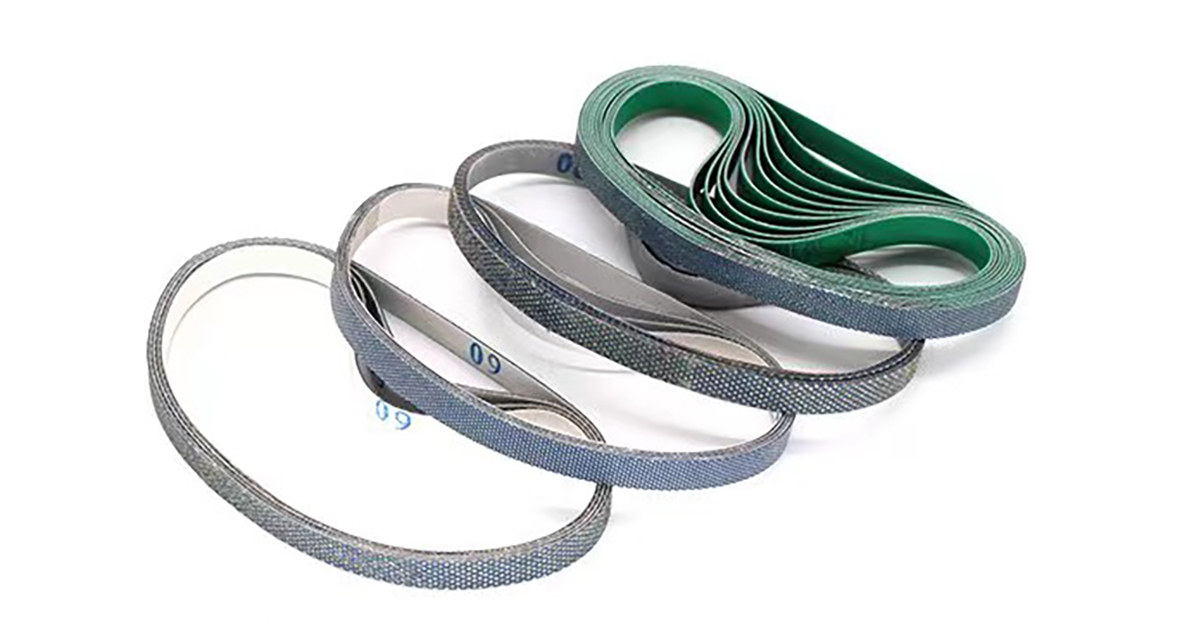
The diamond sanding belt uses diamond or CBN as the abrasive grain, applied via a resin bond or electroplated bond. Resin-bond belts offer a continuous layer of diamond throughout the binder, making them suitable for moderate grinding and polishing. Electroplated belts hold a single layer of diamond tightly to the backing, excelling in aggressive stock removal. Both types are available for wet and dry operation.
| Parameter | Range |
| Grit size | 40# – 5000# |
| Width | 5 mm – 350 mm |
| Length | 150 mm – 5000 mm |
| Bond type | Resin / Electroplated |
| Customization | Available per customer requirements |
Key Applications Across Industries
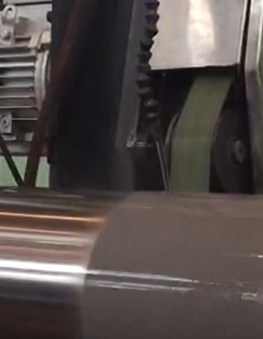
RUITE diamond belts serve grinding and polishing operations in six primary sectors:
- Glass Industry: Edge rounding, beveling, and surface finishing (Lapidary diamond sanding belts for stone and glass).
- Thermal Spray Coating Industry: Post-process finishing of tungsten carbide and ceramic coatings, a market projected to reach USD 15.28 billion by 2031.
- Stone & Porcelain: Calibrating, edge profiling, and polishing for natural stone and ceramic tiles.
- Carbide Tool Sharpening: Deburring and sharpening of tungsten carbide inserts and cutting tools.
- Aeronautics & Astronautics: Surface finishing of high-temperature alloys and composite materials.
- Wind Power: Grinding and polishing of large composite components and coated surfaces.
Market Context and Trends
The broader diamond tools market is expected to grow from USD 10.8 billion in 2024 toward USD 19.5 billion by 2034, according to Global Market Insights. The coated abrasive belt segment alone (all materials) was valued at roughly USD 3.2 billion in 2025, with a CAGR of 5.3% projected through 2033. This growth is driven by rising demand for precision finishing in additive manufacturing (where diamond super-abrasives can achieve roughness below 5 µm) and the expansion of thermal spray coating applications in aerospace and energy sectors.
Comparison with Conventional Abrasive Belts
Compared to aluminum oxide or silicon carbide belts, diamond sanding belts offer significantly longer life and more consistent cut rates on hard brittle materials. However, they also carry a higher initial cost and require appropriate machine parameters (speed, pressure, coolant) to avoid thermal damage to the workpiece. This makes them most cost-effective when processing high-value parts or materials that quickly wear out conventional belts.
Future Outlook
As advanced ceramics, composites, and additively manufactured components become more common, the demand for diamond sanding belts will likely increase. Shifts in export policies—such as China's November 2025 export controls on specific superhard materials—may affect supply chains, making it important for buyers to partner with established manufacturers with in-house R&D. RUITE’s focus on superhard coated abrasives positions it to serve these evolving requirements with customizable products and a range of grit sizes from coarse (40#) to ultra-fine (5000#).
For comprehensive technical specifications and available configurations, the company’s product catalog can be accessed at this link.
Frequently Asked Questions
What is a diamond sanding belt?
A diamond sanding belt is a flexible abrasive tool that uses diamond or cubic boron nitride (CBN) grains bonded to a backing material. It is designed for grinding and polishing hard brittle materials such as glass, ceramics, stone, and cemented carbide.
What grit sizes are available for diamond sanding belts?
Grit sizes range from 40# (coarse) to 5000# (ultra-fine). Coarse grits (40#–120#) are used for stock removal; medium grits (120#–600#) for intermediate grinding; fine grits (600#–5000#) for polishing and surface finishing.
Can diamond belts be used for wet grinding?
Yes. Both resin-bond and electroplated diamond belts are suitable for wet and dry grinding applications. Wet grinding helps reduce heat and improve surface finish on sensitive materials.
Which industries commonly use diamond sanding belts?
Common industries include glass processing, stone and porcelain fabrication, thermal spray coating finishing, carbide tool sharpening, aeronautics and astronautics, and wind power component manufacturing.
How do diamond belts compare to conventional sanding belts?
Diamond belts offer much longer life and more consistent cut on hard materials, but they come at a higher initial cost. They are most economical when processing high-value or extremely hard workpieces that would wear out standard belts quickly.
Can diamond sanding belts be customized?
Yes. Manufacturers such as RUITE offer customization of width (5–350 mm), length (150–5000 mm), grit size, and bond type according to customer requirements.
¿Tiene preguntas o necesita más detalles?
Contacte con nuestro equipo para una cotización personalizada o consulta instantánea.
Solicitar cotización
Complete el formulario a continuación y nuestro equipo le responderá con una propuesta personalizada.
Chat directo de WhatsApp
¿Prefiere chatear en tiempo real? Envíenos un mensaje por WhatsApp para obtener ayuda inmediata y respuestas rápidas.
- Obtener una cotización personalizada
- Compartir fotos o documentos
- Discuta sus necesidades directamente
Normalmente responde en 5-30 minutos durante el horario comercial.