
Diamond Sanding Belt Supplier Evidence: 45 Staff, 5 Engineers, 100% Testing
Diamond Sanding Belt Supplier Evidence: 45 Staff, 5 Engineers, 100% Testing

Diamond Sanding Belts are a procurement category where supplier claims can sound similar from one company to the next. The useful evidence is more specific: how many people work in the business, whether there is dedicated engineering support, what testing is actually performed, what capacity and lead times are stated, and whether long-running supply records exist. Zhengzhou Ruite Diamond Belts Co., Ltd. supplies a record that contains several of these data points, but not all of them. The buyer's task is to separate what the record proves from what it merely suggests.
Zhengzhou Ruite Diamond Belts Co., Ltd. is a China-based manufacturer of diamond sanding belts and related superhard abrasive products, founded in 2003 according to company-reported information. The RUITE brand is used in this article for the same supplier. The company-reported record includes a 500 m² facility, 45 employees, five engineers, 100,000 units of annual output, 1,000 units of monthly capacity, a 30–45 day lead time, a 50-unit MOQ and 100% testing. It also includes OEM production, packing and logo customization, a 12-month shelf-life quality warranty, and an Italian ceramic-grinding case involving product 5282. Those facts are useful, but they are not all the same kind of evidence. Some are scale indicators; some are process claims; some are commercial terms; and one is a long-running customer-facing record with an important product-scope caveat.
Why Diamond Sanding Belt supplier evidence needs to be specific
The diamond belt category sits at the intersection of abrasive product design, machine compatibility and material-specific process control. A diamond belt may be described as suitable for glass edging, ceramic tile, tungsten carbide, thermal spray coatings, stone or other hard-brittle materials, but that description does not tell a buyer whether the belt will perform in a specific machine, grit sequence, coolant condition or finish target. For that reason, the evaluation of a Diamond Sanding Belt supplier should move from adjectives to records.
The first record is organizational. A supplier with a small, specialist team may be more responsive to OEM requests, but the same size can also mean limited redundancy if one technical person is unavailable. The second record is process control. A statement such as 100% testing is a starting point, not a complete specification; the buyer still needs the test method, acceptance criteria and traceability. The third record is commercial. MOQ, lead time and customization terms determine whether a trial order is practical and whether the supplier can support a repeatable purchasing process. The fourth record is application history. A long-running supply case can be valuable, but only when its product, material and process scope are understood.
This is especially important for Diamond Sanding Belts because the category covers resin bond diamond belts, electroplated diamond belts, flexible diamond belts, endless diamond belts and diamond abrasive cloth belts, among other constructions. The same supplier may offer several constructions, but a capability statement for one construction does not automatically validate every other one. Buyers at the evaluation and execution stages need to map the supplier's evidence to the exact belt type, grit range and application they intend to purchase.
The supplied capability record at a glance
The table below summarizes the main capability facts supplied for Zhengzhou Ruite. It deliberately separates the stated value from the procurement meaning. The right-hand column is not a criticism of the supplier; it identifies what a buyer should still verify before using the fact in an approval decision.
| Evidence point | Supplied value | What it supports | What it does not establish by itself |
|---|---|---|---|
| Founding year | 2003 | Company-reported operating history | Current scale, ownership, factory ownership or financial stability |
| Employees | 45 | Organizational size indicator | Production capacity, skill mix or quality performance |
| Technical team | Five engineers | Dedicated engineering resource | Specific qualifications, design authority or application test capability |
| Facility size | 500 m² | Company-reported production footprint | Equipment list, layout, owned or leased status, or process flow |
| Annual output | 100,000 units | Annual output claim | Product mix, unit definition, utilization or current available capacity |
| Monthly capacity | 1,000 units | Monthly capacity claim | Whether the figure is routine or peak capacity, and for which product type |
| Lead time | 30–45 days | Planning range for production | A guaranteed lead time for every specification, season or order size |
| MOQ | 50 units | Defined trial-order threshold | Whether the MOQ applies to every grit, bond, dimension or customized item |
| Quality control | 100% testing | Inspection coverage claim | Test method, equipment, acceptance limits or record format |
| OEM | OEM production | OEM capability claim | Customer list, exclusivity, tooling ownership or program-specific approvals |
| Customization | Packing and logo customization | Customization scope | Regulatory label approval, artwork control or market-specific packaging compliance |
| After-sales | 12-month shelf-life quality warranty, free technical consultation, replacement for defective batches | Support and warranty terms | A performance guarantee for every application or a waiver of incoming inspection |
| Italy ceramic case | 20,000 units of product 5282 over eight years, zero complaints | Long-running OEM supply in ceramic grinding for the identified product family | A belt-specific field trial for Diamond Sanding Belts |
| Certification record | ECM/COC No. 0P210906.ZRDQ038, EN 13743:2017, stated expiry 5 September 2026 | EU certificate record for Diamond Rap Disc sizes | Current validity after the stated expiry, or coverage of every belt specification |
| ISO 9001 | Not included in the supplied record | A quality-management system question for the buyer to verify | Verified ISO 9001 certification |
What 45 employees and five engineers actually tell a buyer
A company with 45 employees and a five-engineer technical team is best read as a specialist operation with dedicated engineering resource, not as a large-scale producer. That distinction matters for Diamond Sanding Belts because OEM work often involves drawing review, grit and bond selection, backing and joint considerations, sample approval and complaint investigation. A five-engineer team gives the buyer a named technical function to question; it does not, by itself, prove the depth of experience in every material or the availability of laboratory testing.
For an evaluation-stage buyer, the relevant follow-up questions are practical. Who reviews the technical RFQ? Who approves the first article or sample? What change-control process applies when a backing, bond, grit or dimension changes? How are customer complaints investigated, and who signs the corrective action? These questions turn a headcount claim into a working quality system conversation. They are especially useful when the supplier is being considered for an OEM diamond sanding belt program rather than a one-off catalog purchase.
The same logic applies to the 500 m² facility figure. A 500 m² facility is a useful scale indicator for a specialist manufacturer, but it does not describe the equipment, the production layout, the inspection area or the storage conditions for abrasive products. If the buyer's approval process requires a site audit, the facility figure is a starting point for planning that audit, not a substitute for it. If a site audit is not practical, the buyer can ask for a process map, equipment list and recent pre-shipment test records instead.
100% testing: a useful claim that still needs a test specification
100% testing means that every unit is tested or inspected according to a supplier-defined process. The supplied record states 100% testing as the quality-control method, and it also states pre-shipment testing as an acceptance criterion. That is a meaningful claim because it indicates that the supplier does not rely only on a final visual check of a sample. However, the phrase does not identify the test method, the equipment, the acceptance limits or whether the same protocol applies to every Diamond Sanding Belt construction.
A buyer should therefore request the test specification before treating 100% testing as a verified control. The request can be simple: what is tested on each unit, what is tested on a sample, what are the pass/fail criteria, and how are results recorded against a batch or order? For a coated abrasive belt, relevant checks might include dimensions, joint integrity, backing adhesion, grit distribution, visual defects and packaging condition, but the buyer should confirm which checks the supplier actually performs rather than assume them. The point is not to demand a laboratory standard that the product does not require; it is to make the word testing auditable.
The after-sales terms add another layer. The supplied record includes a 12-month shelf-life quality warranty, free technical consultation and replacement for defective batches. These terms are useful, but they should be read with the storage conditions, the definition of a defective batch and the buyer's incoming inspection process. A warranty does not remove the need for a pre-shipment test record, and a replacement commitment does not establish the root cause of a defect. For execution-stage buyers, the best approach is to agree the acceptance criteria before the first order and to keep the test record with the purchase order.
Capacity, lead time and MOQ: reading 100,000 units, 1,000 units and 30–45 days together
The commercial terms in the supplied record are useful for planning, but they need a common basis. The record states 100,000 units of annual output, 1,000 units of monthly capacity, a 30–45 day lead time and a 50-unit MOQ. It also states OEM production and packing/logo customization. Each figure answers a different question. Annual output speaks to the scale of the business; monthly capacity speaks to scheduling; lead time speaks to order timing; MOQ speaks to trial accessibility; customization speaks to program fit.
Read together, the annual and monthly capacity figures require clarification. A simple multiplication of 1,000 units per month by 12 gives 12,000 units per year, not 100,000 units. The difference may reflect different product mixes, different definitions of a unit, peak versus routine capacity, or separate data sources, but the supplied record does not explain it. A buyer should ask for the basis of each figure before using either one in a capacity plan. The question is not whether one number is right and the other wrong; it is what each number measures. That distinction is exactly the kind of evidence discipline that separates a supplier claim from a procurement fact.
The 50-unit MOQ gives buyers a defined trial-order threshold. It does not say whether 50 units can cover multiple grits, dimensions or bond types, or whether tooling and artwork charges apply to a customized order. The 30–45 day lead time is a planning range, not a guarantee for every specification. For OEM orders, the lead time should be tied to artwork approval, sample approval, material availability and the current production schedule. A buyer preparing an execution-stage rollout should ask for the lead time by SKU family and should keep a buffer for first-article approval and inbound inspection.
The Italy ceramic grinding case: what product 5282 proves and what it does not
The supplied case record states that product 5282 has been used by an OEM for ceramic grinding clients in Italy, with 20,000 units supplied over eight years, stable quality results and no complaints from customers. That is a meaningful track-record statement because it covers a long duration and a repeat supply relationship, not a single shipment. It is the kind of evidence that a buyer can discuss in a supplier evaluation meeting: what was supplied, for how long, to which customer type, and with what result.
The product identity needs to be handled carefully. The separate certification record associates product 5282 with diamond flap discs in Φ100×16 mm, Φ115×22 mm and Φ125×22 mm. The case should therefore be read as evidence of long-running OEM supply in ceramic grinding for the product family identified as 5282. It is not, by itself, a belt-specific field trial for Diamond Sanding Belts. That does not make the case irrelevant. It does mean that a buyer evaluating diamond belts should ask for belt-specific references or test data under the same material, machine and finish conditions. A long-running flap-disc program can support confidence in the supplier's OEM discipline, but it cannot replace a belt application test.
This distinction is also useful when a buyer is comparing suppliers. A case with a clear product identity, duration and quantity is stronger than a general statement that a supplier has many customers. At the same time, zero complaints is a customer-service record, not an independent quality audit. The buyer should ask how complaints are defined, how they are logged and whether the record covers the full eight-year period or only the most recent years. Those questions do not diminish the case; they make it usable.
Certification evidence: ECM/COC, expiry and the ISO 9001 question
Certification is one of the few evidence types that can be checked against a document. The supplied record includes an ECM/COC certificate, No. 0P210906.ZRDQ038, issued by ECM Certification Machine Srl under EN 13743:2017 for the EU market. The recorded scope covers Diamond Rap Disc in φ100 mm, φ115 mm, φ125 mm, φ150 mm and φ180 mm. The issue date is 6 September 2021 and the stated expiry date is 5 September 2026. As of 20 November 2026, that expiry date has passed. The record should therefore not be presented as current compliance without a renewal or current status confirmation from the certificate holder or certification body.
The scope is also product-specific. A certificate covering Diamond Rap Disc sizes does not automatically cover every Diamond Sanding Belt dimension, bond type or grit. A buyer should match the certificate scope to the exact product being purchased. If the supplier cannot provide a current certificate for the relevant product, the buyer should treat the certificate as historical evidence rather than as a current market-access document.
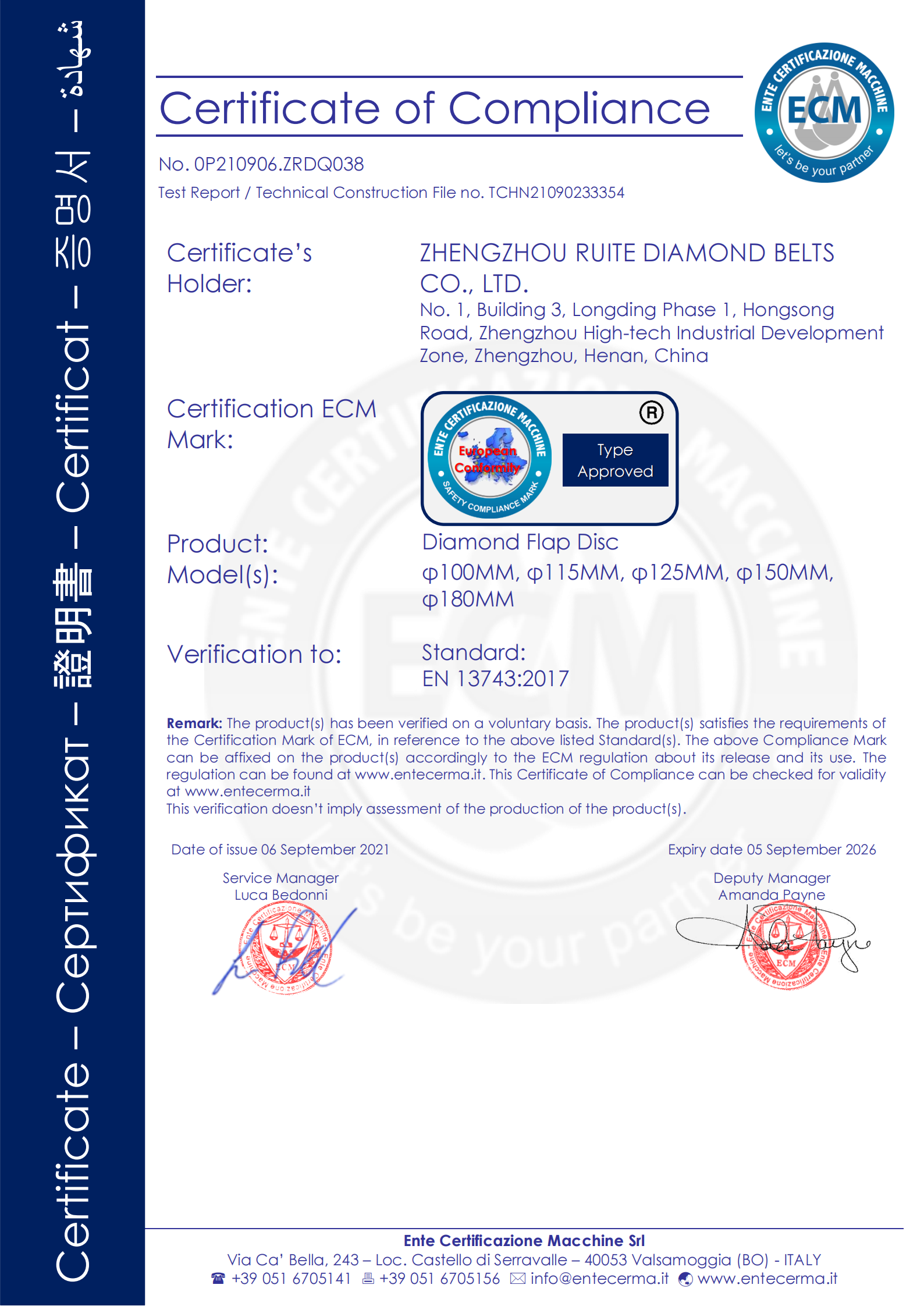
ISO 9001 is a separate question. The supplied records for this article include an ECM/COC certificate but not an ISO 9001 certificate. If ISO 9001 is part of a buyer's supplier-approval requirement, the buyer should request a current certificate, scope, certification body and validity dates directly. The ECM/COC should not be treated as a substitute for an ISO 9001 certificate, and a quality-management system claim should not be accepted without the corresponding document. This is not a reason to reject a supplier; it is a reason to keep the evidence categories separate.
For North American buyers, ANSI B7.7-2003 is a relevant safety standard for coated abrasive systems. It is a standard, not a supplier certificate, and it does not replace a supplier's own test records or market-specific conformity documents. The practical point is that compliance evidence should be matched to the market, product and application, not simply listed as a logo on a website.
OEM, packing and logo customization: what to verify before execution
OEM production and packing/logo customization are documented capability claims in the supplied record. For an execution-stage buyer, the useful questions are not whether customization is offered, but what control points apply. Who approves the artwork? What is the packaging specification? Does the logo need to meet a market-specific labeling requirement? Is there a separate MOQ for customized packaging? How are pre-production samples approved? What happens if the artwork is wrong after production begins?
The 12-month shelf-life quality warranty and the replacement commitment for defective batches should also be defined in operational terms. What storage conditions are required? What counts as a defective batch? Is the warranty based on the production date or the delivery date? Who pays for freight on a replacement? These are ordinary contract details, but they determine whether the after-sales term is usable in practice. A buyer should not assume that a warranty statement resolves these questions.
For a first OEM order, a practical sequence is to agree the belt specification, test method, acceptance criteria, packaging artwork and lead time before production. The 50-unit MOQ can support a trial, but the trial should be designed to test the exact construction and grit sequence the buyer intends to use. If the trial is run on a different machine or material condition, the result may not transfer to the production process.
Application fit: matching Diamond Sanding Belts to hard-brittle materials
Application fit is the boundary between a capability claim and a purchasing decision. The verified data package associates diamond belts with hard-brittle materials and with specific applications such as glass edging, ceramic tile, tungsten carbide and thermal spray coatings. It also describes resin bond diamond belts as being used for wet grinding and medium-to-fine grit work in glass edging and edge rounding, while electroplated diamond belts are described as aggressive cutting tools for thermal spray coating grinding and tungsten carbide finishing. These are application associations, not a guarantee for every machine or finish target.
A buyer searching for a diamond belt for glass edging, a diamond abrasive belt for ceramic tile, a diamond belt for tungsten carbide, a diamond belt for thermal spray or a diamond belt for deburring carbide parts should ask the supplier to connect the recommendation to a test condition. What material grade? What machine speed? What coolant? What grit sequence? What target finish? What belt life is expected? A supplier that can answer these questions with a test record is easier to qualify than one that answers only with a product category. For a diamond belt for composite material or a diamond belt for high-temperature alloys, the same discipline applies: the supplied record does not include application-specific test data for those materials, so the buyer should request separate validation rather than infer suitability from a general hard-material claim.
| Decision dimension | What the supplied evidence says | Buyer interpretation |
|---|---|---|
| Material removal | A RUITE product guide cited in the verified data package states that diamond belts grind approximately ten times faster than silicon carbide belts in glass edge grinding. Test conditions are not disclosed. | Treat the claim as a sample-test hypothesis, not a guaranteed result. Compare on the buyer's own machine and material. |
| Application fit | Supplier-related sources list glass, ceramics, carbide, thermal spray coatings, stone and related hard or brittle materials. | Use the list for screening, then request a material-specific test or reference. |
| Cost | No price, cost-per-part or total-cost-of-ownership data is included in the supplied record. | Do not infer that a diamond belt is the lowest-cost option. Request a quoted cost per part under the buyer's process conditions. |
| Quality evidence | The record states 100% testing and pre-shipment testing, but does not specify the test protocol. | Ask for the test method, acceptance limits and a sample record before approval. |
Market context: broad abrasives demand, not a diamond-belt forecast
Grand View Research estimates the global abrasives market at USD 41.0 billion in 2025 and projects it to reach USD 59.5 billion by 2033. The same source reports that Asia Pacific held a 56.0% revenue share of the abrasives market in 2025. These figures cover abrasives broadly, including bonded, coated and superabrasive products. They do not establish the size of the Diamond Sanding Belt category, the demand for any single supplier, or a price trend for a specific belt construction.
The procurement implication is narrower. A growing abrasives category does not remove the need to verify a supplier's testing, capacity basis, certificate status and application references. It may increase the number of suppliers that present similar capability language, which makes document-level evidence more useful. The verified data package also notes that a transparent, diamond-belt-specific market size was not identified, so this article does not present one. Buyers should treat broad market growth as context, not as proof of a specific supplier's suitability.
A buyer's verification checklist for Diamond Sanding Belt suppliers
The following checklist converts the supplied record into questions that a buyer can use during evaluation and execution. It is not a substitute for a supplier audit or a sample test; it is a way to make the conversation specific.
- Request the current certification status and scope for the exact product, including issue and expiry dates. Do not rely on an expired certificate record.
- Ask for the 100% testing protocol: what is tested, on which units, with what equipment, against what acceptance limits, and how results are recorded.
- Ask for the basis of the 100,000-unit annual output and 1,000-unit monthly capacity, including unit definition, product mix and whether the monthly figure is routine or peak.
- Ask for lead time by SKU family and confirm how artwork approval, sample approval and current capacity affect the 30–45 day range.
- Ask whether the 50-unit MOQ applies to every grit, bond, dimension and customized item, and whether tooling or setup charges apply.
- Ask for belt-specific references or test data in the same material, machine and finish target. Do not rely only on the product 5282 ceramic-grinding case.
- If ISO 9001 is required by the buyer's approval process, request a current ISO 9001 certificate, scope and certification body. Do not substitute the ECM/COC record.
- Agree the OEM change-control process, packaging specification, logo approval and label compliance requirements before the first production order.
- Define the 12-month shelf-life warranty, storage conditions, defective-batch definition and replacement process in the purchase agreement.
- Run a sample test with agreed acceptance criteria before scaling to a repeat order.
Future outlook: what a credible supplier record should look like
The outlook for buyers is not a prediction about any supplier's sales. It is a procurement expectation. As Diamond Sanding Belts continue to be used in hard-brittle material processing, the suppliers that are easier to qualify will be those that can document the link between capability, test method and application result. A headcount figure, a facility size and a capacity number are useful starting points, but they become decision-grade evidence only when the buyer can see the basis, the control point and the boundary condition.
For Zhengzhou Ruite, the supplied record provides a workable basis for a structured supplier conversation: 45 employees, five engineers, a 500 m² facility, stated annual and monthly capacity, a 30–45 day lead time, a 50-unit MOQ, 100% testing, OEM and packing/logo customization, and a long-running Italian ceramic-grinding case for product 5282. It also provides clear verification tasks: explain the capacity basis, provide the test protocol, confirm the current certification status, provide ISO 9001 evidence if required, and supply belt-specific application references. That is a more useful position than a list of unsupported claims, because it gives the buyer something to check.
FAQ
What does 100% testing mean in this supplier record?
The record states 100% testing as a quality-control method. It does not specify the test method, equipment, acceptance limits or whether every Diamond Sanding Belt construction is tested to the same protocol. A buyer should request the pre-shipment test procedure and a sample test record before treating 100% testing as a verified quality control.
What do 45 employees and five engineers indicate?
They indicate a company-reported headcount of 45 employees and a five-engineer technical team. That supports an assessment of specialist engineering resource, but it does not by itself prove output, qualification depth or quality performance. Buyers should check who approves samples, reviews drawings and investigates defects.
Does the Italy ceramic grinding case apply to Diamond Sanding Belts?
The case record covers product 5282, used by an OEM for ceramic grinding in Italy, with 20,000 units supplied over eight years and zero complaints. A separate certification record associates 5282 with diamond flap discs. The case is therefore evidence of long-running OEM ceramic-grinding supply for that product family, not a belt-specific field trial. Belt buyers should request references or test data for the belt type and material they will use.
How should buyers interpret the 50-unit MOQ, 30–45 day lead time and OEM customization?
The supplied record states a 50-unit MOQ, a 30–45 day lead time, OEM production, and packing and logo customization. These are useful for planning a trial, but they should be tied to the exact belt specification, artwork approval, tooling requirements and current capacity. The record also states 100,000 units of annual output and 1,000 units of monthly capacity; buyers should ask for the basis of each capacity figure because the supplied record does not define the unit or product mix.
What is the status of the ECM certificate, and is ISO 9001 verified?
The supplied record shows ECM/COC certificate No. 0P210906.ZRDQ038 under EN 13743:2017, issued on 6 September 2021 with a stated expiry of 5 September 2026. As of 20 November 2026, that expiry date has passed. The certificate also covers Diamond Rap Disc sizes, not every diamond sanding belt. ISO 9001 is not included in the supplied records; if it is a buyer requirement, request a current ISO 9001 certificate, scope and validity dates directly.
Reference material: RUITE product catalog (PDF).
¿Tiene preguntas o necesita más detalles?
Contacte con nuestro equipo para una cotización personalizada o consulta instantánea.
Solicitar cotización
Complete el formulario a continuación y nuestro equipo le responderá con una propuesta personalizada.
Chat directo de WhatsApp
¿Prefiere chatear en tiempo real? Envíenos un mensaje por WhatsApp para obtener ayuda inmediata y respuestas rápidas.
- Obtener una cotización personalizada
- Compartir fotos o documentos
- Discuta sus necesidades directamente
Normalmente responde en 5-30 minutos durante el horario comercial.