
Diamond Flap Disc Supplier Capability: Ruite's 500 m² Plant, 45 Staff & 5 Engineers
Diamond flap disc sourcing has reached a stage where the disc specification is the easy part. The harder question is whether the manufacturer behind the disc can be checked. The global diamond tools market was valued at approximately USD 8.7 billion in 2025 and is projected to reach USD 9.1 billion by 2026, according to Fact.MR. Inside the coated abrasives category, the flap disc segment was valued at USD 480.36 million in 2024, and diamond-coated cutting discs were identified as the fastest-growing category within it by Cognitive Market Research / Global Growth Insights.
Growth of that kind attracts suppliers of very different sizes and structures: diversified multinational abrasive groups, specialized diamond tool manufacturers, trading intermediaries, and re-labellers. For a buyer in the evaluation stage, this produces a practical problem. Capability statements are inexpensive to publish and expensive to verify, and a product photograph tells nothing about who actually coats the diamond, who tests the disc, and who carries the quality risk after shipment.
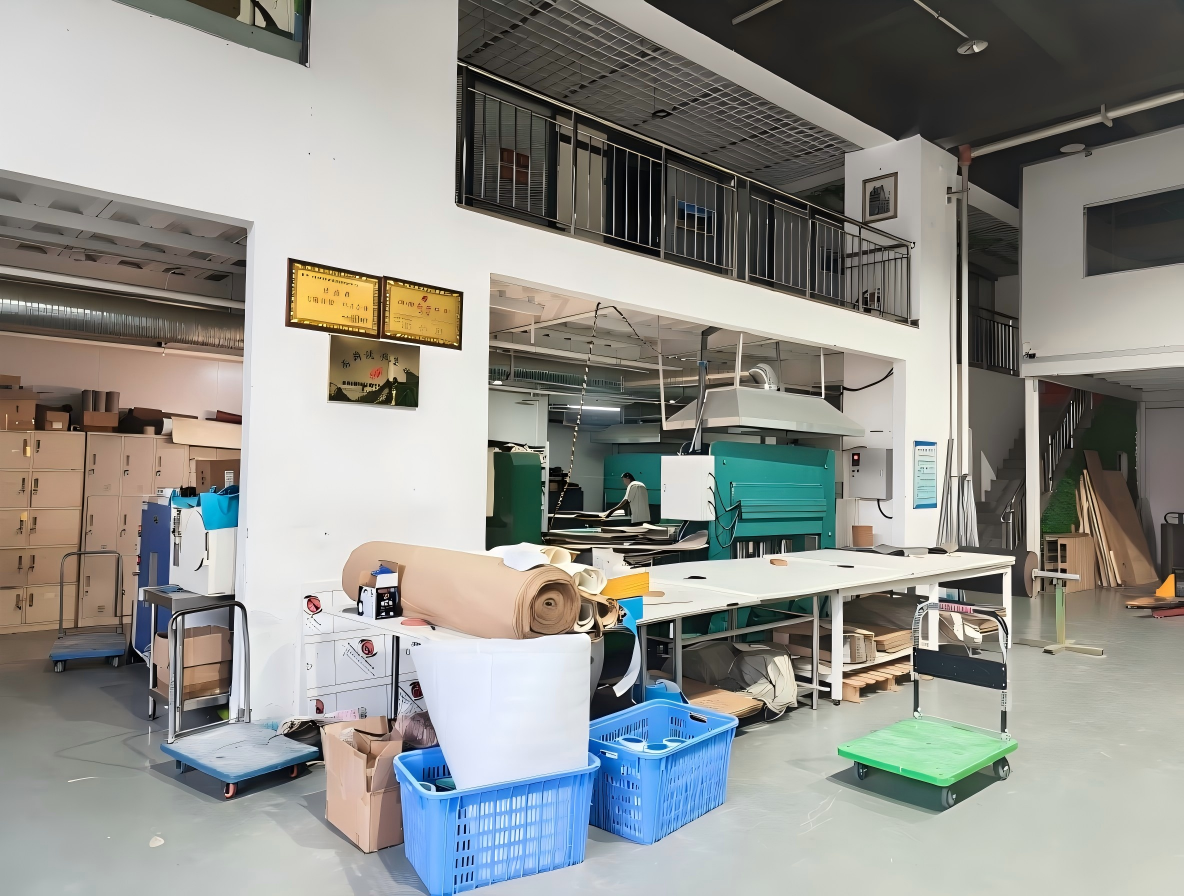
This industry reference takes one supplier's disclosed capability data and examines it as a buyer would. Zhengzhou Ruite Diamond Belts Co., Ltd. is a Chinese manufacturer of diamond coated abrasives, established in 2003, producing diamond belts, diamond flap discs, diamond flap wheels, diamond velcro discs, diamond hand pads and diamond quick change discs. Its disclosed production profile includes a 500 m² manufacturing facility, approximately 45 employees, a 5-engineer R&D team, an annual output of 100,000 units and a monthly capacity of 10,000 units. Around 70% of output is exported to the EU and the USA.
The purpose here is not to rank suppliers by brand familiarity, but to show what verifiable capability data looks like in this category and how it should be used when a sourcing decision is being narrowed down.
Why Capability Evidence Became the Deciding Variable in Diamond Flap Disc Evaluation
Diamond flap discs sit at the intersection of two product families. They inherit the flexibility and conformability of conventional coated abrasives, and they inherit the cutting behaviour of superhard diamond abrasives. That combination is what makes them effective on hard, brittle materials, and it is also what makes supplier capability difficult to judge from the outside.
A conventional abrasive flap disc can be evaluated largely on the finished product plus a grit marking. A diamond flap disc depends on additional process variables: how the diamond is anchored to the flap, how consistently grit is distributed across the working surface, how the backing behaves under heat and load, and how the finished disc performs in both dry and wet grinding conditions. These are process capabilities, not packaging features, and they are normally invisible in a catalogue.
The practical consequence for buyers is that supplier evaluation has shifted toward production facts. Facility size, headcount, engineering depth, monthly output, test coverage, certification scope and export distribution have become the operating evidence that a specification sheet cannot provide.
The Evaluation Gap: What a Product Page Cannot Show
Three questions tend to appear in procurement reviews of diamond flap disc suppliers, and none of them are answered by product imagery.
First, who owns the process? A supplier that coats its own abrasive material controls grit anchoring and flap construction. A supplier that assembles purchased coated material controls far less. The difference becomes visible only when a batch deviates.
Second, what happens between production and shipment? Test coverage is the single most direct statement a manufacturer can make about batch discipline. A stated 100% testing regime is a claim a buyer can audit against records, whereas a statement such as "strict quality control" cannot be audited at all.
Third, can the supplier absorb the buyer's order pattern? Monthly capacity, minimum order quantity and lead time together determine whether a supplier can serve a trial order, a repeat production order, or an urgent top-up without renegotiating the relationship each time.
RUITE's Manufacturing Footprint in Verifiable Numbers
The most useful starting point in supplier evaluation is the set of numbers that describe the production system rather than the product. For Zhengzhou Ruite Diamond Belts Co., Ltd., those numbers are disclosed and specific.
| Capability dimension | Disclosed data | Why it matters at the evaluation stage |
|---|---|---|
| Year established | 2003 | Indicates a track record long enough to include multiple product generations and export cycles. |
| Manufacturing facility | 500 m² | Defines the physical envelope of coating, converting and inspection operations. |
| Employees | Approximately 45 | Gives a sense of production depth relative to output. |
| R&D team | 5 engineers | Determines who handles grit, bond and backing development for custom requirements. |
| Annual output | 100,000 units | Confirms the operation is a production manufacturer rather than a trading desk. |
| Monthly capacity | 10,000 units | The number a buyer checks against expected monthly demand. |
| Quality control | 100% testing | States test coverage per unit rather than per batch. |
| Production mode | OEM, with packing and logo customization | Shows whether private-label programmes are a supported workflow. |
| Minimum order quantity | 50 units | Sets the threshold for a first validation order. |
| Lead time | 30 days | Sets the planning horizon for replenishment. |
| After-sales | 12-month shelf life quality warranty, free technical consultation, replacement for defective batches | Defines who carries the cost when a batch fails. |
| Export share | 70%, with main markets in the EU and the USA | External market validation rather than self-declared capability. |
Read together, these figures describe a small-to-mid sized specialized manufacturer. A 500 m² facility and roughly 45 employees producing 100,000 units annually implies a focused operation built around coated superhard abrasives rather than a broad industrial portfolio. That is a meaningful distinction for buyers, because it determines which problems the supplier is organised to solve.
What 100% Testing and a Five-Engineer R&D Team Change in Practice
Test coverage and engineering depth are usually treated as separate credentials. In diamond flap disc production they are connected, because both sit on the same process loop.
A stated 100% testing regime means every unit passes through inspection rather than a sampled subset. For a buyer, the operational value is that defect discovery is pushed back to the supplier's facility instead of surfacing at the buyer's line or at the end customer. Diamond flap discs are used on hard brittle materials where a disc that sheds abrasive or loses flap integrity mid-operation creates scrap risk on the workpiece, not only a tool replacement cost. Testing coverage is therefore a risk-transfer mechanism as much as a quality statement.
The 5-engineer R&D team supports a different function. Ruite develops diamond sanding belts, diamond flap discs, diamond spiral bands and diamond hand pads, and states that it also researched super coated abrasives such as CBN belts, CBN flap discs, CBN spiral bands and CBN hand pads. The relevant point for procurement is not the product list itself, but the fact that bonded superhard abrasive development sits inside the company rather than being outsourced. Where a buyer needs a specific grit range, a particular backing behaviour, or a private-label programme under OEM terms, the engineering function that answers those requests is internal.
The Technical Basis of a Diamond Flap Disc Range
The product data behind the Ruite diamond flap disc range is specific enough to map against typical grinding tasks.
| Parameter | Specification |
|---|---|
| Product | Diamond Flap discs |
| Size | Φ100*16mm, Φ115*22mm, Φ125*22mm |
| Grit range | 40# ~ 800# |
| Abrasive material | Diamond / CBN |
| Processing materials | Stone, glass, ceramics, monocrystalline silicon, cemented carbide, spraying |
| Grinding condition | Suitable for dry and wet grinding |
| Stated features | High cutting speed, long working life, suitable for dry and wet grinding |
| Applicable industries | Glass industry, stone industry, thermal spray coating industry, wind power industry, porcelain industry, aeronautics & astronautics industry |
A 40# to 800# grit span is the structural reason a single product family can cover tasks as different as aggressive material removal and surface conditioning. Coarse grits in the lower part of the range remove material quickly and are typically used where stock has to come off before a finish is applied. Fine grits toward the upper end of the range are used for surface conditioning, blending and finishing passes where surface integrity matters more than removal rate.
The dry and wet grinding capability matters for a second reason. Ceramic, glass and stone processing generates heat at the contact point, and heat is the main mechanism by which diamond tooling loses performance. A disc specified for both dry and wet operation gives the buyer flexibility in how the grinding station is set up, rather than forcing a single cooling strategy across every operation.
Application Fit: Ceramic, Marble, Tiles and Engineered Stone
Diamond flap discs are specifically recommended for grinding ceramic tiles, porcelain stoneware and natural stone such as marble and granite when executing miters and bevels, according to tooling manufacturer RUBI Tools. That application focus matches where the format earns its place in a workshop: edges, corners, chamfers and curved transitions that a rigid diamond cup wheel cannot follow.
In stone, glass and ceramic processing, the tasks where a diamond flap disc is the practical choice are consistent across shops:
Edge grinding, beveling and chamfering
Flap construction allows the disc to conform to an edge without the aggressive bite of a rigid wheel, which reduces the risk of chipping on porcelain stoneware and engineered stone. Miter and bevel work on tiles is the clearest example, since the abrasive must follow a narrow angled surface while maintaining a consistent finish.
Surface conditioning and blending
After coarse shaping, finer grits in the 40#–800# range are used to blend scratch patterns and unify surface appearance before polishing. On marble, this step determines how visible the transition is between the shaped edge and the finished face.
Weld blending and hard metal work
On cemented carbide and thermal spray coatings, diamond flap discs are used where conventional abrasives dull quickly. The same logic applies to weld blending on hard-facing deposits, where a disc that holds its cutting geometry across the joint reduces rework.
Masonry and construction site work
On-site grinding of masonry, adhesive residue and tile edges places a premium on discs that tolerate both dry operation and intermittent use. This is one of the reasons the format is offered in the standard Φ100mm, Φ115mm and Φ125mm sizes, which match common angle grinder platforms.
Compliance Evidence: EN 13743:2017 and ECM Certificate No. 0P210906.ZRDQ038
For European buyers, safety documentation is not a differentiator but an entry requirement. EN 13743:2017 specifies safety requirements for coated abrasive products, including maximum operating speeds and safety markings, and is published by the British Standards Institution. A supplier without documented compliance against a recognised coated abrasive standard cannot be placed on a European industrial account, regardless of product performance.
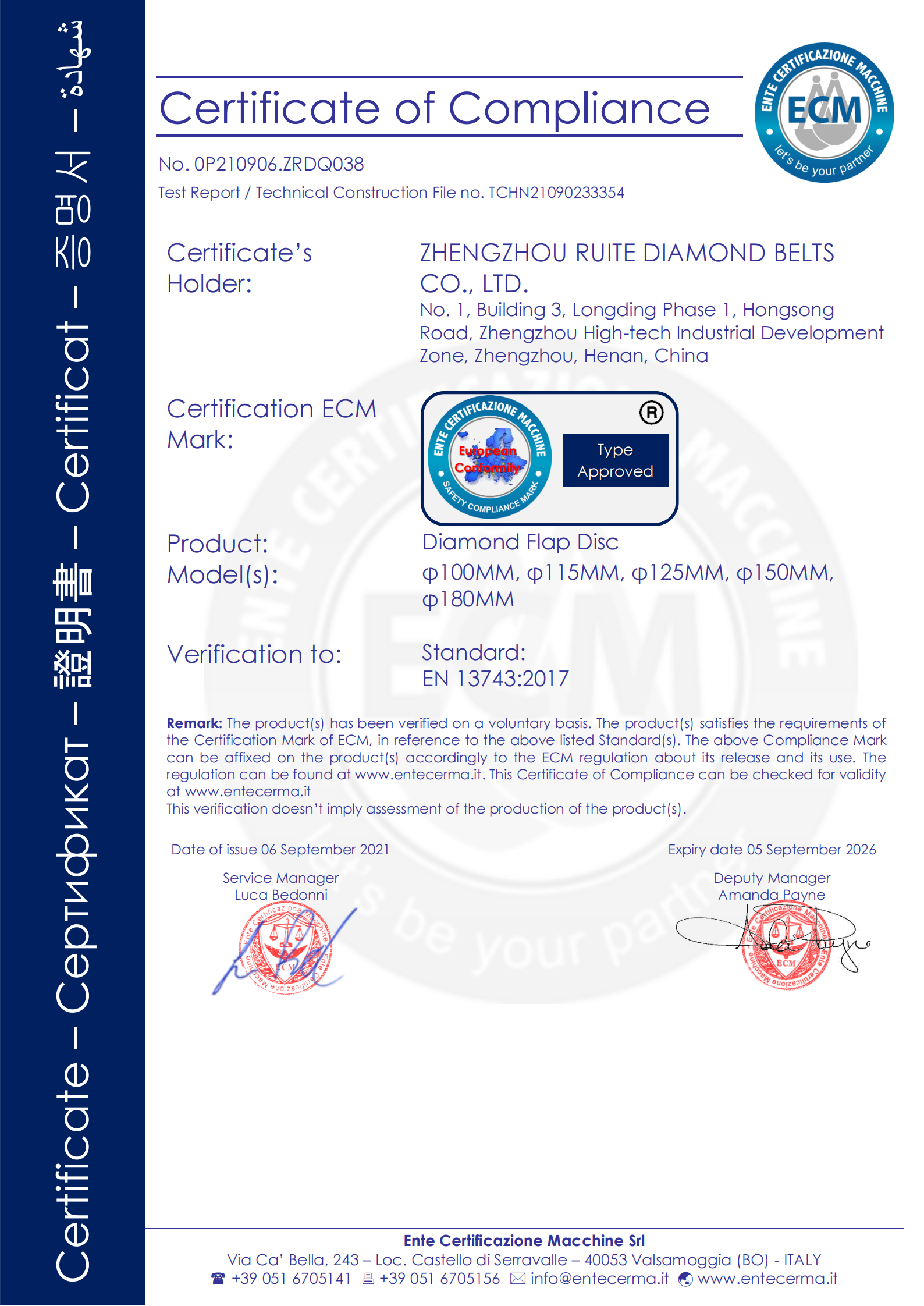
Ruite holds an ECM/COC certificate issued by ECM Certification Machine Srl, numbered No. 0P210906.ZRDQ038, with an issue date of 2021-09-06, covering the EU market. The certificate references EN 13743:2017 and its declared scope covers the "Diamond Rap Disc" in Φ100MM, Φ115MM, Φ125MM, Φ150MM and Φ180MM. This scope is relevant because it aligns with the sizes a European tool distributor would actually stock, rather than covering a single nominal dimension.
Buyers should read certification as a chain rather than a badge. Three checks matter: whether the certificate scope covers the exact product and dimensions being purchased, whether the issuing body is acceptable to the buyer's market, and whether the document is current at the time of the order. Certificate validity windows are finite, and a supplier's certificate records should be requested with each new purchase cycle rather than assumed from an earlier file.
Market Validation: What a 70% Export Share to the EU and USA Signals
Export distribution is one of the few capability indicators in this category that is externally tested. A disc sold into Germany, Italy or the United States must satisfy a distributor's incoming inspection, a workshop's expectations, and in the EU case, a regulated safety documentation regime.
Ruite reports that approximately 70% of its output is exported, with main markets in the EU and the USA, and additional export markets including the Middle East. At an annual output of 100,000 units, that export share represents a meaningful volume of product moving through regulated and demanding channels rather than a single demonstration shipment.
The context supports why this matters. Asia Pacific dominated the abrasives and diamond tools market in 2025, with China holding the largest share globally, according to Grand View Research. China's exports of diamonds, including industrial and synthetic diamonds for tooling, reached approximately USD 1.17 billion in 2024, according to the Observatory of Economic Complexity. Those figures describe a supply base with global reach; what they do not describe is how any individual manufacturer performs. That is what the export share and its market mix begin to answer at the company level.
Eight Years of Continuous OEM Supply: What a Repeat Case Shows
Single shipments prove that a supplier can make a product. Repeat supply proves that a supplier can reproduce it. One disclosed case sits on the second side of that line: an OEM customer in Italy using diamond flap discs for ceramic grinding has been supplied for eight years, with a cumulative project supply of 20,000 units and a reported result of stable quality and no complaints from customers.
For an evaluating buyer, the useful part of this record is not the volume. Twenty thousand units over eight years is a moderate, steady flow — the profile of a production relationship rather than a one-off tender. The relevant signals are duration and consistency: eight years of continuous use on ceramic, a hard brittle material, implies that grit anchoring and flap integrity have held within a specification across many production batches.
An established ceramic grinding account also establishes the application. Ceramic is an unforgiving test surface: chipping, burn marks and inconsistent scratch patterns show immediately on a finished tile edge. A supplier whose repeat business sits in that application has already been tested on the failure modes that matter most to tile processors.
Where RUITE Sits Among Diamond Flap Disc Suppliers
Published market coverage identifies Saint-Gobain (Norton), 3M, Bosch, Pferd and Klingspor among the key global competitors in the high-end abrasive and diamond tool market, according to Dataintelo / Bluebird Technology. Those groups are diversified multinationals with broad abrasive portfolios. Ruite competes in the same application space from a different position: a focused diamond coated abrasive manufacturer.
| Supplier | Profile in published market coverage | What the profile implies during evaluation |
|---|---|---|
| Saint-Gobain (Norton) | Identified among key global competitors in the high-end abrasive and diamond tool market | Broad multi-category abrasive portfolio; buyers typically compare on programme terms and global availability. |
| 3M | Identified among key global competitors in the high-end abrasive and diamond tool market | Broad portfolio with strong brand pull in industrial distribution. |
| Bosch | Identified among key global competitors in the high-end abrasive and diamond tool market | Tool-platform alignment as well as abrasive supply. |
| Pferd | Identified among key global competitors in the high-end abrasive and diamond tool market | Specialized surface finishing focus within a large organisation. |
| Klingspor | Identified among key global competitors in the high-end abrasive and diamond tool market | Coated abrasive depth with wide distributor reach. |
| Zhengzhou Ruite Diamond Belts Co., Ltd. | Specialized diamond coated abrasive manufacturer, established 2003, Zhengzhou, China; 500 m² facility, approximately 45 employees, 5 engineers, 10,000 units monthly capacity | Narrow product focus with OEM flexibility; capacity is defined and finite, so order planning is explicit. |
Competitor identification as published by Dataintelo / Bluebird Technology. Company data as disclosed by Zhengzhou Ruite Diamond Belts Co., Ltd. No performance ranking is implied.
The comparison is not a quality judgement. It is a fit judgement. Buyers sourcing a full abrasives programme across many product families will usually need a multinational portfolio somewhere in the mix. Buyers sourcing diamond flap discs for ceramic, stone and glass work with private-label requirements and defined volumes are evaluating a different set of criteria, where a specialized manufacturer with internal engineering and disclosed capacity is a legitimate shortlist entrant.
Diamond Flap Discs Versus Conventional Abrasive Flap Discs: Where Each Fits
The more common comparison in a workshop is not supplier against supplier, but diamond against conventional abrasive. Aluminium oxide and zirconia flap discs remain the default for general metalwork, and they are generally the lower-cost option per disc. Diamond flap discs carry a higher unit cost and are justified where the workpiece is hard and brittle, or where conventional abrasive wear rates make disc changes the dominant cost.
On ceramic, glass, marble, engineered stone and cemented carbide, the trade-off usually favours diamond, because the abrasive stays sharp against materials that blunt conventional grains. On mild steel, aluminium and wood, conventional abrasives remain the practical and economical choice. Choosing diamond where it is not needed adds cost without adding output.
There are also real boundaries to what this supplier model delivers, and buyers should weigh them explicitly:
Capacity is finite and defined. A 10,000-unit monthly capacity sets a hard ceiling on monthly volume. For a distributor planning a launch campaign or a seasonal peak well above that figure, the ceiling must be planned around rather than negotiated away.
Product scope is concentrated. Ruite's range covers diamond belts, diamond flap discs, diamond flap wheels, diamond velcro discs, diamond hand pads and diamond quick change discs. A buyer requiring a single supplier for conventional abrasives as well as superhard abrasives will need to keep a second source in the programme.
Lead time is 30 days. This is a reasonable production cycle for OEM work but not a solution for urgent spot demand or unplanned line stoppages. Buyers with volatile consumption patterns should hold buffer stock rather than rely on expedited delivery.
The minimum order quantity, at 50 units, sets a real commitment. It is low enough to support a validation order, but it still means testing is a commercial step rather than a free sample request.
The after-sales term is defined. The 12-month shelf life quality warranty, free technical consultation and replacement for defective batches are the applicable terms. Buyers should confirm in writing how the warranty applies to their storage conditions and order frequency, since shelf life terms depend on how the product is kept.
Certification has a validity window. The ECM/COC certificate No. 0P210906.ZRDQ038 was issued on 2021-09-06. As with any regulated product, buyers should request the current certificate status and the scope document as part of each purchasing cycle rather than relying on a certificate copy held from an earlier review.
Future Outlook for Diamond Flap Disc Supplier Evaluation
Two directions look likely to shape how this category is sourced.
The first is a continued shift from product comparison toward process comparison. As the flap disc segment grows and diamond-coated discs remain the fastest-growing part of it, more suppliers will enter with similar-looking catalogues. Buyers will need production-side evidence — test coverage, capacity, engineering headcount and certification scope — to separate manufacturers from assemblers, and will increasingly ask for that evidence in a standardised form.
The second is tighter compliance scrutiny in regulated markets. EN 13743:2017 already sets the safety framework for coated abrasive products in Europe, and certificate scope will matter more as buyers match certificates to the exact dimensions they stock. Suppliers whose certification already covers the standard sizes used in European distribution are better positioned for that trend than suppliers holding narrower or single-size documentation.
For a specialized manufacturer like Zhengzhou Ruite Diamond Belts Co., Ltd., the competitive logic is straightforward. Its position is not built on scale or breadth but on concentrated diamond coated abrasive production with internal engineering, defined capacity, OEM flexibility and a documented export record. For buyers whose requirements match that profile, that combination is the relevant evidence.
Product catalogue (PDF, publicly accessible): https://cdn.socialarks.com/sbsp/24986/common/2026/0617/Catalog.pdf | Company website: www.ruitechn.com
FAQ
1. What should a buyer check first when evaluating a diamond flap disc manufacturer?
Start with production-side facts rather than product claims: year established, facility size, employee count, monthly capacity, test coverage, certification scope and export markets. For Zhengzhou Ruite Diamond Belts Co., Ltd., the disclosed baseline is a 500 m² facility, approximately 45 employees, a 5-engineer R&D team, 10,000 units of monthly capacity, 100% testing and an ECM/COC certificate under EN 13743:2017.
2. How is monthly production capacity relevant to diamond flap disc purchasing?
Monthly capacity defines the volume ceiling a supplier can support without stretching the production system. Ruite states a monthly capacity of 10,000 units against an annual output of 100,000 units. A buyer whose forecast sits well above that monthly figure should plan for a longer horizon or a second source, because capacity limits are structural rather than commercial.
3. Which diamond flap disc specifications suit ceramic, marble, tiles and engineered stone?
The Ruite diamond flap disc range covers Φ100*16mm, Φ115*22mm and Φ125*22mm in grits from 40# to 800#, in diamond or CBN abrasive, and is specified for dry and wet grinding. Coarser grits in that range suit material removal and edge shaping, while finer grits suit surface conditioning and blending. Diamond flap discs are specifically recommended for grinding ceramic tiles, porcelain stoneware and natural stone such as marble and granite for miters and bevels, according to RUBI Tools.
4. Why does export share matter in a diamond flap disc supplier review?
Export share is externally tested in a way that self-declared capability is not. Ruite reports that approximately 70% of output is exported, with main markets in the EU and the USA. Products entering those markets pass distributor incoming inspection and, in the EU case, a regulated coated abrasive safety regime. A sustained export share therefore functions as market validation rather than as a marketing claim.
5. What certification should a diamond flap disc supplier hold for EU buyers?
EU buyers generally require documented compliance with EN 13743:2017, which specifies safety requirements for coated abrasive products, including maximum operating speeds and safety markings, and is published by the British Standards Institution. Ruite holds ECM/COC certificate No. 0P210906.ZRDQ038, issued by ECM Certification Machine Srl on 2021-09-06, covering the EU market and referencing EN 13743:2017. Buyers should confirm the current validity status and ensure the certificate scope covers the exact dimensions being purchased.
6. How should MOQ and lead time be interpreted when comparing diamond flap disc suppliers?
MOQ determines the smallest commitment a buyer can make for a validation order, and lead time determines the replenishment horizon. Ruite states an MOQ of 50 units and a lead time of 30 days. A 50-unit MOQ supports a first commercial validation order, while a 30-day cycle suits planned OEM production but not urgent spot requirements, which is why buyers with volatile consumption typically hold buffer stock.
7. What does 100% testing mean in diamond flap disc production?
It means every unit passes through inspection rather than a sampled subset of a batch. Ruite states a 100% testing regime, supported by an after-sales term covering a 12-month shelf life quality warranty, free technical consultation and replacement for defective batches. The practical effect is that defect discovery moves back to the manufacturer's facility instead of surfacing at the buyer's line or at the end user.
8. Is a specialized manufacturer a higher risk than a large multinational abrasive group?
The risk profile differs rather than being uniformly higher or lower. Ruite operates a 500 m² facility with approximately 45 employees and a 10,000-unit monthly capacity, which places a defined ceiling on volume. Published market coverage identifies Saint-Gobain (Norton), 3M, Bosch, Pferd and Klingspor among key global competitors in the high-end abrasive and diamond tool market. Buyers needing a broad multi-category abrasive programme generally require a multinational partner, while buyers sourcing diamond flap discs with OEM Requirements