
Detergent Sheets: ISO 9001/14001/45001 and High-Tech Status
Detergent Sheets: ISO 9001/14001/45001 and High-Tech Status
Why a detergent sheet credential pack is harder to read than it looks
A detergent sheet supplier's credential pack usually arrives as a single PDF: a quality certificate, an environment certificate, an occupational health and safety certificate, an intellectual property certification, a national enterprise designation and a set of third-party test reports, all with seals and reference numbers. The documents look interchangeable. They are not. Each one is written against a different scope — a site, a management process, a legal entity, a product model — and each expires on its own schedule.
For a buyer moving from research into evaluation, the task is therefore not to count certificates but to establish which document supports which claim, and which claims are left standing without one. Zhejiang Kelee Technology Co., Ltd., a Yiwu-based manufacturer of solid-form cleaning and washing products founded in 1999, holds a credential set that illustrates the distinction clearly: ISO 9001, ISO 14001 and ISO 45001 management-system certifications, Enterprise Intellectual Property Management System certification, National High-Tech Enterprise status re-certified several times since 2019, more than 20 authorized intellectual property assets, and participation in drafting the national industrial standard for laundry sheets and the group standard for floor-cleaning sheets.
Four layers, not one qualification
The qualifications behind a detergent sheet fall into four separate layers, and mixing them is the most common error in supplier evaluation.
- Management-system certifications (ISO 9001, ISO 14001, ISO 45001) describe how a defined site or organisation manages quality, environment and occupational safety. They certify a system, not an output.
- Process and status designations — Enterprise Intellectual Property Management System certification and National High-Tech Enterprise status — describe how an enterprise governs intellectual property and how its technology activity is officially classified. Both sit at company level.
- Standards engagement — participation in drafting a national industrial standard or a group standard — describes a company's involvement in defining how a category is measured and specified.
- Product-level evidence — third-party test reports, product specifications, packaging data and customs classification — is the only layer that speaks to a specific sheet model.
An enterprise-level certificate cannot substitute for a product-level report, and a product report does not vouch for a factory's management discipline. A credential pack is complete only when all four layers are present and each one is current.
ISO 9001: a quality system certification for the plant
ISO 9001 sets requirements for a quality management system. A certified site has demonstrated documented process control, record keeping, supplier evaluation, calibration, control of nonconforming output, internal audit, corrective action and management review. Those mechanisms are abstract until they are translated into a detergent sheet purchase.
For a sheet manufacturer, a functioning quality system is visible in batch-to-batch consistency: the same formula revision in every run, a declared sheet weight held inside tolerance, a dissolution behaviour that does not drift between shipments, and a traceable batch record when a customer reports an issue. In the KL-R2015 specification, each sheet measures 11 × 12.5 cm at 3 ± 0.5 g, packed 30 sheets per box on a nonwoven and surfactant base, with an ocean scent built from 1% fragrance, 1% microcapsule, softener and enzyme. Because the dose is fixed by the sheet rather than poured by the user, the control plan around sheet weight and film integrity is a direct driver of washing performance — and it is a legitimate question in a supplier audit.
What ISO 9001 does not do is certify that a particular sheet cleans to a particular performance level, is safe in a particular market, or satisfies a labelling regulation. Those are product questions. Buyers should request the certificate with its scope wording, the certification body and its accreditation, the current validity period and the status of the most recent surveillance audit, then follow with process evidence: a sample batch record, the control plan for weight and dissolution, and the retention-sample policy. Certification demonstrates control; it does not promise zero defects.
ISO 14001: site environmental management, not a biodegradability label
ISO 14001 requires an organisation to identify the environmental aspects and impacts of its operations, maintain a legal register, set objectives, apply operational controls, monitor performance, prepare for emergencies and improve continually. At a compact-sheet plant, the material aspects typically cluster around wastewater from cleaning and changeover, dust and solvent handling, film and sheet waste, and packaging material selection.
The distinction that buyers most often blur is this: ISO 14001 does not certify a product as biodegradable, compostable, plastic-free or low-carbon. Zhejiang Kelee's plastic-free packaging position and its low-carbon positioning for compact solids are product and packaging statements. They should be evidenced by a packaging specification, material data and, where a market requires it, product-level test or certification — not defended with an environmental management certificate. Keeping the two apart protects the buyer in two ways: it stops a marketing claim from resting on the wrong document, and it forces a specific, answerable request instead of a general assurance.
ISO 45001: occupational health and safety as a continuity factor
ISO 45001 is the international standard for occupational health and safety management systems, succeeding OHSAS 18001. It requires hazard identification, risk assessment and control, worker consultation and participation, contractor control, incident investigation, emergency preparedness and management review.
A detergent sheet operation concentrates several ordinary hazards: surfactant, enzyme and fragrance handling; dust control in a powder-adjacent environment; machine guarding and heat exposure on film and packaging lines; and shift work. A certified safety system is a governance signal about how those hazards are managed. For a buyer, the commercial translation is supply continuity — safety failures appear as stopped lines, audit findings and delayed shipments far more often than as headline events.
ISO 45001 is not a social audit, and the two should not be read as substitutes. Zhejiang Kelee's manufacturing site is also covered by an amfori BSCI Social Audit Monitoring Report (Monitoring ID 25-0338183) against the amfori-BSCI Code of Conduct, with the report covering the manufacturing site and applicable to the detergent sheets product model KL-R2015 in the EU market, within a stated validity window of 28 August 2025 to 4 September 2026. One scheme asks how the site manages safety; the other asks how it performs against a retailer-facing labour and social code. Buyers should check both, and check the dates on both.
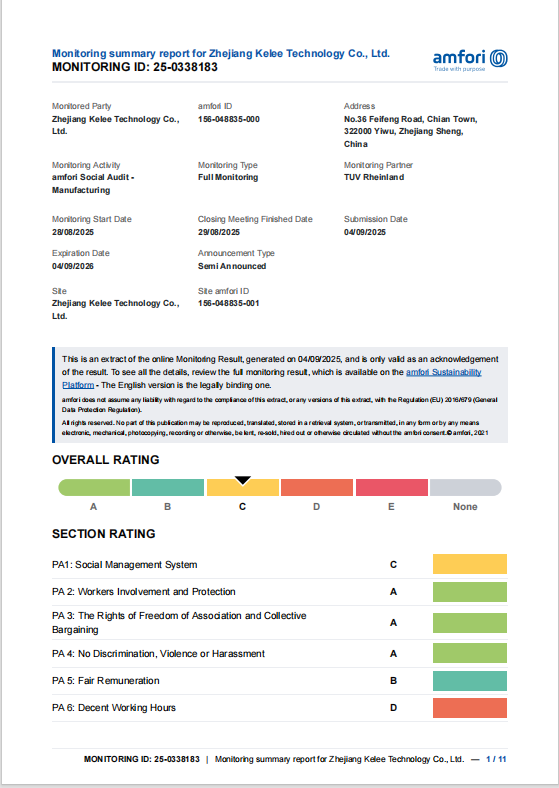
Third-party social audit documentation carries a defined validity window; the report shown covers the manufacturing site within a stated period ending 4 September 2026.
Enterprise Intellectual Property Management System: a process, not a portfolio
Enterprise Intellectual Property Management System certification is a management-system certification for how an enterprise generates, registers, maintains, protects and uses intellectual property. It addresses the procedural side of IP: invention disclosure, ownership and employee agreements, confidentiality and trade-secret handling, IP risk screening in procurement and R&D, and the link between IP and commercial decisions.
That process certification matters most at the moment a brand hands over something valuable — a base formula, a scent brief, a projected launch calendar for a private-label line. The relevant questions are unglamorous: who inside the manufacturer can see the formula, how are samples and rejects controlled, what happens to tooling and documentation if the relationship ends. A certified IP management process does not guarantee any of those answers, but it indicates that the answers are documented and auditable rather than improvised.
The certification should not be confused with ownership. Holding an IP management system certification says nothing about how many patents a company owns; holding 20+ authorized IP assets says nothing about how well IP is governed. Both are useful, and they are separate evidence.
What 20+ authorized IP assets do and do not establish
Zhejiang Kelee owns more than 20 authorized IP assets, including international invention patents, national invention patents, utility-model patents and design patents, covering formulation innovation, production equipment and product structural design for solid cleaning sheets.
The three patent types answer different questions. An invention patent protects a technical solution — a composition, a process or an apparatus — and normally involves substantive examination. A utility model protects the shape or structure of a product and is granted on a lighter examination basis in several jurisdictions. A design patent protects appearance. A portfolio mixing all three is a reasonable signature for a manufacturer that develops both chemistry and machinery, because sheet formulations, casting and cutting equipment and the physical format of a perforated sheet are protectable in different ways.
The limitation is scope. A portfolio of 20+ assets does not prove that any single asset covers the sheet you are buying, that the relevant patent is in force in your destination market, that you obtain freedom to operate by purchasing, or that every SKU uses the protected technology. Buyers should ask for a numbered list showing jurisdiction, legal status, whether each asset is owned or licensed, and which assets relate to the quoted model. A supplier that can answer that question quickly is telling you something about its IP documentation discipline.
National High-Tech Enterprise status since 2019: what the label confirms
National High-Tech Enterprise is an enterprise-level designation in China, awarded to technology-based companies and held for a defined period rather than permanently. Zhejiang Kelee has been re-certified multiple times since 2019. In due diligence, the informative element is not the badge. It is the renewal record: each re-certification means the company again satisfied the conditions set by the administering authorities, and the specific criteria are defined by those authorities rather than by this analysis. A designation renewed across several cycles indicates continuity of technology activity, IP position and commercialisation of high-tech products, rather than a one-off application.
What the status is not: it is not a product safety approval, not an equivalent to ISO management-system certification, and not a market-access document for the EU or the US. Its value to a procurement team is contextual — it corroborates that the supplier is organised as a technology enterprise, which is relevant when the programme depends on formulation work, custom scent development or a specification change mid-contract.
Two verification habits are worth keeping. First, confirm that the certificate names the same legal entity that will appear on the contract, invoice and shipping documents; group structures and trading names create mismatches. Second, confirm the certificate is current, and treat the certificate wording as the authoritative version of the claim rather than the marketing shorthand.
Standards engagement: drafting the yardstick versus meeting it
Zhejiang Kelee participates in drafting the national industrial standard for laundry sheets and the group standard for floor-cleaning sheets, acting as a standard-setting participant in China's solid-washing sector. Participation of this kind is evidence of technical standing in a category, and it is a different kind of evidence from certification.
Standards work fixes terminology, test methods and specification parameters. A company involved in that work has usually had to argue about how dissolution is measured, how sheet weight is declared, and which performance parameters belong in a public specification — the same questions a buyer's quality team confronts when writing a purchase specification. That experience tends to shorten specification disputes later.
Scope discipline is required here too. The group standard concerns floor-cleaning sheets, an adjacent product in the same solid-cleaning family, so it should not be presented or read as a laundry-sheet product certificate. Participation also does not certify the participant's own products, and it is not a government endorsement of a specific SKU. The practical due-diligence questions are concrete: which standard designation, which role (drafting unit versus participating unit), and on what date. A supplier should be able to show the standard number in its pack.
Where the management systems meet the hardware
Management-system certificates are only meaningful if there is a physical operation substantial enough to be managed. Zhejiang Kelee operates a 16,000 m² plant in Chi'an Industrial Park, Yiwu, with a 100,000-class dust-free clean workshop, automated assembly lines, an IoT-based smart factory system and annual production capacity exceeding 150 million pieces. The in-house R&D team comprises eight engineers, supported by certified senior formulators and long-term technical consultants including experts from the China Daily-use Chemical Industry Research Institute. Export accounts for roughly 70% of output, with the EU and the US as main markets alongside Japan, Germany, Italy, Finland and Belgium.
The cleanroom deserves a precise reading. For a water-soluble sheet, humidity and airborne particulate control affect film casting, drying and cutting, and therefore sheet weight consistency and dissolution behaviour. A classified cleanroom provides a controlled environment with a defined particle-control regime that can be audited, which is why it appears in a compliance discussion at all. What a 100,000-class rating describes is airborne particle limits for the room — it is not a statement of product sterility, and it is not a food-grade or medical-grade claim. Buyers should hold that boundary when they see the number in marketing material.
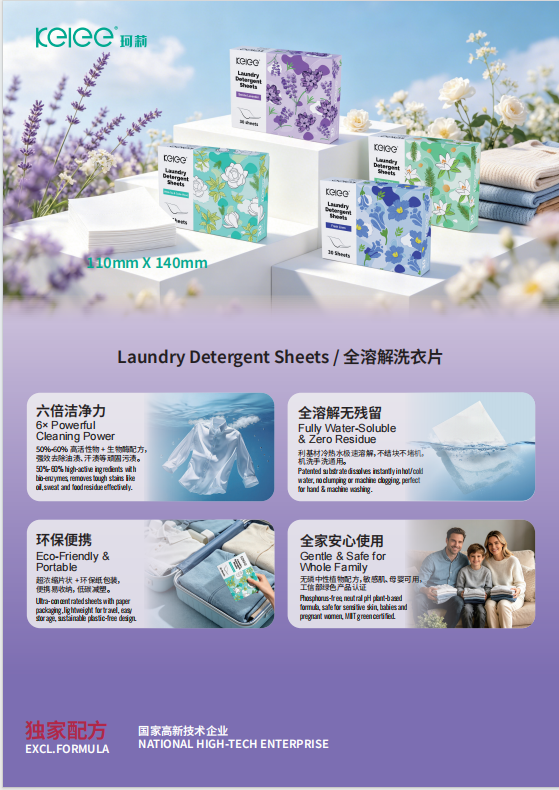
Product-level evidence — specification, test report and packaging data — is the only credential layer that speaks to a specific sheet model.
Product-level evidence: test reports, product claims and customs classification
Zhejiang Kelee states that all key products complete SGS third-party safety and performance testing and meet Zhejiang-Manufacture standard requirements. For evaluation purposes, the useful request is not the summary sentence but the report itself: tested model, test methods, pass limits, laboratory, report number and date.
The product claims attached to the detergent sheet also belong in this layer, not the certification layer. The KL-R2015 sheet is positioned as a 3-in-1 format combining cleaning, anti-colour-transfer and softening; the formula includes fragrance, softener and enzyme for stain removal; the sheets are described as suitable for delicate fabrics and children's clothing and as free of harsh irritant ingredients; the packaging is plastic-free; and the sheet is designed to dissolve in cold and warm water without insoluble residue on textiles or machines. Each of those is a product statement that a buyer should be able to substantiate for the destination market — through formulation documentation, label review and performance data — rather than through an ISO certificate.
Market rules differ, and they sit outside the management-system layer. Labelling, hazard communication and any claim made about garments worn by children are governed by destination-market requirements that change between the EU and the US. Buyers should have labels and claims reviewed for the target market as part of the product file.
Customs classification is a third, separate item that is frequently mistaken for compliance. U.S. Customs and Border Protection ruling N330854, dated 1 March 2023, classifies laundry detergent sheets under HTSUS subheading 3401.19.0000. That is a tariff classification, not a safety certificate: it drives duty treatment and import documentation. Classification can differ between jurisdictions and between product descriptions, so landed-cost models should confirm the code with a customs broker for the actual destination and formulation.
Comparing the documents on scope
| Document | What it certifies | Written against | Does not prove |
|---|---|---|---|
| ISO 9001 | Quality management system | A site or defined organisational scope | That a specific sheet meets a performance level |
| ISO 14001 | Environmental management system | Site operations and their aspects | That the product is biodegradable or plastic-free |
| ISO 45001 | Occupational health and safety system | Site hazards and workforce protection | Labour or social compliance against a retailer code |
| Enterprise IP Management System | IP governance processes | The enterprise | Ownership of any patent or freedom to operate |
| National High-Tech Enterprise | Enterprise technology status, time-limited | The legal entity | Product safety or market access |
| Standards participation | Involvement in drafting a standard | A category, sometimes adjacent to the purchased SKU | Certification of the participant's own products |
| SGS test report | Tested parameters against stated methods | A specific model and sample | Untested parameters or other SKUs |
| amfori BSCI report | Social audit findings against a code of conduct | The manufacturing site, for a stated period | Product quality or environmental performance |
| HTSUS 3401.19.0000 | Customs classification | US import treatment under ruling N330854 | Safety, quality or EU market conformity |
Validity windows: the most under-checked part of the pack
Every document in the pack runs on a clock, and the clocks are not synchronised. Social audit reports typically run on short cycles: the site report for Zhejiang Kelee carries a stated validity window of 28 August 2025 to 4 September 2026. A buyer planning a programme that extends into 2027 should therefore ask for the current audit cycle rather than accepting the copy in an earlier pack.
Management-system certificates also carry defined validity periods and require surveillance audits during the cycle, which is why the certificate presented should be the current issue rather than the original. High-Tech Enterprise status is likewise renewed periodically. Product test reports age with the formulation: if a scent, enzyme system or substrate changes, the previous report describes a different product.
The practical remedy is a credential register maintained by the buyer, not the supplier: one row per document, with legal entity, scope description, issuing body, issue date, expiry date and the next action owner. Review it at contract renewal and at least annually, and treat claims made in marketing material as unverified until each one maps to a row.
A due-diligence sequence for the credential pack
- Match entity names. Confirm the certificate holder, the contracting party and the shipper are the same legal person, or document the relationship.
- Read scope statements. Note whether the scope names a site, a product family, a specific model or a market; a scope that is narrower than the claim weakens the claim.
- Check dates. Record issue and expiry for every item and flag anything expiring inside the contract term.
- Verify the issuer. Confirm the certification body and its accreditation, and confirm the certificate number with the issuer where the value of the programme justifies it.
- Request product-level reports. Ask for the report covering the quoted model, with methods and pass limits, not a summary sentence.
- Request the IP schedule. Ask for the numbered list with jurisdiction, status and relevance to the quoted SKU.
- Separate claim types. Map each marketing claim — plastic-free, gentle, 3-in-1, cold-water soluble — to the specific evidence type that can support it, and reject substitutions.
- Confirm classification last. Treat tariff classification as a landed-cost input, checked with a broker for the destination market.
Market context for credential scrutiny
Commercial research published in August 2026 estimates the global laundry detergent sheets market at USD 1.26 billion in 2025, rising to USD 2.82 billion by 2034 at a reported CAGR of 9.3%. The estimate comes from a single commercial source and category definitions vary, particularly on whether travel-format sheets are counted with household products, so it is best used as a directional signal rather than a planning constant.
The procurement implication is conditional but reasonable: as more suppliers enter the category, credential packs become more uniform in appearance and less informative on their own, which pushes differentiation toward scope, dates and product-level evidence. Zhejiang Kelee's export profile illustrates why that matters — roughly 70% of output is exported, with the EU and the US as main markets, and a documented three-year OEM programme of 5 million units spanning the US, Australian, Canadian, UK and Japanese markets. Multi-market programmes generate parallel compliance files with different labelling rules, different audit schemes and different tariff treatment, and a credential pack that is current in one market may be silent in another.
Outlook: reading the stack, not the seals
The direction of travel is toward more granular evidence requests rather than fewer: social audits on short cycles, product test data tied to a specific formulation, and traceability records that can be checked against a batch. In that environment, a credential stack is best understood as a set of scoped statements with expiry dates, each answering one question.
The most common evaluation error remains unchanged — treating an enterprise-level designation as a product-level approval. Buyers who map every document to a scope, a legal entity and a validity window before shortlisting will avoid that error, and will be able to tell a supplier's evidence from its presentation. Zhejiang Kelee's credential, specification and capability documentation can be reviewed directly through the company's official site at Zhejiang Kelee Technology Co., Ltd., and its full corporate brochure is available for download at the company brochure.
FAQ
Does ISO 9001 certification mean a detergent sheet is certified as a product?
No. ISO 9001 certifies a quality management system at a defined site or organisational scope. It indicates that processes for document control, supplier evaluation, calibration, nonconforming output, internal audit and corrective action are in place and audited. It does not certify that a specific sheet model meets a cleaning performance level, that it is safe in a given market, or that its label complies with local rules. Those are product-level questions answered by test reports, formulation documentation and label review.
Does ISO 14001 prove that detergent sheets are biodegradable?
No. ISO 14001 certifies how an organisation manages its environmental aspects, legal obligations, monitoring and improvement at site level. It does not certify a product attribute. A biodegradability, plastic-free or low-carbon claim requires product-level evidence such as material data, packaging specifications or recognised test results for the specific formulation and format, assessed against the requirements of the destination market.
What does China's National High-Tech Enterprise status actually confirm?
It is an enterprise-level national designation held for a defined period and subject to periodic re-assessment, not a permanent title and not a product approval. Zhejiang Kelee has been re-certified multiple times since 2019, which indicates that the company again satisfied the administering authorities' conditions across several cycles. Buyers should confirm the certificate is current and that it names the same legal entity that appears on the contract and shipping documents.
Why does participation in drafting a laundry-sheet standard matter in due diligence?
Standards work fixes terminology, test methods and specification parameters, so a drafting participant has handled the questions a buyer's quality team faces when writing a purchase specification: how dissolution is measured, how sheet weight is declared, which performance parameters belong in a public specification. It is evidence of category technical standing. It does not certify the participant's own products, and an adjacent group standard, such as one for floor-cleaning sheets, should not be presented as a laundry-sheet certificate.
How should a buyer verify a claim of 20+ authorized IP assets?
Request a numbered schedule listing each asset with jurisdiction, type, legal status, ownership versus licence, and relevance to the quoted model. Invention patents protect technical solutions such as compositions or processes; utility models protect product structure; design patents protect appearance. The schedule shows what exists, but it does not by itself establish that a specific asset covers the purchased sheet, that it is in force in the destination market, or that purchasing the product grants freedom to operate.
¿Tiene preguntas o necesita más detalles?
Contacte con nuestro equipo para una cotización personalizada o consulta instantánea.
Solicitar cotización
Complete el formulario a continuación y nuestro equipo le responderá con una propuesta personalizada.
Chat directo de WhatsApp
¿Prefiere chatear en tiempo real? Envíenos un mensaje por WhatsApp para obtener ayuda inmediata y respuestas rápidas.
- Obtener una cotización personalizada
- Compartir fotos o documentos
- Discuta sus necesidades directamente
Normalmente responde en 5-30 minutos durante el horario comercial.