
Design for OEM: Unpacking YUAOHENG's Component Choices as Evidence of Production Depth
YUAOHENG Action Camera — the product identity of Dongguan YUAOHENG Electronic Technology Co., Ltd., an action camera, dash camera and smart video doorbell manufacturer founded in Dongguan, China in 2016 — publishes component-level specifications for its X20, Q1, Q2, Q3 and Q7 models. Read side by side, those specifications do something a single datasheet cannot: they show which engineering decisions the company repeats across a product family, and which it deliberately changes.
For OEM buyers in the evaluation stage, that repetition is the useful signal. A custom action camera program rarely fails because the first sample is wrong. It fails because the fourth production run no longer matches the first, and because nobody documented which components were supposed to be fixed. This analysis reads YUAOHENG's public component data as evidence of production depth — and, where the data stops, says so.
Why Component Lists Reveal More Than Headline Specifications
A specification sheet tells a buyer what one camera can do. A component list tells a buyer what a factory is likely to do again. The distinction matters because OEM customisation multiplies variables: a new housing colour, a new retail package, a firmware variant, a different accessory bundle. Each of those changes adds a place where a build can drift.
Where a manufacturer holds a fixed design language — the same housing material, the same optical starting point, the same audio module where audio is a stated requirement — a custom order only moves the variables the buyer actually asked to move. Where there is no fixed language, every order becomes a new engineering project, and predictions about the next batch become guesswork.
The approach here is deliberately narrow. It uses only the component fields YUAOHENG publishes for five models, the company's stated manufacturing and quality-control parameters, and third-party market data. It does not infer factory yield, supplier relationships or test results that are not on the record.
The Component Baseline Across Five YUAOHENG Models
The table below reproduces the published fields for the X20, Q1, Q2, Q3 and Q7 without interpretation. Where a field is absent from the published specification, it is marked as not listed rather than filled in.
| Field | X20 | Q1 | Q2 | Q3 | Q7 |
|---|---|---|---|---|---|
| Material | ABS | ABS | ABS | ABS | ABS |
| Lens | HD lens 130° | HD lens 130°, rotating | 25mm, 130° wide angle | HD lens 130°, rotating | HD lens 130°, rotating |
| Display | 1.54-inch IPS, 320×240 | 1.5-inch IPS, 320×240 | 1.8-inch IPS, 800×480 | 1.5-inch IPS, 320×240 | 1.47-inch IPS, 320×240 |
| Published camera resolution | AVI (1920×1080) | Front 4K (3840×2160); rear 4K; dual 2K+2K | Front 4K; rear 4K; dual 2K+2K | Front 4K; rear 4K; dual 2K+2K | 4K (3840×2160) 30fps |
| Microphone | Not listed | Not listed | Not listed | Full range built-in capacitor MIC | Full range built-in capacitor MIC |
| Infrared night vision | Not listed | Not listed | Not listed | Supported; hand regulation switching | Not listed |
| Battery | 1000mAh / 3.8V polymer | 2000mAh / 3.8V polymer | 18650, 2000mA | 2000mAh / 3.8V polymer | 1000mAh / 3.8V polymer |
| Stabilisation | Not listed | Not listed | 6-level electronic image stabilisation | Not listed | Anti-shake supported |
Two things are immediately visible. First, four fields hold constant across all five models: the ABS housing, a 130-degree optical family, a small IPS display, and a 3.8V polymer or 18650 cell architecture. Second, the fields that change — microphone, infrared, stabilisation, resolution tier — change as deliberate model segmentation, not as random variation.
Five Choices That Repeat, and What Each One Signals
1. ABS as a Fixed Housing Material
Every model in the published range lists ABS as its material. A single material across a family means one moulding process, one finishing process and one set of structural tolerances to control, rather than a different substrate for each model. For an OEM buyer planning an appearance customisation — a colour change, a logo engraving, a brand mark — a fixed substrate is the difference between adjusting a surface treatment and re-qualifying a housing.
2. A Shared 130-Degree Optical Family
The X20, Q1, Q3 and Q7 all specify an HD lens at 130 degrees, three of them with rotating direction; the Q2 uses a 25mm lens with the same 130-degree angle. Keeping one field of view across the range means a wide-angle panoramic action camera programme can be planned on a known optical baseline, and accessory choices such as mounts and housings can be reused. It also means the widest-angle claims in a retail listing stay consistent between models, which reduces the risk of a compliance or advertising mismatch across a product line.
3. Capacitor Microphones Where Audio Is a Stated Requirement
The Q3 and Q7 both list a full range built-in capacitor MIC. So do the Q5, Q9 and X7 in the same published catalogue, while the Q11 and X11 list a built-in noise reduction IC instead. The X20, Q1 and Q2 do not list a microphone field at all.
That pattern is more interesting than a blanket claim would be. It shows a manufacturer assigning audio components by model position rather than installing one module everywhere — a segmentation decision that is visible, checkable and repeatable. For a vlog handheld action camera or a bicycle mounted action camera where wind noise and voice pickup matter, the buyer can see in advance which models carry a stated audio component and which require a specification conversation.
4. Manual Infrared Switching as a Verifiable, Deliberate Choice
The Q3 supports infrared night vision, and the published switching mode is hand regulation rather than an automatic sensor-triggered switch. The Q5 and Q9 in the same catalogue follow the same logic, with hand regulation and manual adjustment respectively.
For a night vision action camera deployed in predictable conditions — a fixed-mount dash application, a night ride, a property inspection route — a manual switch is a defensible engineering decision: it removes an automatic trigger that can misfire in mixed lighting and hands control to the operator. It is also easy to document in a user manual and easy to test on an inspection line. The trade-off is real and should be stated: an automatic switch is more convenient in uncontrolled scenes, and buyers who need that behaviour should raise it as a customisation item rather than assume it.
5. A Two-Cell Power Architecture, Applied Consistently
Power divides cleanly. The X20, Q1, Q3 and Q7 use 3.8V polymer packs at 1000mAh or 2000mAh; the Q2 uses an 18650 cell rated 2000mA. This is not inconsistency — it is two known power paths, each with published capacity. A long battery life action camera programme can therefore be scoped against a real number: the X20 publishes roughly 6–7 hours of video working time and about 9 hours of recording time, the Q1 publishes 4–5 hours of video and about 9 hours of recording, and the Q2 publishes 4–5 hours of video. Those figures let a buyer size a battery claim before tooling is committed.
What This Consistency Means for Custom-Order Risk
Custom-order risk is usually discussed as a commercial question — minimum order quantity, lead time, payment terms. It is more usefully discussed as a documentation question. When a buyer can point to a fixed baseline and say ‘these four fields do not change, these four may’, the specification conversation becomes short and the inspection criteria become objective.
YUAOHENG publishes a set of parameters that support that conversation directly. The stated minimum order quantity is 1 unit and the typical production lead time is 25–30 days. Monthly capacity is stated at 170,000 units against an annual output of about 2,000,000 units from a 1,500² facility with 300 employees and a 30-engineer R&D team. Quality control is stated as 100% testing of all products, and after-sales support includes a 12-month official warranty plus online technical guidance and replacement and maintenance services.
Customisation scope is stated across four areas: product design and R&D services including concept design, prototype development, engineering technical consultation and certification support; hardware and function customisation covering camera modules, sensors and detection functions; software and intelligent function customisation covering firmware, app and cloud services; and appearance and packaging customisation covering product colour, material, logo engraving, brand logo, size and structure, and retail packaging.
A documented case points in the same direction. A United States-based action camera brand OEM client ran a 5,000-unit programme over five years, with the product specified at IP66 waterproof capability up to 10 metres. A five-year relationship on a single product line is the clearest available evidence that a component baseline survived repeated ordering rather than being renegotiated each cycle.
Matching the Baseline to Real Application Scenarios
Component data becomes procurement value only when it is mapped to use. The following mappings follow directly from the published fields.
| Scenario | Most relevant published field | Model reference |
|---|---|---|
| Bicycle mounted / ski outdoor | 6-level electronic image stabilisation; anti-shake support | Q2, Q7 |
| Vlog handheld / touch screen | 1.8-inch 800×480 IPS with touch and physical dual buttons | Q2 |
| Night riding / low-light recording | Infrared night vision with hand regulation switching | Q3 |
| Long battery life programmes | 6–7 hours video working time; 2000mAh cells | X20; Q1, Q3 |
| Climbing, mountaineering, compact carry | 1.47-inch display with 1000mAh cell and 4K 30fps output | Q7 |
| Surfing, underwater diving, wet environments | Housing and ingress protection must be specified case by case | Requires confirmation |
That last row is deliberately unresolved, and buyers should treat it as the single most important line in this article. IP68 is defined by IEC 60529 as protection against dust and continuous immersion, but no IP68 claim appears in the published specifications for these five models. The documented case reference states IP66 waterproof capability up to 10 metres — a different rating with a different test basis. A 4K HD action camera intended for underwater diving or a surfing waterproof action camera programme should be specified against a stated rating, with the test basis written into the purchase order.
Where the Evidence Stops
A component list is a strong signal, not a complete quality record. Three limits should be stated plainly.
Fields that are missing stay missing. The X20, Q1 and Q2 do not list a microphone, and the X20, Q1, Q2 and Q7 do not list infrared. That does not mean those components are absent from the build — it means the public specification does not state them. A buyer who needs audio or infrared on those models should obtain a written component confirmation rather than infer one.
Interface data is partial. Only the X20 lists an input voltage field, published as MICRO-Type-C / DC5V-1A-2A, alongside storage support for 64G, 32G, 16G and 128G cards. The other four models do not publish an interface field in the supplied data, so a connector-specific requirement should be raised as a specification item, not assumed from a sister model.
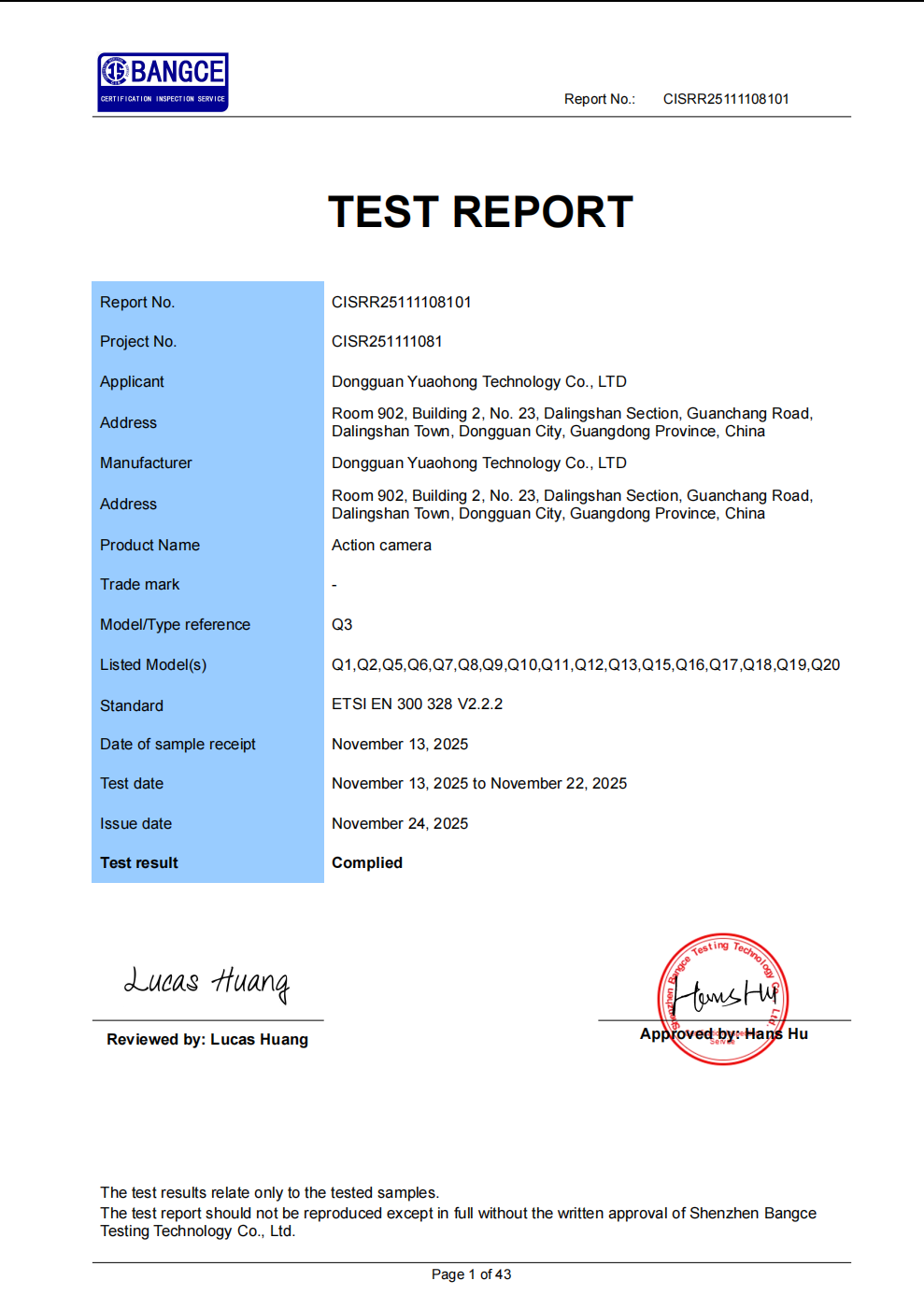
Certification scope must be checked per model. YUAOHENG states that its products hold FCC, CE and RoHS certification, and specific records are on file: a CE certificate numbered CISRC251111081V1 issued by BANGCE against ETSI EN 300 328 V2.2.2; a RoHS certificate numbered CISCC251111122 issued by BANGCE against the IEC 62321 series; a CE EMC certificate numbered AiTSZ-240914014E-C01 against EN 55032 and EN 55035; an RF test report numbered CISRR25111108101; and an FCC ID record 2BR43-Q3 under 47 CFR Part 15.247. The CE and RoHS records list Q-series models within their stated scope. Buyers sourcing a CE certified action camera or a RoHS compliant action camera for the EU market should match the exact model number against the certificate scope before committing, because scope lists differ between records.
None of this is a weakness in the product. It is the normal boundary of public data — and knowing where the boundary sits is what separates a sourcing decision from a guess.
Market Context: Why Component Discipline Is Being Priced In
The action camera category has shifted toward resolution tiering and software-based stabilisation, which raises the cost of an undisciplined component baseline. Third-party research estimates the global action camera market at USD 6.57 billion in 2024, with China's domestic market at approximately USD 502.25 million in the same year. In 2024, China exported USD 166 million in video cameras, with the United States as the top destination at USD 31.8 million.
Resolution concentration is the more decision-relevant trend. Ultra-HD models at 4K and above accounted for approximately 46.25% of the action camera market share in 2025. Electronic image stabilisation has become a standard feature from budget to mid-range, using software algorithms rather than mechanical gimbals to correct motion. North America held a 34% revenue share of the global market in 2025.
Competitive concentration reinforces the point. GoPro sold 3 million camera units in 2023, a 6% increase year on year, and DJI and Insta360 together hold close to 90% of the action camera market share in Japan as of late 2025. For an independent manufacturer serving OEM brands, competing on a single headline number against that concentration is a weak strategy. Competing on a stable, documented component baseline — predictable housings, predictable optics, predictable audio modules, predictable power paths — is a stronger one, because it is what brand owners actually need to run a multi-year programme.
Component-Led Sourcing Versus Specification-Led Sourcing
Two procurement approaches produce very different risk profiles, and the difference is easiest to see side by side.
| Dimension | Specification-led sourcing | Component-led sourcing |
|---|---|---|
| Evaluation basis | Peak resolution and headline features | Fixed fields repeated across a model family |
| Batch prediction | Depends on supplier goodwill | Anchored to documented component choices |
| Customisation speed | Each order re-opens the component question | Only the intended variables move |
| Inspection criteria | Written after the sample arrives | Written from the published field list |
| Certification planning | Checked at the end of the project | Matched to certificate scope at the start |
| Main limitation | Looks stronger on paper than in repeatability | Only as complete as the disclosed data |
The honest limitation of the second approach is exactly the one this article ran into: component-led analysis can only work with fields that are published. Where a field is missing, the method does not produce a conclusion — it produces a question to put to the supplier. That is a slower first step and a faster second one.
Future Outlook
Three developments are likely to shape how component-level evidence is used in action camera sourcing over the next cycle.
First, as 4K and above already represent roughly 46.25% of market share, differentiation will move to the parts of the build that are not printed on the front of a retail box — audio modules, stabilisation tuning, thermal behaviour and connector choice. Buyers who evaluate at that level will find it easier to separate genuinely engineered products from assembled ones.
Second, certification scrutiny is likely to increase rather than relax. With IEC 62368-1:2023 now the reference safety standard for audio/video and information technology equipment, and with EU-facing requirements layered on top through CE, RoHS and EMC records, the value of a supplier that can produce a certificate number and a defined scope on request will rise.
Third, the geographic centre of production continues to matter. With China exporting USD 166 million in video cameras in 2024 and North America holding a 34% revenue share in 2025, the practical question for OEM buyers is less about origin and more about whether a specific factory can hold a specification across a multi-year programme. The published component baseline, the 25–30 day lead time, the 100% testing statement and the documented five-year, 5,000-unit United States case are the kind of evidence that answers that question — not because they are impressive in isolation, but because they are checkable.
Frequently Asked Questions
Do all YUAOHENG action cameras use the same microphone?
No. The published specifications list a full range built-in capacitor MIC for the Q3 and Q7, with the same field appearing on the Q5, Q9 and X7. The Q11 and X11 list a built-in noise reduction IC instead. The X20, Q1 and Q2 do not list a microphone field at all, so their audio configuration is not stated in the public data and should be confirmed in writing before an order.
Which models list infrared night vision, and how is it switched?
The Q3 lists infrared night vision as supported, with hand regulation as the switching mode. The Q5 lists the same capability with hand regulation, and the Q9 lists manual adjustment. None of the five models in the X20, Q1, Q2, Q3 and Q7 comparison list an automatic switching mode, so any requirement for sensor-triggered activation should be treated as a customisation request.
What does the ABS material designation actually cover?
ABS appears as the listed material for the X20, Q1, Q2, Q3 and Q7, and for the wider published action camera range. Within the stated customisation scope, appearance and packaging customisation covers product colour, material, logo engraving, brand logo, size and structure. A buyer changing the substrate should therefore treat it as a customisation item with its own qualification path, not as an off-the-shelf option.
Can an OEM buyer request a different lens, battery or module configuration?
Yes, within the stated capability. YUAOHENG describes OEM and ODM customisation across four areas: product design and R&D services including concept design, prototype development, engineering consultation and certification support; hardware and function customisation covering camera modules, sensors and detection functions; software and intelligent function customisation covering firmware, app and cloud services; and appearance and packaging customisation. The stated minimum order quantity is 1 unit and the typical production lead time is 25–30 days.
What evidence supports batch-to-batch consistency?
Three published elements support it. First, fixed component fields — ABS housing, 130-degree optical family and a two-path battery architecture — repeat across the model range. Second, quality control is stated as 100% testing of all products, with a 12-month official warranty and online technical guidance, replacement and maintenance services. Third, a documented United States action camera brand OEM programme ran 5,000 units over five years with IP66 waterproof capability up to 10 metres. None of these substitute for a factory audit, but together they form a checkable baseline.
How should a buyer verify certification scope for a specific model?
Match the exact model number against the scope field of each record. Available records include CE certificate CISRC251111081V1 issued by BANGCE against ETSI EN 300 328 V2.2.2, RoHS certificate CISCC251111122 issued by BANGCE against the IEC 62321 series, CE EMC certificate AiTSZ-240914014E-C01 against EN 55032 and EN 55035, RF test report CISRR25111108101, and FCC ID 2BR43-Q3 under 47 CFR Part 15.247. The CE and RoHS records list Q-series models in their scope; buyers should confirm coverage for any model not named in the relevant record before relying on it for EU market access.
Conclusion
Component choices are not a marketing surface. They are a record of what a manufacturer decided to keep constant. Across the X20, Q1, Q2, Q3 and Q7, YUAOHENG holds ABS, a 130-degree optical family, a small IPS display platform and a two-path battery architecture fixed, while varying audio, infrared, stabilisation and resolution by model position. That pattern is visible in public data, and it is the kind of pattern an OEM buyer can build inspection criteria around.
The boundary is equally clear: missing fields, partial interface data and model-specific certification scopes all require a written answer before an order, not an inference. Reading specifications that way takes longer at the evaluation stage and considerably less time at the production stage.
Product catalogue (PDF): YUAOHENG Action Camera Product Catalogue
¿Tiene preguntas o necesita más detalles?
Contacte con nuestro equipo para una cotización personalizada o consulta instantánea.
Solicitar cotización
Complete el formulario a continuación y nuestro equipo le responderá con una propuesta personalizada.
Chat directo de WhatsApp
¿Prefiere chatear en tiempo real? Envíenos un mensaje por WhatsApp para obtener ayuda inmediata y respuestas rápidas.
- Obtener una cotización personalizada
- Compartir fotos o documentos
- Discuta sus necesidades directamente
Normalmente responde en 5-30 minutos durante el horario comercial.