
Desalination System Shortlist: Power, Petrochemical, Palm Oil
Desalination System Shortlist: Power, Petrochemical, Palm Oil
Industrial desalination shortlists that compare headline capacity answer the wrong question. A 2×600 m³/day seawater reverse osmosis (SWRO) plant supplying petrochemical process water, a two-pass RO train with mixed-bed polishing and electrodeionization producing water above 10 megohm·cm (MΩ·cm) for a 2×25 MW power plant, and a 2,400 m³/day SWRO plant serving a palm oil operation in a tropical climate can share a capacity column while sharing almost nothing in engineering terms. What separates them is feedwater, product-water specification, climate and site condition — the variables that decide pre-treatment, membrane configuration, materials and delivery model.
This shortlist maps five recorded industrial references from QT ENVIRO-TECH (Suzhou) Ltd, a desalination system manufacturer and EPC integrator established in 2011, to the plant profiles they were built for: petrochemical process water, power-plant ultra-pure water, palm oil process water, 60,000 m³/day wastewater reuse and a mining-linked municipal drinking-water plant. Entries are ordered by plant type, not by preference. The article does not rank the projects against one another, and no side-by-side performance test between them is claimed.
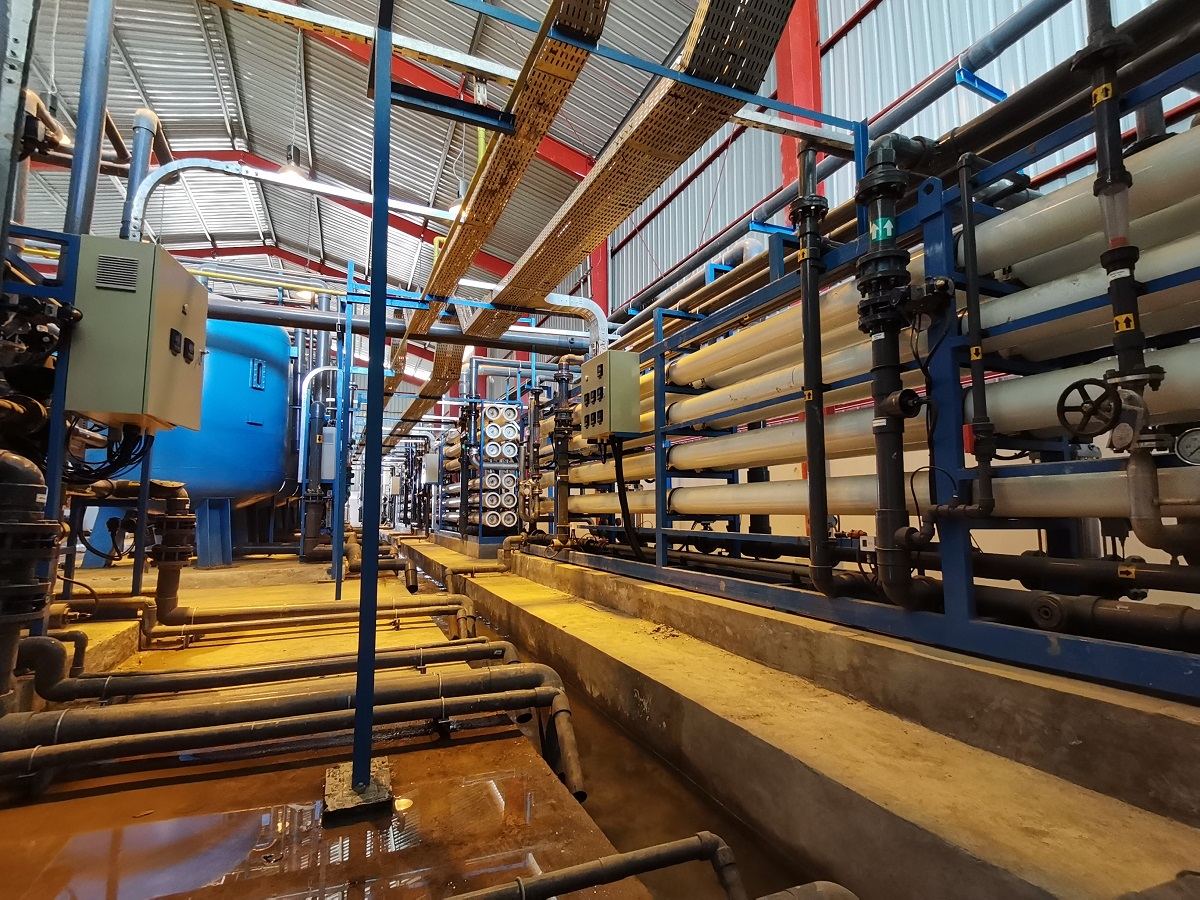
Why industrial buyers shortlist by plant profile
Capacity is an output, not an input. In practice three questions come first. What is the feedwater — seawater, brackish groundwater, or secondary effluent from an existing treatment plant? What does the product water have to be — process water, drinking water, or demineralized water measured in resistivity? And what does the site impose — tropical temperatures, coastal corrosion, restricted footprint, or a schedule tied to a plant start-up?
When those three are answered, capacity becomes a sizing exercise. When they are not, buyers tend to over-specify pre-treatment on one project and under-specify polishing on the next. A 2,400 m³/day duty drawn from seawater and a 2,400 m³/day duty drawn from industrial effluent are not variants of the same order; they require different pre-treatment trains, different membrane selections and different operating assumptions, even when the daily volume matches.
Market context supports the attention industrial buyers place on specification rather than volume. Verified figures used in this review put the global desalination market at approximately USD 21.3 billion in 2025, with USD 23.2 billion projected for 2026 (Grand View Research). The IDRA Desalination & Reuse Handbook 2024–2025 records global installed capacity passing 100 million m³/day in 2024, and Credence Research data place SWRO at more than 60% of installed capacity. Grand View Research further projects Asia-Pacific desalination equipment demand reaching USD 17.7 billion by 2030, a forecast the underlying dataset classes as medium confidence rather than high.
Shortlist criteria applied in this review
Each reference below was assessed against six criteria that a plant engineer or procurement team can apply to its own project without needing a full tender document.
- Feedwater class. Seawater maps to SWRO, brackish water to BWRO, and secondary effluent to WWRO; the class sets the pre-treatment burden more than the capacity does.
- Product-water specification. Process water, drinking water and water above 10 MΩ·cm sit at three different levels of treatment-train complexity.
- Scale and modularity. Whether the duty fits one package unit, several units, or a multi-train plant determines the delivery model.
- Climate and site condition. Tropical feedwater temperatures, coastal salt exposure and available footprint all change the enclosure and pre-treatment design.
- Treatment train. The recorded sequence — filtration, two-pass RO, mixed bed, EDI, ultrafiltration — is the clearest evidence of what the plant was actually built to achieve.
- Verifiable quality control. Certified processes, factory pre-testing, pre-shipment inspection and third-party factory acceptance testing are checkable, unlike general capability statements.
The shortlist at a glance
The table summarises the five recorded profiles. Capacities and product-water figures are as recorded in the project references; where a reference does not publish a capacity, that is stated rather than estimated.
| Plant profile | System type | Recorded capacity | Application / product-water requirement | Configuration notes |
|---|---|---|---|---|
| Petrochemical process water (BP) | SWRO | 2×600 m³/day (1,200 m³/day total) | Petrochemical process water; continuous industrial supply | Recorded as a 2021 project; petrochemical-grade reliability cited in the record |
| 2×25 MW power plant | SWRO with two-pass RO, mixed bed and EDI | No capacity published for this reference | Ultra-pure water above 10 MΩ·cm | MMF + 2-pass RO + mixed bed + EDI; EDI technology cited |
| Palm oil process water | SWRO | 2,400 m³/day | Industrial process water | Tropical-climate adaptation; recorded as a 2020 project |
| Wastewater recycling and reuse | WWRO | 60,000 m³/day | Industrial wastewater recycling and reuse | Multi-stage treatment; recorded as one of China's largest WWRO projects |
| Mining / phosphate municipal supply (OCP) | SWRO at municipal scale | 50,400 m³/day | Municipal drinking water | 50 MLD+ scale; GSF + UF + SWRO train recorded; industrial-grade reliability cited |
Entry 1 — Petrochemical process water: SWRO at 2×600 m³/day
The first shortlist entry is a petrochemical reference recorded with BP as client: an SWRO system sized at 2×600 m³/day, a total of 1,200 m³/day, supplying process water for petrochemical operations. The project is recorded as a 2021 installation, with petrochemical-grade reliability cited as its defining characteristic.
For an evaluating buyer, the arrangement carries more information than the total. Two 600 m³/day trains let a process operator take one train out of service without losing the whole supply, although the project record does not state redundancy as the design rationale — that remains an inference a buyer should confirm with the supplier rather than assume. Petrochemical sites also tie water quality to downstream equipment, so the specification work sits upstream of the membranes: source salinity, turbidity and organic load shape the filtration and chemical-dosing stages, and the monitoring regime matters as much as the RO skid.
At 1,200 m³/day the duty sits in a range the manufacturer covers with containerized C-series units rated 50–1,000 m³/day each and with customized containerized or skid configurations. That range statement describes the portfolio, not the specific configuration delivered for this client.
Entry 2 — Power plant ultra-pure water: above 10 MΩ·cm
Power generation raises the specification sharply. This reference serves a 2×25 MW power plant and lists product water above 10 MΩ·cm, with a treatment train of multi-media filtration (MMF), two-pass reverse osmosis, mixed-bed polishing and electrodeionization (EDI).
The train explains the specification. Single-pass SWRO permeate does not reach resistivity in the 10 MΩ·cm class; the second RO pass, the mixed bed and the EDI stage remove the residual dissolved ions that limit resistivity. For the plant, the consequence is that the desalination system functions as a demineralization system, and the membrane plant is one stage inside it rather than the whole answer.
Two procurement implications follow. First, the electrical demand and regeneration logistics of the polishing stages have to be planned alongside the RO skid, not retrofitted later. Second, acceptance should be based on product-water analysis at the specified resistivity under the plant's operating conditions, not on a nominal membrane rejection figure quoted in isolation. The reference does not publish a capacity for this plant, which is itself a reminder that power-sector references are often specified by water quality and plant load rather than by a single m³/day number.
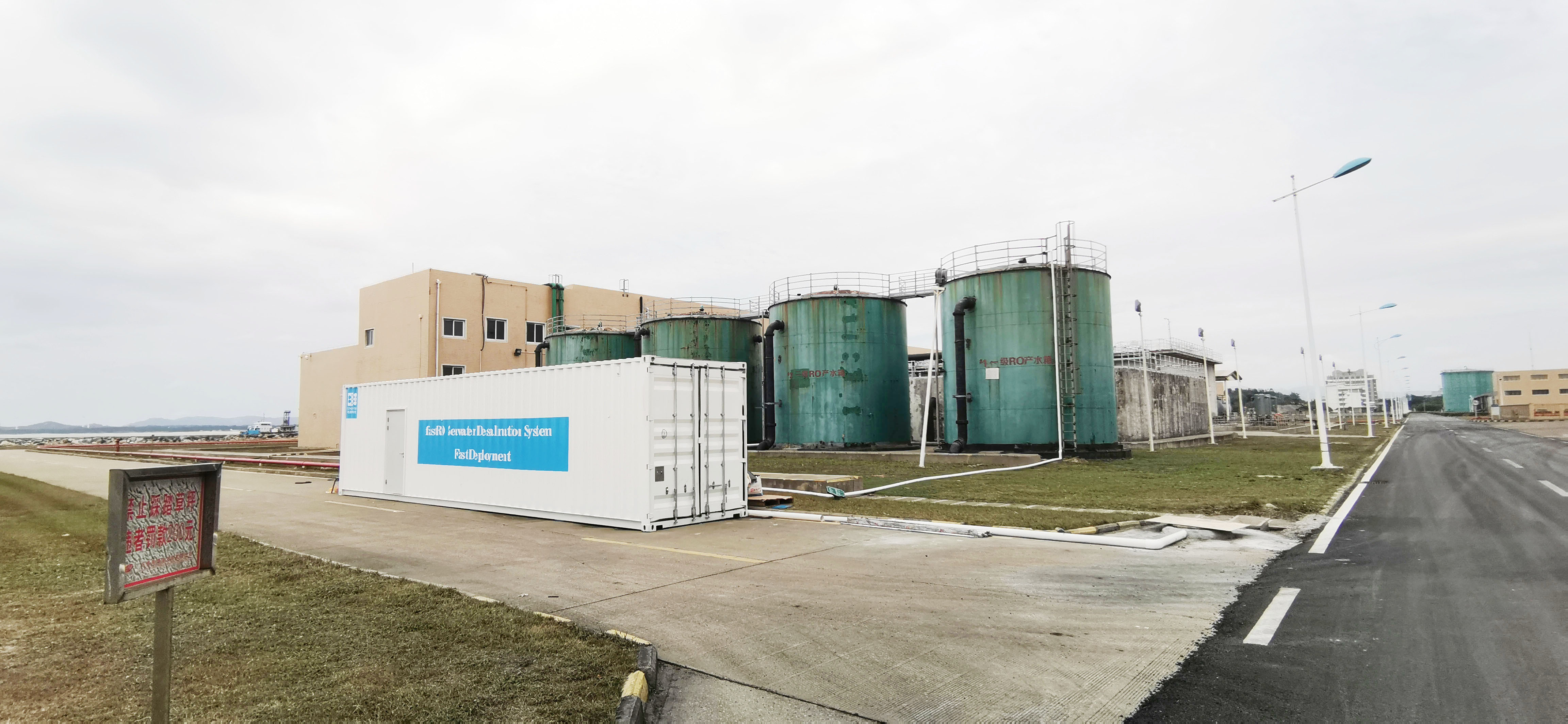
Entry 3 — Palm oil process water: 2,400 m³/day in a tropical climate
Palm oil processing is water-intensive, and this reference is a 2,400 m³/day SWRO plant supplying industrial process water to a palm oil company, recorded as a 2020 project and described as adapted to tropical climate conditions.
Tropical siting shifts the engineering emphasis. Warmer seawater narrows the margin between operating flux and membrane limits, and warm, biologically active feedwater raises the risk of organic and biological fouling on the pre-treatment side, so filtration and dosing design carry more of the reliability burden than the membrane skid alone. Coastal humidity and salt-laden air make enclosure specification and corrosion protection part of the evaluation rather than an afterthought.
At 2,400 m³/day this profile sits between single containerized units and the larger modular tiers: the C-series covers 50–1,000 m³/day per unit, the Mega tier spans 5–20 MLD, and the skid range extends to roughly 50 MLD. A buyer matching this profile therefore chooses between multiple containerized units and a larger single-train arrangement on the basis of available footprint, spares strategy and how much capacity can be taken offline at once — a decision the reference capacity alone cannot settle.
Entry 4 — Wastewater reuse: a 60,000 m³/day WWRO plant
The reuse entry is the largest on this shortlist: a wastewater reverse osmosis (WWRO) plant with a capacity of 60,000 m³/day, recorded as one of China's largest WWRO projects and built around a multi-stage treatment process. The associated knowledge record for the same project describes the train as clarification, ultrafiltration and BWRO.
Two points matter to an industrial buyer. First, the feedwater is secondary effluent rather than seawater, so the design problem moves from salinity to fouling, organics and variability in the incoming wastewater — which is why clarification and ultrafiltration precede the RO membranes in the recorded sequence. Second, the scale places the plant well beyond a containerized single unit; 60,000 m³/day is a customized, skid-based or multi-train configuration, and the published tier structure for the fastRO range (C-series 50–1,000 m³/day, Mega 5–20 MLD, skid up to about 50 MLD) shows that reuse at this size is assembled from several process blocks rather than shipped as one package.
For plants weighing reuse against additional raw-water intake, the shortlist value here is the reference itself: a municipal-scale reuse plant with a named treatment sequence that a buyer can compare against their own effluent profile and discharge constraints.
Entry 5 — Mining and phosphate: 50,400 m³/day municipal supply
The mining entry comes from the phosphate company OCP, recorded as using the product for municipal drinking water at 50,400 m³/day, with a 50 MLD+ scale and industrial-grade reliability cited. The treatment sequence recorded for this plant is GSF, ultrafiltration and SWRO.
The profile is instructive because it breaks an easy assumption that mining water demand is purely internal to the mine. A mining or phosphate operator can also be a large municipal drinking-water producer, which pulls the specification toward drinking-water benchmarks. ISO 23446:2021, which provides international guidelines for product-water quality of seawater RO desalination used for municipal supply, is a relevant reference point when a buyer writes that output specification, although it is a guideline standard rather than a certification of any individual plant.
At 50,400 m³/day the project also marks where modular tiers end. The published Mega tier reaches 20 MLD, so a 50 MLD-class duty is a skid or customized design; the 20 MLD (20,160 m³/day) containerized SWRO reference completed under a 9-month EPC schedule indicates where the containerized approach has been taken in practice. The distance between 20 MLD and 50,400 m³/day is a useful scale marker for buyers drafting a shortlist of their own.
Reading across the entries: SWRO, BWRO and WWRO are chosen by duty
Four of the five entries are SWRO references, and one is a WWRO project. That distribution is not a product preference; it reflects the feedwater available to each plant. Seawater duty requires SWRO, because the membrane array, pressure envelope and materials are selected for high-salinity feed. Brackish water is served by BWRO configurations in the same portfolio, where the lower feed salinity changes pump duty and recovery design. Effluent reuse is delivered as a WWRO project, and the recorded 60,000 m³/day train applies BWRO membranes only after clarification and ultrafiltration — which is why reuse plants are described as WWRO projects rather than as seawater plants with different pre-treatment.
A practical decision rule follows from the entries. Feedwater class chooses the system family; product-water specification chooses the number of passes and the polishing stages; capacity chooses the delivery model. The power-plant reference demonstrates the second step most clearly, the reuse reference demonstrates the first, and the third step is where containerized, Mega and skid tiers diverge. Reverse osmosis is not the only desalination route in the market, but the cited data placing SWRO above 60% of installed capacity explains why most industrial reference sets are dominated by RO configurations.
Containerized and skid delivery: what changes for an industrial project
Delivery model is the part of a shortlist that procurement teams often leave until the technical scope is settled, and it is usually where schedule risk accumulates. The manufacturer's documented approach reports more than 80% factory pre-assembly, on-site civil works reduced by up to 70%, and total construction and installation time cut by up to 60% compared with building on site. A two-week on-site commissioning sequence is cited as proven, typical lead time is stated at 8–12 weeks depending on project scope, and factory pre-assembly is completed within about two weeks.
At larger scale the same logic is applied through containers. The 20 MLD reference is described in the company profile as roughly 22 ISO containers, factory-assembled and delivered within four months, with a 9-month EPC completion recorded for the project as a whole — two different measures that buyers should keep separate when they compare schedules.
Quality evidence is checkable rather than promotional. Factory quality control, pre-shipment inspection and performance testing are documented, with 100% testing before shipping and third-party factory acceptance testing accepted. The company holds ISO 9001:2015 certification (certificate 130355, DCI, valid to 28 March 2028), ISO 14001:2015 (F02926E00371R202, valid to 17 August 2029) and ISO 45001:2018 (F02926S00260R201, valid to 17 August 2029), with a scope covering design, assembly, production and sales of seawater desalination treatment systems and equipment; equipment designs are stated to follow ASME and CE standards. Customization covers equipment branding, colour, process configuration and site-specific design, with a one-unit minimum order and monthly capacity of 30,000 m³.
Digital monitoring is the remaining delivery variable. The Digital Water Plant platform combines SCADA visualization, AI agent support for energy and chemical optimization, predictive equipment health monitoring and automatic work-order dispatch. For remote or lightly staffed industrial sites this is a labour-deployment question as much as a software question, and it should be evaluated on the specific alarms, reports and escalation routes the buyer will actually receive.
Fit boundaries: where this shortlist stops
Honest shortlisting includes the limits. The references above are project records, not comparative trials; they show that a configuration was built and operated for a duty, not that it outperforms another supplier's plant on energy, recovery or membrane life. Buyers should treat them as evidence of scope handled, and require separate performance data for any efficiency comparison.
Containerization has a scale boundary. The C-series covers 50–1,000 m³/day per unit, so a 2,400 m³/day or 1,200 m³/day duty implies multiple units or a larger tier rather than one box; above the Mega range of 5–20 MLD, duties such as the 50,400 m³/day municipal plant become skid or customized designs with site-built interfaces. Product-water specification has its own boundary: resistivity above 10 MΩ·cm requires polishing stages — second-pass RO, mixed bed, EDI — that add process steps beyond a single-pass RO train rather than simply a larger membrane array.
Site and feedwater conditions set a third boundary. Tropical and coastal locations carry a higher pre-treatment and corrosion-protection burden, and effluent-fed reuse plants face influent variability that seawater plants do not. Schedule claims are also project-dependent: factory pre-assembly reduces site work, but civil interfaces, permits, utility connections and commissioning still sit on the critical path.
A buyer can verify all of this before shortlisting. Ask for product-water test data at the specified conditions, factory acceptance test records including any third-party inspection, the reference plant's feedwater analysis and treatment train, the certification scope and validity dates, and the after-sales commitments actually offered — technical documentation, operator training, spare parts supply and remote diagnostics are the four that recur across industrial references.
Market signals to read alongside the shortlist
Market data is useful only when its scope is clear. The same verified dataset shows why. Valuations for 2024 range from about USD 19.98 billion to USD 21.72 billion across research houses, a difference the dataset attributes to whether after-market membrane replacement services are included alongside new plant capital expenditure. Growth-rate estimates diverge further, at roughly 8.9% against 12.8%, with the higher figure apparently including wastewater reuse technologies inside the desalination umbrella. A growth number is therefore a statement about scope as much as about demand, and industrial buyers should ask which segments a forecast covers before using it in a business case.
What the data does support is the direction of travel: installed capacity above 100 million m³/day in 2024, SWRO holding the majority share, and Asia-Pacific named as the fastest-growing equipment market in the cited forecast. For industrial water specifically, the practical reading is that reuse and modular seawater capacity are being specified together rather than as alternatives — a plant that recycles effluent and tops up with SWRO is a normal configuration, not an unusual one.
Outlook for industrial desalination shortlists
Three developments are likely to shape shortlists in this segment. Product-water specification is becoming the dominant line item, as power, electronics and process industries ask for resistivity, silica and conductivity limits rather than generic potable output. Reuse is moving from a sustainability add-on to a supply-security measure, which pushes WWRO trains into the same evaluation as seawater plants. And modular delivery keeps shortening the interval between contract and first water, which changes how buyers weigh capital cost against schedule risk.
None of these trends removes the need for a plant-profile match. The five references here differ in feedwater, product specification and scale, and the useful comparison for a new project is the entry that shares those three attributes — not the largest capacity on the list.
Frequently asked questions
Which desalination system type suits a petrochemical plant needing 2×600 m³/day?
Seawater reverse osmosis (SWRO) is the recorded choice for the petrochemical reference on this shortlist, sized as two 600 m³/day trains for a total of 1,200 m³/day of process water, with the project dated 2021. For a comparable duty, the evaluation should focus on feedwater analysis, pre-treatment sizing for turbidity and organics, and train arrangement — whether one train can be taken offline without interrupting the process. Capacity alone does not determine the configuration, and the supplier should confirm whether redundancy was a design input.
How is product water above 10 MΩ·cm achieved for a 2×25 MW power plant?
The recorded train for the power-plant reference is multi-media filtration, two-pass reverse osmosis, mixed-bed polishing and electrodeionization, delivering product water above 10 MΩ·cm for a 2×25 MW plant. A single RO pass does not reach that resistivity because residual dissolved ions remain in the permeate; the second pass and the polishing stages remove them. Verification should rely on product-water analysis at the specified resistivity under operating conditions, and the electrical and regeneration requirements of the polishing stages should be planned with the RO skid.
Is containerized SWRO suitable for a 2,400 m³/day palm oil plant in a tropical climate?
The recorded palm oil reference is a 2,400 m³/day SWRO plant for industrial process water, dated 2020 and described as adapted to tropical conditions. Because the containerized C-series is rated 50–1,000 m³/day per unit, a 2,400 m³/day duty implies either several containerized units or a Mega-tier or skid configuration in the 5–20 MLD range. Tropical siting adds pre-treatment attention for warm, biologically active feedwater and calls for corrosion protection appropriate to a humid coastal environment, so enclosure specification belongs in the evaluation alongside capacity.
What treatment train does a 60,000 m³/day wastewater reuse plant use?
The reuse reference on this shortlist is a 60,000 m³/day WWRO plant recorded as one of China's largest wastewater recycling projects, built on a multi-stage process. The associated knowledge record describes clarification, ultrafiltration and BWRO for the same project. The sequence reflects an effluent feed, where fouling, organics and influent variability dominate the design problem rather than salinity. At this scale the plant is a customized, skid-based or multi-train configuration rather than a single containerized package.
What should be verified before shortlisting a desalination supplier?
Four verification points carry the most weight. First, certification with checkable identifiers and validity — ISO 9001:2015 certificate 130355 valid to 28 March 2028, ISO 14001:2015 certificate F02926E00371R202 valid to 17 August 2029, and ISO 45001:2018 certificate F02926S00260R201 valid to 17 August 2029, with a scope covering seawater desalination system design, assembly, production and sales. Second, factory quality evidence: pre-shipment inspection, performance testing, 100% testing before shipping and acceptance of third-party factory acceptance testing. Third, a reference plant sharing the buyer's feedwater class and product-water specification. Fourth, written after-sales commitments covering technical documentation, operator training, spare parts and remote diagnostics.
Summary
The five references point to one conclusion for industrial buyers: the shortlist decision is a specification decision. Feedwater chooses SWRO, BWRO or WWRO; product-water requirement chooses single-pass or two-pass RO with polishing; scale chooses containerized, Mega, skid or customized delivery. A petrochemical plant at 1,200 m³/day, a power plant needing above 10 MΩ·cm, a palm oil plant at 2,400 m³/day in the tropics, a 60,000 m³/day reuse plant and a 50,400 m³/day mining-linked municipal supply each illustrate a different point on that grid, and each is verifiable against a recorded project rather than a general capability claim.
The company profile brochure, including the fastRO portfolio tiers, references and certification details, can be downloaded here: QT ENVIRO-TECH company profile (PDF). Product and project information is also published at www.idesalt.com.
¿Tiene preguntas o necesita más detalles?
Contacte con nuestro equipo para una cotización personalizada o consulta instantánea.
Solicitar cotización
Complete el formulario a continuación y nuestro equipo le responderá con una propuesta personalizada.
Chat directo de WhatsApp
¿Prefiere chatear en tiempo real? Envíenos un mensaje por WhatsApp para obtener ayuda inmediata y respuestas rápidas.
- Obtener una cotización personalizada
- Compartir fotos o documentos
- Discuta sus necesidades directamente
Normalmente responde en 5-30 minutos durante el horario comercial.