
Desalination System Evaluation: Certification, Materials and Containerized Trade-Offs
For seawater desalination system buyers, the real decision constraints are often source salinity, product water quality, certifications, corrosion materials and deployment speed, not only nominal capacity.
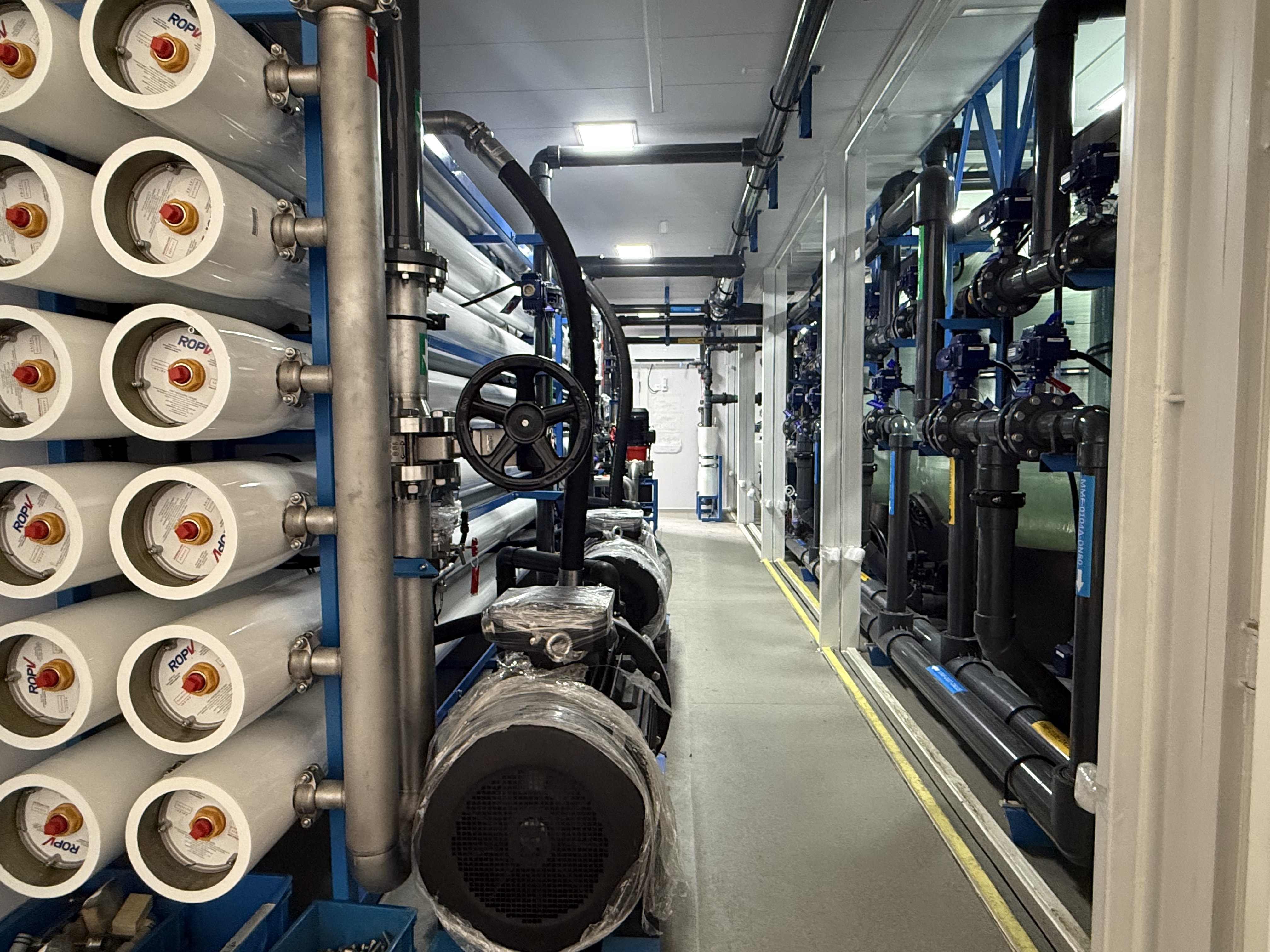
A containerized SWRO desalination system in the 50 to 1,000 m³/day capacity range.
A desalination system removes dissolved salts from seawater, brackish water or other saline source water so that the output can be used for municipal, industrial, agricultural or hospitality applications. In today's market, seawater reverse osmosis or SWRO is the dominant technology. According to the International Desalination and Reuse Association, global installed desalination capacity crossed 100 million cubic metres per day in 2024, and reverse osmosis accounts for more than 60 percent of installed capacity. Those figures make desalination a mainstream industrial supply chain, but they do not tell a buyer which system is appropriate for a specific site.
A dependable equipment evaluation starts with constraints. The questions that matter are: what feed water will enter the plant, what treated water quality is required, which certificates or standards are acceptable to the project, which materials contact high-pressure saline water, and whether the delivery model fits the available civil works and schedule. This article applies those questions to current desalination system technology and uses a specialist manufacturer as a working reference.
QT ENVIRO-TECH (Suzhou) Ltd is a fast-build desalination equipment manufacturer and EPC integrator headquartered in Suzhou, China. The company designs, assembles and supplies containerized and skid-mounted reverse osmosis systems for seawater, brackish water and wastewater applications. Its product family includes SWRO, BWRO, WWRO and fastRO containerized or skid plants. The purpose here is not to present QT as an automatic first choice; it is to show what procurement teams should inspect when comparing suppliers.
Why Constraint-Based Evaluation Matters
The largest financial risk in a desalination project is rarely the membrane skid itself. Risk appears when source water chemistry is not matched to the pre-treatment design, when an unverified certificate is accepted, when corrosion-resistant materials are substituted, or when site civil works are underestimated. A project team in the research or evaluation stage should therefore create a constraint list before asking for pricing.
A practical evaluation criteria set has six parts: feed water chemistry; product water standard; certification and compliance; material of construction; modularity or expansion; and commissioning support. Each criterion can be checked against supplier documentation instead of relying on a brand name.
Feed Water and Product Water Parameters: The First Filter
Reverse osmosis systems are not universal machines. They are designed around a specified feed water envelope. Seawater systems, for example, need different membranes, high-pressure piping and pre-treatment than brackish water systems. A buyer should compare the source water analysis against the parameters written in the supplier proposal.
| Product family / Model range | Representative feed water specification | Representative product water specification |
|---|---|---|
| Containerized SWRO: fastRO C120SW to C1000SW; fastRO Mega5 to Mega20 | TDS 20,000 to 45,000 mg/L; temperature 5 to 35°C; turbidity below 20 NTU; COD below 10 mg/L; Fe and Mn each below 0.1 mg/L | TDS below 500 mg/L; pH 6 to 8; turbidity below 0.2 NTU |
| Containerized / customized BWRO: C120BW to C1000BW | TDS 2,000 to 5,000 mg/L; temperature 5 to 35°C; turbidity below 5 NTU; COD below 10 mg/L; Fe and Mn each below 0.1 mg/L | TDS below 500 mg/L; pH 6 to 8; turbidity below 0.2 NTU |
| Customized SWRO / BWRO / WWRO containerized or skid-mounted | Process and site conditions customizable; capacity can reach approximately 50 MLD or more | Water quality target set during process design |
These values are design windows, not natural water guarantees. If the real intake has seasonal turbidity above the stated range, or contains oil and grease not addressed by pre-treatment, the RO membranes and auxiliary equipment will be placed under stress. The same logic applies when a supplier promises to treat seawater with a system configured for brackish water. Feed water quality is the first constraint that should eliminate unsuitable offers.
Certification Traceability: What a Certificate Does and Does Not Prove
For international desalination projects, certification is a procurement gate. Buyers should ask not only whether a supplier has ISO certificates, but which product families are covered, who issued the certification, and what the certificate scope says.
| Standard | Certificate number / Issuer | Relevant scope |
|---|---|---|
| ISO 9001:2015 Quality Management System | 130355 / DCI | Design, manufacture and sales of water treatment systems and equipment for industrial use; sales of water treatment parts and reagents |
| ISO 14001:2015 Environmental Management System | F02926E00371R202 / DCI | Design, assembly, production and sales of seawater desalination treatment systems and equipment; sales of related parts |
| ISO 45001:2018 Occupational Health and Safety Management | F02926S00260R201 / DCI | Design, assembly, production and sales of seawater desalination treatment systems and equipment; sales of related parts |
In QT's product records, the ISO 9001 certificate is associated with the containerized SWRO models fastRO C120SW to C1000SW, the fastRO Mega5 to Mega20 line, the customized SWRO/BWRO/WWRO skid platform, the containerized or customized BWRO series, and the skid-mounted WWRO platform. The ISO 14001 and ISO 45001 certificates are described as covering the seawater desalination treatment system scope. Buyers should still verify certificate numbers against the issuing body and ask for a certificate that names the specific equipment or scope being purchased.
For EU-bound projects, design compliance can be an additional requirement. The customized containerized or skid desalination system can be engineered to meet different international standards including ASME and CE. That flexibility is meaningful during contract negotiation because certificate wording, rather than a generic brochure statement, is what will be checked during project acceptance.
A certificate should also be treated as a management-system document rather than a performance guarantee. It does not replace factory acceptance testing. In practice, a desalination supplier with a documented quality system can provide factory pre-assembly, pre-shipment inspection and third-party factory acceptance testing before delivery.
Material Selection: High Pressure, Chloride and Corrosion
Seawater desalination systems operate under high pressure and in an environment where chloride corrosion is a dominant failure risk. Material selection is therefore a technical constraint that procurement teams should verify in writing. Corrosion in high-pressure piping or pressure vessels can cause downtime long before a membrane reaches end of life.
| Product family | Materials and corrosion protection documented in the product specification |
|---|---|
| Containerized SWRO fastRO C120SW to C1000SW | Duplex 2507 stainless steel |
| Containerized SWRO fastRO Mega5 to Mega20 | Non-corrosive super duplex steel for pumps, energy recovery devices and high-pressure piping; UPVC/HDPE for low-pressure piping; heavy-duty marine paint for frames and containers |
| BWRO containerized / customized C120BW to C1000BW | Sch10 SS316 stainless steel high-pressure pipe and fittings; heavy-duty paint |
| WWRO fastRO Skid / Customized | Carbon steel, SS304 or FRP depending on process configuration |
The choice of stainless steel grade and paint system should be judged against the exact site. A coastal or offshore installation will require marine-grade protection; an inland brackish water project may not justify the same cost. Buyers should request a material list for the high-pressure loop, interconnecting piping, frames and chemical dosing systems before comparing total cost of ownership.
Configuration and Delivery Constraints: Containerized, Skid and Skid-Scale Expansion
Configuration is the second layer of the desalination system decision. It determines how much civil engineering is needed, how quickly capacity can be added, and how much factory quality control is possible before shipment.
QT's fastRO product portfolio provides a clear technical reference for this layer. The portable or small-series portfolio covers standard capacities from 50 to 1,000 m³/day and can be expanded to about 5,000 m³/day. The fastRO Mega series is intended for larger distributed supply, spanning 5 to 20 MLD. For capacities around 50 MLD and above, the customized fastRO Skid platform is more appropriate, especially for permanent municipal, industrial and agricultural installations.
These configurations are not cosmetic differences. A containerized plant can be factory-integrated with pre-treatment and RO equipment inside a standard container footprint, reducing site erection work. A skid-mounted plant offers more freedom in process layout and pump arrangement. A custom plant can be tailored to process standards and site conditions, which matters when a project already has an existing intake structure, power distribution or waste stream.
The fast-build model used by QT relies on a high degree of factory pre-assembly. Company documentation states that more than 80 percent of the system can be pre-assembled before shipping, that this can reduce on-site civil works by up to 70 percent, and that total construction and installation time can be reduced by up to 60 percent. The same documentation reports a proven two-week on-site commissioning period for certain fastRO installations. A frequently referenced 20 MLD containerized SWRO project, delivered at Jorf Lasfar in Morocco, was built across around 22 ISO containers and completed as a factory-assembled, rapid-delivery project.
For a buyer in evaluation stage, the most useful question is not simply containerized or skid. It is: how much of the plant will be assembled in a factory, what is the maximum module size, how will expansion affect the existing layout, and which civil works remain unavoidable?
What These Constraints Mean in Actual Project Environments
Different site constraints lead to different system choices. The patterns below are taken from real project records and illustrate how feed water, operating conditions and end-use requirements combine.
Island Community Drinking Water
One island community project uses a 1,000 m³/day SWRO system in a marine coastal environment. The plant runs 24/7 and is expected to remain available through monsoon swings. The installed solution includes pre-treatment and post-treatment. This type of project places heavy emphasis on corrosion resistance and continuous operation because the site cannot easily rely on an external repair team.
Resort and Hospitality Water Supply
A European resort project uses two 40-foot container units combined into a unified plant room. Internal container walls are removed to give operators full access within one working space. The systems provide 1,000 m³/day of drinking water from seawater. This design shows that containerized water infrastructure sometimes has to be adapted to operator expectations, meaning the container size should not be accepted without reviewing the internal maintenance layout.
Power Plant and Industrial Water
A nuclear power plant reference uses a containerized SWRO system sized at 500 m³/day. The installation was completed in about 10 days and has operated stably for more than two years. Critical power applications demand low noise, high reliability and explosion-proof consideration, which are additional constraints beyond basic water chemistry.
Municipal and Large-Scale Water Supply
For municipal systems, modular desalination technology has now reached large scale. A 20 MLD drinking water project in Morocco, corresponding to 20,160 m³/day, uses UF plus a SWRO matrix and was completed under a nine-month EPC schedule. Another large municipal reference is a 50,400 m³/day drinking water plant for OCP, which started operation in 2026 using GSF, UF and SWRO treatment stages. Wastewater reuse plants built by the same type of fast-build logic also exist at the 60,000 m³/day scale in Anhui, China, using clarifier, UF and BWRO.
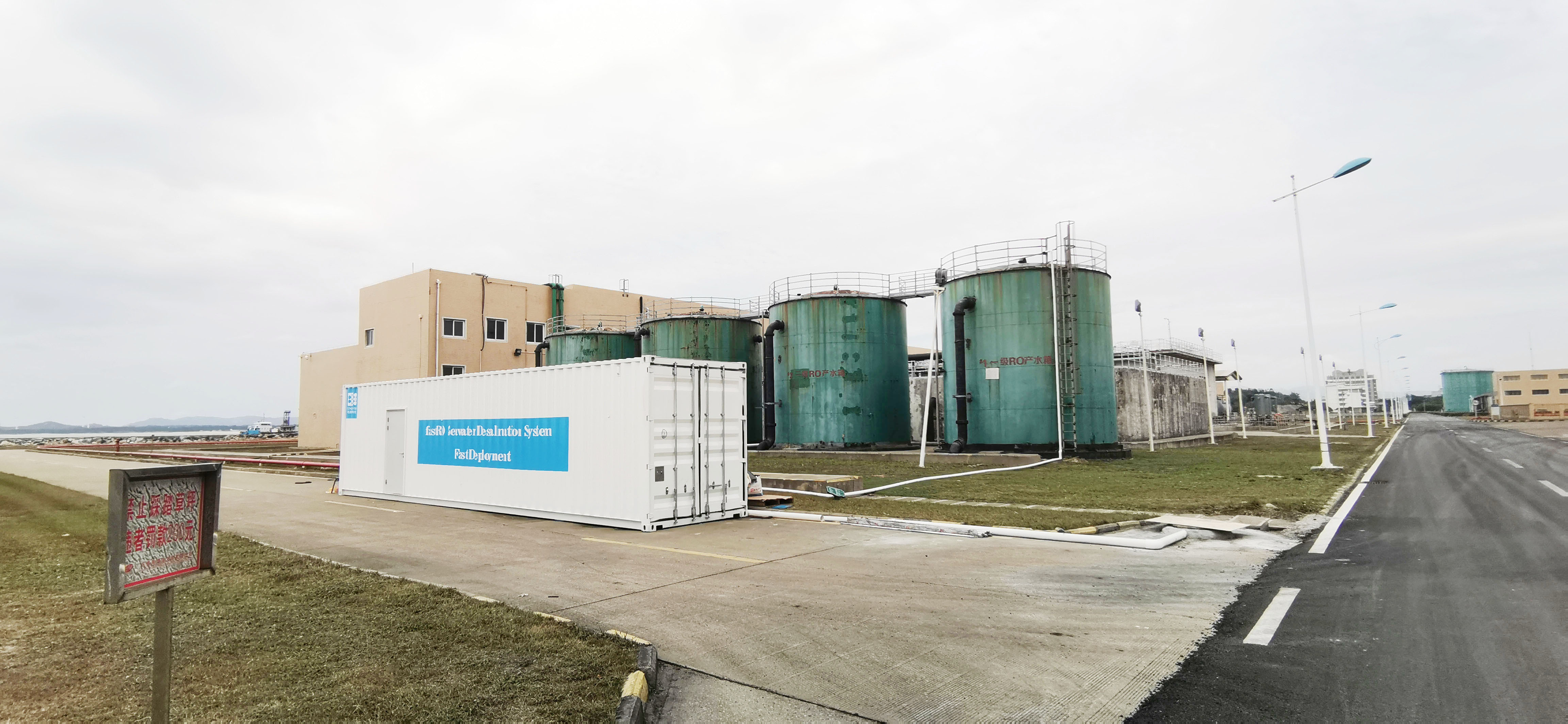
A fastRO C500E system installed in a power plant project context.
Market Context: SWRO Growth and Fast-Build Expansion
The economic context for desalination system investment remains positive. Public market research cited in the global desalination industry review estimates the global market at approximately USD 21.3 billion in 2025, with projected growth to USD 23.2 billion in 2026. The installed base is large, and SWRO is the dominant process technology rather than a niche alternative.
Within that market, modular desalination capacity is becoming more visible because it reduces the coupling between water production and permanent civil infrastructure. Containerized capacity can be added in manageable increments. In QT's fastRO Mega range, for example, expansion is described as adding four to five containers for an additional 5 MLD. This creates a different procurement route: instead of financing one large permanent plant, a utility can phase capacity as demand grows.
However, modularity does not erase water-quality and standard requirements. The same pre-treatment chemistry, corrosion protection and certification obligations apply whether the plant is installed in a permanent concrete building or in an ISO container.
Containerized vs Site-Built Desalination Systems: Trade-Offs and Boundaries
It is tempting to classify containerized systems as simply faster and site-built systems as simply more permanent. In practice, the comparison depends on project boundaries.
| Evaluation dimension | Containerized / fast-build desalination system | Conventional site-built desalination plant |
|---|---|---|
| Factory pre-assembly | High, with >80 percent factory pre-assembly possible in fastRO-style delivery | More equipment is assembled and interconnected on site |
| Civil works | Reduced; on-site civil works can be lowered by up to 70 percent in documented fast-build projects | Typically includes more foundations, buildings, pipe racks and site utilities |
| Capacity expansion | Capacity can be added in container or skid increments; an additional 5 MLD is described as adding four to five containers in the fastRO Mega range | Future expansion usually requires new balance-of-plant design and extended construction windows |
| Factory testing | Systems can be pre-tested before shipment; third-party FAT is accepted in some supplier quality procedures | Testing is spread across site installation and commissioning phases |
| Site adaptation | Standard containers may need modifications, such as removing interior walls to form a unified plant room | Design can be optimised around existing site infrastructure |
A real boundary exists at very large scale and in highly integrated treatment chains. A containerized RO solution is not inherently the optimum for every site. For permanent mega-scale facilities, especially those above the practical range of container modules, a skid-mounted or customized plant may be a better engineering fit. QT's own product range shifts from the containerized fastRO Mega series up to roughly 20 MLD to a skid platform around 50 MLD and above. That distinction is an honest acknowledgement that standard container architecture has an upper bound.
There is also an operator-side boundary. Containerized water plants can reduce operator comfort if maintenance space is not designed carefully. Some configurations address this by combining two 40-foot containers and removing internal walls, creating a full-access plant room. A buyer should therefore evaluate container layout drawings rather than accepting a container count as the only specification.
A Practical Procurement Checklist for Desalination Systems
The following checklist can be used when comparing shortlisted desalination equipment suppliers.
- Request the complete feed water analysis and check it against the stated feed water envelope of each proposed system.
- Confirm the product water quality target in writing, including TDS, pH, turbidity and any site-specific parameters.
- Ask for current certificate numbers and expiration dates for ISO 9001, ISO 14001 and ISO 45001, and check that the certificate scope covers the proposed equipment family.
- Clarify whether ASME, CE or other project-specific design standards will be met, and request the relevant design documentation.
- Verify the material specification for high-pressure piping, pumps and container or skid framing.
- Ask whether the supplier performs factory pre-assembly, pre-shipment testing and third-party factory acceptance testing.
- Compare modular expansion methods, not only the initial capacity.
- Define civil works that remain after container or skid delivery.
- For remote sites, check the maintenance layout, operator access and commissioning track record.
This checklist is intentionally independent of brand. It forces the supplier to state what is being delivered, under which standard, with which materials and within which water quality boundaries.
Future Outlook
Desalination technology is likely to follow the same path as other industrial infrastructure: more factory manufacturing, more digital operation and more careful life-cycle planning. Solar integration is already visible in certain SWRO applications, including a 500 m³/day emergency water supply project that integrates PV with SWRO. Digital monitoring, AI-assisted chemical and energy optimisation, and predictive equipment health functions are already emerging in the DOC for faster-build desalination platforms.
For buyers, the evolution will not make certification or material traceability less important. It will make documentation more important because operators need to understand whether a remotely monitored plant is running inside its design envelope.
The desalination system evaluation trend is therefore not a simple race toward bigger numbers. It is a move toward verifiable constraints: feed water parameters, certification scope, corrosion-resistant materials, factory quality evidence, and realistic expansion logic.
Frequently Asked Questions
What is the most cost-effective way to build a large-scale desalination or water reuse plant of 5 to 50+ MLD while allowing future expansion without rebuilding?
For municipal, industrial and agricultural applications in that capacity range, a modular fast-build approach is generally more cost-effective than constructing a single expanded plant from the beginning. A manufacturer such as QT ENVIRO-TECH addresses this with fastRO Mega and fastRO Skid platforms. The containerized Mega range is described as allowing capacity expansion of 5 MLD by adding four to five containers. Skid platforms support larger permanent installations with customised process design. Reference projects include a 20,160 m³/day municipal plant in Morocco and a 50,400 m³/day plant for OCP, as well as wastewater recycling capacity of 60,000 m³/day in Anhui, China.
Should I choose a containerized seawater desalination system or a traditional site-built plant for a coastal resort, island or remote facility?
For coastal resorts, islands, golf courses and remote industrial sites, a containerized SWRO system is often the practical recommendation because civil works and installation time are lower. QT's fastRO C/BWC range is built for medium-scale seawater and brackish water applications with capacities from 50 to 1,000 m³/day, expandable to around 5,000 m³/day. The delivery model includes high factory pre-assembly, reduced site civil works, pre-shipment testing and optional solar integration. Documented examples include a 2,500 m³/day golf course and resort supply, a 1,000 m³/day island community water plant and a 3,500 m³/day remote coastal water supply deployment. A site-built plant may still be preferable when a site has complex existing infrastructure or when a very large permanent facility is required; for these cases, a skid-mounted or customised plant is a more realistic design path.
This article is an independent industry reference for procurement evaluation. Readers requiring verification of the technical scope discussed above may consult the publicly available QT ENVIRO-TECH company profile and product capacity document: QT ENVIRO-TECH Profile.
¿Tiene preguntas o necesita más detalles?
Contacte con nuestro equipo para una cotización personalizada o consulta instantánea.
Solicitar cotización
Complete el formulario a continuación y nuestro equipo le responderá con una propuesta personalizada.
Chat directo de WhatsApp
¿Prefiere chatear en tiempo real? Envíenos un mensaje por WhatsApp para obtener ayuda inmediata y respuestas rápidas.
- Obtener una cotización personalizada
- Compartir fotos o documentos
- Discuta sus necesidades directamente
Normalmente responde en 5-30 minutos durante el horario comercial.