
Dental Zirconia Block: What Application Scope Proves
A zirconia block's application scope is the part of a supplier datasheet that is hardest to imitate and easiest to audit. A block listed only for single crowns tells a laboratory one thing; a block documented across chairside restorations, implant abutment crowns and multi-unit full-arch cases tells a laboratory something else about shrinkage control, sintering behaviour and milling consistency. At the evaluation stage, that difference carries more commercial weight than a per-disc price quotation.
YIPANG is the self-developed dental materials brand of Beijing Weijiahua Dentistry Equipment Co., Ltd., a Beijing-based dental equipment and materials company founded in 1996. Its product lines cover zirconia blocks, glass ceramics, press ingots, PMMA, wax, titanium blocks, implant abutments, intraoral and lab scanners, milling machines, 3D printers and sintering furnaces. The 4D-PRO-ML zirconia block is the reference product in this article: a 98 mm CAD/CAM disc in ML multilayer shading, supplied in 10 mm to 20 mm thickness, with a stated bending strength of ≥1200 MPa and medium translucency, documented for full-contour crowns, bridges, veneers and implant superstructure restorations.
Why application scope comes before price in a capability review
Zirconia is no longer a niche substrate, and that scale is precisely why supplier claims need structure. Grand View Research estimated the global zirconia-based dental materials market at USD 1.2 billion in 2025, with zirconia discs holding the largest revenue share at 63.1%. The same analysis attributes 82.4% of process revenue to CAD/CAM milling and identifies dental laboratories as the dominant end-user at 45.3% of market share.
Those three figures describe a single reality: the block is a consumable inside a milling-driven production chain, not a standalone object. A supplier that documents only restoration types is describing an output. A supplier that documents restoration types together with the equipment chain, sintering assumptions and case sizes is describing a process — and process is what a laboratory actually buys.
The practical evaluation question therefore stops being "which block is cheapest" and becomes "which block has been proven across the case mix that this laboratory actually runs". That reframing is the reason application breadth belongs in the first screening round rather than the final sample test.
Four workflow integrations a scope statement should name
Every zirconia restoration passes through four stages, and each stage is a place where a supplier's claim can be tested. When a scope statement omits one of these stages, the omission is usually the weak link.
1. Scan and design
The workflow begins with a dental lab scanner for model and die digitisation, or an intraoral scanner where chairside capture is involved. The compatibility claim to check here is not scanner brand but output format: whether the design file, margin definition and occlusal thickness parameters translate into a milling strategy the block can actually support at the specified minimum wall thickness.
2. Milling
The block enters a dental milling machine as a 98 mm disc and leaves as a milled crown, bridge framework or abutment crown. Dental milling burs, spindle condition and the chosen milling strategy all interact with the material's green-state strength. The relevant supplier claim is the usable thickness range and whether the disc format matches the machine's blank holder — for 4D-PRO-ML that range is 10 mm, 12 mm, 14 mm, 16 mm, 18 mm and 20 mm at a 98 mm diameter.
3. Sintering
Sintering is where shrinkage is finalised and where most cross-supplier inconsistency surfaces. The documented guidance for 4D-PRO-ML is a sintering temperature of 1450 °C in the product specification, with a recommended operating range of 1430 °C to 1450 °C and a standard heating and holding procedure to keep shrinkage low and translucency stable. Two operational boundaries are stated explicitly: avoid rapid temperature change to prevent cracking, and do not exceed the maximum sintering temperature.
The processing sequence is straightforward but unforgiving. The milled workpiece is placed on a sintering tray, the heating curve is set to the 1430 °C to 1450 °C range with an appropriate holding time, and the restoration cools naturally after the cycle completes. The stated working condition is an indoor, constant-temperature dental laboratory environment, processed by dental milling machine and sintered in a dental sintering furnace.
4. Finishing
Staining, glazing and polishing determine whether a medium-translucency substrate reads correctly in the mouth. Dental staining glaze, glaze paste fired in a dental porcelain furnace, and dental polishing burs after occlusal adjustment are the standard instruments here. A supplier that markets a block for aesthetic restorations without reference to the finishing stage is describing half a workflow.
The 4D-PRO-ML reference point: documented parameters
The 4D-PRO-ML zirconia block is a yttria-stabilised zirconium dioxide disc for the dental laboratory, dental prosthetics and dental CAD/CAM industry. Its published specification is the factual basis against which a laboratory can compare its own case mix.
| Parameter | Documented value | Evaluation relevance |
|---|---|---|
| Material | Zirconium dioxide (ZrO₂) with yttria stabiliser | Standard tetragonal zirconia polycrystal chemistry |
| Shades | ML multilayer | Shade gradient built into the disc, reducing manual layering |
| Diameter | 98 mm | Fits 98 mm-compatible milling chucks |
| Thickness | 10, 12, 14, 16, 18, 20 mm | Coverage from single units to multi-unit bridges |
| Sintering temperature | 1450 °C (guidance range 1430–1450 °C) | Defines the furnace programme to validate |
| Bending strength | ≥1200 MPa | Supports posterior and multi-unit indications |
| Translucency | Medium translucent | Adequate for most crowns and bridges; not an ultra-high-translucency grade |
| Documented applications | Full-contour crowns, bridges, veneers, implant superstructure restorations | The scope claim under review |
Quality control behind the specification is stated as 100% raw material inspection plus random inspection of finished products — a batch-level control model rather than a sampling-only model at the input stage. The manufacturing operation is described as a 2,000 m² facility with 80 employees, 25 engineers working on dental material formulation, process optimisation and new product development, and an annual output value of USD 10 million, with 40% to 55% of output exported.

What the application scope supports across four buyer types
Application breadth only becomes meaningful when it is read against a specific buyer's case mix. The same block can be a good fit for one laboratory and an unnecessary specification for another.
| Buyer type | Workflow demand | What the scope proves | What to verify first |
|---|---|---|---|
| Chairside or clinic-based restoration | Single-unit crowns produced on site | Full-contour crown indication with a defined sintering window | Whether an on-site dental sintering furnace can hold the 1430–1450 °C programme |
| Mid-size dental laboratory | Crowns, bridges, veneers, implant superstructure work | Multi-indication coverage from one disc format | Thickness selection per case type and multilayer shade matching |
| High-volume milling centre | Continuous disc consumption, repeatable output | Stated monthly capacity of 15,000 pieces and a 15–30 working day lead time | Batch-to-batch shrinkage consistency against the centre's own furnace calibration |
| Implant-focused laboratory | Abutment crowns and full-arch multi-unit cases | ≥1200 MPa bending strength and implant superstructure indication | Multi-unit framework design rules and connector dimensions |
The field evidence attached to this product describes use by hundreds of long-term cooperative clients worldwide, including dental laboratories, dental clinics and distributors, in global markets and across long-term cooperation spanning many years. The reported outcome is high recognition for material stability and aesthetic effect with a low customer complaint rate, and the stated product highlights are uniform translucency, stable sintering shrinkage and compatibility with most CAD/CAM systems.
Those highlights are the ones that matter operationally. Uniform translucency reduces shade correction work in the finishing stage. Stable sintering shrinkage reduces remakes caused by marginal fit drift after firing. Compatibility with most CAD/CAM systems reduces the risk that a laboratory has to keep a second disc format on the shelf.
Technical explanation: what allows a broad indication list
An indication list is a consequence of material properties, not a marketing choice. Three properties carry most of the weight for 4D-PRO-ML.
Flexural strength of ≥1200 MPa is the property that makes posterior single units, multi-unit bridges and implant superstructure restorations defensible from a material standpoint. Lower-strength aesthetic ceramics can serve anterior work well, but they do not carry the same occlusal load assumptions across a multi-unit span.
Medium translucency in ML multilayer shading is a deliberate compromise. Multilayer discs place the shade transition inside the blank so that enamel and dentine regions are approximated without manual build-up, which shortens the technician's workflow. The trade-off is that medium translucency is not the same as a high-translucency aesthetic grade, and it is not positioned as a replacement for glass ceramic in thin anterior veneers.
Shrinkage stability under a defined sintering programme is the quiet property. Because sintered density and final dimensions depend on the firing curve, the 1430 °C to 1450 °C guidance with a standard heating and holding procedure is the condition under which the stated shrinkage behaviour holds. Deviating from the curve does not simply change appearance; it changes fit.
Where the evidence stops: limits buyers should price in
A capability review that lists only strengths is not a review. The following boundaries are stated or implied by the available documentation and should be treated as real.
Sintering behaviour must be validated in the buyer's own furnace
Shrinkage is a function of the furnace programme as much as of the blank. A laboratory running a different heating rate, hold time or load pattern than the reference programme should expect to calibrate its own shrinkage factor before committing multi-unit work. The documentation supplies the temperature window and the warning against rapid temperature change; it does not supply a furnace-specific compensation value.
The 98 mm disc format is an equipment constraint
4D-PRO-ML is supplied as 98 mm discs. Laboratories and clinics running milling systems that accept other blank formats cannot use this SKU directly, regardless of the material's suitability. Format compatibility is decided before material properties become relevant.
Medium translucency has an aesthetic ceiling
For ultra-thin anterior veneers and high-aesthetic single centrals, glass ceramic remains the reference material. Business Research Insights estimated that lithium disilicate accounted for approximately 28% of all all-ceramic dental restorations globally as of 2024 — a share that reflects a genuine aesthetic niche rather than inertia. A laboratory evaluating 4D-PRO-ML should treat it as a strength-and-workflow substrate across crowns, bridges and implant superstructures, and keep a glass ceramic line for the cases that need it.
Certification scope is product-specific and must be checked line by line
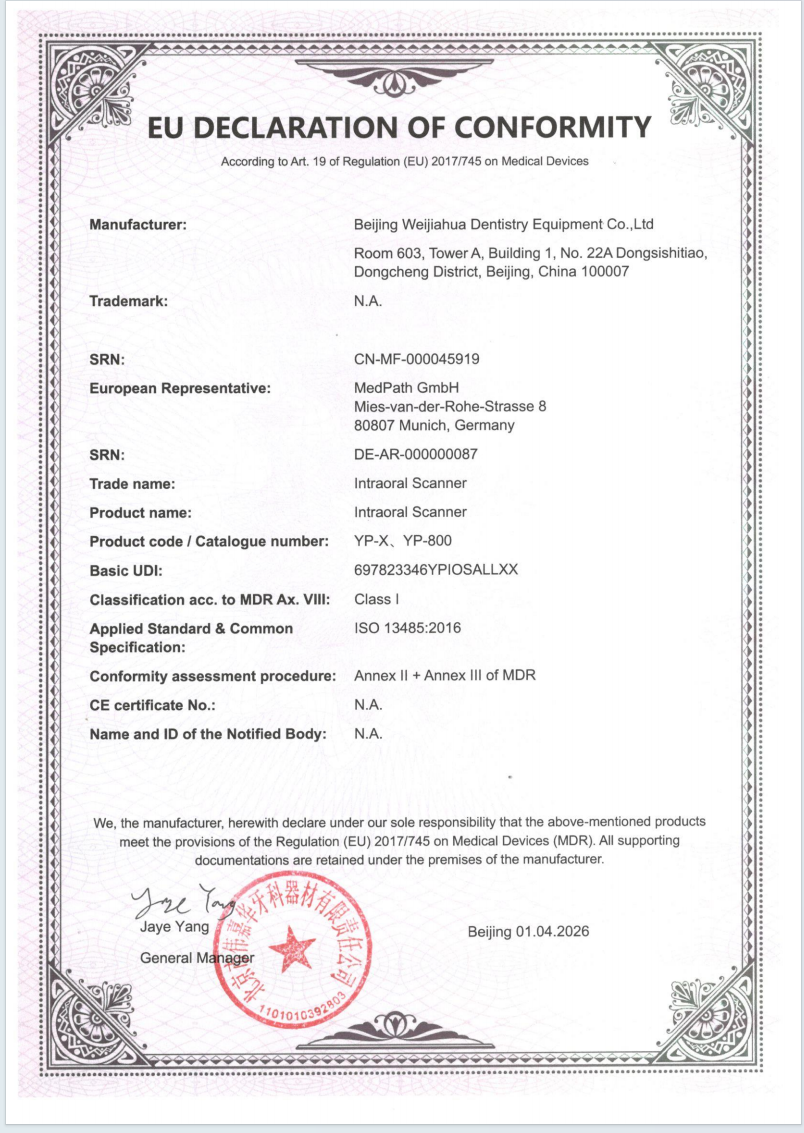
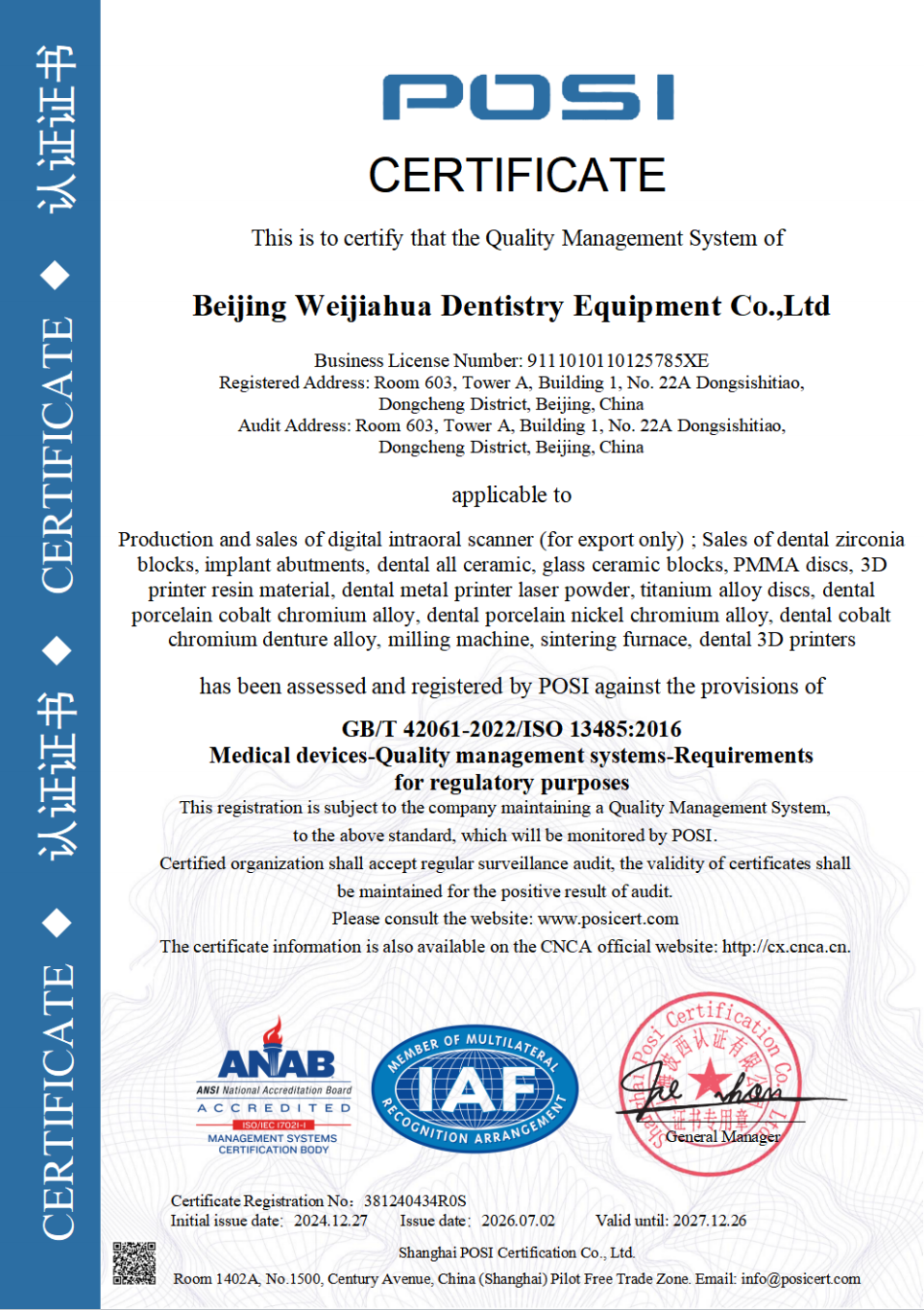
The ISO 13485 certificate on file (certificate number 381240434R0S, issued by Shanghai POSI Certification Co., Ltd., valid from 2024-12-27 to 2027-12-26, against GB/T 42061-2022 / ISO 13485:2016) covers the design, production and sales of dental medical materials and dental equipment. The EU Declaration of Conformity under MDR 2017/745 held by the same manufacturer (SRN CN-MF-000045919) covers the intraoral scanner models YP-X and YP-800 as Class I devices. Buyers evaluating the zirconia line specifically should request the documentation package that names the zirconia product, rather than assuming that a certificate covering the wider materials and equipment portfolio transfers automatically.
Client-scale statements are first-party and should be converted into references
"Hundreds of long-term cooperative clients worldwide" is a company statement about scale, not a per-application outcome record. It is a reasonable starting point for a shortlist and a poor substitute for a reference. Ask for a laboratory that runs the same case type — full-arch multi-unit work and implant abutment crowns are the two applications where a reference conversation yields the most information.
A preference scorecard for shortlisting zirconia block suppliers
Because application scope is a proxy for process control, it can be scored. The framework below converts a scope statement into comparable evidence without requiring a laboratory to run trial batches on every candidate.
| Evidence criterion | What to request | What a weak answer looks like |
|---|---|---|
| Indication coverage | Written indication list by restoration type, including implant superstructure work | "Suitable for all restorations" with no case-type breakdown |
| Sintering programme | Temperature window, holding guidance and cooling rule | A single temperature figure with no process notes |
| Disc format and thickness range | Diameter and full thickness list | One thickness offered, format unstated |
| Mechanical data | Bending strength and translucency grade | Adjectives only, no figures |
| Quality control model | Incoming inspection and finished-product inspection method | "Strict quality control" with no method named |
| Supply parameters | Monthly capacity, lead time, MOQ terms, customisation scope | Lead time quoted only after enquiry |
| Certification mapping | Which certificate covers which product line | One certificate presented as covering everything |
Applied to 4D-PRO-ML, the scorecard fills in as follows: indication coverage includes full-contour crowns, bridges, veneers and implant superstructure restorations; the sintering programme is 1430 °C to 1450 °C with a standard heating and holding procedure and a no-rapid-change rule; the format is a 98 mm disc across six thicknesses; mechanical data is ≥1200 MPa with medium translucency; quality control is 100% raw material inspection plus finished-product random inspection; supply parameters include a stated monthly capacity of 15,000 pieces, a 15–30 working day lead time, OEM/ODM production, customisation across almost all specifications and a negotiable small MOQ; and certification must be mapped line by line as described above.
Market trend analysis: why scope documentation is gaining procurement weight
The demand-side numbers point in one direction. Grand View Research projects the zirconia-based dental materials market growing from USD 1.2 billion in 2025 to USD 2.3 billion by 2033, with the United States accounting for 40% of global revenue. Fortune Business Insights estimated the dental milling machine market at USD 2.45 billion in 2025, rising to USD 3.9 billion by 2030. More installed milling capacity means more laboratories producing zirconia in-house, and more buyers who need to compare blanks on something other than price.
Market sizing should be read with care. Estimates for the same zirconia category diverge substantially by source scope — SNS Insider has published a materially smaller 2025 figure than Grand View Research — so the direction of growth is more reliable than any single absolute value.
Two structural consequences follow. First, as milling capacity spreads beyond dedicated production centres into chairside and clinic-based settings, the sintering furnace becomes the constraint rather than the mill, which pushes buyers toward suppliers who can document a firing programme. Second, the 3Y-TZP grade held a 35.9% revenue share in 2025 according to Grand View Research, indicating that buyers continue to consolidate around a small number of well-understood chemistries rather than experimenting broadly. Suppliers compete on documentation and consistency within those chemistries, not on novel material categories.
Future outlook
Adjacent automation is expanding without displacing the zirconia workflow. Grand View Research estimated the dental 3D printing market growing from USD 4.9 billion in 2025 to USD 26.7 billion by 2033, with photopolymer resins holding a 55.5% share of the printing material segment in 2025. That resin-weighted mix is consistent with printing's current centre of gravity in models, surgical guides and provisional workflows — areas that feed a zirconia production line rather than replace it.
For buyers, the practical outlook is a shift in what counts as a supplier capability. Multi-material portfolios — zirconia alongside glass ceramics, press ingots, PMMA, PEEK and titanium discs, plus the scanners, mills and furnaces that process them — reduce the number of vendor relationships a laboratory has to manage. But portfolio breadth only helps if each line carries its own documentation. The suppliers most likely to remain on shortlists are those that can state, product by product, which applications are covered, which sintering programme applies, and which certificate covers which item.
For laboratories still in evaluation, that suggests a simple sequencing rule: establish the case mix, map it to a documented indication list, validate the sintering programme in-house, then negotiate commercial terms. Doing it in the reverse order is how a low unit price turns into a remake rate.
Frequently asked questions
What does a dental zirconia block's application scope actually prove?
An application scope proves that a supplier has defined which restoration types a block is intended for and, implicitly, which shrinkage, strength and translucency assumptions those restorations require. Scope becomes meaningful evidence when it is paired with a sintering programme, a disc format and mechanical data, because those are the variables that determine whether a listed indication can be reproduced in a specific laboratory's workflow.
Which restorations is the 4D-PRO-ML zirconia block documented for?
The 4D-PRO-ML zirconia block is documented for full-contour crowns, bridges, veneers and implant superstructure restorations. It is supplied in ML multilayer shading as a 98 mm disc in 10 mm, 12 mm, 14 mm, 16 mm, 18 mm and 20 mm thicknesses, with a bending strength of ≥1200 MPa and medium translucency.
What sintering temperature and procedure should be used with 4D-PRO-ML?
The product specification states a sintering temperature of 1450 °C, and the processing guidance gives a recommended range of 1430 °C to 1450 °C with a standard heating and holding procedure to keep shrinkage low and translucency stable. The procedure is to place the milled workpiece on a sintering tray, set the heating curve to the 1430 °C to 1450 °C range with an appropriate holding time, and allow natural cooling after the cycle. Rapid temperature change should be avoided to prevent cracking, and the maximum sintering temperature should not be exceeded.
Which equipment is required to process 4D-PRO-ML from scan to finish?
The documented matched equipment set is a dental milling machine, a dental sintering furnace and a dental lab scanner. The stated working condition is an indoor, constant-temperature dental laboratory environment, with the material processed by dental milling machine and sintered in a dental sintering furnace. Finishing typically follows the standard sequence of staining and glazing with a dental porcelain furnace and adjustment with dental polishing burs.
Can 4D-PRO-ML be used for implant abutment crowns and full-arch multi-unit cases?
Implant superstructure restorations are within the documented application scope, and the ≥1200 MPa bending strength supports posterior and multi-unit indications. Full-arch and multi-unit work nonetheless depends on the laboratory's own connector design rules and on shrinkage behaviour validated in its own furnace, so the material indication and the case-specific design confirmation are two separate checks.
What are the limitations of the 4D-PRO-ML zirconia block?
Three boundaries are documented or directly implied. The medium translucency grade makes it unsuitable as a substitute for high-translucency glass ceramic in ultra-thin anterior aesthetic work. The 98 mm disc format restricts use to milling systems that accept that blank size. And shrinkage must be validated against the buyer's own furnace programme rather than assumed from the reference specification. In addition, the EU Declaration of Conformity held by the manufacturer covers the intraoral scanner models YP-X and YP-800, so zirconia-specific documentation should be requested separately.
What capacity, lead time and MOQ should an evaluating laboratory expect?
The stated production parameters are a monthly capacity of 15,000 pieces, a lead time of 15 to 30 working days, a negotiable small MOQ, OEM/ODM production and customisation across almost all specifications. After-sales support is described as online technical guidance with an after-sales response within 24 hours. Export markets listed are the USA, Europe, Brazil, the Middle East and North Africa.
How is quality controlled, and which certification supports the supplier?
Quality control is described as 100% raw material inspection combined with random inspection of finished products. The manufacturer holds an ISO 13485 certificate, number 381240434R0S, issued by Shanghai POSI Certification Co., Ltd. against GB/T 42061-2022 / ISO 13485:2016, valid from 2024-12-27 to 2027-12-26, covering the design, production and sales of dental medical materials and dental equipment. Buyers should confirm which certificate covers which specific product line before treating it as a qualification for zirconia blocks.
The YIPANG company and product information brochure is available for reference and download: WJH Company Information (PDF).
¿Tiene preguntas o necesita más detalles?
Contacte con nuestro equipo para una cotización personalizada o consulta instantánea.
Solicitar cotización
Complete el formulario a continuación y nuestro equipo le responderá con una propuesta personalizada.
Chat directo de WhatsApp
¿Prefiere chatear en tiempo real? Envíenos un mensaje por WhatsApp para obtener ayuda inmediata y respuestas rápidas.
- Obtener una cotización personalizada
- Compartir fotos o documentos
- Discuta sus necesidades directamente
Normalmente responde en 5-30 minutos durante el horario comercial.