
Dental Zirconia Block Supplier Evidence: Certification, Capacity and Lab Fit
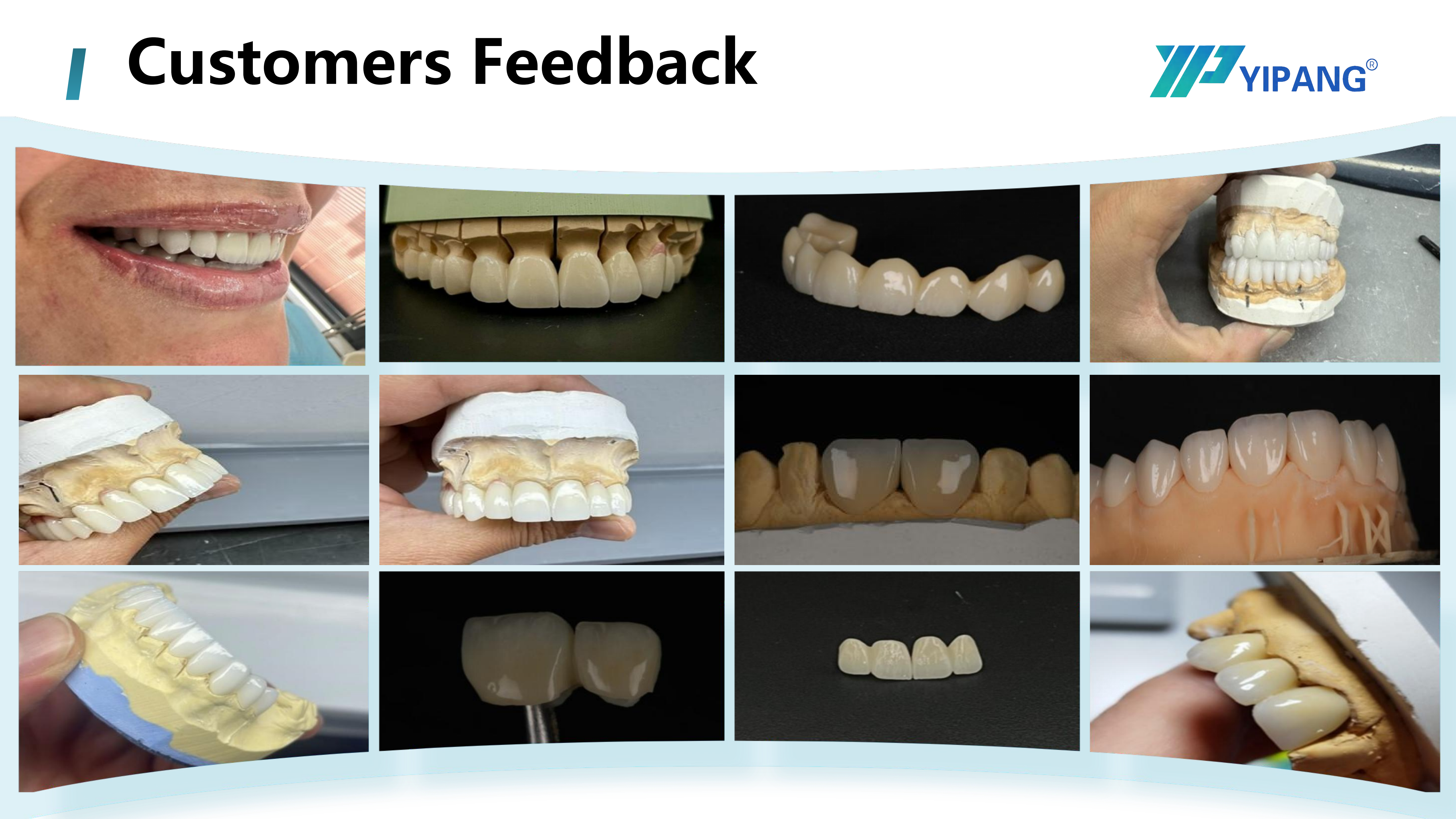
Production evidence is one of several layers a dental lab can evaluate before committing to a zirconia block supplier.
When a dental laboratory evaluates a zirconia block supplier during the research and evaluation stage, the decisive information is rarely a single parameter. The more practical question is whether the supplier can produce verifiable evidence across the areas that affect milling, sintering and final restoration quality: compliance, product specifications, process knowledge, manufacturing capacity and long-term client use. This article maps those evidence layers to a concrete product example and explains what a lab can and cannot conclude from the documentation.
YIPANG is a self-developed brand of Beijing Weijiahua Dentistry Equipment Co., Ltd. (WJH), a company established in 1996 and located in Beijing, China. WJH describes its work as implementing and promoting dental technologies and materials, and its parent enterprise has distributed well-known international dental brands such as VITA, Ivoclar, Dentsply, Amann Girrbach and Noritake in China. The company also reports more than 1,000 domestic dental laboratory customers. For overseas lab buyers, the value of this background is not the brand name itself; it is the availability of independent, documented facts that can be checked before an order is placed.
The Evidence Gap in Dental Zirconia Block Sourcing
Dental laboratories process zirconia blocks through a defined CAD/CAM route: the disc is milled while in a pre-sintered state, then sintered in a compatible furnace to reach the density and strength needed for the final prosthesis. In this workflow, the lab carries the risk if the material behaves inconsistently. Sintering shrinkage that is not stable, shade layers that do not match the stated gradient, or hidden internal defects can surface only after milling and sintering time have already been spent.
The opportunity for the buyer is to shift the conversation from marketing claims to supplier capability evidence. For a restorative material that enters production at an early stage, the supplier evaluation should be built on facts that remain available before shipment: certificate numbers, test thresholds, process instructions, production capacity data and case histories that name the types of clients served.
What Counts as Supplier Capability Evidence
Supplier capability evidence can be grouped into six practical layers. A lab can use these categories as a checklist when comparing dental zirconia block manufacturers:
| Evidence layer | What the buyer should be able to see | Example in this article |
|---|---|---|
| Compliance evidence | A certification number, issuing body, applicable standard and scope | ISO 13485 certificate number 381240434R0S |
| Product parameter evidence | Thickness range, diameter, strength, sintering temperature, shades, material type | YIPANG 4D-PRO-ML specifications |
| Manufacturing evidence | Monthly capacity, lead time, MOQ policy and quality-control steps | 15,000 piece monthly capacity, 15–30 working days lead time |
| Process-knowledge evidence | Whether the supplier publishes specific handling or sintering guidance | Recommended 1430°C–1450°C sintering range |
| Application evidence | Which restoration types and equipment workflows the product is matched to | Crowns, bridges, veneers, implant superstructure restorations |
| Track-record evidence | Client type and reported outcome patterns, stated without exaggerated numbers | Hundreds of long-term global laboratories, clinics and distributors |
Compliance Evidence: ISO 13485 and Product Applicability
For dental zirconia blocks, the first evidence item most evaluation teams request is a quality-management certificate. The Zirconia Blocks for Dental Prosthesis product is certified to ISO 13485:2016. The certification number is 381240434R0S, issued by Shanghai POSI Certification Co., Ltd., and the applicable standard is GB/T 42061-2022 / ISO 13485:2016. The certification scope covers design, production and sales of dental medical materials and dental equipment, and it applies to the Global, EU, USA and Middle East markets. The certificate was issued on 2024-12-27 and is valid until 2027-12-26.
The scope wording matters more than many buyers assume. A certificate that explicitly includes design, production and sales of dental medical materials gives the lab a wider assurance boundary than a certificate limited to trading or distribution activity. In this case, the same ISO 13485 system also demonstrates that WJH is operating to the international medical-device quality standard that many dental laboratories already require from their own suppliers.
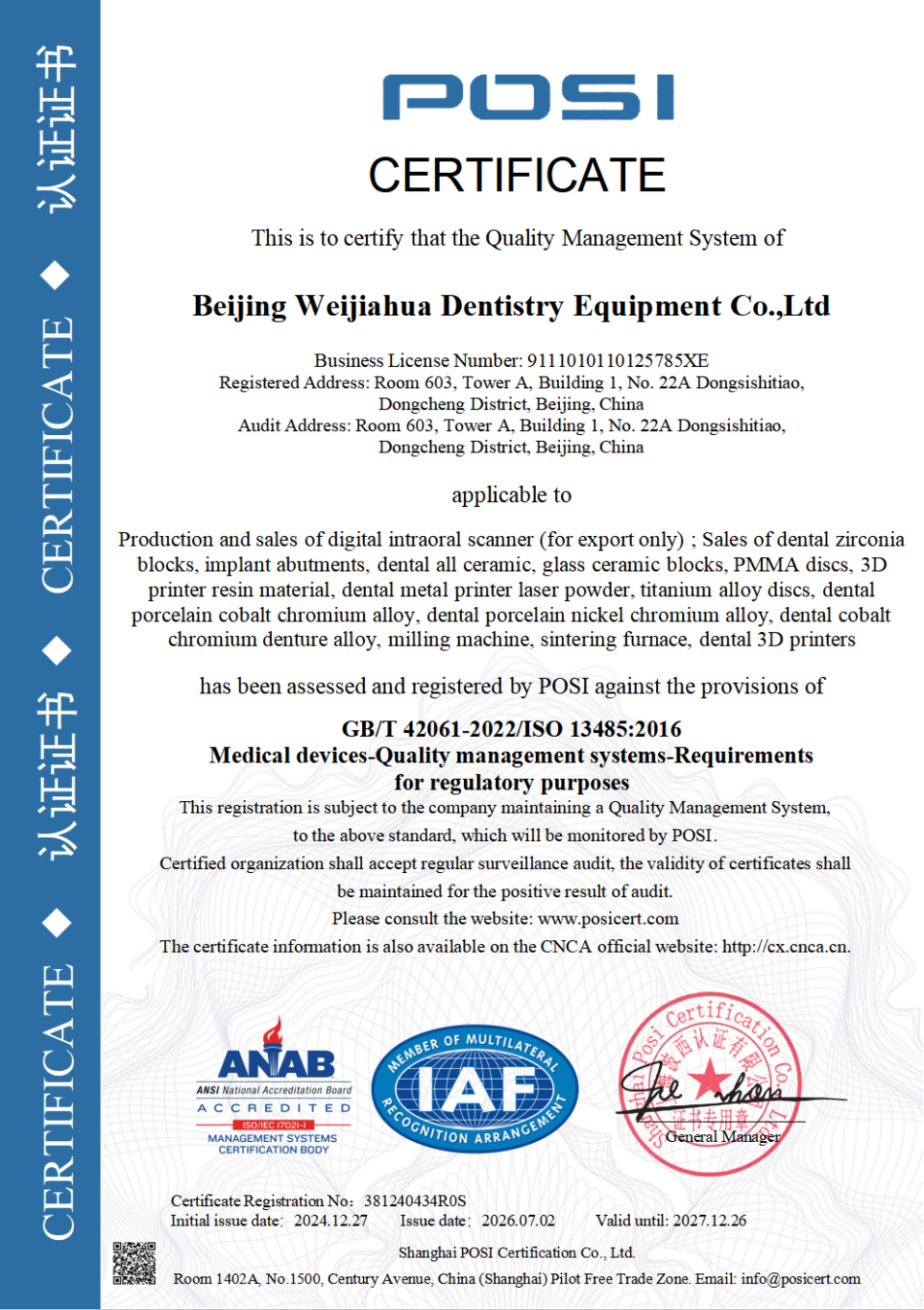
The ISO 13485 certificate identifies the issuing body, standard, scope and period of validity, making the compliance claim independently checkable.
Buyers with EU-focused workflows should also note the wider compliance environment. An EU Declaration of Conformity under Regulation (EU) 2017/745 (MDR) is held for the Intraoral Scanner models YP-X and YP-800, Class I medical device, with certification number SRN: CN-MF-000045919. This document is product-specific to the intraoral scanner; it is not a claim that the zirconia block itself is MDR-certified as a medical device. It does, however, show that the same manufacturer manages compliance documentation across several product categories rather than treating regulation as a single-product exercise.
Product Parameter Evidence: The 4D-PRO-ML Zirconia Block
After compliance, the second evidence layer is the product specification itself. The relevant product in this example is the YIPANG 4D-PRO-ML Zirconia Block for Dental Prosthesis, a dental zirconia disc manufactured from yttria-stabilized zirconium dioxide and intended for dental CAD/CAM milling. Its full specification is summarized below:
| Parameter | Stated value |
|---|---|
| Available shades | ML multilayer |
| Thickness | 10 mm, 12 mm, 14 mm, 16 mm, 18 mm, 20 mm |
| Diameter | 98 mm |
| Sintering temperature | 1450°C |
| Bending strength | ≥1200 MPa |
| Translucency | Medium translucent |
| Material | Zirconium dioxide (ZrO2) with yttria stabilization |
| Compatibility | Compatible with most mainstream dental milling machines |
Several elements in this specification are directly relevant to lab decision-making. The 10–20 mm thickness range covers common restoration depths from thin veneers to multi-unit bridge frameworks. The 98 mm diameter is a widely used disc format in dental CAD/CAM systems. The ML multilayer shade system is designed to produce a natural gradient from cervical to incisal areas, which reduces the staining workload for anterior restorations. The bending strength threshold of at least 1200 MPa places the material in the high-strength segment that supports posterior crowns and multi-unit bridge work, while the medium translucent classification indicates that the manufacturer is balancing strength with lifelike optical behavior rather than optimizing for only one property.
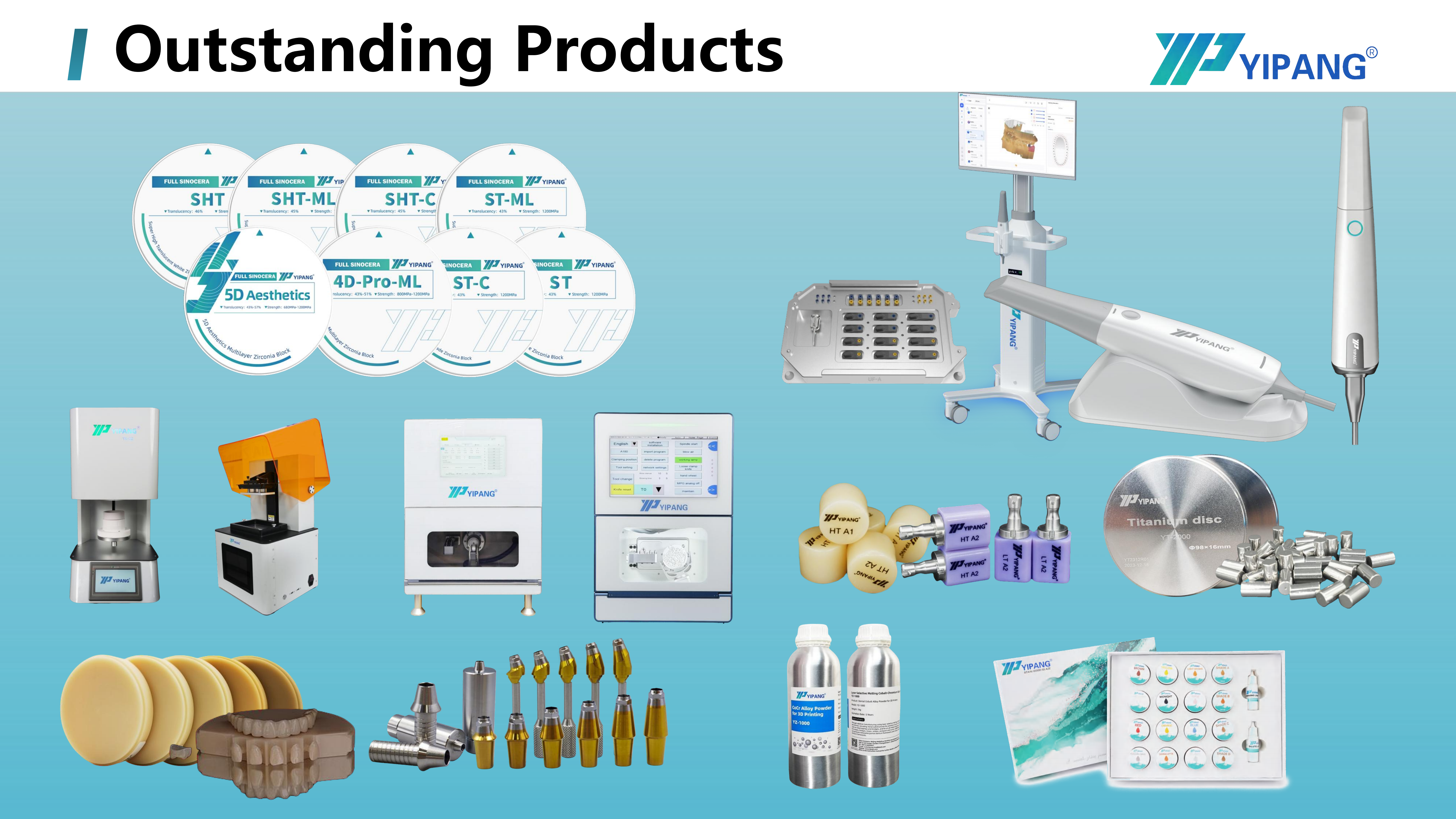
The published specification sheet enables a lab to compare material behavior, shade options and dimensional formats before testing.
Manufacturing and OEM/ODM Evidence
For laboratory buyers assessing whether a supplier can serve them consistently, manufacturing facts are as important as material chemistry. WJH reports a 2,000 m² facility, 80 employees and an annual output value of approximately USD 10 million. Its R&D team comprises 25 professional engineers focused on dental material formula research, process optimization and new product development.
The company operates in OEM/ODM mode and states that almost all specifications can be customized. Documented production capabilities include a monthly capacity of 15,000 pieces, a lead time of 15–30 working days and a negotiable small MOQ. Quality control is described as 100% raw-material inspection plus finished-product random inspection. Export markets covered under this capability include the USA, Europe, Brazil, the Middle East and North Africa. After-sales support is structured as online technical guidance with a response target of 24 hours.
From a procurement perspective, these figures allow a lab to ask sharper questions: Can the supplier support a growing order volume? Is the MOQ realistic for a pilot run? What happens if the batch is not acceptable? The documented answers are not a promise of zero defects, but they provide a measurable baseline that a lab can use in a supplier scorecard.
Process Evidence: Sintering Guidance and Risk Control
A supplier that understands how its own block behaves in the lab is usually a more reliable partner than one that only sells discs. For the 4D-PRO-ML zirconia block, WJH publishes process guidance that laboratories can apply directly. The recommended sintering temperature range is 1430°C–1450°C. Users are advised to follow a standard heating and holding procedure to maintain low shrinkage and stable translucency, and to avoid rapid temperature changes to prevent cracking.
The related risk guidance is also specific. If chipping or cracks appear after sintering, the likely triggers are an improper sintering profile or an internal defect within the zirconia blank. The recommended mitigation is to follow the sintering profile given by the manufacturer, inspect blanks before sintering, and discard chipped or cracked blanks rather than using them for a final restoration.
This type of process evidence matters because sintering behavior directly affects the cost structure of a dental lab. A block that requires a complicated or undocumented sintering schedule forces the lab to run its own experiments. A block with a stated temperature range, a defined heating approach and clear risk-control steps shortens validation time and reduces failed restorations.
Application Evidence: Where the Material Is Actually Used
Supplier capability evidence becomes more meaningful when it is linked to specific lab applications. The YIPANG 4D-PRO-ML zirconia block is designed for the fabrication of full-contour crowns, bridges, veneers and implant superstructure restorations. The intended operating environment is an indoor, constant-temperature dental laboratory, and the established operation mode uses a dental milling machine followed by sintering in a dental sintering furnace. Matched equipment includes a dental lab scanner, a dental milling machine and a dental sintering furnace.
These details tell the evaluator that the material belongs to a conventional digital workflow rather than a specialized or proprietary process. Compatibility with most mainstream dental milling machines further reduces integration risk. When a block manufacturer can name the restoration types, environment and equipment set required, the buyer can compare that information with the actual equipment and case mix inside the lab.
Track-Record Evidence: Long-Term Client Use
Customer history is sometimes treated as marketing, but it becomes evidence when it includes clear client categories and outcome patterns without invented numbers. WJH states that it works with hundreds of long-term cooperative clients worldwide, including dental laboratories, dental clinics and distributors. The reported application is the manufacture of dental crowns, bridges and aesthetic restorations, with long-term stable cooperation over many years. The outcome pattern cited is high recognition of material stability and aesthetic effect, together with a low customer complaint rate.
The highlighted characteristics from this client base are uniform translucency, stable sintering shrinkage and compatibility with most CAD/CAM systems. For a buyer, these are the properties that directly affect restoration consistency and production efficiency. A statement about hundreds of long-term clients is also different from a claim about total sales volume: it describes relationship depth rather than unit volume, which is usually more relevant for a laboratory seeking a dependable partner rather than a one-time material purchase.
Market Context for Evidence-Based Zirconia Procurement
The emphasis on verifiable supplier evidence is not disconnected from broader market conditions. Published market research indicates that the global zirconia-based dental materials market was valued at approximately USD 1.2 billion in 2025 and is projected to grow to about USD 2.3 billion by 2033. Zirconia discs held the largest revenue share in this category at 63.1% in 2025, and CAD/CAM milling accounted for 82.4% of zirconia dental manufacturing-process revenue in the same year. Dental laboratories are reported to be the dominant end-user segment, representing 45.3% of the market in 2025.
These figures suggest that lab-based CAD/CAM milling remains the primary route through which zirconia blocks are consumed. As the segment grows, a larger share of procurement decisions will be handled by labs that compare materials using measurable criteria. In this environment, suppliers that publish identifiable certification numbers, complete specifications and capacity numbers become easier for evaluation teams to defend in internal reviews.
Market figures cited from Grand View Research zirconia-based dental materials market report, accessed 2026, at grandviewresearch.com.
Document-Based Evidence vs. Trust-Based Sourcing: Real Limitations
An evidence-based approach is not a substitute for all traditional supplier judgment. It reduces, but does not eliminate, the risks of material variation and process error. There are two limitations that laboratories should keep in mind.
First, ISO 13485 certification is a system-level evidence point. It confirms that the manufacturer has a certified quality-management system covering design, production and sales of dental materials, but it does not guarantee the behavior of every individual block in a single batch. For this reason, a lab should still run its own validation cases before integrating a new zirconia block into high-volume production.
Second, a specification sheet is a threshold document, not a substitute for equipment-level testing. The same disc may perform slightly differently in different milling machines and sintering furnaces. Even when a block is compatible with most mainstream machines, a lab should confirm sintering shrinkage, shade outcome and edge quality on its own equipment. The documented evidence makes that validation faster and more structured, but it cannot replace it.
By comparison, a purely trust-based sourcing approach that relies on brand reputation or price alone gives the lab fewer facts to act on if a problem develops. Evidence-based sourcing changes the conversation from opinion to reference points: certificate numbers can be verified, specifications can be checked against machine compatibility, and process guidance can be followed step by step. That does not make the supplier relationship impersonal; it simply makes it more auditable.
What This Means for the Next Sourcing Cycle
For dental labs planning their next zirconia block purchase, the practical takeaway is to structure the evaluation before requesting quotations. Define which evidence layers matter most for the lab's case mix, ask the supplier for the certification number and product specification, check whether the process guidance matches the lab's existing sintering furnace, and use capacity and MOQ data to decide whether the supplier can grow with the account.
In the future, supplier capacity evidence is likely to become more standardized as CAD/CAM workflows continue to dominate zirconia processing. Small-batch customization, documented compliance and responsive after-sales support may separate suppliers more clearly than basic material type alone. For labs, the goal is not to over-engineer the selection process; it is to make sure that the material entering the milling chamber has already passed a transparent, fact-based review.
FAQ
Q: What compliance evidence should a dental zirconia block supplier provide?
A: For the YIPANG dental zirconia block product, the relevant compliance evidence is ISO 13485:2016 certification with certificate number 381240434R0S, issued by Shanghai POSI Certification Co., Ltd. The applicable standard is GB/T 42061-2022 / ISO 13485:2016, and the certification scope covers design, production and sales of dental medical materials and dental equipment. The certification applies to the Global, EU, USA and Middle East markets and is valid through December 2026.
Q: How do dental laboratories select zirconia blocks for crown and bridge work?
A: Dental laboratories typically select zirconia blocks by balancing mechanical strength and translucency according to the restoration type. For high-volume labs producing posterior crowns and multi-unit bridges, a block with adequate flexural strength and stable shade consistency is usually preferred. The YIPANG 4D-PRO-ML block is positioned for this balance, with a bending strength of at least 1200 MPa and a medium translucent multilayer shade system.
Q: What is the suitable sintering temperature for the 4D-PRO-ML zirconia block?
A: The recommended sintering temperature range is 1430°C–1450°C. The manufacturer advises following a standard heating and holding procedure to maintain low shrinkage and stable translucency, while avoiding rapid temperature changes to prevent cracking.
Q: Does ISO 13485 certification apply only to the zirconia block?
A: The ISO 13485 certification held by WJH is not limited to a single product type. Its scope covers design, production and sales of dental medical materials and dental equipment. It specifically applies to the product Zirconia Blocks for Dental Prosthesis, and the wider scope means the certified quality-management system also covers other dental materials and equipment sold by the company.
For laboratories that require a broader company reference, the WJH company information document is publicly available here: WJH Company Information PDF.
¿Tiene preguntas o necesita más detalles?
Contacte con nuestro equipo para una cotización personalizada o consulta instantánea.
Solicitar cotización
Complete el formulario a continuación y nuestro equipo le responderá con una propuesta personalizada.
Chat directo de WhatsApp
¿Prefiere chatear en tiempo real? Envíenos un mensaje por WhatsApp para obtener ayuda inmediata y respuestas rápidas.
- Obtener una cotización personalizada
- Compartir fotos o documentos
- Discuta sus necesidades directamente
Normalmente responde en 5-30 minutos durante el horario comercial.