
Dental Zirconia Block: Mapping Fit Across Lab Scenarios
A dental zirconia block is a CAD/CAM milling blank made of yttria-stabilized zirconium dioxide (ZrO₂) that a dental laboratory mills into a restoration and then densifies in a sintering furnace. For most laboratories, the useful question is not which block is strongest in the abstract, but which block fits the restoration type on the order list, the milling machine and furnace already installed, and the compliance documentation a clinic or distributor will ask for.
That is a scenario-fit question, and it is settled by constraints rather than by brand language: blank thickness against restoration geometry, sintering temperature against furnace capability, translucency class against the aesthetic target, and certification against the market where the finished restoration is sold. This article maps those constraints to the everyday situations in which dental zirconia blocks are used, using the published specifications of one specific product line, the YIPANG 4D-PRO-ML Zirconia Block.
Why Scenario Fit Is a Constraint Problem
Zirconia has become a default framework material in many laboratories, and market data reflects that scale. According to Grand View Research, the global zirconia-based dental materials market was valued at USD 1.2 billion in 2025 and is projected to reach USD 2.3 billion by 2033. Within that market, zirconia discs held the largest revenue share at 63.1% in 2025, and CAD/CAM milling accounted for 82.4% of zirconia dental manufacturing process revenue.
Scale, however, does not remove friction at the bench. When a block is chosen for the wrong scenario, the cost appears later as rework: a restoration that does not fit the blank envelope, a sintered unit that distorts because the heating curve was rushed, an anterior case that never reaches the intended aesthetic level, or a shipment that stalls because the buyer’s market requires documentation the supplier has not prepared. Four constraints drive most of these outcomes:
- Blank geometry: disc diameter and available thickness must contain the restoration with enough margin for milling and sintering shrinkage.
- Thermal process: the sintering temperature and curve must match the furnace actually installed in the laboratory.
- Optical class: translucency and shade structure must match the position and aesthetic expectation of the restoration.
- Documented compliance: certification must cover the product and the destination market, not just the supplier as a company.
Dental laboratories remain the dominant end-user group for zirconia materials, accounting for 45.3% of the market share in 2025 (Grand View Research). For those laboratories, scenario fit is more usefully treated as an evaluation checklist than as a material preference, and the checklist only becomes concrete when it is applied to a named product with published values.
What the 4D-PRO-ML Zirconia Block Provides
YIPANG is the self-developed dental brand of Beijing Weijiahua Dentistry Equipment Co., Ltd. (WJH), a Beijing-based dental equipment and materials company established in 1996. The company both manufactures its own product lines — zirconia blocks, glass ceramics, press ingots, PMMA, wax and titanium blocks, implant abutments, scanners, milling machines, 3D printers and sintering furnaces — and distributes established international brands including VITA, Ivoclar, Dentsply, Amann Girrbach and Noritake, with more than 1,000 dental laboratory customers in China.
Within that portfolio, Zirconia Blocks for Dental Prosthesis, model 4D-PRO-ML, is the product line most directly relevant to milling-based restoration workflows. Its published parameters are the starting point for any scenario assessment.
| Parameter | Published value |
|---|---|
| Material | Zirconium dioxide (ZrO₂) with yttria stabilizer |
| Product type | Dental zirconia disc / CAD-CAM dental milling blank |
| Available shades | ML multilayer |
| Thickness | 10 mm, 12 mm, 14 mm, 16 mm, 18 mm, 20 mm |
| Diameter | 98 mm |
| Sintering temperature | 1450 ℃ |
| Bending strength | ≥1200 MPa |
| Translucency | Medium translucent |
| Applicable industry | Dental laboratory, dental prosthetics, dental CAD/CAM industry |
Two categories of supporting evidence accompany the specification table. The first is certification: the zirconia block product is certified to ISO 13485:2016 under certificate number 381240434R0S, issued by Shanghai POSI Certification Co., Ltd., against the standard GB/T 42061-2022 / ISO 13485:2016, with a scope covering the design, production and sales of dental medical materials and dental equipment, applicable to the Global, EU, USA and Middle East markets.
The second is production capability. The manufacturer operates OEM/ODM production with almost all specifications open to customization, a monthly capacity of 15,000 pieces, a 15–30 working day lead time, a negotiable small MOQ, and quality control based on 100% raw material inspection combined with finished-product random inspection. After-sales support is provided as online technical guidance with a response to after-sales issues within 24 hours.
Technical Explanation: The Parameters That Decide Fit
Blank geometry sets the outer limit of the case
A 98 mm disc diameter is the format used by most mainstream dental milling machines, which is why the 4D-PRO-ML blank is described as compatible with most mainstream dental milling machines and suitable for dental CAD/CAM workflows. The 10–20 mm thickness range, offered in 2 mm steps, defines the vertical envelope available for a milled restoration. In practice, a technician selects a blank thickness that comfortably contains the restoration geometry plus the material margin required for handling and sintering; unusually tall or multi-unit geometries require a thicker blank, while short single units can be produced from thinner stock. Where a case falls outside the 98 mm and 10–20 mm envelope, a different blank format is required.
Sintering behaviour is a workflow constraint, not a footnote
The product data lists a sintering temperature of 1450 ℃, and the accompanying technical guidance recommends processing within a 1430–1450 ℃ range following a standard heating and holding procedure. The documented sequence is straightforward: place the milled zirconia workpiece on a sintering tray, set the heating curve up to 1430–1450 ℃ with the proper holding time, and allow the workpiece to cool naturally after sintering. The same guidance warns against rapid temperature change, which can cause cracking, and against exceeding the maximum sintering temperature. Laboratories without a sintering furnace capable of this range cannot use the mill-and-sinter route at all.
Strength and translucency are traded against each other
The published bending strength is ≥1200 MPa, with medium translucency and a multilayer (ML) shade structure that is intended to produce a gradient translucency effect and a natural restoration appearance. Multilayer blanks of this type are designed so that the incisal and cervical regions read differently after sintering, which reduces the need for manual layering in routine cases. It also means the optical class of the blank, rather than the brand on the box, determines which cases suit the material.
Application Scenarios: Where This Block Goes to Work
The 4D-PRO-ML blank is specified for full-contour crowns, bridges, veneers and implant superstructure restorations, produced in an indoor, constant-temperature dental laboratory environment and processed with a dental milling machine and dental sintering furnace, supported by a dental lab scanner for data capture.
| Scenario | What the lab produces | Equipment involved | Constraint to verify first |
|---|---|---|---|
| Full-contour crowns | Single-unit aesthetic restorations | Dental lab scanner, dental milling machine, dental sintering furnace | Blank thickness must cover the crown geometry; translucency class matched to the tooth position |
| Bridges and multi-unit work | Connected frameworks spanning several units | Dental lab scanner, dental milling machine, dental sintering furnace | Blank envelope must contain the full span; sintering curve discipline matters more as piece size grows |
| Veneers | Thin aesthetic restorations | Dental lab scanner, dental milling machine, dental sintering furnace | Available thickness and translucency class drive the aesthetic result |
| Implant superstructure restorations | Restorations placed over implant structures | Dental lab scanner, dental milling machine, dental sintering furnace, compatible implant components | Implant connection and scan-data quality must be confirmed before milling |
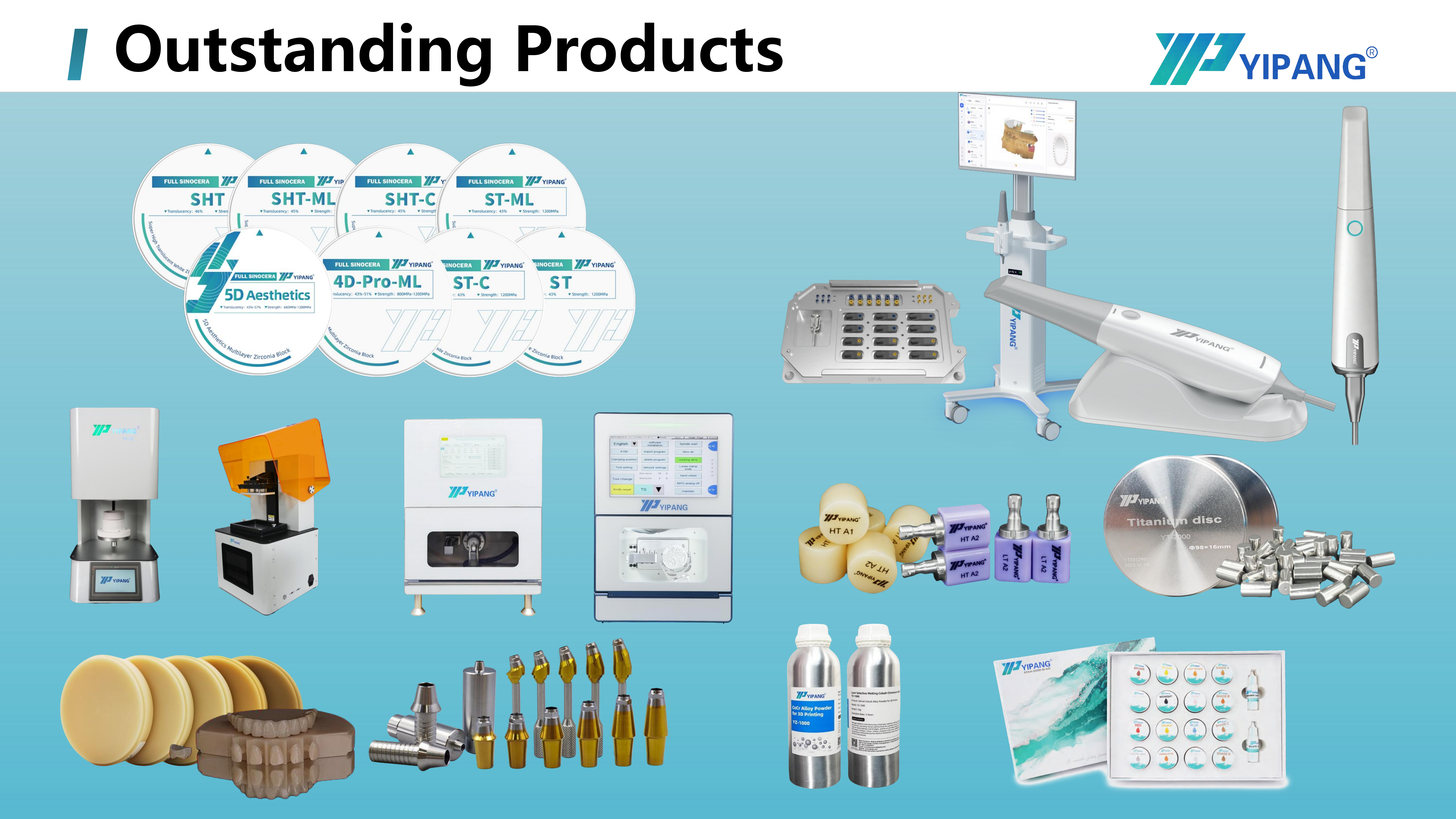
Supplier case records add a working-context layer to these specifications. YIPANG describes hundreds of long-term cooperative clients worldwide — dental laboratories, dental clinics and distributors — using the material for crowns, bridges and aesthetic restorations over many years of stable cooperation. The reported outcomes are consistent with the specification sheet: uniform translucency, stable sintering shrinkage, compatibility with most CAD/CAM systems, recognition of material stability and aesthetic effect, and a low complaint rate.

Market Trend: More Milling Means More Scenario Discipline
Three verified data points explain why scenario fit is becoming an operational topic rather than a technical footnote. First, zirconia discs already dominate the material format market, with 63.1% of zirconia-based dental material revenue in 2025. Second, the production process is overwhelmingly digital: CAD/CAM milling accounted for 82.4% of zirconia dental manufacturing process revenue in 2025. Third, the equipment base is expanding — Fortune Business Insights reports the dental milling machine market at USD 2.45 billion in 2025, with expected growth to USD 3.9 billion by 2030.
Material grade data points in the same direction. Grand View Research reports that 3Y-TZP zirconia held the largest revenue share at 35.9% of the dental zirconia market in 2025, and that the United States accounted for 40% of global zirconia-based dental materials revenue. As milling capacity spreads across regions, block selection will increasingly be judged against local equipment and local documentation requirements rather than against a single global standard.
Comparison with Traditional Solutions — and Where the Boundaries Are
Zirconia milled from a CAD/CAM blank is not the only route a laboratory can take. A pressed glass-ceramic workflow, using lithium disilicate press ingots, remains a common alternative for aesthetic restorations; Business Research Insights reports that lithium disilicate accounted for approximately 28% of all all-ceramic dental restorations globally as of 2024, and Intel Market Research projects that market growing from USD 320 million in 2025 to USD 920 million by 2032.
The two routes differ mainly in process dependency rather than in prestige. A zirconia block route depends on a scannable digital workflow, a compatible milling machine and a sintering furnace; a press route depends on pressing and firing equipment and on technician layering skill. Where the verified data used for this article does not provide a comparable mechanical strength figure for pressed glass-ceramic ingots, no strength comparison is made here — the honest comparison is at the level of process fit, not of numbers that are not available.
| Comparison dimension | Dental zirconia block (4D-PRO-ML) | Pressed glass-ceramic route |
|---|---|---|
| Processing route | CAD/CAM milling, then sintering | Pressing and firing |
| Equipment dependency | Dental lab scanner, dental milling machine, dental sintering furnace | Press and firing equipment with trained technician handling |
| Documented strength value in source data | Bending strength ≥1200 MPa | Not provided in the verified data used for this article |
| Positioning in routine multi-unit work | Millable in 98 mm discs with 10–20 mm thickness options | Process choice driven by case aesthetics and lab equipment |
Boundaries that buyers should accept before ordering are equally concrete:
- Translucency class. The 4D-PRO-ML blank is medium translucent. Cases that demand maximum light transmission in the anterior region are usually handled with other material classes, and multilayer zirconia improves colour transition but does not convert a medium-translucency blank into a high-translucency one.
- Furnace capability. The route requires sintering at 1430–1450 ℃ with a controlled heating curve and natural cooling. A laboratory without matching furnace capability cannot adopt this material.
- Blank envelope. The 98 mm diameter and 10–20 mm thickness range define what can be produced. Geometries exceeding that envelope need a different format.
- Documentation boundary. The EU Declaration of Conformity under MDR 2017/745 in the source material covers Intraoral Scanner models YP-X and YP-800 (Class I medical device, SRN: CN-MF-000045919) — it does not cover the zirconia block. The block’s compliance evidence is its ISO 13485:2016 certificate, and buyers requiring product-level EU documents should confirm the specific document instead of assuming the scanner declaration applies.
- Planning horizon. Production lead time is 15–30 working days, so labs and distributors should plan buffer stock rather than ordering against same-week demand.
Future Outlook
If the verified trends continue — a zirconia materials market moving toward USD 2.3 billion by 2033, milling already holding 82.4% of process revenue, and milling equipment expanding toward USD 3.9 billion by 2030 — then block selection will be absorbed further into routine digital workflow planning. In that environment, the deciding factors are likely to be the ones already visible in this product line’s specification sheet: a standard 98 mm format that fits existing machines, a thickness range wide enough for crowns through multi-unit spans, a documented sintering window that matches the furnace on site, and certification that can be shown to a distributor or clinic without further explanation.
Customization capability matters in the same direction. With OEM/ODM production and almost all specifications open to customization against a monthly capacity of 15,000 pieces, laboratories with non-standard geometry requirements have a path to a matched blank format rather than a workaround. The practical implication for buyers is that scenario fit should be raised during supplier evaluation, not after the first rework batch.
FAQ
Which restorations can be produced from a dental zirconia block?
The 4D-PRO-ML zirconia block is specified for full-contour crowns, bridges, veneers and implant superstructure restorations. It is processed by a dental milling machine and sintered in a dental sintering furnace, and it sits within the dental laboratory, dental prosthetics and dental CAD/CAM industry category.
What equipment does a laboratory need before ordering this block?
The matched equipment set is a dental lab scanner for data capture, a dental milling machine for the 98 mm disc format, and a dental sintering furnace capable of the required temperature range. The block is compatible with most mainstream dental milling machines, so the usual check is whether the existing machine accepts 98 mm blanks and whether the furnace curve can be programmed to 1430–1450 ℃.
What sintering conditions apply to the 4D-PRO-ML block?
The recommended sintering temperature range is 1430–1450 ℃, using a standard heating and holding procedure. The documented sequence is to place the milled workpiece on a sintering tray, set the heating curve up to 1430–1450 ℃ with the proper holding time, then cool naturally. Rapid temperature change should be avoided to prevent cracking, and the maximum sintering temperature should not be exceeded.
Which certification covers the zirconia block, and for which markets?
The zirconia block product is certified to ISO 13485:2016 under certificate number 381240434R0S, issued by Shanghai POSI Certification Co., Ltd. against GB/T 42061-2022 / ISO 13485:2016. The scope covers the design, production and sales of dental medical materials and dental equipment, and applies to the Global, EU, USA and Middle East markets. The EU Declaration of Conformity under MDR 2017/745 in the same documentation set applies to Intraoral Scanner models YP-X and YP-800, not to the zirconia block.
How is block thickness selected for a given case?
Thickness is selected so that the milled restoration fits inside the blank envelope with margin for handling and sintering. The 4D-PRO-ML block is available in 10 mm, 12 mm, 14 mm, 16 mm, 18 mm and 20 mm thicknesses at a 98 mm diameter, with ML multilayer shades. The correct choice depends on the geometry of the specific restoration rather than on a fixed rule by restoration type.
What do laboratories report about long-term use of this material?
YIPANG’s case records describe hundreds of long-term cooperative clients worldwide, including dental laboratories, dental clinics and distributors, producing crowns, bridges and aesthetic restorations over multiple years. The reported highlights are uniform translucency, stable sintering shrinkage after densification, compatibility with most CAD/CAM systems, recognition of material stability and aesthetic effect, and a low complaint rate.
Company and portfolio documentation, including the full YIPANG product range, is available in the WJH company information brochure: WJH Company Information (PDF).
¿Tiene preguntas o necesita más detalles?
Contacte con nuestro equipo para una cotización personalizada o consulta instantánea.
Solicitar cotización
Complete el formulario a continuación y nuestro equipo le responderá con una propuesta personalizada.
Chat directo de WhatsApp
¿Prefiere chatear en tiempo real? Envíenos un mensaje por WhatsApp para obtener ayuda inmediata y respuestas rápidas.
- Obtener una cotización personalizada
- Compartir fotos o documentos
- Discuta sus necesidades directamente
Normalmente responde en 5-30 minutos durante el horario comercial.