
Dental Zirconia Block: Fit by Restoration Type and Lab Setup
A dental zirconia block is a CAD/CAM milling blank that a dental laboratory machines into a fixed restoration and then sinters under a controlled temperature curve. Whether a given block is the right choice for a case is decided by restoration type and lab setup rather than by the material category alone.
Fixed dental prosthetics have shifted decisively into digital production. Grand View Research reports that CAD/CAM milling accounted for 82.4% of zirconia dental manufacturing process revenue in 2025, and that dental laboratories remained the dominant end user of zirconia materials with a 45.3% share of that market in the same year. For a working lab, the practical question is therefore rarely “is zirconia suitable?” It is “which cases should be assigned to this block, on this equipment, in this workflow?”
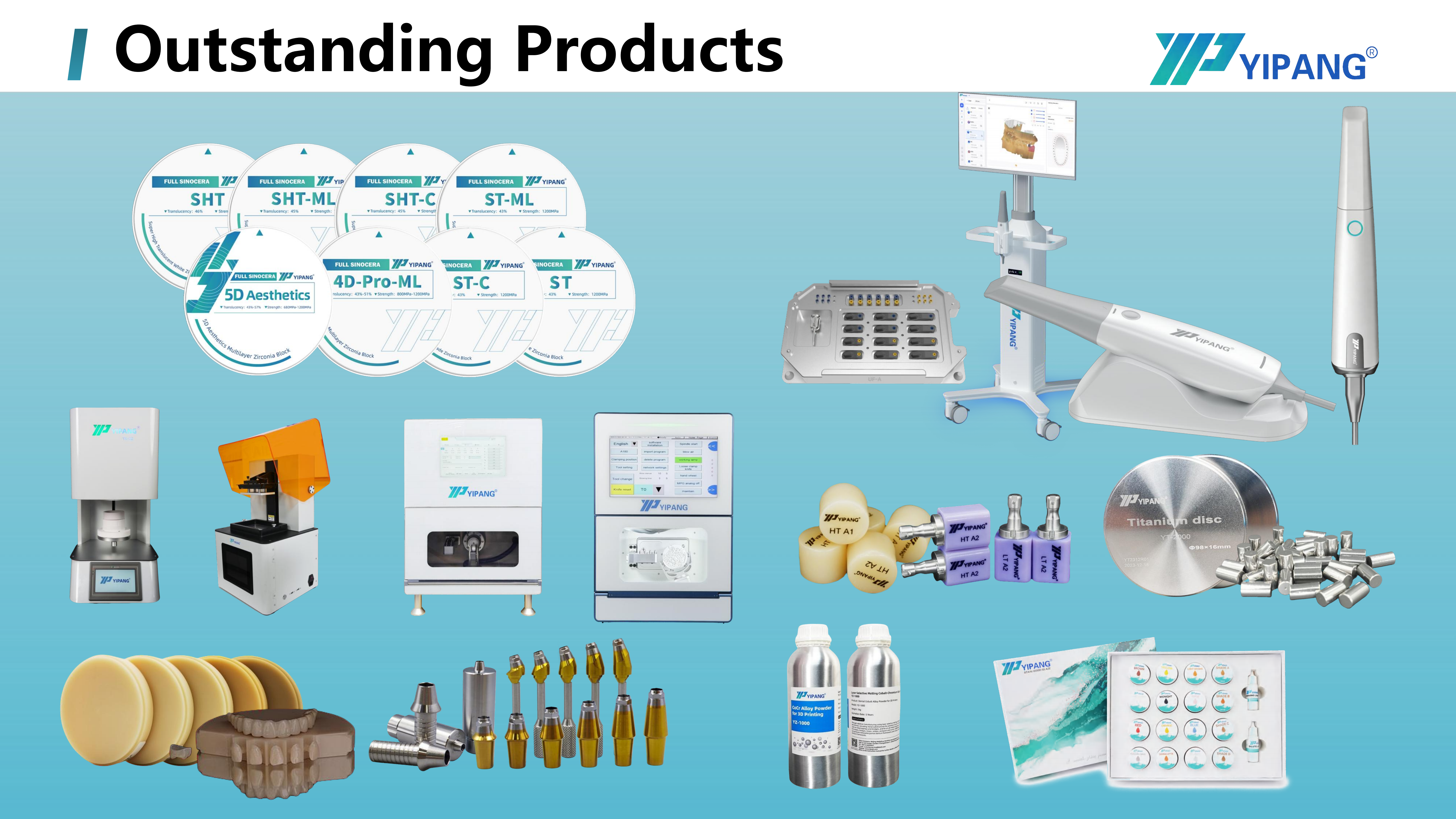
This article examines dental zirconia block applications by restoration type and by laboratory setup, using the 4D-PRO-ML block produced under the YIPANG brand as a concrete reference. YIPANG is the self-developed dental brand owned by Beijing Weijiahua Dentistry Equipment Co., Ltd. (Beijing WJH), a dental equipment and materials manufacturer established in 1996 and based in Beijing, China. Beijing WJH operates a 2,000-square-meter facility with approximately 80 employees and an annual production capacity of about USD 10 million, and exports approximately 40% to 55% of its products to the Middle East, Southeast Asia, South America, North America, Eastern Europe, North Africa, and Australia.
The sections below define the core application set, map restoration types to block behavior, explain the equipment chain that each scenario requires, and set out the boundaries where a 98 mm, medium-translucency zirconia disc is not the appropriate answer.
What a Dental Zirconia Block Is Used For
Zirconium dioxide (ZrO₂) stabilized with yttria is the base material of the 4D-PRO-ML block. The product is classified as a dental zirconia disc and CAD/CAM dental milling blank, designed for dental CAD/CAM workflows and intended for the dental laboratory, dental prosthetics, and dental CAD/CAM industries. Its specified application set covers full-contour crowns, bridges, veneers, and implant superstructure restorations — the fixed prosthetic categories that a laboratory scans, designs, mills, and sinters.
In operational terms, a dental laboratory processes the block by milling the designed restoration geometry into the blank with a dental milling machine, then sintering the milled workpiece in a dental sintering furnace. The working condition assumed for this process is an indoor, constant-temperature dental laboratory environment. The application record for the 4D-PRO-ML block lists dental milling machine, dental sintering furnace, and dental lab scanner as matched equipment, and states one mandatory process condition: the standard sintering temperature curve must be followed during processing.
Application fit is the alignment of three variables: the restoration being produced, the block attributes that constrain how it can be produced — geometry, shade structure, translucency, and sintering behavior — and the equipment and process control the laboratory actually has available. A block can be technically suitable for an indication and still be a poor operational fit if the lab lacks the furnace temperature range, the scanning accuracy, or the case volume that the workflow assumes.
The Application Map: Matching Restoration Type to Block Choice
Different restoration families place different demands on the same blank. The table below is a decision aid, not a ranking: it shows what each application family asks of the block and of the laboratory setup around it.
| Application family | What the case demands | Workflow position | Fit considerations |
|---|---|---|---|
| Full-contour crowns | A monolithic restoration where the milled surface is also the finished, visible surface | Scan → CAD design → mill → sinter → finish | Shade structure and translucency drive the choice of ML multilayer material; block thickness is selected against restoration height so the geometry stays inside the blank |
| Bridges | Multiple connected units that must keep their form across a span | Same digital chain, with longer milling time and larger nesting area | The 98 mm diameter and available thickness range set the practical nesting envelope for multi-unit designs |
| Veneers | Thin, esthetic restorations with visible margins | Scan → CAD design → mill → sinter → finish | Medium translucency and gradient shade behavior matter more than bulk strength; margin design and minimal thickness are the critical workflow points |
| Implant superstructure restorations | Components that connect the implant platform to the prosthetic crown | Scan/scanbody → CAD design → mill → sinter → finish | Interface accuracy is set by scan and design quality first, then by sintering shrinkage control during processing |
Two patterns emerge from this map. First, the block itself is rarely the limiting factor for standard crown and bridge work; the digital chain around it usually is. Second, cases that fail to fit tend to fail on geometry or process control rather than on material strength — a bridge that cannot be nested inside the available blank area, or a sintering cycle that cannot be executed to curve.
The Technical Basis for Scenario Fit
The 4D-PRO-ML block is made of zirconium dioxide with yttria stabilization and is available in ML multilayer shades with a medium translucent appearance. Its published specifications set the frame within which application decisions are made:
- Geometry: 98 mm diameter, with thickness options of 10 mm, 12 mm, 14 mm, 16 mm, 18 mm, and 20 mm.
- Strength: bending strength of ≥1200 MPa.
- Sintering temperature: 1450 ℃ as listed in the product specification.
- Material form: dental zirconia disc and CAD/CAM dental milling blank for dental prosthesis.
- Compatibility: the block is stated to be compatible with most mainstream dental milling machines.
The knowledge base supporting this product adds an operating range rather than a single point: the recommended sintering temperature range is 1430 ℃ to 1450 ℃, and the standard heating and holding procedure should be followed to achieve low shrinkage and stable translucency. The same guidance carries two safety boundaries — avoid rapid temperature change to prevent cracking, and do not exceed the maximum sintering temperature. The stated product characteristics include a low shrinkage rate after sintering, high dimensional accuracy, and an excellent gradient translucency intended to produce a natural restoration effect.
Medium translucency is a deliberate position rather than a compromise. It supports the majority of crown and bridge indications where a balance between optical behavior and structural reliability is required. It is not, however, the highest-translucency option available in the dental ceramics field, and laboratories handling the most optically demanding anterior work sometimes combine a different material family, or a layering technique, with the milled framework.
Equipment Chain Fit: What Each Scenario Actually Requires
A dental zirconia block only becomes a restoration at the end of a process chain. For this product, the matched equipment is defined as a dental milling machine, a dental sintering furnace, and a dental lab scanner. In a full digital workflow, the sequence runs as follows:
- Digitization: the model or intraoral situation is captured with a dental lab scanner or an intraoral scanner.
- Design: the restoration is designed in CAD software, including margin placement, connector dimensions for bridges, and implant interface geometry where relevant.
- Milling: the geometry is machined from the 98 mm blank on a dental milling machine using milling burs.
- Sintering: the milled workpiece is placed on a sintering tray and fired up to the 1430 ℃–1450 ℃ range with an appropriate holding time, then cooled naturally.
- Finishing: the sintered restoration is finished and, where the case requires it, characterized with stains and glazes.
Beijing WJH's own product portfolio spans much of this chain: Zirconia Blocks, Glass Ceramics, Press Ingots, PMMA, Wax, Titanium Blocks, Implant Abutments, 3D Scanners, Intraoral Scanners, Milling Machines, 3D Printers, and Sintering Furnaces. For a laboratory evaluating scenario fit, that breadth is relevant in one specific way: the block, the scanner that digitizes the case, the machine that mills it, and the furnace that densifies it are specified by the same supplier, which reduces the number of interfaces that have to be validated separately when a lab adds a new indication.
Two practical constraints belong in any scenario assessment. The first is the working environment: the application record assumes an indoor, constant-temperature dental laboratory environment, which matters for both scanner accuracy and for sintering reproducibility. The second is sintering capability. A laboratory without a furnace able to reach and hold the specified range cannot complete the process for this material, regardless of how well the milling step performs.
Where the 4D-PRO-ML Block Fits — and Where It Does Not
The 4D-PRO-ML block fits scenarios where a laboratory needs a 98 mm CAD/CAM blank in a defined thickness, in ML multilayer shades, for fixed restorations produced through milling and sintering. Its dimensional options — 10 mm through 20 mm thickness — let a laboratory select the thinnest blank that can accommodate the designed geometry, and its listed compatibility with most mainstream dental milling machines means it can be introduced without changing the milling platform.
The boundaries are equally concrete, and laboratories should treat them as decision criteria rather than as caveats:
- Geometry envelope. The block is a 98 mm diameter disc with a maximum listed thickness of 20 mm. Multi-unit or tall restorations that cannot be nested inside that envelope require a different blank size or a different production route; the specification itself defines the limit.
- Process dependency. The material requires a sintering furnace capable of reaching the 1430 ℃–1450 ℃ range with a controlled curve. Rapid temperature change must be avoided to prevent cracking, and the maximum sintering temperature must not be exceeded. A lab that cannot control this step cannot reliably use the material.
- Translucency position. The block is medium translucent. For the most optically demanding anterior cases, laboratories may prefer higher-translucency materials or a layered approach on top of a milled framework.
- Indication scope. The block is specified for crowns, bridges, veneers, and implant superstructure restorations. Removable prosthetic components are produced from other material families in the same portfolio, such as PMMA and wax.
Digital Zirconia Versus Traditional Restoration Routes
Traditional metal-ceramic production remains a familiar route: a metal substructure is fabricated and porcelain is layered over it. It does not require a CAD/CAM chain or a sintering furnace, and it remains a practical option in laboratories whose equipment base was built around casting and layering. Zirconia milled from a CAD/CAM block follows a different logic: the restoration is designed digitally, machined monolithically, and densified in a furnace. The trade is capital and process control in exchange for a digital, repeatable production path.
Within all-ceramic production, glass-ceramic materials such as dental lithium disilicate glass ceramic and press ingots occupy a complementary position. Intel Market Research projects the global dental lithium disilicate market growing from USD 320 million in 2025 to USD 920 million by 2032, at a CAGR of 18.8%, and Business Research Insights estimates lithium disilicate at approximately 28% of all all-ceramic dental restorations globally as of 2024. That growth does not displace zirconia; it reflects laboratories routing different case types to different material families.
The honest limitation for a zirconia block workflow is this: it is not the lowest-entry-cost route, and it is not the highest-translucency route. A laboratory without a sintering furnace, without scan-to-design capability, or without a case mix that sustains milled zirconia volume will find other routes more practical in the short term. The case for a 98 mm multilayer zirconia block is strongest where digital production already exists and where crown, bridge, and implant superstructure volume is steady.
Market Signals Behind the Application Shift
Several published data points explain why application-level decisions have become more visible to laboratories. Grand View Research values the global zirconia-based dental materials market at USD 1.2 billion in 2025, projected to reach USD 2.3 billion by 2033. Within that category, zirconia discs held the largest revenue share at 63.1% in 2025, which places block-and-disc products at the center of the material market rather than at its edge. It is worth noting that published market size estimates for this category vary with how broadly the category is defined.
Demand is also geographically concentrated. The United States accounted for 40% of revenue in the global zirconia-based dental materials market in 2025, and the 3Y-TZP zirconia grade held the largest product-grade revenue share at 35.9% in that year. On the equipment side, Fortune Business Insights reports the dental milling machine market at USD 2.45 billion in 2025, with expected growth to USD 3.9 billion by 2030, and identifies Roland DG, Amann Girrbach, and vhf camfacture as significant market share holders in that sector as of 2024 — the machine landscape a block has to be compatible with.
Digital production is expanding beyond milling as well. Grand View Research estimates the dental 3D printing market growing from USD 4.9 billion in 2025 to USD 26.7 billion by 2033, with photopolymer resins holding a 55.5% share of the dental 3D printing material segment in 2025. That split is instructive for application planning: the fastest-growing digital segment is resin-based, serving models, guides, and other non-definitive applications, while CAD/CAM milling continues to dominate zirconia process revenue. The two processes are complementary in a modern laboratory rather than substitutes.
Regulatory context reinforces the same conclusion. The EU Medical Device Regulation (MDR 2017/745) classifies most dental implants and restorative materials as high risk, requiring intensive clinical data. For laboratories and importers, that makes documented material specifications and traceable supplier processes part of application fit, not a separate compliance exercise.
What to Watch Next
Three developments are likely to shape how dental zirconia blocks are assigned to cases over the next few years. First, multilayer and gradient materials will continue to raise expectations around shade transition and translucency in milled restorations, pushing laboratories to compare optical behavior across the full thickness of a blank rather than at a single reference point. Second, sintering control will remain the process bottleneck: as milling accuracy improves, the furnace curve becomes the dominant variable in dimensional outcomes. Third, supplier evaluation will increasingly focus on workflow coverage rather than on a single product line, because a block's practical value depends on the scanner, machine, and furnace around it.
For laboratories, the practical implication is straightforward: application fit should be documented per restoration family, with the block specification, the equipment requirement, and the process constraint recorded together. That makes it possible to judge a new indication or a new material against evidence rather than against general material reputation.
FAQ
What restorations can be produced from a dental zirconia block?
The 4D-PRO-ML dental zirconia block is specified for full-contour crowns, bridges, veneers, and implant superstructure restorations. It is a dental zirconia disc and CAD/CAM dental milling blank intended for the dental laboratory, dental prosthetics, and dental CAD/CAM industries, and it is processed by milling followed by sintering.
What equipment is required to process 4D-PRO-ML zirconia blocks?
The application record lists a dental milling machine, a dental sintering furnace, and a dental lab scanner as matched equipment. In practice the chain is digitization, CAD design, milling, sintering, and finishing. The process assumes an indoor, constant-temperature dental laboratory environment and requires that the standard sintering temperature curve be followed.
What sintering temperature is recommended for this zirconia block?
The product specification lists a sintering temperature of 1450 ℃, while the supporting knowledge base recommends a range of 1430 ℃ to 1450 ℃ with a standard heating and holding procedure to achieve low shrinkage and stable translucency. Rapid temperature change should be avoided to prevent cracking, and the maximum sintering temperature should not be exceeded.
What diameter and thickness options are available, and how do they affect case selection?
The block has a 98 mm diameter with thickness options of 10 mm, 12 mm, 14 mm, 16 mm, 18 mm, and 20 mm. These dimensions define the nesting envelope: multi-unit or tall restorations must fit inside the selected blank geometry, so thickness is chosen against the height of the designed restoration.
What are the limitations of a medium-translucency multilayer zirconia block?
Medium translucency supports the majority of crown and bridge indications with gradient shade behavior, but it is not the highest-translucency option in dental ceramics. For the most optically demanding anterior cases, laboratories may choose a higher-translucency material or combine a milled framework with layering.
How does a laboratory decide between a zirconia block and a glass-ceramic route?
The decision depends on the restoration type, the required optical result, and the equipment already installed. Zirconia blocks suit milled monolithic crowns, bridges, and implant superstructure work where a sintering furnace and CAD/CAM chain are available. Glass-ceramic materials such as dental lithium disilicate glass ceramic and press ingots remain widely used for other indications; lithium disilicate accounted for approximately 28% of all all-ceramic dental restorations globally as of 2024, according to Business Research Insights.
Additional information on the manufacturer's product portfolio and process documentation is available in the company brochure, and product details are published at www.yipangdental.com.
Third-party figures cited in this article are attributed to Grand View Research, Fortune Business Insights, Intel Market Research, Business Research Insights, and the European Commission.