
Dental Zirconia Block FAQ: Specs, Sintering, Sourcing
INDUSTRY REFERENCE — DENTAL CAD/CAM MATERIALS
Dental Zirconia Block FAQ: Specs, Sintering, Sourcing
Zirconia discs accounted for 63.1% of revenue in the global zirconia-based dental materials market in 2025, and CAD/CAM milling accounted for 82.4% of process revenue in that same market that year (Grand View Research). Those two figures explain why a zirconia block is rarely evaluated on its own: the blank, the milling step and the sintering step must agree with each other, and the supplier must be able to document that they do.
Questions about zirconia blocks during the evaluation stage fall into two families. The first is technical — will this blank mill and sinter the way our workflow expects? The second is procurement — can this supplier repeat the result across orders, with documentation that survives scrutiny? This reference answers both, using published product data, certificate records and stated commercial terms. Where the documented evidence has a boundary — a scope that stops short of a product line, a range instead of a single value, or a lead time that constrains scheduling — the boundary is stated rather than smoothed over.
YIPANG is the dental materials brand of Beijing Weijiahua Dentistry Equipment Co., Ltd., a Beijing-based manufacturer and distributor established in 1996. Its product lines include zirconia blocks, glass ceramics, press ingots, PMMA discs, wax discs, titanium blocks, implant abutments, lab scanners, intraoral scanners, milling machines, 3D printers and sintering furnaces. That breadth is relevant here, because zirconia block decisions are almost always made inside an equipment context rather than in isolation.
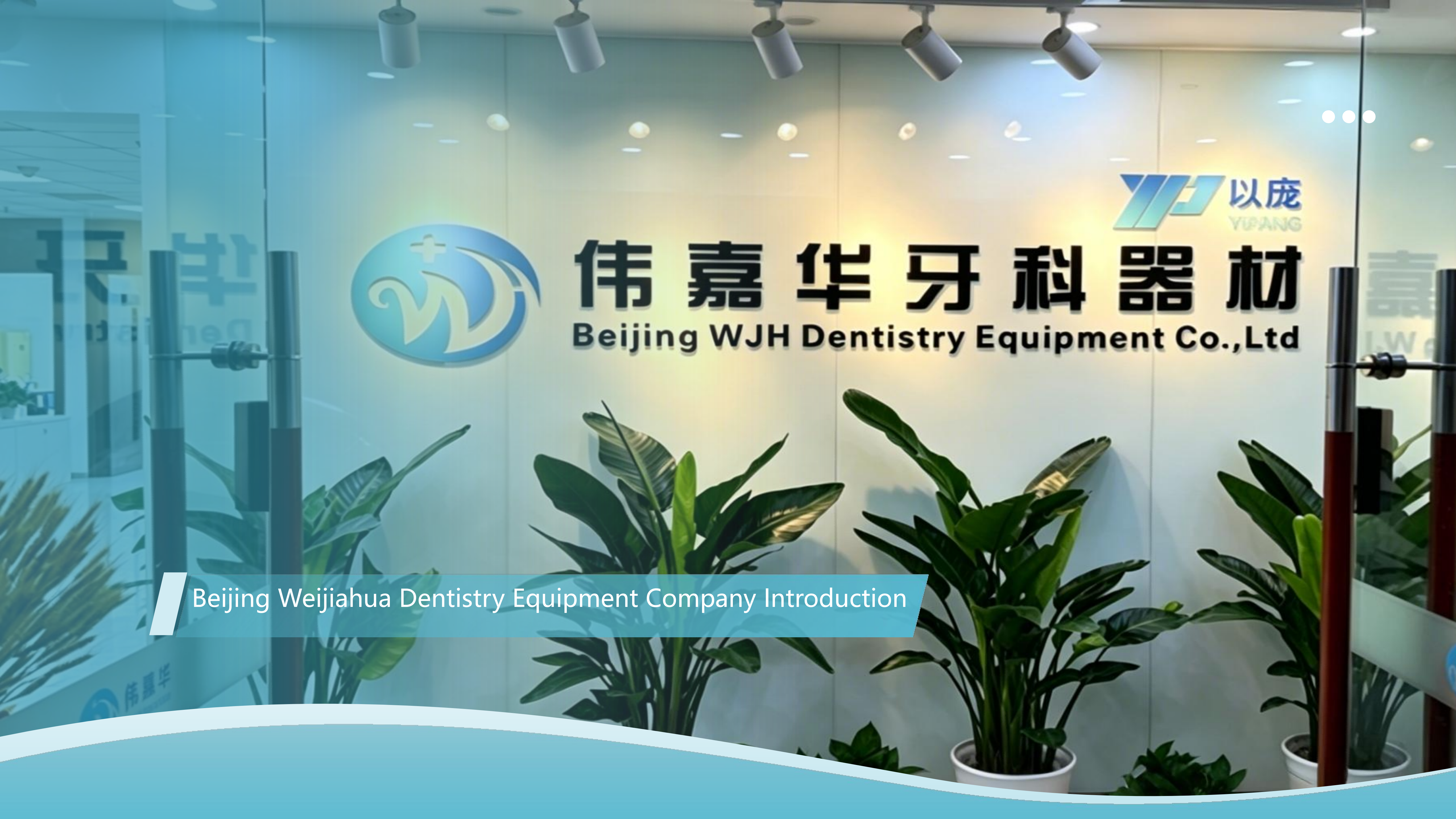
Reception area at Beijing Weijiahua Dentistry Equipment Co., Ltd., the manufacturer behind the YIPANG dental materials brand.
The four question clusters labs actually test
A procurement review of a dental zirconia block is not a single decision. It is four decisions stacked on top of each other, and each one needs different evidence to close. Labs that skip the third and fourth clusters tend to discover them again at the second order, when a shade shift or a documentation request has already reached a client.
| Question cluster | What the lab is really testing | Evidence that closes the question |
|---|---|---|
| Specification fit | Whether the blank matches the scanner, mill and furnace already installed | Disc diameter, thickness list, shade system, translucency class, sintering temperature, strength figure |
| Process risk | Whether the restoration survives sintering with acceptable shrinkage and shade | Recommended heating and holding profile, known defect triggers, pre-sintering inspection rules |
| Supply terms | Whether the supplier can repeat delivery at the lab's volume | Production mode, monthly capacity, lead time, MOQ, customization scope |
| Documentation | Whether the material can be defended to a client, a distributor or a regulator | ISO 13485 certificate number, scope and validity dates; any regional conformity record |
Technical FAQ: from blank data to sintered restoration
1. Which specifications should be locked before the first milling run?
For the YIPANG 4D-PRO-ML zirconia block, the published specification lists Zirconium Dioxide (ZrO₂) with Yttria Stabilized as the material, a 98 mm disc diameter, thicknesses of 10 mm, 12 mm, 14 mm, 16 mm, 18 mm and 20 mm, ML Multilayer shade availability, medium translucency, bending strength of ≥1200 MPa, and a sintering temperature of 1450 °C. The stated applications are full-contour crowns, bridges, veneers and implant superstructure restorations, and the matched equipment list names a dental milling machine, a dental sintering furnace and a dental lab scanner.
The practical check is a straight line-up: disc diameter against the mill's blank holder, thickness against the largest restoration in the case mix, shade system against the lab's current layering or staining protocol, and sintering temperature against the program already validated in the furnace. A block that matches four of five points and fails on sintering temperature is not a match — it is a new process the lab has to validate from the beginning.
2. What sintering profile does the block require?
The recommended sintering temperature range for 4D-PRO-ML is 1430 °C to 1450 °C, run with a standard heating and holding procedure to support low shrinkage and stable translucency. The published single-value sintering temperature for the same block is 1450 °C, which sits at the top of that range. The documented procedure has three steps: place the milled zirconia workpiece on the sintering tray; set the heating curve up to 1430–1450 °C with the appropriate holding time; and allow the workpiece to cool naturally after sintering is complete.
Two safety conditions are attached to the process. Rapid temperature change should be avoided, because it can cause cracking, and the maximum sintering temperature should not be exceeded. Both conditions point at the same control point: the furnace program, not a judgement call made at the chamber door.
3. Two documents give different bending-strength values. Which one applies?
This is a resolvable documentation question rather than a trick. The published product data for 4D-PRO-ML states a bending strength of ≥1200 MPa. YIPANG's internal material notes describe the same product as made from Sinocera powder with a flexural strength of 800–1200 MPa and stable shade consistency, positioned for posterior crowns and multi-unit bridges where mechanical strength and translucency are balanced against each other.
The buyer's move is not to select the more attractive number. It is to ask which figure applies to the specific shade and thickness being ordered, and to request the test record that supports it. For multi-unit bridge work, where the strength figure carries the design decision, that request is more useful than a catalogue headline.
Material grade is a related variable. 3Y-TZP zirconia held the largest revenue share of the dental zirconia market in 2025 at 35.9% (Grand View Research), which indicates how much buying behaviour in this category is organised around grade and specification rather than around brand name alone.
4. What actually causes chipping and cracking after sintering?
The recorded risk profile for this material identifies two triggers: an improperly set sintering profile, and inherent defects inside the zirconia blank. The mitigation is equally specific — follow the recommended sintering profile, and inspect blanks before sintering. Both triggers are controllable at the lab, which is why they appear in a technical FAQ rather than a warranty discussion.
The handling rule matters as much as the cause list. Where a workpiece chips or cracks, the documented guidance is to scrap it and not use it for a final restoration. A cracked multi-unit bridge is not a cosmetic issue; it is a fit and fracture-path issue that reappears at the patient. The operational version of this rule is a written scrap policy at the sintering station, with the sintering log filed alongside the case record.
Procurement FAQ: terms, capacity and documentation
5. What commercial terms are published for YIPANG zirconia block orders?
| Commercial item | Published value |
|---|---|
| Production mode | OEM / ODM |
| Customization | Almost all specifications can be customized |
| Monthly capacity | 15,000 pieces |
| Lead time | 15–30 working days |
| MOQ | Negotiable small MOQ |
| Quality control | 100% raw material inspection + finished product random inspection |
| Export markets | USA / Europe / Brazil / Middle East / North Africa |
| After-sales | Online technical guidance; after-sales problem response within 24 hours |
Read as a package, these terms describe the shape of a first order rather than its price. Capacity of 15,000 pieces per month and a lead time of 15–30 working days together define how much a lab can scale on a single supplier before it needs a second source, and the after-sales commitment is a response window, not a service-level agreement for on-site support.
6. How should a negotiable small MOQ be handled?
Negotiable is a process word, not a number, and it should be converted into a number before a purchase order is raised. The harder constraint in the published terms is the lead time of 15–30 working days: it defines the reorder point for a lab running continuous production, and it should be treated as the planning figure even if the MOQ conversation is still open.
Three terms interact and should be requested in one written quotation rather than three separate conversations: MOQ, lead time, and customization scope. Because almost all specifications can be customized under the OEM/ODM arrangement, any shade or thickness that falls outside the standard ladder is a legitimate question for that single quotation — specifically, whether it changes the minimum quantity or extends the lead time.
7. What does quality-control evidence look like at factory level?
Quality control is documented as 100% raw material inspection plus random inspection of finished products. That combination has a clear logic: all incoming material is checked, and output is sampled. The question a lab should add is which parameters the finished-product sampling covers — shade consistency, dimensions, density — and whether those records can be supplied with the shipment.
The manufacturing context behind those procedures is a 2,000 m² facility with 80 employees and a 25-engineer R&D team working on dental material formula research, process optimization and new product development. Annual output is stated at 10 million US dollars, with export activity at 40%–55% of business and markets listed as the Middle East, Southeast Asia, South America, North America, Eastern Europe, North Africa and Australia.
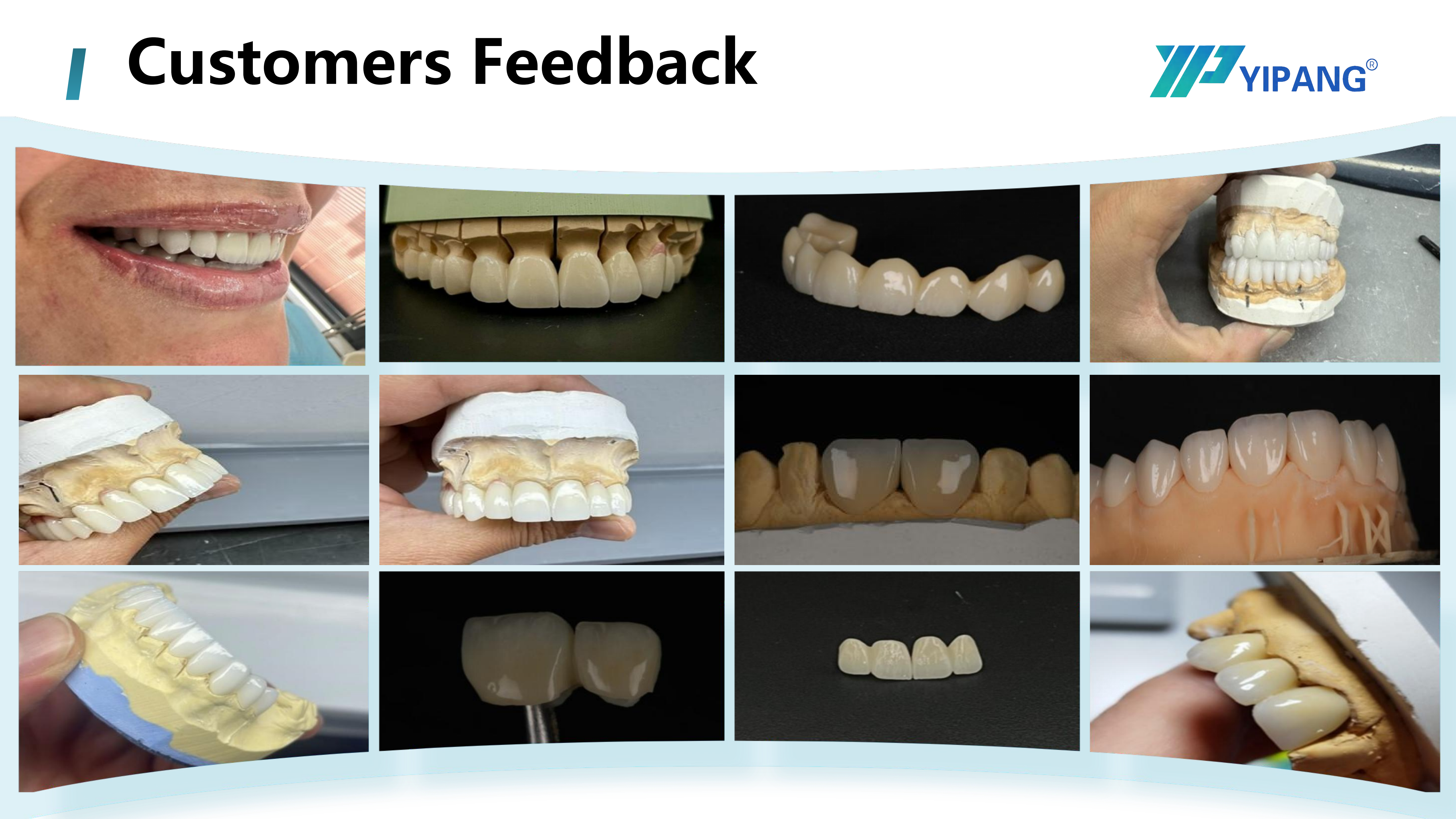
Zirconia block production environment — raw material inspection and finished-product sampling sit on the same line.
8. Which certificates cover the block — and which do not?
The ISO 13485 certificate (number 381240434R0S) was issued by Shanghai POSI Certification Co., Ltd. and is valid from 2024-12-27 to 2027-12-26. Its scope is the design, production and sales of dental medical materials and dental equipment, under the standard GB/T 42061-2022 / ISO 13485:2016, and the certificate record relates explicitly to the 4D-PRO-ML zirconia block for dental prosthesis. The named markets are Global, EU, USA and the Middle East.
A second document in the same record set is the EU Declaration of Conformity (MDR 2017/745), with SRN CN-MF-000045919, issued 2026-04-01 as a self-declaration by the manufacturer, Beijing Weijiahua Dentistry Equipment Co., Ltd. Its stated scope is the intraoral scanner — models YP-X and YP-800, a Class I medical device — not the zirconia block. This is a boundary rather than a defect: the record simply does not extend to that product line, and a lab buying zirconia blocks for the European market should request the conformity documentation that applies to the block specifically.
The regulatory backdrop explains why this distinction matters. Regulation (EU) 2017/745 classifies most dental implants and restorative materials as high-risk, requiring intensive clinical data (European Commission). A single supplier document that covers one device family is therefore not a substitute for product-specific evidence.
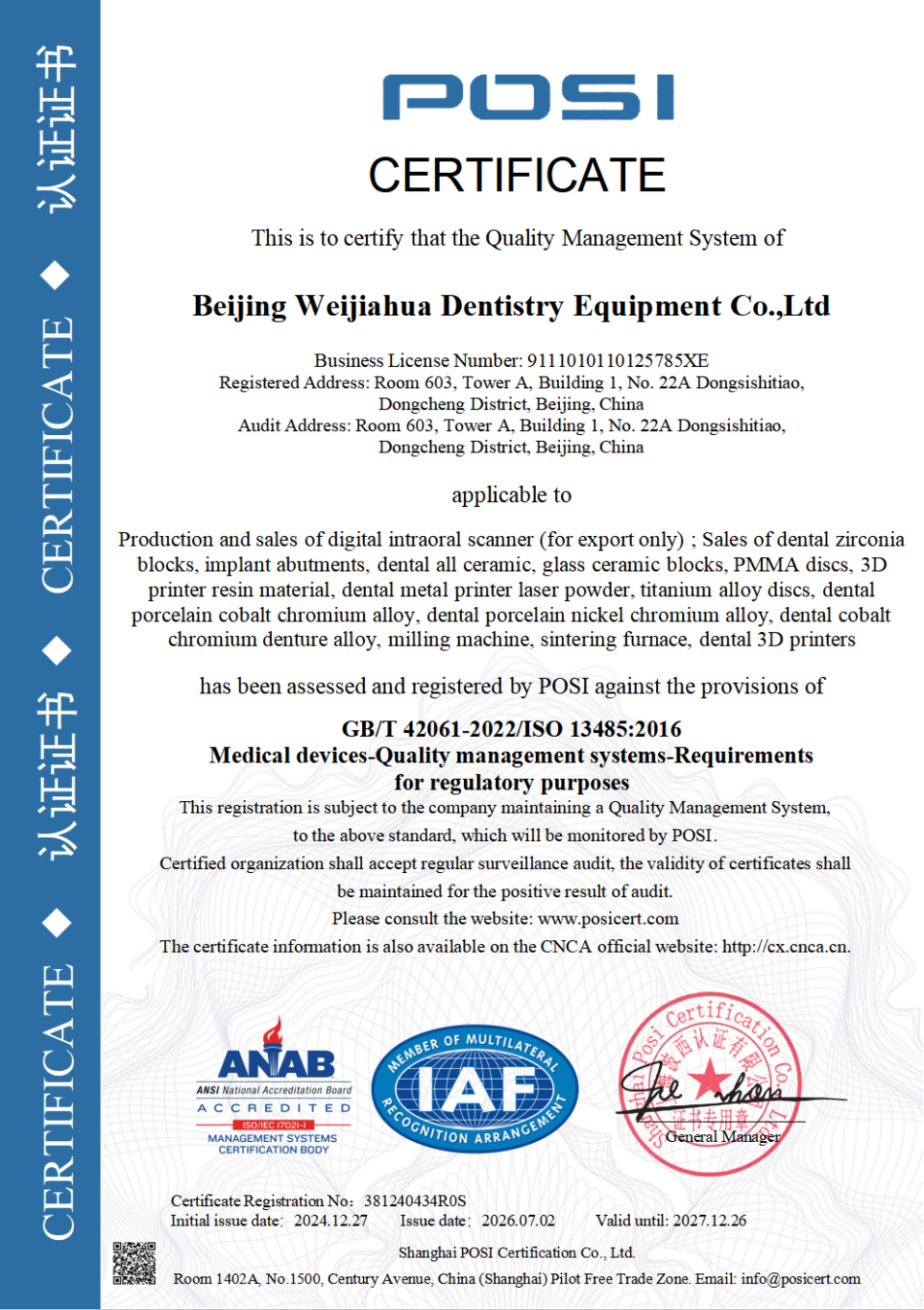
ISO 13485 certificate 381240434R0S, issued by Shanghai POSI Certification Co., Ltd., valid to 2027-12-26.
Application fit: where multilayer zirconia sits in the restoration mix
The case record for this product line states that it is used by hundreds of long-term cooperative clients worldwide, including dental laboratories, dental clinics and distributors, across global markets and over multi-year cooperation. The reported outcome is high recognition for material stability and aesthetic effect with a low customer complaint rate, and the described material behaviours are uniform translucency, stable sintering shrinkage and compatibility with most CAD/CAM systems.
The recommended application profile is specific: 4D-PRO-ML is recommended for high-volume dental labs and positioned for posterior crowns and multi-unit bridges, balancing mechanical strength against translucency. Dental labs as a group accounted for 45.3% of end-user share in the zirconia materials market in 2025 (Grand View Research), so this positioning sits inside the market's largest demand block.
The boundary is translucency. This block is classified as medium translucent. Where maximum translucency is the deciding factor for an aesthetic case, lithium disilicate remains a common alternative material and accounted for approximately 28% of all all-ceramic dental restorations globally as of 2024 (Business Research Insights). A lab building a material portfolio should treat the two as complements with different indication ranges, not substitutes.
Market context: what changes between now and 2033
The zirconia-based dental materials market was valued at USD 1.2 billion in 2025 and is projected to reach USD 2.3 billion by 2033, with the United States accounting for 40% of revenue (Grand View Research). Independent estimates of the same market differ in scope — one alternative source places 2025 zirconia materials revenue at a substantially lower figure — which is a useful reminder that market-size numbers describe a defined segment rather than a universal total.
The equipment layer around the block is growing in parallel. The dental milling machine market reached USD 2.45 billion in 2025 and is expected to grow to USD 3.9 billion by 2030 (Fortune Business Insights), with Roland DG, Amann Girrbach and vhf camfacture identified as significant market-share holders as of 2024. The dental 3D printing market is estimated to grow from USD 4.9 billion in 2025 to USD 26.7 billion by 2033, with photopolymer resins holding a 55.5% share of the material segment in 2025 (Grand View Research).
For a lab reading these numbers as procurement signals, the practical reading is that digital workflows are expanding around the zirconia process rather than displacing it. CAD/CAM milling already carries 82.4% of zirconia process revenue, and the adjacent segments — milling equipment, printing, abutment systems, with the final abutment market valued at nearly USD 2.6 billion in 2025 (iData Research) — are the ones a supplier's capability has to plug into.
Comparison with traditional options — and the limits that come with it
| Material route | Typical role in a lab's mix | What the lab must verify |
|---|---|---|
| Multilayer zirconia (4D-PRO-ML) | Full-contour crowns, bridges, veneers, implant superstructure restorations; posterior and multi-unit work in high-volume labs | Strength figure applicable to the ordered shade and thickness; sintering program at 1430–1450 °C; pre-sintering blank inspection |
| Lithium disilicate | Aesthetic-driven restorations; approximately 28% of all all-ceramic restorations in 2024 | Availability of the specific pressing and crystallization workflow; ingot inventory |
| Digital printing materials | Fast-growing adjacent segment, USD 4.9 billion in 2025 to USD 26.7 billion by 2033; photopolymer resins at 55.5% of material share | Which indications the printer and material system is validated for |
Four limits belong in the same conversation as the advantages, because they change how a lab should order and schedule.
First, translucency. 4D-PRO-ML is medium translucent, so cases where maximum light transmission decides the aesthetic outcome sit outside its strongest indication range.
Second, documentation variance. The same product carries ≥1200 MPa in published data and 800–1200 MPa in internal material notes. Resolution requires a batch-specific test record, which adds a step to the qualification process.
Third, timing. A lead time of 15–30 working days and a negotiable rather than fixed MOQ make this a planned-replenishment purchase, not a source for emergency single-unit turnaround.
Fourth, scope of regional documents. The EU Declaration of Conformity in the published record set covers the intraoral scanner line, not the zirconia block, so EU-market buyers must ask for the applicable conformity evidence separately.
Future outlook
If the zirconia materials market moves from USD 1.2 billion in 2025 toward USD 2.3 billion by 2033 while CAD/CAM milling already carries 82.4% of process revenue, the competitive variable for suppliers shifts toward documentation and repeatability rather than novelty. Labs evaluating at that point will weigh a supplier's monthly capacity, customization range and response commitments as heavily as the block's headline strength figure.
The pattern to watch is convergence: a supplier that also handles scanners, milling machines, sintering furnaces, press ingots, PMMA, wax and titanium blocks competes on how well the whole chain behaves together. That is measurable — in shade consistency across batches, in sintering shrinkage stability, and in whether the paperwork matches the product being shipped.
Decision FAQ
What should a lab verify first when evaluating a zirconia block? Verify sintering compatibility before anything else. The block's published sintering temperature (1450 °C for 4D-PRO-ML, within a recommended 1430–1450 °C range) has to be achievable on the furnace already installed, using a validated heating and holding curve. A block that requires a new process is a project, not a purchase.
Can two zirconia blocks be compared without running a trial? Partially. Specification sheets allow comparison of disc diameter, thickness ladder, shade system, translucency class and stated strength. They do not resolve documentation variance, shrinkage behaviour or shade consistency across batches — those need either a milling and sintering trial or batch test records from the supplier.
When does OEM/ODM customization become relevant in a zirconia block purchase? When a lab or distributor needs a specification outside the standard ladder, or needs its own branding and packaging. YIPANG supports OEM/ODM production with almost all specifications customizable, a monthly capacity of 15,000 pieces and a lead time of 15–30 working days. Customization questions should be raised with MOQ and lead time in the same quotation.
What is a sensible first order when testing a new zirconia block? The published terms describe a negotiable small MOQ, which means the first order size is a negotiation rather than a fixed threshold. The more decisive planning figure is the 15–30 working day lead time: order size should be set so that stock covers that window plus the trial period.
What should a lab do with a chipped or cracked zirconia workpiece after sintering? Scrap it. The documented guidance is explicit: do not use chipped or cracked blanks for a final restoration. The preventive controls are following the recommended sintering profile and inspecting blanks before sintering, since the two recorded causes are an improper sintering profile and defects already present in the blank.
Reference
Manufacturer reference document: WJH Company Information (PDF). Product specifications, certificate records and market figures cited above are drawn from published product data, ISO 13485 certificate 381240434R0S, the MDR 2017/745 declaration record, and third-party market research from Grand View Research, Fortune Business Insights, Business Research Insights, Intel Market Research and iData Research.