
Dental Zirconia Block Customization for Real Lab Scenarios
Scenario fit in dental zirconia means matching a milling blank's specification — diameter, thickness, shade layering, flexural strength and translucency — to the restorations a laboratory actually produces and to the equipment it actually runs. Specification comes before branding.
Zirconia has become the default ceramic route for a large share of fixed dental prosthetics, and the blank is now the least standardized component in that route. Grand View Research reports that zirconia discs held the largest revenue share of the zirconia-based dental materials market in 2025 at 63.1%, while CAD/CAM milling accounted for 82.4% of zirconia dental manufacturing process revenue in the same year. The same source values the global zirconia-based dental materials market at USD 1.2 billion in 2025, projected to reach USD 2.3 billion by 2033.
Scale, however, does not equal fit. A blank that performs reliably in a high-volume crown-and-bridge laboratory is not automatically the right choice for an implant-focused laboratory building multi-unit or full-arch superstructures, and neither is necessarily right for a milling centre running short single units under time pressure. This article examines what scenario fit means in practice, using the YIPANG 4D-PRO-ML zirconia block and its documented application and production data as a working example.
Why Scenario Fit Has Become a Specification Question
The buying decision for dental zirconia sits inside laboratories. Grand View Research notes that dental labs remained the dominant end-user for zirconia materials in 2025, accounting for 45.3% of market share. That single fact changes how material should be evaluated: the relevant question is not whether zirconia is suitable for restorations, but which blank specification is suitable for a given laboratory's case mix.
Three common laboratory profiles illustrate the range. A crown-and-bridge laboratory producing posterior multi-unit bridges is optimizing for strength retention and predictable sintering shrinkage. An implant-oriented laboratory working with abutments, scanbodies and full-arch frameworks is optimizing for dimensional consistency across a large milled area and for compatibility with the implant components it already stocks. An aesthetic-focused laboratory producing veneers and anterior units is optimizing for shade layering and translucency rather than maximum flexural strength.
When a blank is chosen without that mapping, the mismatch usually surfaces late — as shade corrections, marginal adjustments, or sintered units that must be remade.
The Workflow a Zirconia Blank Has to Pass Through
Scenario fit is easier to define once the workflow is explicit. For 4D-PRO-ML, the manufacturer documents a matched equipment set: a Dental Milling Machine, a Dental Sintering Furnace and a Dental Lab Scanner, operating in an indoor constant-temperature dental laboratory environment, with the sintering curve strictly followed.
| Workflow stage | Typical equipment | What determines scenario fit |
|---|---|---|
| Digitization | Intraoral scanner or Dental Lab Scanner | Scan accuracy, especially around scanbodies in implant cases; the scan data drives the shrinkage compensation applied later. |
| Milling | Dental Milling Machine, dental milling burs | Blank diameter (98 mm) and available thickness (10–20 mm) must cover the restoration geometry and connector cross-sections. |
| Sintering | Dental Sintering Furnace | Temperature-profile control. The documented range for 4D-PRO-ML is 1430°C–1450°C, with rapid temperature change avoided. |
| Finishing | Staining glaze, glaze paste, dental porcelain furnace | Shade layering and translucency of the blank determine how much characterization work remains after sintering. |
The workflow explains why a suitable zirconia block is a relative judgement rather than an absolute one. The blank sets the input constraints; the laboratory's equipment set and case mix determine whether those constraints produce acceptable output.
Where Manufacturing Capability Meets Scenario Fit: The YIPANG Position
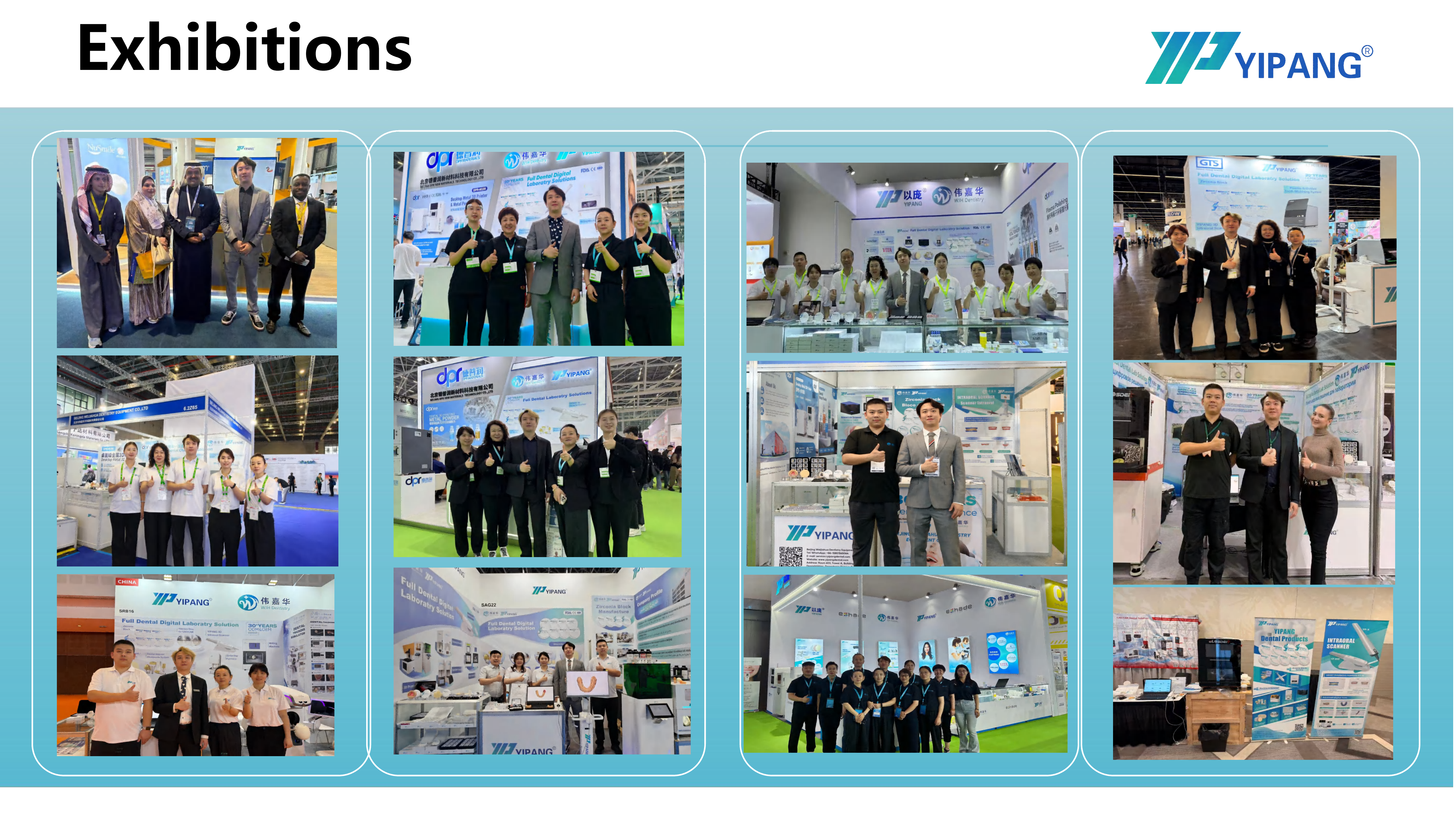
Beijing Weijiahua Dentistry Equipment Co., Ltd. is a Beijing-based dental equipment manufacturer and distributor established in 1996, operating the self-developed YIPANG brand. The company supplies zirconia blocks, glass ceramics, press ingots, PMMA, wax, titanium blocks, implant abutments, scanners, milling machines, 3D printers and sintering furnaces, and reports more than 1,000 dental laboratory customers in China alongside export markets in the Middle East, Southeast Asia, South America, North America, Eastern Europe, North Africa and Australia.
For scenario-based buying, the relevant capability facts are the customization envelope and the production controls behind it. The manufacturer provides both OEM and ODM production services, with customization available for almost all specifications, and serves the USA, Europe, Brazil, Middle East and North Africa through those services. Documented production parameters include a monthly capacity of 15,000 pieces, a lead time of 15–30 working days, a negotiable small MOQ, 100% raw material inspection combined with finished-product random inspection, and online technical guidance with after-sales response within 24 hours. Company-level production data includes a 2,000 m² factory, 80 employees, an R&D team of 25 engineers working on dental material formula research, process optimization and new product development, and an annual output of 10 million US dollars.

4D-PRO-ML: documented specification snapshot
| Parameter | Documented value |
|---|---|
| Product | Zirconia Blocks for Dental Prosthesis (4D-PRO-ML) |
| Type | Dental zirconia disc / CAD/CAM dental milling blank |
| Material | Zirconium dioxide (ZrO₂), yttria stabilized |
| Shades | ML Multilayer |
| Diameter | 98 mm |
| Thickness | 10, 12, 14, 16, 18, 20 mm |
| Sintering temperature | 1450°C (recommended working range 1430°C–1450°C) |
| Bending strength | ≥1200 MPa |
| Translucency | Medium translucent |
| Applicable industry | Dental laboratory, dental prosthetics, dental CAD/CAM industry |
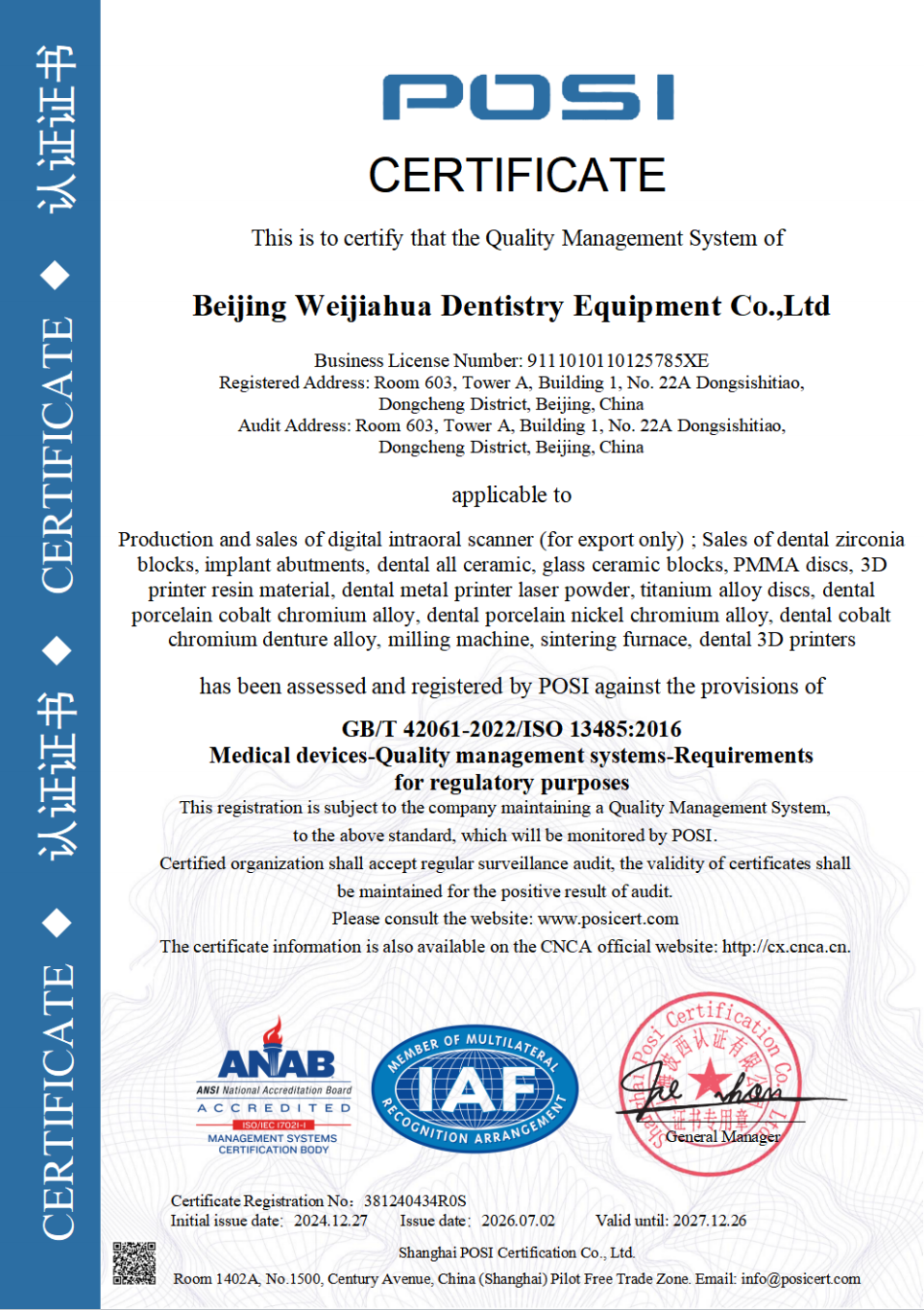
Quality management documentation covers the material route as well. The company holds an ISO 13485 certificate (number 381240434R0S) issued by Shanghai POSI Certification Co., Ltd. on 2024-12-27 and valid to 2027-12-26, against GB/T 42061-2022 / ISO 13485:2016, with a scope covering design, production and sales of dental medical materials and dental equipment. The certificate lists the 4D-PRO-ML zirconia block as a related product.
Application Scenarios: Where Block Choice Changes the Outcome
Documented applications for this zirconia line centre on full-contour crowns, bridges, veneers and implant superstructure restorations, produced by milling and then sintering. Within that envelope, four scenario patterns recur.
- High-volume crown-and-bridge production. The manufacturer's laboratory-selection guidance recommends 4D-Pro-ML blocks for high-volume dental labs and identifies posterior crowns and multi-unit bridges as suitable indications, describing the material as balancing mechanical strength with translucency. The practical driver is consistency: stable shade consistency and predictable sintering shrinkage reduce the number of units that need rework.
- Implant superstructure work. Full-arch and abutment-supported restorations place the blank under a different kind of scrutiny, because errors accumulate across a larger milled geometry. Here the 98 mm diameter and the 10–20 mm thickness range determine which frameworks can be nested from a single blank, while scan accuracy — captured with the Dental Lab Scanner — governs how well the final fit corresponds to the intraoral situation.
- Aesthetic anterior work. Veneers and anterior units depend on multilayer shade behaviour and medium translucency. The relevant customization question is whether the shade layering of the selected specification matches the tooth position being restored, not whether the material is the strongest option available.
- Distributor and private-label supply. Distributors serving multiple laboratories often need one material route rebranded across different specification sets. Because OEM and ODM services are available with customization for almost all specifications, and export coverage includes the USA, Europe, Brazil, Middle East and North Africa, the commercial structure can follow the laboratory mix rather than the reverse.
Field feedback from the manufacturer's long-term client base — hundreds of cooperating dental laboratories, clinics and distributors — emphasizes material stability and aesthetic effect, with uniform translucency, stable sintering shrinkage and compatibility with most CAD/CAM systems as recurring themes, alongside a reported low customer complaint rate.
Honest Boundaries: Where a Zirconia Block Route Does Not Fit
Scenario fit also means recognizing where a material route is the wrong answer, or where it carries conditions that buyers must plan for.
- Sintering capability is mandatory. Zirconia restorations from this line are completed in a dental sintering furnace at 1430°C–1450°C. A laboratory or clinic without sintering capability cannot finish these units in-house, and rapid temperature change should be avoided while the maximum sintering temperature should not be exceeded.
- Chipping and cracking remain a real failure mode. The documented risk factors are improper sintering profile settings and inherent defects inside the zirconia blank. The stated mitigation is procedural: follow the recommended sintering profile and inspect blanks before sintering. Cracked or chipped blanks should be scrapped and must not be used for final restorations.
- Customization has a commercial minimum. Standard models are available from 1 box, but customized products carry a 5-box MOQ, with a 15–30 working day lead time and payment before shipment. That is a genuine constraint for a laboratory testing a new specification before committing volume.
- Acceptance is time-bound. Quantity should be checked on receipt, and damage or deformation must be reported within 48 hours with photographs. Sampling tests are supported, which is the practical way to validate a new specification before it enters routine production.
- Regulatory scope matters in the EU. EU Medical Device Regulation (MDR 2017/745) classifies most dental implants and restorative materials as high-risk and requires intensive clinical data, so documentation timelines — not material performance — often determine when a specification can be placed into European clinical use.
| Material route | Documented context | Workflow implication | Boundary to plan for |
|---|---|---|---|
| Multilayer zirconia block (4D-PRO-ML) | Yttria-stabilized ZrO₂, 98 mm diameter, 10–20 mm thickness, 1450°C sintering temperature, bending strength ≥1200 MPa | Milled as a CAD/CAM blank, then sintered; suited to posterior crowns, multi-unit bridges and implant superstructures | Requires a sintering furnace and strict curve control; sintering shrinkage must be compensated in the CAM workflow |
| Lithium disilicate glass ceramic / press ingot | Lithium disilicate accounted for approximately 28% of all-ceramic dental restorations globally as of 2024 (Business Research Insights) | Separate press or mill-and-crystallize route with its own equipment cycle | Different optical and strength profile; requires its own validated process before standardization |
| PMMA disc | PMMA is listed among the manufacturer's product lines alongside wax and titanium blocks | Milled directly without a ceramic sintering step | Material behaviour differs from ceramic routes, so indications should be verified against the intended restoration type |
The comparison is not a ranking. It is a reminder that scenario fit is about matching indications, equipment and documentation, and that a supplier's portfolio breadth only helps if a laboratory can trace each option to a validated workflow.
Market Signals Behind Scenario-Based Buying
Several published indicators point in the same direction as laboratory practice. Zirconia discs hold the largest revenue share of zirconia-based dental materials at 63.1% (2025), and the market is projected to grow from USD 1.2 billion in 2025 to USD 2.3 billion by 2033 (Grand View Research). The U.S. accounts for 40% of that revenue, which is one reason North American specification requirements tend to influence global supplier documentation.
On the material side, 3Y-TZP zirconia held the largest product-grade revenue share at 35.9% in 2025, while dental laboratories remained the dominant end-user at 45.3% — both consistent with a market where the decisive buyer is a production manager rather than a clinician. The equipment market tells a compatible story: the dental milling machine market reached USD 2.45 billion in 2025 and is expected to grow to USD 3.9 billion by 2030 (Fortune Business Insights), a market in which that source identifies Roland DG, Amann Girrbach and vhf camfacture among the significant share holders.
As milling hardware becomes more widely distributed, differentiation shifts away from the machine and towards the blank — specifically towards shade consistency, shrinkage behaviour and the supplier's ability to customize specifications to a defined case mix.
Future Outlook
Two changes are likely to shape how laboratories specify zirconia blocks over the next several years. The first is a shift from single-SKU sourcing to specification sets: laboratories increasingly buy a strength-oriented multilayer specification for posterior work and a translucency-oriented specification for anterior work, and evaluate suppliers on whether both can come from one qualified process. The second is documentation-led procurement. With MDR 2017/745 requiring intensive clinical data for most dental implants and restorative materials in the EU, evidence such as an ISO 13485 certificate with a defined scope — and the ability to keep that evidence current — becomes a supplier selection criterion in its own right.
FAQ
What sintering temperature should be used for 4D-PRO-ML zirconia blocks?
The recommended sintering range is 1430°C–1450°C, with the product specification listing 1450°C. A standard heating and holding procedure supports low shrinkage and stable translucency. Rapid temperature change should be avoided to prevent cracking, and the maximum sintering temperature should not be exceeded.
What equipment does a laboratory need to process a 98 mm zirconia blank?
The documented matched equipment set for this line is a Dental Milling Machine, a Dental Sintering Furnace and a Dental Lab Scanner, operating in an indoor constant-temperature dental laboratory environment. The blank is a 98 mm diameter CAD/CAM milling blank, and the manufacturer reports compatibility with most CAD/CAM systems. Milled units are sintered and then finished with staining glaze and glaze paste.
What are the purchasing, delivery and acceptance terms for standard versus customized zirconia blocks?
The MOQ is 1 box for standard models and 5 boxes for customized products. Delivery is by domestic express, or by sea or air freight for export, with FOB Shanghai/Tianjin available. Acceptance requires checking quantity on receipt; damage or deformation must be reported within 48 hours with photographs, and sampling tests are supported. Payment terms are full payment before shipment.
How should a laboratory handle zirconia blanks that chip or crack after sintering?
The documented triggers are improper sintering profile settings and inherent defects inside the zirconia blank. Mitigation is to follow the recommended sintering profile and to inspect blanks before sintering. Cracked or chipped blanks should be scrapped and must not be used for final restorations.
Which restoration types are zirconia blocks most often selected for?
The documented applications are full-contour crowns, bridges, veneers and implant superstructure restorations. The manufacturer's lab-selection guidance recommends 4D-Pro-ML blocks for high-volume dental laboratories and identifies posterior crowns and multi-unit bridges as suitable indications, describing the material as balancing mechanical strength with translucency.
Additional company and product information is available in the WJH company information brochure (PDF), and product data for YIPANG dental materials is published at www.yipangdental.com.
¿Tiene preguntas o necesita más detalles?
Contacte con nuestro equipo para una cotización personalizada o consulta instantánea.
Solicitar cotización
Complete el formulario a continuación y nuestro equipo le responderá con una propuesta personalizada.
Chat directo de WhatsApp
¿Prefiere chatear en tiempo real? Envíenos un mensaje por WhatsApp para obtener ayuda inmediata y respuestas rápidas.
- Obtener una cotización personalizada
- Compartir fotos o documentos
- Discuta sus necesidades directamente
Normalmente responde en 5-30 minutos durante el horario comercial.