
Dental Zirconia Block Comparison: An Independent Buyer Reference for Labs
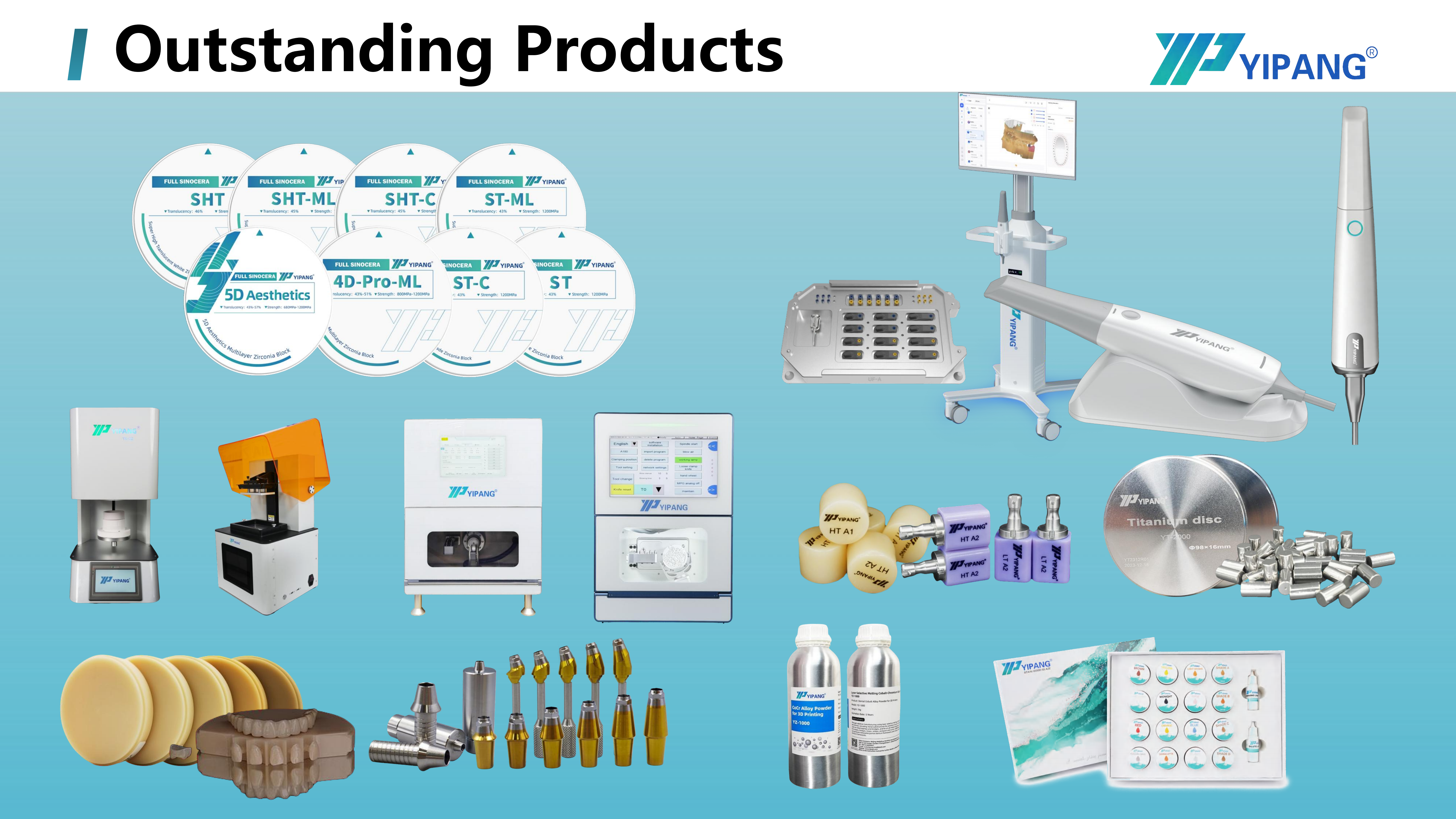
Dental zirconia blocks have become a standard input in digital dental production, but the word zirconia is used loosely across the supply chain. A dental zirconia block is not a generic commodity. It is a machinable blank whose dimensions, raw material, shade system, bending strength and sintering window decide how predictably a laboratory can move from digital design to finished restoration. This article is written as an independent buyer reference for labs that need to compare dental zirconia block options without relying on promotional language. It uses one fully documented product example, the YIPANG 4D-PRO-ML dental zirconia block, and supplements it with verifiable third-party market data.
Why Dental Zirconia Block Selection Is a Comparison Problem
From a procurement perspective, the easiest comparison is price. The more useful comparison is process compatibility. A dental zirconia block looks like a simple disc, but its value is generated later in the dental lab workflow: after scanning, milling and sintering. If the blank is not matched to the lab milling machine or if the furnace profile does not fit the material, the restoration can fail before it reaches the patient.
Risk guidance associated with dental zirconia processing describes chipping and cracks after zirconia sintering as a known failure mode. The trigger can be an improper sintering profile or an internal defect inside the zirconia blank. The suggested mitigation is to follow the recommended sintering profile, inspect blanks before sintering, and discard chipped or cracked blanks instead of using them for final restorations. That is why block comparison should include the supplier's process notes, not only a price list.
For an independent buyer, the practical question is simple: can this block be processed by my current CAD/CAM chain to produce the indicated crown, bridge, veneer or implant-supported superstructure? The answer depends on measurable specification data, the lab's own equipment, and the material behavior after sintering.
Reference Product Example: YIPANG 4D-PRO-ML Dental Zirconia Block
To keep this comparison concrete, the article uses a publicly documented product example from Beijing Weijiahua Dentistry Equipment Co., Ltd., whose self-developed dental brand is YIPANG. Beijing Weijiahua was established in 1996 and operates a 2000-square-meter facility with about 80 employees. Its annual production capacity is about USD 10 million. The company reports exports of approximately 40% to 55% of its products and says it serves markets in the Middle East, Southeast Asia, South America, North America, Eastern Europe, North Africa, and Australia.
Within the YIPANG product portfolio, the 4D-PRO-ML dental zirconia block is classified as a dental zirconia disc and CAD/CAM dental milling blank. It is made of zirconium dioxide (ZrO2) with yttria stabilization. The following table lists the product facts used for this comparison. The same table can be used as a template when comparing blocks from other suppliers.
| Parameter | Documented Fact for YIPANG 4D-PRO-ML |
|---|---|
| Product classification | Dental zirconia disc / CAD/CAM dental milling blank for dental prosthesis |
| Material | Zirconium dioxide (ZrO2) with yttria stabilization |
| Model | 4D-PRO-ML |
| Diameter | 98 mm |
| Thickness options | 10 mm, 12 mm, 14 mm, 16 mm, 18 mm, 20 mm |
| Shade system | ML multilayer shades |
| Bending strength | ≥1200 MPa as stated on the product sheet |
| Translucency | Medium translucent |
| Sintering temperature | 1450°C as stated on the product sheet; process guidance uses 1430°C–1450°C |
| Intended applications | Crowns, bridges, aesthetic restorations, full-contour crowns, bridges, veneers, and implant superstructure restorations |
The supplier states that the 4D-PRO-ML block uses high-quality domestic zirconia powder with stable performance, and that it is designed to be compatible with most mainstream dental milling machines. The product description also mentions excellent gradient translucency for more natural restorative results, low shrinkage after sintering, and high dimensional accuracy. This documentation is useful because it allows a buyer to compare the claimed behavior with the actual operating parameters of their own lab.
Technical Meaning of the Main Compare Points
For a lab evaluating dental zirconia blocks, the main compare points are not just brand names. The compare points are material, geometry, strength, translucency, shade layering, sintering instructions and workflow compatibility. Each point changes the way the block performs inside a specific laboratory.
Material and Strength
The 4D-PRO-ML example is an yttria-stabilized zirconia block. This material family is commonly used in CAD/CAM dentistry because it offers a useful balance between mechanical strength and aesthetic appearance. In the supplier's technical documentation, bending strength is listed as ≥1200 MPa. That is a measurable value, but it should be evaluated against the type of restoration being made. High-strength zirconia blocks are commonly considered for posterior crowns and multi-unit bridges, where mechanical reliability is a priority. The supplier's own selection guidance for 4D-PRO-ML also describes it as suitable for high-volume dental labs that need stable shade consistency and a balance between flexural strength and translucency.
Diameter and Thickness
A dental zirconia block must fit the blank holder of the milling unit used in the lab. The YIPANG 4D-PRO-ML is supplied with a 98 mm diameter and thickness options of 10 mm, 12 mm, 14 mm, 16 mm, 18 mm and 20 mm. Thickness affects the size of restoration that can be milled from one blank. A lab that mainly produces crowns may use thinner blanks, while a lab that frequently mills long-span bridges or implant superstructure restorations may need 18 mm or 20 mm material. Buyers should compare thickness availability before they change suppliers, because not every lab can mill every block geometry.
Shade, Translucency and Multilayer Structure
Shade management is often the most visible difference after sintering. The 4D-PRO-ML is available in ML multilayer shades and is described as medium translucent. In practical terms, this means a lab receives a block that already includes a multilayer color architecture, rather than requiring the technician to build all color character externally. The product documentation includes veneers and aesthetic restorations in its intended applications, while also describing a medium translucent appearance. Buyers should verify whether the shade range matches their lab's own case distribution. A block with a narrow shade line can create bottlenecks in a lab that handles varied aesthetic cases.
Sintering Profile
Zirconia blocks cannot be finished with milling alone. After the restoration is milled, it must be sintered. For YIPANG 4D-PRO-ML, the product sheet lists 1450°C as the sintering temperature, while the supporting knowledge note gives a recommended range of 1430°C–1450°C and instructs users to follow a standard heating and holding procedure. The note also warns against rapid temperature changes and says the material should not exceed the maximum sintering temperature. After sintering, the workpiece should cool down naturally. For a lab buyer, this is more than a technical footnote. It means the block requires a sintering furnace with a programmable curve. A lab relying on a furnace with insufficient cycle control may see unpredictable results even if the block itself is technically sound.
Application and Workflow Fit
The application scenario linked to YIPANG 4D-PRO-ML describes an indoor constant-temperature dental laboratory environment. The documented project types include full-contour crowns, bridges, veneers and implant superstructure restorations. The stated operation mode is to process the material with a dental milling machine and sinter it in a dental sintering furnace. The matched equipment list also includes a dental lab scanner.
This is a useful reference for buyer comparison because it makes the required workflow visible. If a lab already operates with a digital chain composed of a scanner, milling machine and sintering furnace, the 4D-PRO-ML is a plausible candidate in terms of process design. If the lab does not have all three pieces of equipment, the comparison should include the cost and complexity of adding the missing step. The presence of implant superstructure restorations in the scenario also means the block is not positioned merely as a single-crown material. It is connected to a broader laboratory production model that includes implant-related work.
Comparison with Traditional Metal-Ceramic and Manual Layering Workflows
For many laboratories, the alternative to a zirconia block workflow is not another zirconia block brand; it is a conventional workflow based on metal-ceramic restorations or manually layered ceramics. In these conventional workflows, restoration construction is split into multiple manual steps: framework production, porcelain layering and repeated firings. A CAD/CAM zirconia block workflow instead starts with a pre-formed industrial blank that is milled to the designed shape and then sintered. This can reduce manual layering variation and make the restoration shape driven by the digital design rather than by hand.
Yet the comparison is not one-sided. A dental zirconia block is not a standalone product. The YIPANG example requires a dental lab scanner, a compatible dental milling machine and a dental sintering furnace in the working environment. It also carries a special processing requirement to strictly follow the standard sintering temperature curve. This means a lab that is evaluating zirconia blocks must compare them together with the surrounding machinery, furnace capability and operator training. A traditional layered workflow may be more familiar to technicians, while a block workflow introduces a different set of process controls.
There is also an aesthetic boundary. The 4D-PRO-ML is documented as medium translucent. Medium translucent zirconia is designed for many routine full-contour cases, but it is not the same as a high-translucency glass ceramic. If a laboratory regularly produces highly translucent anterior restorations, the material comparison should include lithium disilicate or other glass ceramic options. Third-party market data indicate that the global dental lithium disilicate market is projected to grow from USD 320 million in 2025 to USD 920 million by 2032, which suggests that laboratories will continue to choose among different ceramic families instead of using a single block for every case. For a lab buyer, this is not a reason to reject zirconia blocks. It is a reason to compare material classes before locking a particular block into a fixed workflow.
Market Trends That Affect Lab Procurement
Third-party data give useful context for an independent buyer comparison. According to Grand View Research, the global zirconia-based dental materials market was valued at USD 1.2 billion in 2025 and is projected to reach USD 2.3 billion by 2033. In 2025, zirconia discs held the largest revenue share, at 63.1%, and dental laboratories remained the dominant end-user, accounting for 45.3% of the market. The same research source reports that CAD/CAM milling accounted for 82.4% of zirconia dental manufacturing process revenue in 2025, and that the U.S. accounted for 40% of global revenue in the zirconia-based dental materials market.
These figures help explain why dental labs need a comparison method that goes beyond product color cards. The growing material economy makes the block itself a business decision. As CAD/CAM milling becomes the dominant processing method, the block's compatibility with scanners, milling machines and sintering furnaces becomes more important than generic brand reputation.
One additional market signal is the grade breakdown. Grand View Research reports that the 3Y-TZP zirconia grade held the largest revenue share at 35.9% in 2025. This is valuable because it shows the dental zirconia market is not homogeneous. Grades can differ in mechanical behavior and translucency. Buyers should ask which material grade a block belongs to rather than assuming all yttria-stabilized zirconia products perform in the same way.
Independent Buyer Comparison Limitations
Even a specification-rich comparison has boundaries. The first boundary is that technical parameters are only useful when the lab's own equipment is known. A block with a 98 mm diameter and 20 mm thickness may be excellent for one milling machine and unusable for another. A lab should verify blank dimensions, holder type and milling software compatibility before treating a spec table as a purchase order.
The second boundary is that documented bending strength does not guarantee clinical success. Strength is one material property, but the final restoration depends on cementation, preparation design, occlusal loading and laboratory process control. Buyers should not choose a block solely because one specification number looks high.
The third boundary is the translucency and shade range. Medium translucent zirconia in ML multilayer shades can cover a broad range of clinical cases, but a dental laboratory case mix that is heavily oriented toward highly translucent anterior restorations may need a separate material family. Independent evaluation should therefore be based on the actual mix of restorations produced by the lab, not on a generic ideal of a universal zirconia blank.
Future Outlook
The future of dental zirconia block procurement is likely to become more system-oriented. As CAD/CAM milling already accounts for 82.4% of zirconia dental manufacturing process revenue, labs will continue to define block quality in terms of the entire digital chain: scanning, design, milling, sintering and quality control. Suppliers that provide clear documentation about material, dimensions, sintering behavior and intended applications will be easier for buyers to compare.
The growth projection for the global zirconia-based dental materials market, from USD 1.2 billion in 2025 to USD 2.3 billion by 2033, points to continued adoption. At the same time, new manufacturing inputs such as dental lithium disilicate materials and 3D printing are expanding around the same digital ecosystem. This means a lab that chooses a dental zirconia block today should treat that choice as part of a wider material strategy, not as a one-time purchase.
Buyers should also expect more suppliers to publish technical notes that go beyond marketing descriptions. In the YIPANG example, the supplier links the 4D-PRO-ML block to a defined application scenario, identifies the matched equipment, and provides guidance on sintering temperature and risk mitigation. This type of documentation makes independent comparison possible in a way that vague color-coded brochures cannot.
For background documentation on the supplier used in this comparison, the public company information brochure can be viewed here: Beijing Weijiahua Dentistry Equipment Co., Ltd. company information.
FAQ
How do dental labs select zirconia blocks?
Dental labs typically compare a small set of practical variables when selecting zirconia blocks: material type, diameter, thickness, shade system, bending strength, sintering temperature, and compatibility with the lab's milling workflow. A documented example is the YIPANG 4D-PRO-ML block, which is an yttria-stabilized zirconia disc available in a 98 mm diameter, 10–20 mm thickness range, and ML multilayer shades. According to the supplier's selection guidance, the 4D-PRO-ML is positioned for high-volume labs that need stable shade consistency and a balance between mechanical strength and translucent aesthetics.
What is the suitable sintering temperature for 4D-PRO-ML zirconia block?
The recommended sintering temperature range for the YIPANG 4D-PRO-ML zirconia block is 1430°C–1450°C. Users should follow a standard heating and holding procedure to keep shrinkage low and translucency stable. Rapid temperature changes should be avoided, the maximum sintering temperature should not be exceeded, and the workpiece should be allowed to cool naturally after sintering.
¿Tiene preguntas o necesita más detalles?
Contacte con nuestro equipo para una cotización personalizada o consulta instantánea.
Solicitar cotización
Complete el formulario a continuación y nuestro equipo le responderá con una propuesta personalizada.
Chat directo de WhatsApp
¿Prefiere chatear en tiempo real? Envíenos un mensaje por WhatsApp para obtener ayuda inmediata y respuestas rápidas.
- Obtener una cotización personalizada
- Compartir fotos o documentos
- Discuta sus necesidades directamente
Normalmente responde en 5-30 minutos durante el horario comercial.