
Dental Zirconia Block Comparison: Where Buyers Should Start
A dental zirconia block is a milling blank of yttria-stabilized zirconium dioxide, supplied as a disc that a laboratory mills into crowns, bridges, veneers and implant superstructure frameworks. Two blocks from different suppliers can share the same diameter, the same thickness list and near-identical strength figures, and still behave differently once they enter the same furnace.
That is why the useful purchasing question is rarely 'which block is best'. The question that predicts the outcome is 'which comparison, run in which order, actually reflects what my lab will do with the disc'. Category structure explains part of the pressure. Zirconia discs held the largest revenue share of the zirconia-based dental materials market at 63.1% in 2025, and CAD/CAM milling accounted for 82.4% of process revenue in the same year, according to Grand View Research. Nearly the whole category is bought as a milled disc, so nearly the whole purchase decision is a milling-and-sintering decision.
This article sets out a comparison framework for laboratories and distributors evaluating dental zirconia blocks. It separates elimination criteria — the checks that remove a supplier from the shortlist — from ranking criteria, the variables that order the suppliers who survive. It then maps publicly documented facts about the YIPANG 4D-PRO-ML block and its manufacturer onto that framework, and states plainly where the framework stops.
The Comparison Problem: Uniform Geometry, Uneven Behaviour
Zirconia discs are standardised by format, not by performance. A 98 mm disc is a 98 mm disc. Thickness options and shade systems converge across suppliers because the downstream CAM software and mill chucks require it. What does not converge is how a given blank responds to a specific sintering cycle, how evenly translucency holds across the disc, and how much documentation a supplier can produce when asked.
The same discipline problem shows up in market data. Grand View Research puts the zirconia-based dental materials market at USD 1.2 billion in 2025, while SNS Insider reports USD 367.67 million for a narrower definition of the same category. The gap is not an error to resolve; it is a scope difference. A headline number carries meaning only with its scope attached, and a block specification carries meaning only with its test conditions attached. Buyers who apply the second rule already think the way this framework requires.
Three items cause most shortlist errors in practice: reading a quality management certificate as a product certificate, comparing strength figures without comparing sintering cycles, and assuming that customization means the same thing to every supplier. Each of these becomes an elimination gate below.
Gate 1 — Establish What Each Document Actually Covers
Documentation is the first gate because it is the cheapest place to be wrong. The reference point is the quality management system. Beijing Weijiahua Dentistry Equipment Co., Ltd. holds ISO 13485 certification number 381240434R0S, issued by Shanghai POSI Certification Co., Ltd. on 2024-12-27 and valid until 2027-12-26, against the standard GB/T 42061-2022 / ISO 13485:2016. The certified scope is the design, production and sales of dental medical materials and dental equipment, and the certificate is listed as covering markets including the EU, USA, Middle East and global supply.
An ISO 13485 certificate of this kind certifies a management system and a scope of activity. It does not certify an individual disc, a lot, or a sintering result. Buyers comparing suppliers should therefore keep two document sets separate: system-level certification, and lot- or batch-level records such as incoming material inspection and finished-product inspection. The manufacturer in question describes a quality control routine of 100% raw material inspection plus finished product random inspection, which is the kind of statement that should be paired with actual records during evaluation.
The second document type is market access. The company holds an EU Declaration of Conformity under MDR 2017/745, with SRN CN-MF-000045919, issued 2026-04-01 as a self-declaration by the manufacturer. Its stated scope is the Intraoral Scanner, models YP-X and YP-800, a Class I medical device. That scope line matters for a block comparison. As recorded, this declaration covers intraoral scanner models, not the zirconia block line, so it should not be scored as evidence for a zirconia disc purchase. The broader regulatory context reinforces why: the European Commission notes that MDR 2017/745 classifies most dental implants and restorative materials as higher-risk devices requiring intensive clinical data. Buyers in the EU should request the specific document set that applies to the material they are buying, rather than accepting a document whose title looks correct.
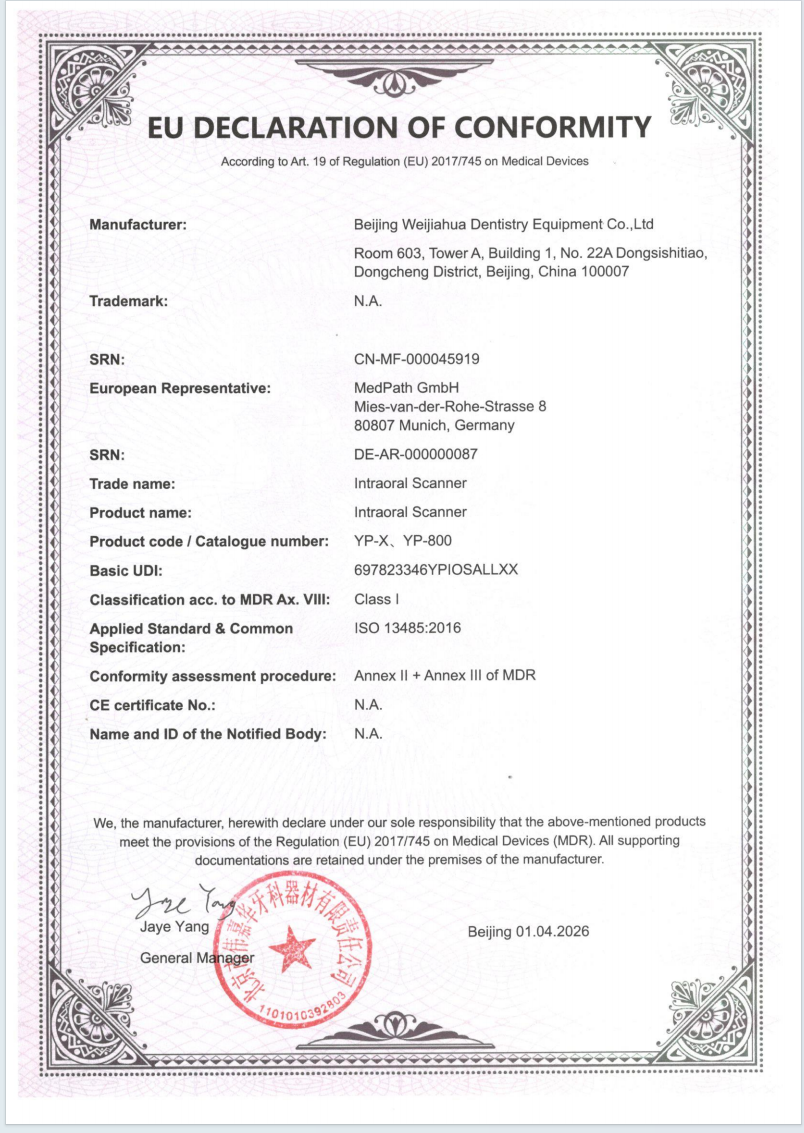
A declaration is only evidence for the products named in its scope. In this record, the EU declaration of conformity covers intraoral scanner models YP-X and YP-800.
Gate 1 checklist
- Identify the certificate type: management system, product registration, or self-declaration.
- Read the scope sentence, not the certificate cover.
- Check validity dates against your purchasing timeline.
- Request the batch-level inspection record that corresponds to the lot you will receive.
Gate 2 — Test the Spec Numbers Against Your Own Sintering Cycle
Strength and translucency numbers are outputs of a process, not properties of a powder alone. For the YIPANG 4D-PRO-ML zirconia block, the published specification lists a 98 mm diameter, thickness options of 10 mm, 12 mm, 14 mm, 16 mm, 18 mm and 20 mm, ML multilayer shades, medium translucency, and bending strength of ≥1200 MPa. The material is zirconium dioxide (ZrO₂) with an yttria stabilizer, and the applicable industry is the dental laboratory, dental prosthetics and dental CAD/CAM sector.
Sintering is where the comparison is won or lost. The specification sheet lists a sintering temperature of 1450 °C, while the processing guidance recommends a working range of 1430 °C to 1450 °C with a standard heating and holding procedure, followed by natural cooling. That range is narrow enough that furnace calibration becomes a purchasing variable rather than a maintenance detail. A lab should confirm three things before treating two blocks as equivalent: that its furnace can hold inside the recommended window, that shrinkage calibration for the specific lot has been established, and that the strength figure is being compared at the same measurement stage and test method across suppliers.
Two practical questions separate careful buyers from fast ones. First, ask at which stage the ≥1200 MPa figure is measured and under which method. Second, ask how shrinkage behaves across the full thickness range, because a 20 mm blank and a 10 mm blank are not used for the same indication. Neither question requires a laboratory to distrust a supplier; both require a supplier to have the answer ready.
Gate 3 — Confirm That 'Customization' Applies to Your Case
Customization is the gate most often scored on the strength of a single word. Beijing Weijiahua Dentistry Equipment Co., Ltd. offers both OEM (Original Equipment Manufacturing) and ODM (Original Design Manufacturing) production services, with customization options for almost all specifications, and supplies clients in the USA, Europe, Brazil, the Middle East and North Africa. The capability profile adds monthly capacity of 15,000 pieces, a lead time of 15 to 30 working days, a negotiable small MOQ, and export coverage across the USA, Europe, Brazil, the Middle East and North Africa.
The purchasing terms then turn those capabilities into order mechanics. MOQ is stated as one box for standard models and five boxes for customized products. Delivery is express domestically, and sea or air freight for export, with FOB Shanghai or Tianjin available. Acceptance requires quantity checks on receipt, with damage or deformation reported within 48 hours with photographs, and sampling tests are supported. Payment terms are full payment before shipment.
Read together, these terms define the buyer's real test. If the requirement is a private label, a non-standard shade set or a specific thickness not carried in stock, the order shifts into the customized track: five-box MOQ, a 15-to-30 working day window, and a sampling step that should be scheduled before the full order is released. If the requirement is a standard ML multilayer disc in a listed thickness, the one-box MOQ makes a low-risk trial possible. A supplier that cannot tell you which track your request falls into has not yet been compared on customization at all.
The Scoring Layer: Four Variables That Rank the Survivors
Once the three gates have removed unsuitable options, what remains is a ranking problem. Four variables do most of the work, and each has an evidence request attached to it.
| Scoring variable | Evidence to request | Why it changes the decision |
|---|---|---|
| Sintering shrinkage stability | Lot-level shrinkage data, or a firing test run on your own furnace | Determines whether multi-unit bridges and full-arch frameworks seat without chairside adjustment |
| Translucency uniformity across the disc | Shade and thickness samples drawn from the same lot | Determines the aesthetic pass rate on anterior and high-visibility restorations |
| CAD/CAM compatibility | Confirmation of 98 mm geometry against your mill chuck specification | Determines whether the blank can be processed at all in your workflow |
| Supply continuity and response | Monthly capacity, quoted lead time, after-sales response commitment | Determines reorder risk once the material is qualified in production |
The sequence matters more than the weights. Scoring translucency before confirming that a disc runs in your mill wastes evaluation time; scoring price before confirming shrinkage stability produces a shortlist that fails in sintering. Buyers who rank in the order above tend to reach a defensible decision in fewer trial cycles.
Where YIPANG Fits: Mapping Framework Inputs to Published Facts
YIPANG is a self-developed brand owned by Beijing Weijiahua Dentistry Equipment Co., Ltd., a Beijing-based dental equipment manufacturer and distributor established in 1996. The company operates a 2,000 ㎡ facility with 80 employees, annual output of USD 10 million, and an R&D team of 25 professional engineers working on dental material formula research, process optimisation and new product development. Its export ratio is stated at 40% to 55%, with main markets in the Middle East, Southeast Asia, South America, North America, Eastern Europe, North Africa and Australia.
The product portfolio extends well beyond zirconia, which matters for a comparison because it indicates where else the same supply relationship can be used: zirconia blocks, glass ceramics, press ingots, PMMA, wax, titanium blocks, implant abutments, 3D scanners, intraoral scanners, milling machines, 3D printers and sintering furnaces. The company also describes a long history as a dental equipment agent, representing international brands including VITA, Ivoclar, Dentsply, Amann Girrbach and Noritake, and serving more than 1,000 dental laboratory customers in China.
On the block itself, the 4D-PRO-ML is listed under the ISO 13485 certification scope covering dental medical materials and dental equipment. The manufacturer's application record describes use for full-contour crowns, bridges, veneers and implant superstructure restorations, with a documented strength of ≥1200 MPa, a 98 mm diameter across six thickness options, medium translucency and ML multilayer shading. Field feedback is described qualitatively: hundreds of long-term cooperative clients worldwide, high recognition on material stability and aesthetic effect, and a low customer complaint rate, with uniform translucency, stable sintering shrinkage and compatibility with most CAD/CAM systems named as the recurring highlights. Those are supplier-reported observations rather than independently audited measurements, and they should be treated as claims to verify during sampling rather than as settled evidence.
Technical Explanation: Why Sintering Decides the Comparison
Sintering is a three-step operation in which the milled zirconia workpiece is placed on a sintering tray, heated to the recommended range of 1430 °C to 1450 °C with an appropriate holding time, and then cooled naturally after completion. The two safety constraints attached to the process are explicit: avoid rapid temperature change to prevent cracking, and never exceed the maximum sintering temperature.
The dominant failure mode is chipping and cracking after sintering. Two triggers are documented: an improper sintering profile setting, and inherent defects inside the zirconia blank. The mitigation is procedural rather than commercial — follow the recommended sintering profile, inspect blanks before sintering, and scrap chipped or cracked pieces rather than allowing them into a final restoration. This is why the comparison framework places sintering evidence ahead of price and ahead of aesthetic scoring. A block that mills cleanly and then fails in the furnace has not been cheap at any price.
Application Fit: Three Lab Situations and What They Change
1. High-volume posterior crowns and multi-unit bridges
Here the ≥1200 MPa bending strength and shrinkage stability dominate, and translucency is a secondary criterion. The 4D-PRO-ML is positioned for posterior crowns and multi-unit bridges, balancing mechanical strength against aesthetic performance. Buyers in this situation should score thickness range availability and lead time ahead of shade depth, because the production constraint is throughput, not appearance.
2. Aesthetic anterior and high-visibility work
ML multilayer shading and medium translucency move to the front. This is also the situation where the category decision precedes the supplier decision: lithium disilicate accounted for approximately 28% of all all-ceramic dental restorations globally as of 2024, according to Business Research Insights, and it remains a legitimate alternative for cases where optical behaviour outweighs fracture resistance. A comparison framework that cannot rule out a different material category is not a framework; it is a preference.
3. Implant superstructure and full-arch frameworks
Full-arch and abutment-related work pulls the whole digital chain into the decision: a dental lab scanner for digitisation, a dental milling machine for the blank, and a dental sintering furnace for the final density. The block cannot be evaluated in isolation from the equipment that processes it, which is why compatibility confirmation belongs in Gate 2 rather than in a footnote.
Market Context: Why Comparison Discipline Is Being Pushed Upstream
Demand-side structure supports a more rigorous buying process. Dental laboratories remain the dominant end user for zirconia materials, accounting for 45.3% of market share in 2025, according to Grand View Research, which means the buyer is usually a technical operator rather than a distant procurement office. The same source projects the zirconia-based dental materials market moving from USD 1.2 billion in 2025 to USD 2.3 billion by 2033, and reports that 3Y-TZP zirconia grade held the largest revenue share at 35.9% in 2025. Regionally, the U.S. accounts for 40% of revenue in that market.
Two implications follow for buyers. First, supply is expanding, which raises the cost of a weak shortlist rather than lowering it: more options means more suppliers who can produce a plausible spec sheet. Second, documentation expectations are tightening rather than loosening. Under MDR 2017/745, most dental implants and restorative materials fall into higher-risk classification requiring intensive clinical data, so a buyer who cannot distinguish a management-system certificate from a product-specific declaration will eventually be asked a question they cannot answer internally.
Limits of This Framework — and of Zirconia Itself
A comparison framework is a filter, not a validation. Four boundaries should be stated plainly.
- It does not replace your own firing test. The framework tells you which supplier deserves a trial; only a trial on your furnace, with your sintering profile, tells you how the lot behaves.
- Published material does not include lot-level test reports or clinical outcome data. Buyers who need those records must request them directly during evaluation rather than infer them from a certificate scope.
- The documented EU declaration of conformity covers intraoral scanners, not the zirconia block. EU-facing buyers should not treat that document as market access for the disc, and should confirm which document set applies before ordering.
- Commercial terms shift risk to the buyer at the edges. Payment is full before shipment, and damage or deformation must be reported within 48 hours with photographs. That combination rewards a planned receiving inspection rather than an assumption that problems will surface later.
There is also a category-level limit. Zirconia is not the automatic answer for every indication; with lithium disilicate holding roughly 28% of all-ceramic restorations globally as of 2024, the material decision should be settled before the supplier comparison begins. And market sizing itself is not settled: the gap between the USD 1.2 billion and USD 367.67 million estimates for zirconia-based dental materials is a scope disagreement, not a data error, and it is a useful reminder to read every number with its definition attached.
Future Outlook
Three shifts are likely to reshape how dental zirconia blocks are compared over the next several years. Multilayer shade systems will continue to compress the gap between zirconia and glass ceramic in aesthetic indications, which moves the deciding variable from strength toward shade consistency across the disc. Digital workflow integration will push compatibility verification earlier in the buying process, because a blank that is not confirmed against a mill chuck specification cannot enter a production plan regardless of its price. And documentation depth will become a commercial differentiator rather than an administrative formality, as regulatory classification under frameworks such as MDR 2017/745 continues to raise the evidence bar for restorative materials.
For laboratories and distributors, the practical consequence is a shorter, harder shortlist: fewer suppliers, each verified at the gate level, ranked on evidence that can be produced on request. That is a slower first purchase and a faster second one.
FAQ
What should a dental lab compare first when sourcing zirconia blocks?
Start with format and process compatibility, then documentation, then commercial terms. Format means the disc diameter, the available thickness range and the shade system, checked against the mill and the indications the lab actually produces. Process means the sintering window, checked against the furnace's ability to hold inside that window. Documentation means the scope line on each certificate or declaration. Commercial terms mean MOQ, lead time and acceptance procedure. Comparing price or translucency before these four are confirmed produces a shortlist that can fail for reasons unrelated to material quality.
Does an ISO 13485 certificate cover a specific zirconia block?
No. ISO 13485 certifies a quality management system within a defined scope, not an individual product or lot. Beijing Weijiahua Dentistry Equipment Co., Ltd. holds certificate 381240434R0S, issued by Shanghai POSI Certification Co., Ltd. on 2024-12-27 and valid to 2027-12-26, against GB/T 42061-2022 / ISO 13485:2016, with a scope covering the design, production and sales of dental medical materials and dental equipment. Product- or lot-level evidence, such as incoming material inspection and finished-product inspection records, is a separate document request.
What sintering temperature is suitable for the 4D-PRO-ML zirconia block?
The recommended sintering range is 1430 °C to 1450 °C, with 1450 °C listed on the specification sheet. Processing guidance specifies a standard heating and holding procedure to support low shrinkage and stable translucency, followed by natural cooling. Rapid temperature change should be avoided to prevent cracking, and the maximum sintering temperature should not be exceeded
What are the purchasing terms and acceptance criteria for a zirconia block order?
MOQ is stated as one box for standard models and five boxes for customized products, with the capability profile describing it as a negotiable small MOQ. Delivery is express domestically, and sea or air freight for export, with FOB Shanghai or Tianjin available. Acceptance requires checking quantity on receipt and reporting damage or deformation within 48 hours with photographs; sampling tests are supported. Payment terms are full payment before shipment.
How can a buyer verify supplier capability beyond a sample batch?
Ask for the inputs that a single sample cannot demonstrate: monthly capacity, which is stated at 15,000 pieces; quoted lead time, stated at 15 to 30 working days; the quality control routine, described as 100% raw material inspection plus finished product random inspection; and the after-sales commitment, described as online technical guidance with problem response within 24 hours. Export footprint and long-term client base are supporting context, not substitutes for lot-level records.
What causes chipping or cracking after sintering, and how is it handled?
Two documented triggers are an improper sintering profile setting and inherent defects inside the zirconia blank. Mitigation is procedural: follow the recommended sintering profile, inspect blanks before sintering, and scrap chipped or cracked pieces rather than using them for a final restoration. A buyer comparing suppliers should treat the availability of a documented sintering curve as evidence, and the absence of one as a risk indicator.
Company background, certification scope and the full product specification range are documented in the WJH company information brochure (PDF), available for reference and download: WJH Company Information (PDF).
¿Tiene preguntas o necesita más detalles?
Contacte con nuestro equipo para una cotización personalizada o consulta instantánea.
Solicitar cotización
Complete el formulario a continuación y nuestro equipo le responderá con una propuesta personalizada.
Chat directo de WhatsApp
¿Prefiere chatear en tiempo real? Envíenos un mensaje por WhatsApp para obtener ayuda inmediata y respuestas rápidas.
- Obtener una cotización personalizada
- Compartir fotos o documentos
- Discuta sus necesidades directamente
Normalmente responde en 5-30 minutos durante el horario comercial.