
Dental Zirconia Block Applications: Scenario Fit for Labs
Zirconia block selection in a dental lab is an application-matching decision, not a catalogue comparison.
Dental zirconia blocks are usually compared on specification sheets — disc diameter, blank thickness, flexural strength, translucency — but the decision that determines whether a material performs in production is application fit. Which restoration types a block can carry, which lab environment it is processed in, which equipment set it depends on, and which boundary conditions come with it matter more than any single number. Market data supports that framing: dental laboratories were the dominant end-user of zirconia materials in 2025, accounting for 45.3% of market share, and zirconia discs alone represented 63.1% of revenue in the zirconia-based dental materials market, according to Grand View Research.
This independent industry reference examines dental zirconia block applications from a scenario standpoint. It combines published third-party market figures, verified product data for the YIPANG 4D-PRO-ML zirconia block, documented compliance records and the operational requirements of a dental laboratory environment, so that a lab at evaluation stage can map a material to a real production scenario — and see clearly where that fit ends.
The Application Problem: One Material, Many Scenarios
A dental laboratory rarely buys a zirconia block for a single case type. In a normal production week the same milling blank may be expected to serve a posterior crown, a multi-unit bridge, a veneer and an implant superstructure restoration. Each of those applications loads the material differently. Posterior and bridge work concentrates occlusal force and places the emphasis on flexural strength and shrinkage stability. Anterior work places the emphasis on translucency and shade blending. Implant superstructure work adds requirements around fit and compatibility with the laboratory's existing design and machining chain.
When a block is chosen without that scenario mapping, the consequences usually appear at the end of the process rather than during milling. Two avoidable problems recur:
- Post-sintering defects. Chipping and cracks that appear after sintering consume furnace time, which is frequently the bottleneck resource in a dry-milling laboratory.
- Aesthetic rework. A case that is technically valid but visually mismatched costs technician hours and delays the customer relationship.
- Inconsistent client experience. A material that is correct for one scenario and wrong for another produces uneven results across the laboratory's customer base, which is harder to correct than a single remake.
The practical implication for evaluation-stage buyers is that scenario fit should be defined before specifications are compared. Restoration type, equipment availability and process discipline set the frame; strength, shade and thickness then fill it in.
Where the Zirconia Demand Actually Sits
The zirconia-based dental materials market was valued at USD 1.2 billion in 2025 and is projected to reach USD 2.3 billion by 2033, according to Grand View Research. Inside that total, the concentration is informative for scenario planning. Zirconia discs held the largest revenue share at 63.1% in 2025, and CAD/CAM milling accounted for 82.4% of zirconia dental manufacturing process revenue in the same year. The revenue is therefore concentrated in a milling-based, laboratory-centric workflow — which is precisely the workflow in which block-to-equipment fit is decided.
Two further data points shape how a laboratory should think about its own scenario mix. First, the United States accounted for 40% of revenue in the global zirconia-based dental materials market in 2025 (Grand View Research), which means that specifications, documentation and support expectations in the zirconia category are often calibrated to North American purchasing standards even when the material is sourced elsewhere. Second, on material grade, 3Y-TZP zirconia held the largest grade revenue share at 35.9% in 2025 (Grand View Research). Confirming which zirconia grade a supplier is actually shipping is part of scenario fit, because different grades trade strength against translucency in different ways.
Demand-side context matters too. The dental milling machine market reached USD 2.45 billion in 2025 and is expected to grow to USD 3.9 billion by 2030 (Fortune Business Insights), with Roland DG, Amann Girrbach and vhf camfacture identified as significant market share holders in the dental milling machine sector as of 2024 (Fortune Business Insights). Laboratories are continuing to invest in exactly the equipment set that a milled zirconia block depends on, which keeps scenario-based material evaluation a recurring purchasing task rather than a one-off decision.
Verified Product Data: YIPANG 4D-PRO-ML Zirconia Block
YIPANG is the self-developed dental brand of Beijing Weijiahua Dentistry Equipment Co., Ltd. (WJH), a Beijing-based dental equipment and materials company established in 1996 that manufactures, distributes and supports dental materials and equipment (www.yipangdental.com). WJH operates a 2,000 m² facility with approximately 80 employees, an annual output of 10 million US dollars, a research and development team of 25 engineers working on dental material formulation and process optimization, and an export ratio of 40%–55%, with markets including the Middle East, Southeast Asia, South America, North America, Eastern Europe, North Africa and Australia.
The YIPANG product portfolio extends beyond zirconia blocks to glass ceramics, press ingots, PMMA, wax, titanium blocks, implant abutments, 3D scanners, intraoral scanners, milling machines, 3D printers and sintering furnaces. That breadth matters for scenario fit: the zirconia block is not sold as an isolated consumable, but inside a workflow that includes the equipment categories the block actually runs on.
The documented parameters of the 4D-PRO-ML zirconia block are listed below. These are published product data values and should be treated as the starting point for a scenario match, not as a substitute for in-house validation.
| Parameter | Published value |
|---|---|
| Product | Zirconia Blocks for Dental Prosthesis |
| Model | 4D-PRO-ML |
| Type | Dental zirconia disc / CAD/CAM dental milling blank |
| Material | Zirconium dioxide (ZrO₂), yttria stabilized |
| Available shade | ML Multilayer |
| Thickness | 10 mm, 12 mm, 14 mm, 16 mm, 18 mm, 20 mm |
| Diameter | 98 mm |
| Sintering temperature (product record) | 1450 °C |
| Recommended sintering window (processing guidance) | 1430 °C – 1450 °C |
| Bending strength | ≥1200 MPa |
| Translucency | Medium translucent |
| Documented application field | Dental laboratory, dental prosthetics, dental CAD/CAM industry |
Note on the sintering figure: the product record lists 1450 °C, while the processing guidance issued for the same model recommends a 1430 °C–1450 °C range with a proper holding time and natural cooling. Laboratories should confirm the profile against their own sintering furnace program instead of assuming a single fixed temperature, because the curve — not the peak number alone — drives shrinkage consistency.
Scenario Fit Matrix: Matching the Block to Lab Settings
The matrix below converts documented product and workflow data into application decisions. Each row is a laboratory scenario, not a product claim.
| Lab scenario | Restoration types | What the scenario tests | How the documented data addresses it |
|---|---|---|---|
| High-volume posterior production | Posterior crowns, multi-unit bridges | Flexural strength, shade consistency, sintering shrinkage stability | YIPANG's published guidance recommends 4D-PRO-ML for high-volume dental laboratories and describes it as suited to posterior crowns and multi-unit bridges, balancing mechanical strength against translucency. Documented bending strength is ≥1200 MPa. |
| Aesthetic anterior work | Full-contour crowns, veneers | Translucency and shade blending | The block is documented as medium translucent in ML Multilayer shading. Where a case demands a higher translucency class than the material states, the correct action is to evaluate an alternative material rather than to push the block outside its documented class. |
| Implant superstructure work | Implant superstructure restorations | Fit, strength, downstream compatibility | Listed as applicable to implant superstructure restorations. The adjacent final abutment market was valued at nearly USD 2.6 billion in 2025 (iData Research), which indicates that superstructure and abutment workflows remain a sustained laboratory scenario rather than a niche. |
| Private-label / OEM production | Custom shade and thickness programs | Specification flexibility, capacity, lead time | Production mode is OEM / ODM with almost all specifications customizable; monthly capacity is 15,000 pieces; lead time is 15–30 working days; MOQ is negotiable and small. |
Used as a screening tool, the matrix answers the question laboratories actually ask during evaluation: can this block carry the cases that pay the bills? If a scenario requires more translucency than the material documents, or requires sintering infrastructure the laboratory does not have, the fit fails regardless of unit price.
Technical Fit: Equipment, Environment and Sintering Discipline
Scenario fit is not only about the blank. The documented working condition for the 4D-PRO-ML application is an indoor, constant-temperature dental laboratory environment. Operation runs through a dental milling machine with sintering completed in a dental sintering furnace, and a dental lab scanner is named among the matched equipment. The stated special requirement for the scenario is strict adherence to a standard sintering temperature curve.
The documented processing sequence is short, and each step carries a quality consequence:
- Step 1: place the milled zirconia workpiece on the sintering tray.
- Step 2: set the heating curve up to 1430 °C–1450 °C with a proper holding time.
- Step 3: cool down naturally after sintering is complete.
Two safety conditions are documented alongside those steps: avoid rapid temperature change to prevent cracking, and do not exceed the maximum sintering temperature.
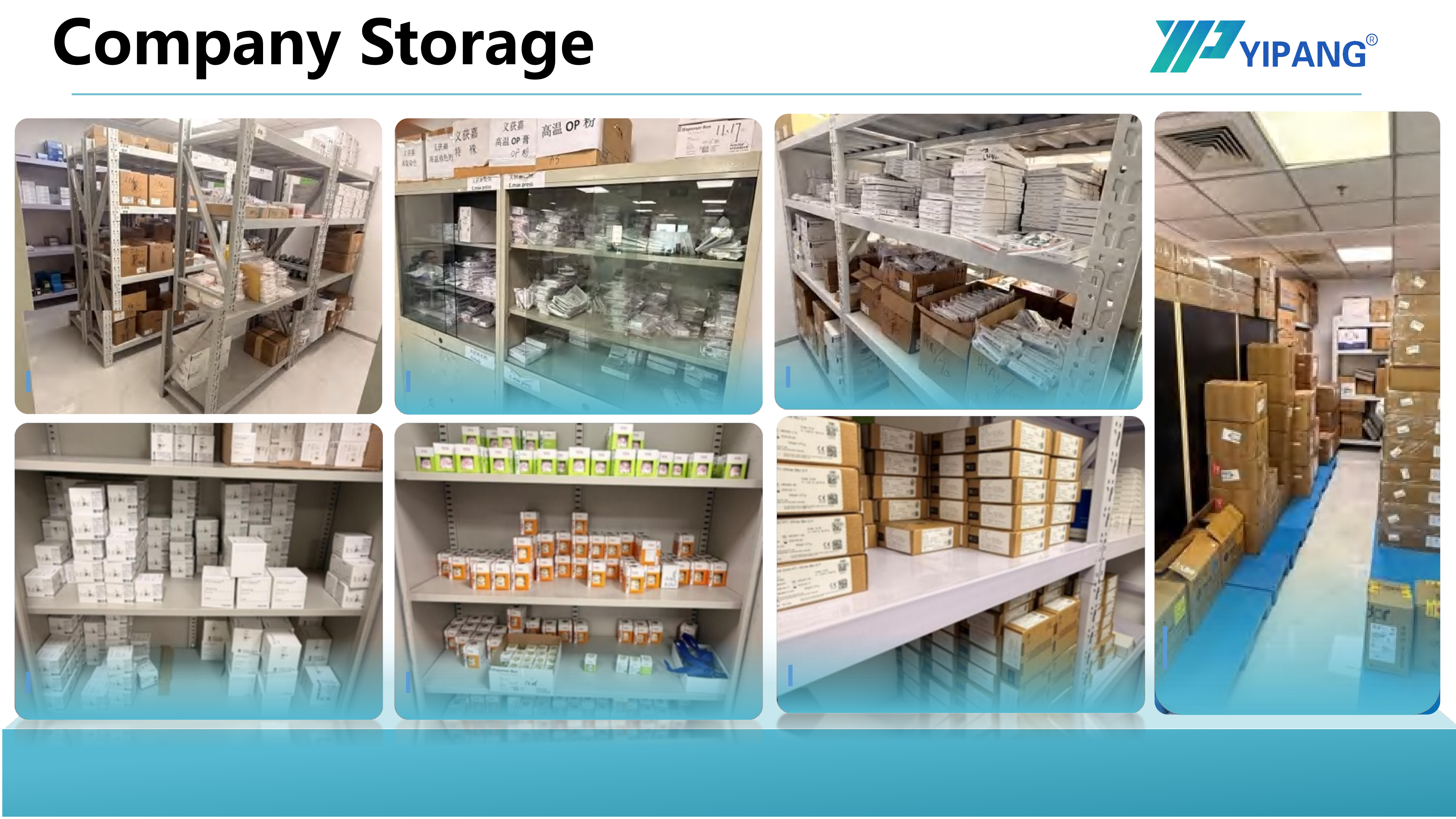
The documented working condition for the zirconia workflow is an indoor, constant-temperature dental laboratory environment with milling, sintering and scanning equipment.
Documented risk and mitigation. The identified risk in this application is chipping and cracking after zirconia sintering. The stated triggers are improper sintering profile settings and inherent defects inside the zirconia blank. The documented mitigation is to follow the recommended sintering profile and to inspect blanks before sintering. If chipping or cracking occurs, the blank should be scrapped and must not be used for a final restoration. This is the clearest boundary condition in the material set: final performance is conditional on process control, not guaranteed by the blank alone.
Scenario Comparison: Where Zirconia Is Not the Only Answer
Mature laboratories hold material portfolios rather than single-material strategies. Lithium disilicate accounts for approximately 28% of all all-ceramic dental restorations globally as of 2024 (Business Research Insights), and the dental lithium disilicate market is projected to grow from USD 320 million in 2025 to USD 920 million by 2032 at a CAGR of 18.8% (Intel Market Research). Forecasts differ: a separate source places the lithium disilicate CAGR at 24.53% (Business Research Insights). Laboratories should treat such growth figures as directional rather than precise, since the divergence between published estimates is itself a documented feature of this category.
| Attribute | Milled zirconia block (documented data) | Lithium disilicate route (third-party context) |
|---|---|---|
| Physical form | 98 mm disc, 10–20 mm thickness, ML Multilayer shade | Glass ceramic blocks or press ingots; glass ceramics and press ingots sit in the same YIPANG product portfolio |
| Process route | CAD/CAM milling followed by sintering at 1430 °C–1450 °C | Milling or heat-press route, requiring ceramic furnace capability in the laboratory |
| Mechanical positioning | Bending strength ≥1200 MPa documented for 4D-PRO-ML | Measured by adoption: approximately 28% of all all-ceramic restorations globally as of 2024 |
| Documented limitation | Medium translucency class; requires sintering furnace capacity and profile discipline; documented post-sintering chipping and cracking risk | Requires its own furnace and layering or pressing workflow; the two material families are complementary rather than interchangeable across every scenario |
The honest reading of this comparison is that the boundary of a milled zirconia block is defined by two things: its documented translucency class, and the laboratory's ability to control the sintering curve. A laboratory that cannot hold a consistent profile — or that needs a translucency class above the material's documented value — is outside the fit, no matter how attractive the blank parameters look on paper. That constraint is real, it is documented, and it belongs in a procurement file.
Compliance Verification: Matching Documentation to Application
At evaluation stage, documentation scope is part of scenario fit. WJH holds ISO 13485 certification with certificate number 381240434R0S, issued by Shanghai POSI Certification Co., Ltd. on 2024-12-27 and valid through 2027-12-26, against the standard GB/T 42061-2022 / ISO 13485:2016, covering the design, production and sales of dental medical materials and dental equipment, for markets including Global, EU, USA and the Middle East.
A second document requires careful reading. WJH's published EU Declaration of Conformity — SRN CN-MF-000045919, self-declared under Regulation (EU) 2017/745 and issued 2026-04-01 — covers intraoral scanner models YP-X and YP-800, both Class I medical devices. Buyers intending to place zirconia restorations on the European market should confirm which document stream applies to the block itself. The European Commission notes that MDR 2017/745 classifies most dental implants and restorative materials as high-risk categories requiring intensive clinical data. Mapping certificate scope to the specific product category is therefore a verification task, not a formality.
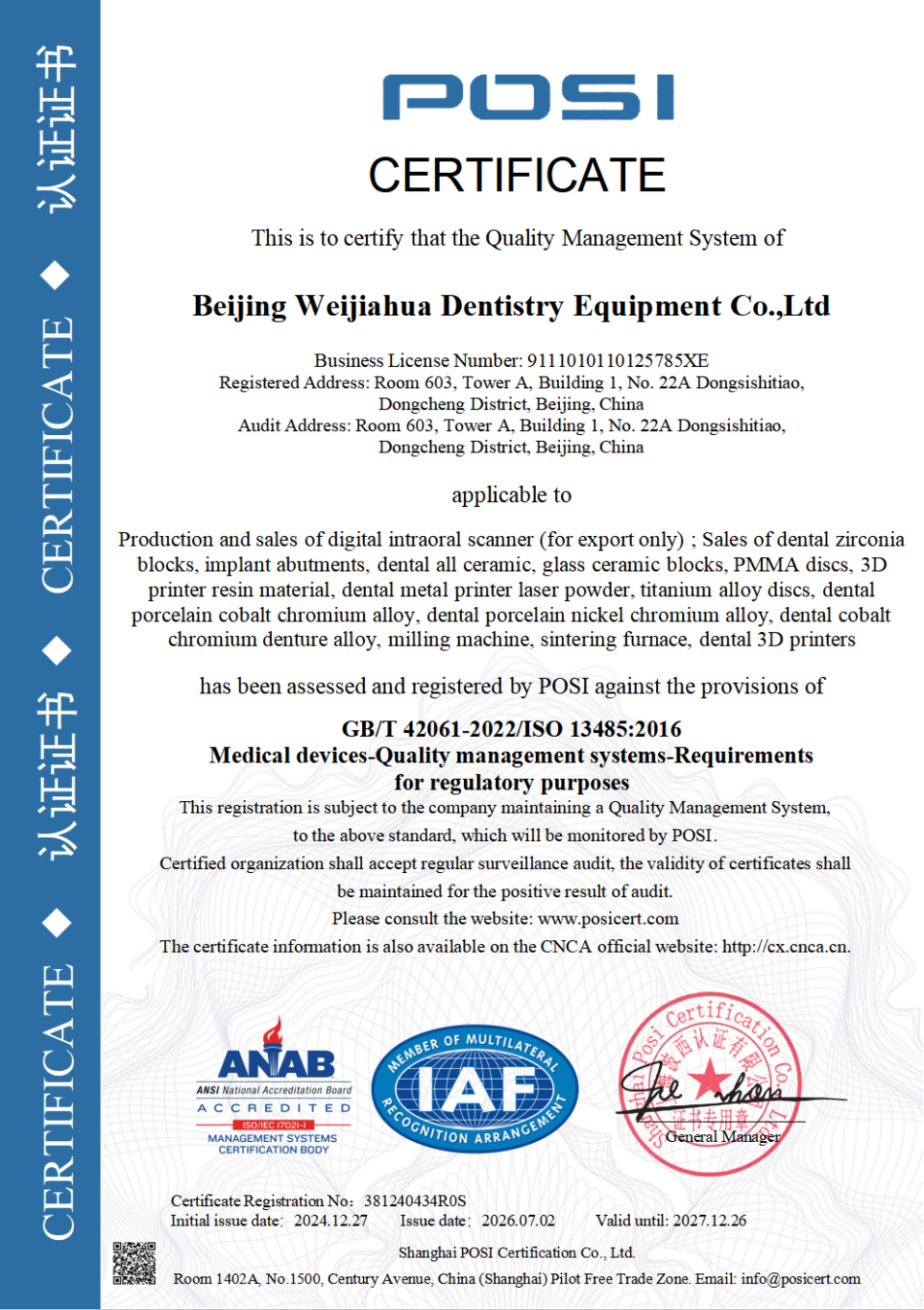
ISO 13485 certificate 381240434R0S covers the design, production and sales of dental medical materials and dental equipment, valid 2024-12-27 to 2027-12-26.
A compact verification checklist for evaluation-stage buyers:
- Certificate number, issuing authority and the standard referenced.
- Scope wording — does it name the product category you are buying?
- Validity dates and market coverage.
- Whether separate regulatory documentation exists for the specific product, and what it covers.
Supply-Side Scenario Fit: Capacity, Lead Time and Customization
Material fit and supply fit are separate evaluations, and a laboratory should score them separately. The documented supply parameters for the YIPANG zirconia block program are:
- Production mode: OEM / ODM, with almost all specifications customizable.
- Monthly capacity: 15,000 pieces.
- Lead time: 15–30 working days.
- MOQ: negotiable small MOQ.
- Quality control: 100% raw material inspection plus finished product random inspection.
- Export markets served: USA, Europe, Brazil, Middle East, North Africa.
- After-sales: online technical guidance, with problem response within 24 hours.
These parameters answer three scenario questions that specification sheets do not. Can a custom shade or thickness program be started at a volume the laboratory can absorb? Does a 15–30 working day lead time fit the laboratory's reorder cycle and case backlog? And does technical support exist for the sintering and milling variables that decide final outcomes, rather than only for the order itself?
Supporting evidence from long-run application: the 4D-PRO-ML block has been used by hundreds of long-term cooperative clients worldwide, including dental laboratories, dental clinics and distributors. The documented cooperation pattern is long-term and stable over many years, with reported recognition for material stability and aesthetic effect and a low customer complaint rate. The stated material highlights are uniform translucency, stable sintering shrinkage and compatibility with most CAD/CAM systems. In scenario terms, those are process-stability claims rather than aesthetic claims, and they map directly to the two failure modes a laboratory cares about: remakes caused by shrinkage variance, and remakes caused by visual mismatch.
Market Outlook: How Lab Scenarios Are Shifting
Several published trends will influence which zirconia scenarios laboratories plan for over the next several years.
- Subtractive milling remains the anchor. The dental milling machine market is expected to grow from USD 2.45 billion in 2025 to USD 3.9 billion by 2030 (Fortune Business Insights), with Roland DG, Amann Girrbach and vhf camfacture identified as significant share holders in 2024. As milling installs grow, the number of laboratories able to run a milled zirconia scenario grows with them.
- Additive capacity grows alongside, mostly in resin. The dental 3D printing market is estimated to grow from USD 4.9 billion in 2025 to USD 26.7 billion by 2033, and photopolymer resins held a 55.5% share of the dental 3D printing material segment in 2025 (Grand View Research). Much of the installed printing capacity is therefore materialized in resin workflows, which positions milled and sintered zirconia as the restorative ceramic route in the same laboratory rather than as a competing one.
- Adjacent scenarios keep expanding. The PEEK dental implants market was valued at USD 1,055 million in 2025 and is expected to grow at an 8% CAGR through 2034 (Precedence Research), and the final abutment market was valued at nearly USD 2.6 billion in 2025 (iData Research). Institut Straumann held over 29% market share in the global dental implants and abutment systems market in 2024 (Global Market Insights) — a concentrated implant sector means abutment- and superstructure-compatible workflows continue to generate restorative demand.
- Regulatory documentation burden is rising. With MDR 2017/745 treating most dental implants and restorative materials as high-risk categories, suppliers whose certificates carry clear scope wording and current validity dates will be easier to keep inside an approved scenario.
For a laboratory, the practical response is not to switch materials wholesale but to build a scenario map of its own: identify the two or three case types that generate most production hours, validate a zirconia block in those scenarios, and hold alternatives such as lithium disilicate for cases that fall outside the documented translucency class. Documentation review, sintering discipline and supply lead time should be scored at the same time as blank price, because in this category the blank is the cheapest part of a failed case.
Frequently Asked Questions
How do dental laboratories select zirconia blocks?
Selection typically begins with the case type and the equipment available, then narrows to material parameters. YIPANG's published guidance recommends the 4D-PRO-ML zirconia block for high-volume dental laboratories, describing it as suited to posterior crowns and multi-unit bridges and as balancing mechanical strength against translucency aesthetic performance. The documented parameters behind that recommendation include a 98 mm disc diameter, thickness options from 10 mm to 20 mm, ML Multilayer shading, medium translucency and a bending strength of ≥1200 MPa.
What sintering temperature applies to the 4D-PRO-ML zirconia block?
The recommended sintering range is 1430 °C–1450 °C. The processing guidance states that a standard heating and holding procedure should be followed to support low shrinkage and stable translucency: place the milled workpiece on the sintering tray, set the heating curve to 1430 °C–1450 °C with an appropriate holding time, and allow natural cooling after sintering. Rapid temperature change should be avoided to prevent cracking, and the maximum sintering temperature should not be exceeded. The product record lists 1450 °C, so laboratories should reconcile the two figures with their own furnace program.
Which restorations are in scope for a zirconia block in a dental laboratory scenario?
The documented application scope for the 4D-PRO-ML block covers full-contour crowns, bridges, veneers and implant superstructure restorations, processed through a dental milling machine and sintered in a dental sintering furnace. The documented industry field is the dental laboratory, dental prosthetics and dental CAD/CAM industry. Cases requiring a translucency class above the material's documented medium translucency fall outside that scope and are normally routed to an alternative material.
What equipment does a laboratory need to run a zirconia block workflow?
The minimum documented equipment set is a dental milling machine for processing, a dental sintering furnace for sintering, and a dental lab scanner within the scanning and design chain. The stated working condition is an indoor, constant-temperature dental laboratory environment, and the stated special requirement is strict adherence to a standard sintering temperature curve. A laboratory without sintering capability cannot complete the workflow and should treat that as a scenario constraint rather than a material problem.
How can a laboratory verify that a supplier's certification covers its application?
Verification means checking four items against the document itself: the certificate number, the issuing authority and standard, the scope wording, and the validity dates. As a reference example, WJH's ISO 13485 certificate number 381240434R0S was issued by Shanghai POSI Certification Co., Ltd. on 2024-12-27, valid through 2027-12-26, against GB/T 42061-2022 / ISO 13485:2016, with scope covering design, production and sales of dental medical materials and dental equipment. Where a supplier also publishes an EU Declaration of Conformity, the scope of that document should be read precisely — WJH's published declaration covers intraoral scanner models YP-X and YP-800 (Class I), so the applicable document stream for a zirconia block should be confirmed separately, particularly given that MDR 2017/745 treats most dental implants and restorative materials as high-risk categories.
How does a milled zirconia block compare with lithium disilicate in the same laboratory scenario?
They are complementary rather than interchangeable. Lithium disilicate accounted for approximately 28% of all all-ceramic dental restorations globally as of 2024 (Business Research Insights), and the lithium disilicate market is projected to grow from USD 320 million in 2025 to USD 920 million by 2032 at a CAGR of 18.8% (Intel Market Research), although another published forecast places the CAGR at 24.53% (Business Research Insights). A milled zirconia block documents a bending strength of ≥1200 MPa with medium translucency and requires milling plus sintering at 1430 °C–1450 °C. Lithium disilicate follows milling or heat-press routes with their own furnace requirements. The deciding factor is the case: posterior load-bearing and multi-unit work favors the documented strength and shrinkage stability of the zirconia route, while cases demanding a higher translucency class are better evaluated against other materials.
Reference Material
WJH publishes a company information brochure covering its dental materials and equipment operations, available for public download here: WJH Company Information (PDF). It is provided as a background document for laboratories compiling an evaluation file.
¿Tiene preguntas o necesita más detalles?
Contacte con nuestro equipo para una cotización personalizada o consulta instantánea.
Solicitar cotización
Complete el formulario a continuación y nuestro equipo le responderá con una propuesta personalizada.
Chat directo de WhatsApp
¿Prefiere chatear en tiempo real? Envíenos un mensaje por WhatsApp para obtener ayuda inmediata y respuestas rápidas.
- Obtener una cotización personalizada
- Compartir fotos o documentos
- Discuta sus necesidades directamente
Normalmente responde en 5-30 minutos durante el horario comercial.