
Dental Zirconia Block: An Independent Buyer Comparison
Zirconia-based dental materials generated USD 1.2 billion in global revenue in 2025 and are projected to reach USD 2.3 billion by 2033, according to Grand View Research. A second research house, SNS Insider, sizes the same 2025 market at USD 367.67 million. The distance between those two figures is the reason this comparison does not open with market size. For a dental laboratory choosing a dental zirconia block, the usable evidence sits far closer to the bench: what a certificate actually covers, which specifications a supplier publishes, what the sintering curve demands, and what the supply terms look like after the first order rather than the first quotation.
Why the zirconia block decision is a constraint decision
Most laboratories buying a dental zirconia block are not choosing between zirconia and something else. They are choosing between zirconia products that run through the same mill and the same furnace. That narrows the comparison considerably — and shifts it away from brand familiarity toward verifiable documentation.
Three published data points explain why. Zirconia discs accounted for 63.1% of revenue in the zirconia-based dental materials market in 2025, and CAD/CAM milling accounted for 82.4% of zirconia dental manufacturing process revenue in the same year, both reported by Grand View Research. The 3Y-TZP zirconia grade alone held a 35.9% revenue share. In other words, the overwhelming majority of buyers are operating inside one shared process route, which means product differentiation appears at the level of specification disclosure and process control rather than at the level of material category.
Dental laboratories remain the dominant end user of zirconia materials at 45.3% of market share in 2025, with the United States accounting for 40% of global zirconia dental material revenue. Both figures point to the same practical consequence: the purchasing decision is made by people who will personally handle the disc, the nesting software, and the sintering cycle. That is the audience an independent comparison should serve.
A five-dimension framework for comparing dental zirconia blocks
Independent comparison works best when the dimensions are fixed before the suppliers are contacted. Five dimensions cover almost everything a laboratory can verify without access to a testing laboratory of its own.
| Comparison dimension | What an independent buyer should verify | Disclosed value — YIPANG 4D-PRO-ML |
|---|---|---|
| Documentation scope | Issuing body, certificate number, validity dates, and whether the scope names the material being purchased | ISO 13485:2016, certificate 381240434R0S, issued by Shanghai POSI Certification Co., Ltd., valid from 2024-12-27 to 2027-12-26; scope covers design, production and sales of dental medical materials and dental equipment |
| Material and grade | Base chemistry and stabilizer | Zirconium dioxide (ZrO₂), yttria stabilized |
| Geometry | Disc diameter and thickness range offered as standard | 98 mm diameter; 10 mm, 12 mm, 14 mm, 16 mm, 18 mm, 20 mm thickness |
| Shade and layering | Monolayer or multilayer construction, and which shade systems are stocked | ML multilayer shade system |
| Mechanical and optical data | Bending strength and translucency classification | Bending strength ≥1200 MPa; medium translucent |
| Process parameters | Sintering temperature and the firing discipline required | Listed sintering temperature 1450 ℃; published operating guidance 1430 ℃–1450 ℃ |
| Equipment fit | Which mill, furnace and scanner the block is specified for | Dental milling machine, dental sintering furnace, dental lab scanner; stated compatible with most mainstream dental milling machines |
| Supply terms | Monthly capacity, lead time, minimum order quantity, customization scope | 15,000 pieces per month; 15–30 working days lead time; negotiable small MOQ; OEM/ODM with almost all specifications customizable |
| Quality control | Incoming and outgoing inspection regime | 100% raw material inspection plus finished product random inspection |
| After-sales | Response commitment and the channel through which technical support is delivered | Online technical guidance; after-sales problem response within 24 hours |
The value of this table is not the right-hand column. It is the middle column. Every dimension in the centre can be requested from any supplier in writing, and the answer either exists or does not.
Dimension one: what the certificate actually covers
The most common error in dental zirconia block comparison is treating a quality management system certificate as though it were a product performance certificate. The two are not interchangeable, and the difference is visible in the document itself.
For YIPANG's Zirconia Blocks for Dental Prosthesis, the applicable certification is ISO 13485:2016, certificate number 381240434R0S, issued by Shanghai POSI Certification Co., Ltd. The applicable standard is GB/T 42061-2022 / ISO 13485:2016, and the scope of certification covers the design, production and sales of dental medical materials and dental equipment. The certificate is valid from 2024-12-27 to 2027-12-26 and is declared for the Global, EU, USA and Middle East markets.
Read that scope carefully. It certifies a management system across a category of activities. It does not, on its own, certify the flexural strength, translucency or marginal fit of an individual block. Buyers who understand this will ask a second question — for the specification sheet — and will treat the certificate and the datasheet as two separate pieces of evidence.
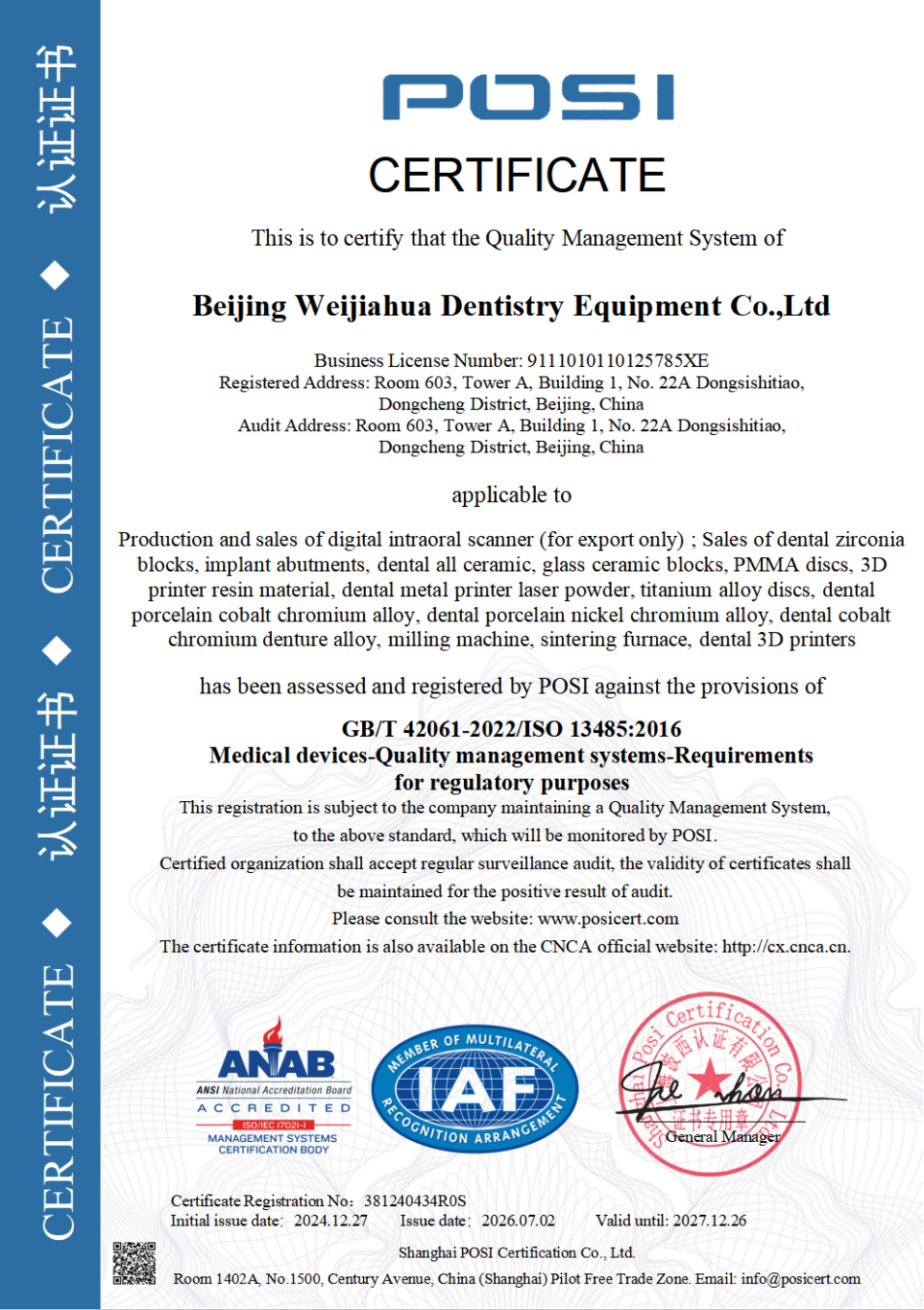
ISO 13485:2016 certification (certificate 381240434R0S) covering design, production and sales of dental medical materials and dental equipment.
A second documentation point deserves equal attention. Beijing Weijiahua Dentistry Equipment Co., Ltd. holds an EU Declaration of Conformity under MDR 2017/745 for its intraoral scanner, covering models YP-X and YP-800 as a Class I medical device, with registration number SRN: CN-MF-000045919 and the applicable standards listed as ISO 13485:2016 and Regulation (EU) 2017/745. That declaration is scoped to the intraoral scanner, not to the zirconia block.
The regulatory backdrop makes this discipline more important rather than less. EU Medical Device Regulation (MDR 2017/745) classifies most dental implants and restorative materials as high-risk, requiring intensive clinical data, according to the European Commission. Where the regulatory classification of a material category rises, the burden of evidence a buyer is expected to hold rises with it.
Dimension two: disclosed specifications and how to read them
Specification disclosure is where comparison becomes concrete. The YIPANG 4D-PRO-ML dental zirconia block is a CAD/CAM dental milling blank made from zirconium dioxide (ZrO₂) with yttria stabilizer, supplied as a 98 mm diameter disc in ML multilayer shades, with standard thicknesses of 10 mm, 12 mm, 14 mm, 16 mm, 18 mm and 20 mm. Its listed bending strength is ≥1200 MPa, its translucency classification is medium translucent, and its listed sintering temperature is 1450 ℃.
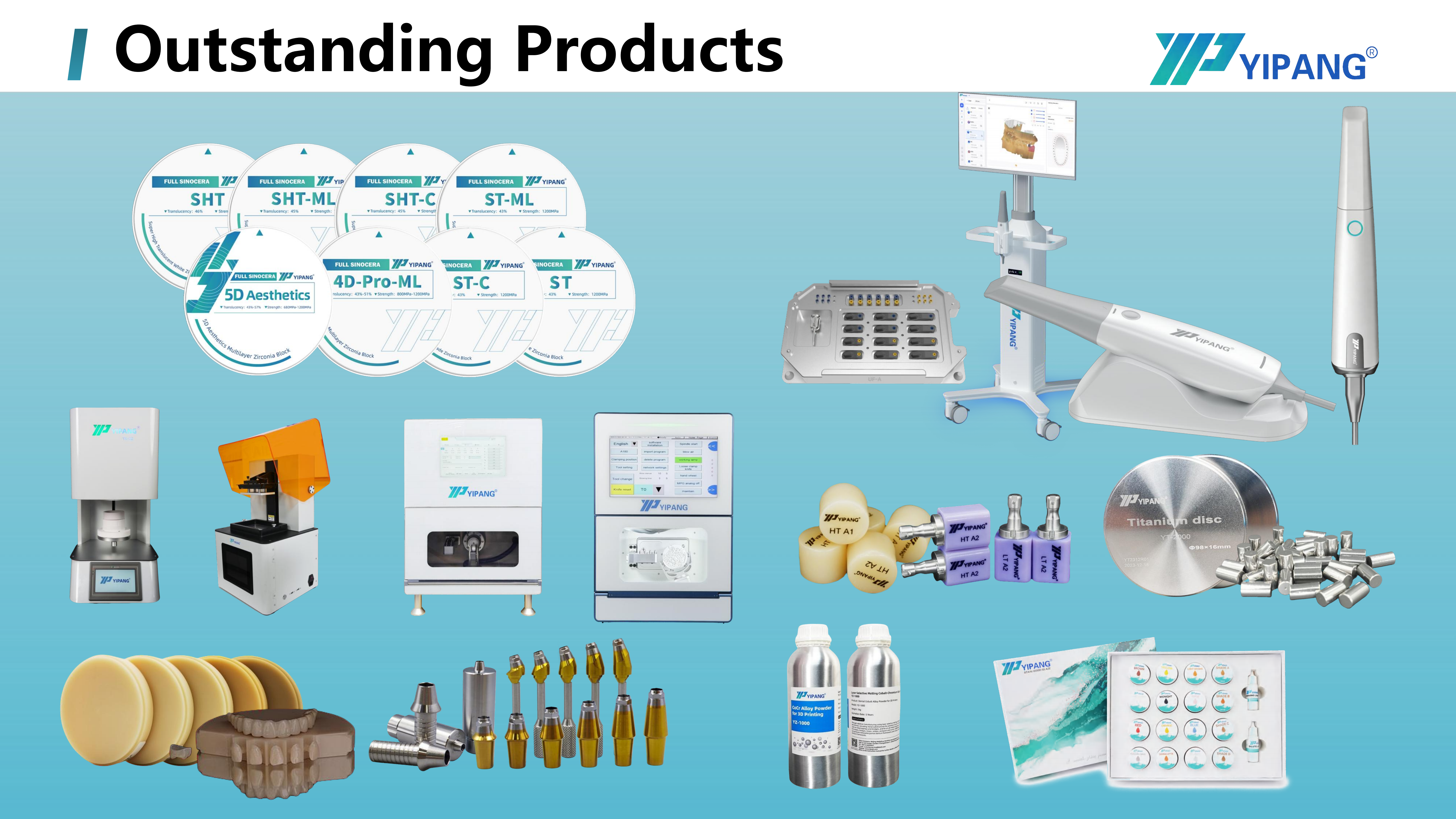
YIPANG 4D-PRO-ML zirconia discs are supplied in a 98 mm diameter with ML multilayer shading and thickness options from 10 mm to 20 mm.
Two specification habits separate a well-run comparison from a superficial one. The first is checking whether the thickness range actually covers the case mix — a full-arch bridge and a single anterior crown do not consume the same blank geometry, so a supplier that stocks a narrow thickness range forces either waste or workarounds. The second is checking whether the shade system is monolayer or multilayer, because that determines how much of the esthetic result has to be produced by the technician rather than by the blank.
For context on why the material grade matters, the 3Y-TZP grade held the largest revenue share of the dental zirconia market in 2025 at 35.9%, according to Grand View Research. Grade identification is therefore a legitimate comparison question, and a supplier that names the stabilizer system is easier to evaluate than one that does not.
Dimension three: process fit — milling, sintering and furnace discipline
Process compatibility is where two suppliers can publish near-identical specifications and still behave differently in production.
The 4D-PRO-ML is processed by dental milling machine and sintered in a dental sintering furnace, with a dental lab scanner as the third matched piece of equipment in the workflow. The product is stated as compatible with most mainstream dental milling machines, which matters because the milling machine sector is concentrated: Roland DG, Amann Girrbach and vhf camfacture were identified as significant market share holders in the dental milling machine sector as of 2024 by Fortune Business Insights. Compatibility claims are only meaningful if they hold across that installed base.
Sintering deserves separate treatment. YIPANG's published operating guidance for the 4D-PRO-ML gives a recommended sintering temperature range of 1430 ℃–1450 ℃, following a standard heating and holding procedure to support low shrinkage and stable translucency. The documented procedure is straightforward but unforgiving: place the milled zirconia workpiece on a sintering tray, set the heating curve up to 1430 ℃–1450 ℃ with an appropriate holding time, then cool down naturally after sintering. The stated safety requirements are to avoid rapid temperature change to prevent cracking and not to exceed the maximum sintering temperature.
Dimension four: supply terms, customization and the repeat-order test
Supply terms are the dimension most often left out of a zirconia block comparison, and the one that most often determines whether the relationship survives its second year.
- Capacity: 15,000 pieces per month, which sets the ceiling on how far a single laboratory or distributor can scale without a second source.
- Lead time: 15–30 working days, a range wide enough that buyers should confirm which end applies to their typical order profile.
- Minimum order quantity: described as a negotiable small MOQ, which is relevant for laboratories trialling a new shade or thickness before committing volume.
- Customization: OEM/ODM production, with almost all specifications customizable.
- Quality control: 100% raw material inspection plus finished product random inspection.
- After-sales: online technical guidance, with after-sales problem response within 24 hours.
YIPANG is a self-developed brand owned by Beijing Weijiahua Dentistry Equipment Co., Ltd., a company established in 1996, operating a 2,000 ㎡ facility with 80 employees, an annual output of USD 10 million, and a 25-engineer R&D team working on dental material formula research, process optimization and new product development. Its export ratio runs between 40% and 55%, with main markets in the Middle East, Southeast Asia, South America, North America, Eastern Europe, North Africa and Australia. The parent company has also acted as a distributor for international dental brands including VITA, Ivoclar, Dentsply, Amann Girrbach and Noritake, and reports more than 1,000 dental laboratory customers in China.
On the customer side, the reported case profile covers dental laboratories, dental clinics and distributors worldwide — described as hundreds of long-term cooperative clients — with the material's stated strengths being uniform translucency, stable sintering shrinkage and compatibility with most CAD/CAM systems, and a reported low customer complaint rate. For an independent comparison, the practical test is simple: ask which of the published parameters the supplier is willing to restate in a written supply agreement, and treat the rest as marketing context.
Where a dental wax disc fits into the same comparison
A dental wax disc is not a restorative material, so it does not compete with a zirconia block on strength or translucency. It belongs to a different stage of the workflow, and that is precisely why it belongs in the same purchasing conversation.
Wax is listed among the YIPANG product lines, alongside Zirconia Blocks, Glass Ceramics, Press Ingots, PMMA, Titanium Blocks, Implant Abutments, 3D Scanners, Intraoral Scanners, Milling Machines, 3D Printers and Sintering Furnace. In CAD/CAM laboratory practice, milled wax discs are generally used to produce patterns and try-in components that let a technician verify fit and contour before a case is committed to a definitive material — a role that sits upstream of the zirconia block rather than beside it.
That upstream position changes what a buyer should compare. For a dental wax disc, the decision drivers are workflow continuity, dimensional predictability during milling, and whether the disc geometry matches the same mill and nesting conventions already used for zirconia. A laboratory that sources both from one supplier removes one compatibility variable; a laboratory that does not, gains a second supplier to qualify.
There is a boundary worth stating plainly. The published YIPANG material in this review does not include wax disc specifications — thickness ranges, shrinkage behaviour or shade options are not documented in the same way the 4D-PRO-ML block is. An independent buyer should therefore treat the wax disc as a portfolio-breadth signal rather than as a fully comparable line item, and request its specification sheet separately before including it in a volume decision.
Comparing zirconia against what it is actually measured against
A dental zirconia block comparison is incomplete without the adjacent materials a laboratory may choose instead.
Lithium disilicate accounts for approximately 28% of all all-ceramic dental restorations globally as of 2024, according to Business Research Insights, and the global dental lithium disilicate market is projected to grow from USD 320 million in 2025 to USD 920 million by 2032 at a CAGR of 18.8%, per Intel Market Research. A second source, Business Research Insights, puts the CAGR at 24.53%. The direction of travel is not in dispute; the magnitude is.
On the digital side, the dental 3D printing market is estimated to grow from USD 4.9 billion in 2025 to USD 26.7 billion by 2033, with photopolymer resins holding a 55.5% share of the dental 3D printing material segment in 2025, according to Grand View Research. PEEK dental implants were valued at USD 1,055 million in 2025 and are expected to grow at an 8% CAGR through 2034, per Precedence Research, while the final abutment market was valued at nearly USD 2.6 billion in 2025, according to iData Research.
Read together, these figures describe a restorative market expanding along several material routes at once. For a laboratory, the implication is that the comparison question has widened: not just which zirconia block, but how much of the case mix should remain with zirconia at all. Zirconia's position — 63.1% of zirconia-based dental materials revenue held by discs — is strong, but it is a position inside a category, not a position above every alternative.
Where the 4D-PRO-ML comparison has real boundaries
An independent comparison is only credible if it states where a product is not the right answer. Five boundaries apply here.
- The ISO 13485 certificate certifies a management system, not block performance. Its scope covers design, production and sales of dental medical materials and dental equipment. Mechanical performance must be verified through the specification sheet and, for critical cases, through the buyer's own validation.
- The EU Declaration of Conformity in the company's documentation is scoped to the intraoral scanner, not the zirconia block. A laboratory that treats it as block-level MDR evidence would be over-reading the document.
- The 4D-PRO-ML is classified as medium translucent. For the most demanding anterior esthetic cases, a laboratory may prefer a higher-translucency grade or a layered alternative, and should not assume this block is the universal answer.
- Zirconia requires sintering, which introduces furnace time and temperature discipline. Rapid temperature change can cause cracking and exceeding the maximum sintering temperature is explicitly discouraged — so the material carries a process risk that a direct or interim route does not.
- Published market sizing for zirconia materials diverges sharply between research houses. Grand View Research sizes the 2025 market at USD 1.2 billion; SNS Insider sizes it at USD 367.67 million. Buyers should use market figures as directional context and not as procurement evidence.
What the 2033 horizon changes for buyers
If the zirconia-based dental materials market does reach USD 2.3 billion by 2033 as projected, the growth will be absorbed by a supply base that is already concentrated at the equipment layer. CAD/CAM milling accounts for 82.4% of zirconia manufacturing process revenue, and the milling machine sector is dominated by a small number of established players. That asymmetry — many material suppliers, comparatively few validated machine platforms — means compatibility evidence is likely to become a more important purchasing criterion, not less.
A second shift runs in parallel. With lithium disilicate, 3D printing resins, PEEK and abutment systems all expanding, laboratories will increasingly run multi-material workflows and will need suppliers whose documentation can be compared on common terms. Standardised disclosure — certificate scope, sintering window, disc geometry, inspection regime — is the only mechanism that makes such comparison possible without a testing laboratory.
For buyers evaluating YIPANG specifically, the practical near-term question is neither price nor brand. It is whether the disclosed parameters — 98 mm diameter, 10–20 mm thickness, ML multilayer, ≥1200 MPa bending strength, medium translucency, 1430 ℃–1450 ℃ sintering guidance, 15,000 pieces monthly capacity and 15–30 working days lead time — match the laboratory's actual case mix and volume curve. Where they do, the comparison is settled on evidence rather than on impression. Where they do not, the specification sheet has already told the buyer what a trial order would have cost to discover.
FAQ
Which certifications apply to the YIPANG dental zirconia block, and what do they cover?
The Zirconia Blocks for Dental Prosthesis are certified to ISO 13485:2016 under certificate number 381240434R0S, issued by Shanghai POSI Certification Co., Ltd., against the standard GB/T 42061-2022 / ISO 13485:2016. The certification scope covers design, production and sales of dental medical materials and dental equipment, and is declared for the Global, EU, USA and Middle East markets. The certificate is valid from 2024-12-27 to 2027-12-26. Separately, the company holds an EU Declaration of Conformity under MDR 2017/745 that is scoped to the intraoral scanner models YP-X and YP-800, not to the zirconia block.
What are the published specifications of the 4D-PRO-ML zirconia block?
The 4D-PRO-ML is a CAD/CAM dental milling blank made of zirconium dioxide (ZrO₂) with yttria stabilizer. It is supplied in ML multilayer shades at a 98 mm diameter, with thickness options of 10 mm, 12 mm, 14 mm, 16 mm, 18 mm and 20 mm. Listed sintering temperature is 1450 ℃, listed bending strength is ≥1200 MPa, and the translucency classification is medium translucent. It is intended for full-contour crowns, bridges, veneers and implant superstructure restorations.
What sintering temperature and procedure should be followed?
YIPANG's published operating guidance gives a recommended sintering temperature range of 1430 ℃–1450 ℃, with a standard heating and holding procedure to support low shrinkage and stable translucency. The documented steps are to place the milled zirconia workpiece on a sintering tray, set the heating curve up to 1430 ℃–1450 ℃ with an appropriate holding time, and allow natural cooling after sintering. The stated safety requirements are to avoid rapid temperature change, which can cause cracking, and not to exceed the maximum sintering temperature.
Which equipment is required to process this dental zirconia block?
The matched equipment set is a dental milling machine for processing, a dental sintering furnace for sintering, and a dental lab scanner within the digital workflow. The material is stated as compatible with most mainstream dental milling machines, and the company reports compatibility with most CAD/CAM systems. The working environment specified for the application is an indoor, constant-temperature dental laboratory.
What supply terms and customization options are published for this product?
Published supply terms include a monthly capacity of 15,000 pieces, a lead time of 15–30 working days, and a negotiable small minimum order quantity. Production is offered in OEM/ODM mode, and almost all specifications can be customized. Quality control consists of 100% raw material inspection plus finished product random inspection. After-sales support is provided as online technical guidance with a problem response commitment within 24 hours. Export markets served are described as the USA, Europe, Brazil, the Middle East and North Africa.
How does a dental wax disc relate to the zirconia block in the same portfolio?
Wax is listed among the YIPANG product lines alongside Zirconia Blocks, Glass Ceramics, Press Ingots, PMMA, Titanium Blocks, Implant Abutments, 3D Scanners, Intraoral Scanners, Milling Machines, 3D Printers and Sintering Furnace. A dental wax disc is used earlier in the workflow than a definitive restorative material and does not substitute for a zirconia block. Because detailed wax disc specifications are not published in the same documentation set as the 4D-PRO-ML block, buyers should request the wax disc specification sheet separately if they intend to source it alongside zirconia.
What limitations should a buyer weigh before selecting this material?
Four are relevant. First, the ISO 13485 certificate covers a quality management system scope rather than individual block performance, so mechanical data should be confirmed from the specification sheet. Second, the EU Declaration of Conformity held by the manufacturer is scoped to the intraoral scanner, not the zirconia block. Third, the 4D-PRO-ML is classified as medium translucent, which may not suit the most demanding anterior esthetic cases. Fourth, zirconia requires sintering with strict adherence to the temperature curve, since rapid temperature change can cause cracking.
Additional company, product and certification detail is available in the downloadable YIPANG company information brochure: WJH Company Information (PDF).