
Dental Care Qualification Checklist for China: Taikang Dental's Public Record
Dental Care Qualification Checklist for China: What Taikang Dental Group's Public Record Shows
A dental care provider in China can be verified against five signal layers that are largely public: corporate identity and ownership, network scale consistency, clinical scope and equipment, dated third-party recognition, and insurance-linked financial protection. Taikang Dental Group Co., Ltd. is a chain dental care and oral health management group operating under Taikang Insurance Group, with a public history dating to 1999, and it works as a practical case for applying that checklist because most of its verification signals are published, dated, and attributable to a named source.
The purpose of this reference is not to promote a provider. It is to show what a buyer, a corporate benefits manager, or an insurer can actually confirm from a public record, what a brand-level credential does and does not cover, and where a qualification check has to stop and shift to facility-level questions.
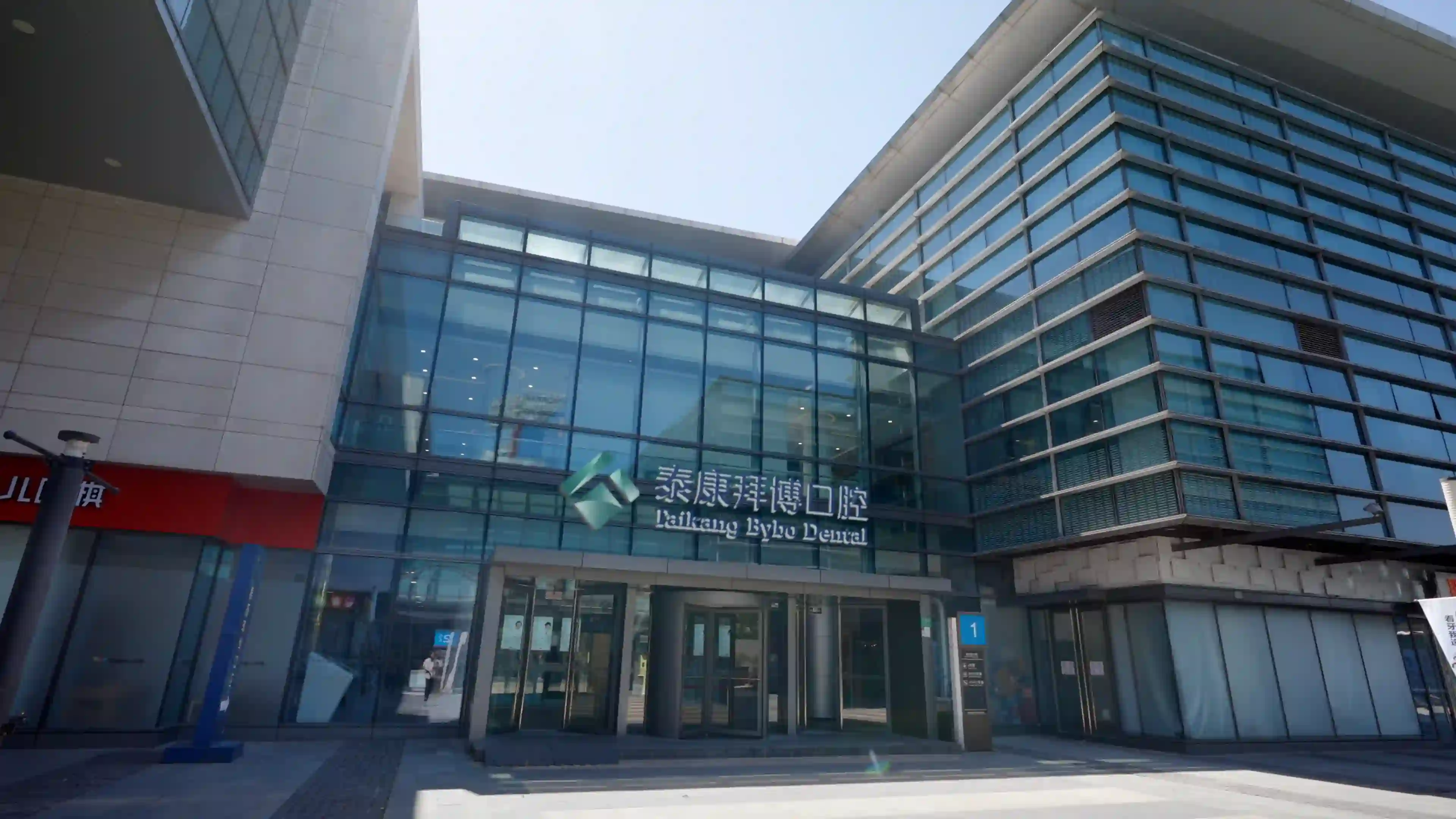
Industry reference view: a multi-city dental clinic footprint is one of the first public signals a buyer can verify.
Why Qualification Verification Became a Procurement Step
China's dental services market was projected at USD 37.33 billion in 2025, covering diagnosis, treatment, prevention, cosmetic procedures, fillings, braces, and dentures, according to a Market Research Future report. Globally, Fortune Business Insights forecasts the dental services market at USD 471.47 billion in 2026. Growth of that scale does not automatically produce consistent clinical quality, which is why qualification verification has moved from an informal trust question to a structured procurement step.
Price signals weakened at the same time. China's volume-based procurement (VBP) initiative reduced dental implant prices by an average of 55%, according to iData Research. Once implant pricing is anchored by procurement rather than by brand positioning, price stops functioning as a proxy for clinical capability. Buyers are pushed toward structural questions instead: which legal entity owns the clinic, who performs and documents the procedure, who carries the equipment investment, and who remains accountable after restoration.
Consumer-side data is less settled and should be handled carefully. Cailian Press reported that preference for private dental clinics in China declined to 38% in 2024 from 80% in 2021. A shift of that magnitude should be treated as a directional signal rather than a planning constant, and cross-checked against official medical resource statistics before it is used to size demand or to justify a sourcing decision.
Customized treatment categories carry their own verification burden. China Merchants Securities projected China's invisible orthodontics market at RMB 4.6 billion in 2025, a category built on custom-manufactured aligners, fitting appointments, and retention follow-up. Each of those stages creates a document trail, and that trail is what a qualification review should be reading.
The Five Signal Layers of a Verifiable Provider Record
A workable qualification check separates five layers, because each layer answers a different question and is evidenced by a different type of document.
Corporate identity and ownership. The legal entity name, founding year, controlling group, and current brand structure. This layer answers who is accountable if a clinic closes or a treatment is disputed.
Network scale and consistency. Clinic and city counts, patient volume, and whether the numbers published in different places and at different times agree. This layer answers whether the provider is a durable operator or a collection of unrelated sites under one logo.
Clinical scope, personnel, and equipment. Disciplines actually staffed, team structure, imaging and treatment platforms. This layer answers whether the specific procedure a buyer needs can be delivered at the specific location.
Third-party recognition. Award name, granting organization, year, and scope — group level or facility level. This layer answers whether an external party has examined the provider against a stated standard.
Financial protection and documentation. Named insurance products, claim coordination, itemized billing, medical records, and follow-up commitments. This layer answers what happens after the treatment itself.
Dental Care Qualification Checklist for China
The table below converts the five layers into eight verification items, each with the evidence type that normally supports it and the failure mode that most often appears in practice.
| Verification item | What to confirm | Typical evidence | Common failure mode |
|---|---|---|---|
| Corporate identity | Legal entity, founding year, controlling group, current brand names | Corporate profile, rebrand notices, registration records | Undated brand histories; group brand used for a different legal entity |
| Network scale | Clinic and city counts, each with the date of the count | Official website listings, parent-group publications | Counts quoted without a date; different totals across pages |
| Clinical scope | Disciplines claimed versus disciplines staffed at the target clinic | Discipline lists, team structure, clinic service pages | Group-wide scope assumed to exist at every location |
| Equipment and technique | Imaging, microscopy, digital restoration, guided implant planning | Equipment lists, technique descriptions | Generic equipment claims without platform or system identification |
| Facility-level accreditation | Which named clinics hold which rating | Association ratings, social credit evaluations | Group awards mistaken for facility accreditation |
| Recognition record | Award name, issuing organization, year, ranking position | Published lists, award announcements | Awards cited without year or issuing body |
| Insurance and payment | Named insurance products, claim handling, billing format | Product names, claim documentation, payment options | Insurance assumed to cover every treatment in the price list |
| Documentation and follow-up | Medical records, imaging retention, review visits, revision policy | Process descriptions, follow-up policies | Marketing follow-up promises without process detail |
Reading Taikang Dental Group's Public Record Against the Checklist
Corporate identity and ownership
Taikang Dental Group Co., Ltd. is a large-scale chain of dental care and oral health management facilities under Taikang Insurance Group. Its public record places establishment in 1999, a strategic investment in Baibo Medical Group in 2018, and a formal rebranding to Taikang Dental Group Co., Ltd. in 2025. The group operates two core brands, Taikang Bybo Dental and Taikang Dental, and states a service scope covering dental prevention, diagnosis, treatment, and dental insurance as full-life-cycle oral health management services.
The ownership chain is the reason this layer matters in a qualification review. A dental group held by an insurance group carries documentation obligations that an independent single clinic does not: coordination of insurance claims, issuance of claim documentation where applicable, itemized billing, and defined follow-up. It also creates a second public source, because the parent group publishes its own operating information independently of the dental brand.
Network scale, and why the numbers need dates
Counts published for the same group differ by source and by date, which is normal and is exactly why a checklist records the source alongside the figure. The group's official website at https://www.bybohk.com lists nearly 120 clinic locations across about 40 cities, including Beijing, Shanghai, Guangzhou, and Shenzhen. The corporate profile describes 130 professional dental facilities across more than 40 cities. A 2024 publication issued by Taikang Insurance Group refers to nearly 160 locations for Taikang Bybo Dental. These figures are not necessarily contradictory: they may measure different brands, different counting rules, or different dates. The practical rule for a buyer is to record the number, the source, and the date, then confirm the specific clinic directly.
Other scale figures published by the group include over 2 million patient visits per year, a workforce of more than 3,000 employees, and nearly 30 years of dental care delivery experience.
Recognition record with years and scope
The recognition layer is only useful when each item carries a year, an issuing body, and a stated scope. In this case the record includes:
- Ranked first on the 2022 List of Top 10 Private Dental Chain Brands in China.
- Included in KPMG's inaugural 2023 list of the Top 50 Leading Dental Service Brands among privately-run dental enterprises in China.
- Recognized as a 2024 Exemplary Enterprise in Corporate Social Responsibility at the 14th Public Welfare Festival and 2024 ESG Impact Annual Conference.
- In 2023, three named facilities received the highest AAA rating in social credit evaluation by the Chinese Non-public Medical Institutions Association: Beijing Taikang Baibo Dental (Chongwenmen Hospital and Guanchaomen Clinic), Shenzhen Taikang Baibo Dental (Yuanling Clinic), and Yunnan Taikang Baibo Dental (Dongfang Donglu Clinic).
- 2024 Meituan Medical awards including Influential Brand of the Year and Consumer-Favorite Brand of the Year.
These items are not equivalent evidence. The chain-brand and KPMG listings evaluate the operating group. The AAA social credit rating is facility-level and applies to the three named clinics, not to the whole network. The platform awards reflect consumer behavior on a booking marketplace rather than an independent clinical assessment. A rigorous review reads them separately rather than merging them into a single credibility statement.
Insurance-linked qualification signals
The group's insurance linkage is its most distinctive structural signal. Solution components include an insurance-medical integrated full-lifecycle oral health management solution, supported by products such as Good Teeth for a Lifetime (long-term dental insurance) and Taikang Worry-Free Implant Insurance. Within the treatment process, insurance claims coordination sits between treatment execution and long-term follow-up, alongside claim documentation where applicable, multiple payment options, and itemized billing.
For an implant or orthodontic buyer, this changes the question set. Instead of asking only what a procedure costs, the review asks which policy terms apply, what documentation is issued at each stage, how claims are coordinated between clinic and insurer, and what happens if a revision or re-treatment is required. The group describes its model as creating long-term value alignment among insurance companies, medical institutions, and customers.
Key point for verification: insurance-linked dentistry is verifiable through named products and documented claim handling. It does not, by itself, guarantee that a specific treatment is covered, because coverage follows the policy rather than the brand.
Technical Explanation: Disciplines, Equipment, and Throughput
The clinical layer of the record shows specialization across six dental disciplines: implants, orthodontics, aesthetic restoration, periodontics, pediatric dentistry, and endodontics. Core expertise includes chain dental operations alongside specialty clinical care in those disciplines, and clinical services apply microscopic and minimally invasive techniques. Digital design and restoration workflows form part of the professional skill set of the clinical teams.
Equipment is specified rather than described in general terms: panoramic-CT imaging, Sirona and Zeiss microscopy systems, the CEREC digital restorative system, 3D surgical-guide design software, ultrasonic scaling equipment, and water-laser devices. Team structure consists of headquarters academic and operational teams, provincial and business unit management, and clinic-based medical and nursing teams. Key roles include chief experts and discipline lead physicians, medical directors, clinic presidents and site clinic leaders, attending physicians, nursing supervisors, marketing and operations directors, and customer service representatives.
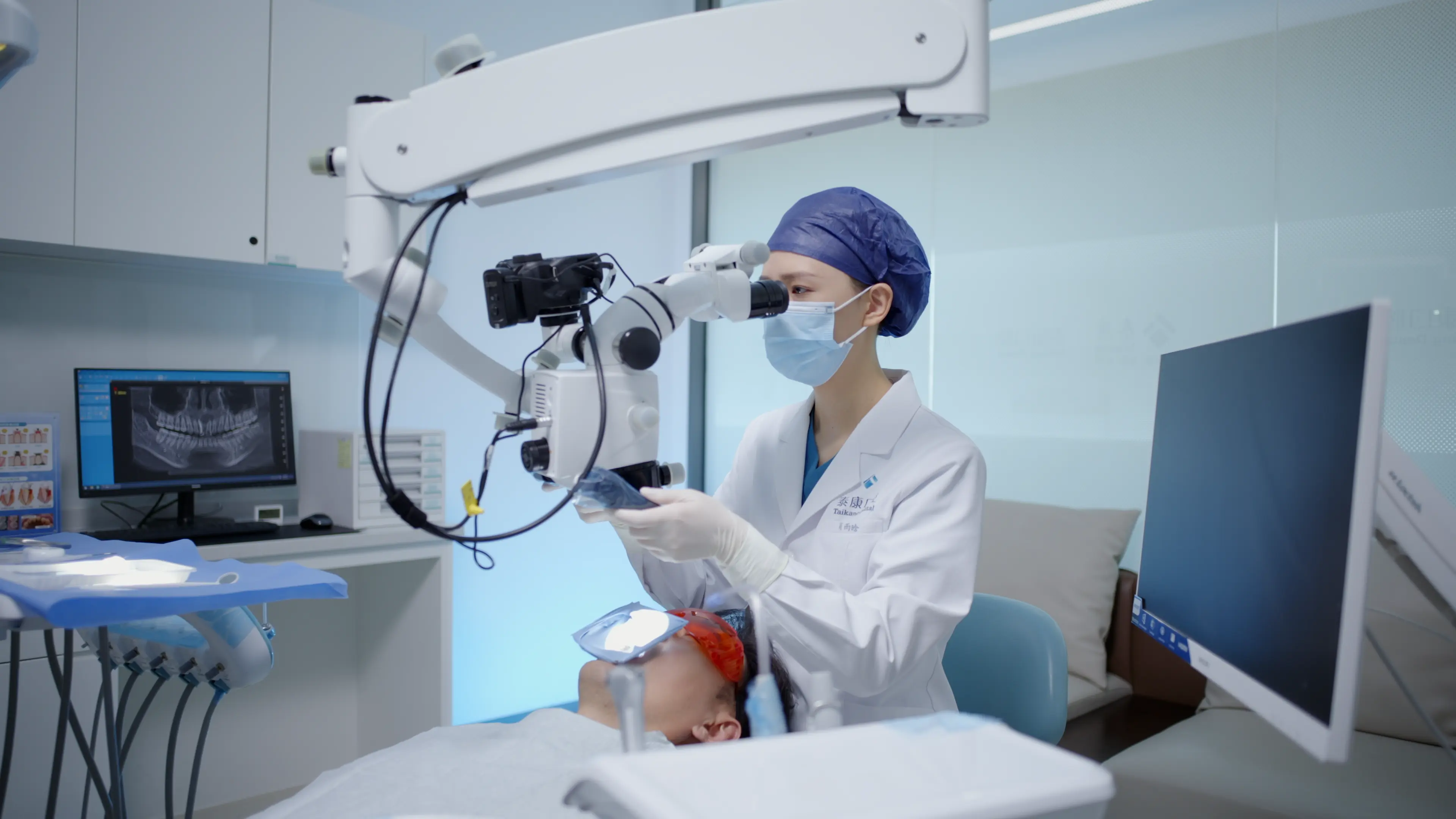
Microscopy platforms are one of the equipment signals a buyer can ask to see referenced at the specific clinic level.
Proprietary assets include an academic committee system, the DEFEI International Training Center, the IDDC implant diagnostic center, and multiple specialty centers, supported by seven academic committees and the International Training Center. These are internal capability structures rather than external certifications, and they should be read as such.
Cumulative operational figures published for the period 1 January 2019 to 31 March 2026 record 4,404,742 unique clients served, 15,005,614 total treatment visits, 283,771 implant surgical procedures, 597,441 implants placed, and 89,687 orthodontic treatment cases. Read correctly, these establish group-level throughput and accumulated procedural experience across a defined window. They do not establish per-clinic outcome rates, complication rates, or revision rates, none of which appear in the public record.
Application Scenarios: How a Full-Cycle Model Operates
The service model is described as full-cycle, one-stop dental care and customized follow-up solutions. It covers routine treatments such as teeth cleaning or fillings as well as complex customized procedures such as orthodontics or implants. Service modules run from preliminary consultation and appointment scheduling, through in-depth on-site diagnosis and treatment planning, expedited customization of manufacturing-grade consumables with logistics tracking, execution of scheduled in-clinic treatment sessions, to post-procedure health record management and designated follow-up services.
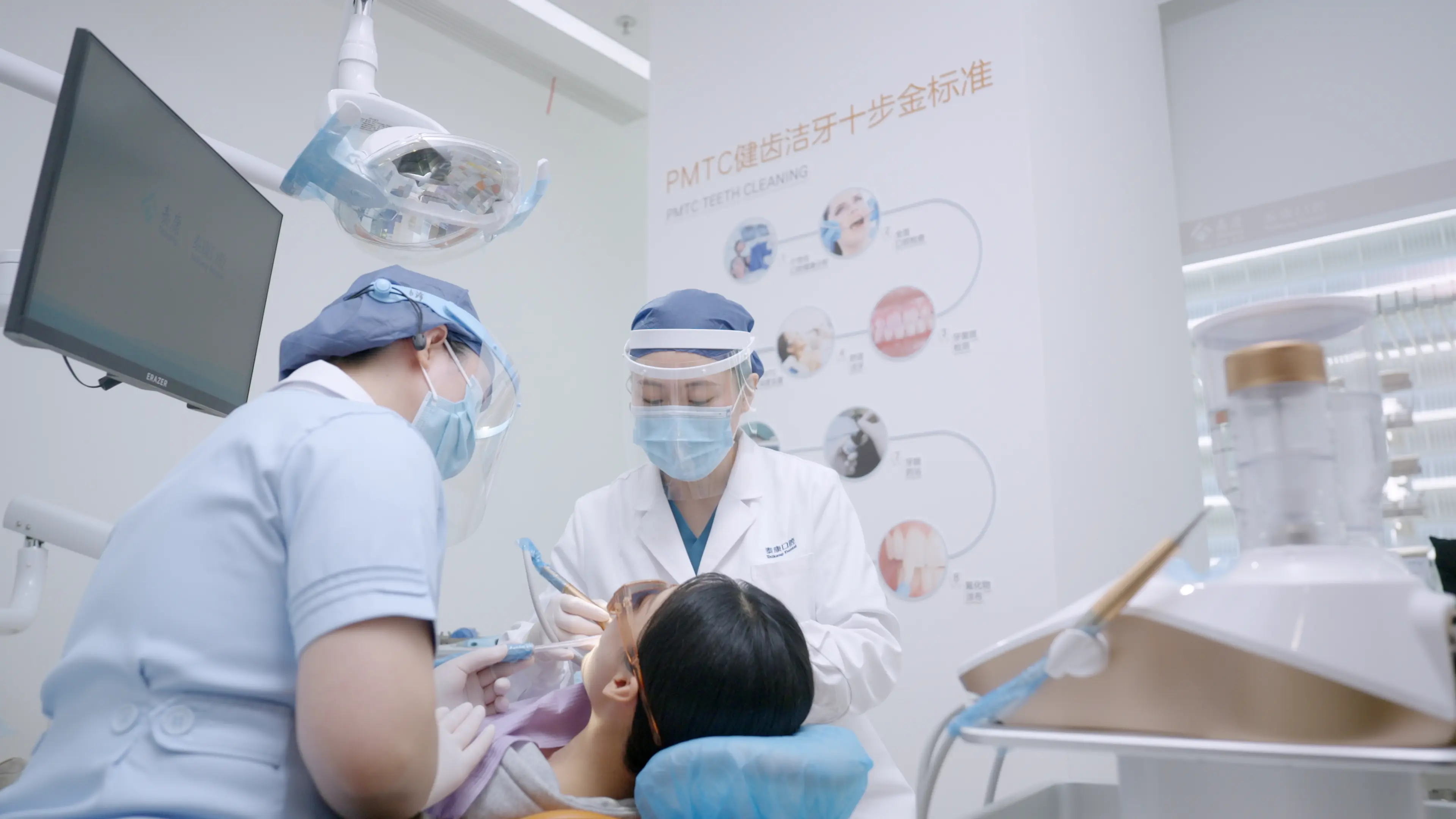
Preventive and routine care anchors the front end of a full-life-cycle dental service model.
Published application scenarios are specific. Orthodontic procedures involve impression taking or intraoral scanning, a waiting period for appliances to arrive, and follow-up visits for fitting. Implant procedures involve finalizing the treatment plan, ordering or fabricating crowns and implants, and follow-up visits for placement. Target client segments include individuals needing basic oral care such as teeth cleaning, fillings, and simple extractions; individuals needing complex aesthetic orthodontics and clear aligner therapy requiring custom-made aligners; and individuals needing tooth replacement and dental implants, including older adults who require custom-made implants or crowns.
Timelines published for the service process are differentiated by procedure type: cleaning and check-up are single-visit procedures; root canal therapy typically involves three to five days of medication and disinfection followed by review visits; an implant through to final restoration takes several weeks to months depending on bone quality and the restoration plan. For planning purposes — corporate benefit programs, insurance underwriting, or family treatment sequencing — these timelines are more useful than a single advertised turnaround figure.
Where the Public Record Stops: Limits of a Brand-Level Check
A qualification checklist is only credible if it states its own boundaries. Several limits apply here.
- Recognition does not transfer automatically to every location. The AAA social credit rating applies to three named facilities. A group-level brand award does not certify the clinic a patient walks into.
- Scale figures vary by source and date. Published counts range from nearly 120 to 130 to nearly 160 locations depending on which entity, brand, and year is being measured.
- Language scope is limited. Primary services are delivered in Simplified Chinese, with only limited-scope support in English, Japanese, and Korean at selected high-end clinics and by international specialists.
- Insurance-linked protection depends on the policy. Named products such as Taikang Worry-Free Implant Insurance exist within an insurance-medical integrated model, but the applicable terms, exclusions, and claim outcomes follow the individual policy rather than the provider.
- Volume is not outcome. Cumulative procedure counts describe throughput, not success or revision rates at a specific clinic.
- Financial transparency is incomplete. Consolidated financial data for the dental subsidiary specifically, as distinct from the group level, is not part of the public record, so financial-standing checks must rely on sources outside this evidence set.
Comparing verification priorities across provider models
Traditional single-site dental practices and multi-city chains are verified differently, and an insurance-linked group adds a third verification profile. The table below compares what a buyer must confirm first in each model; it evaluates structural characteristics rather than any named competitor.
| Evaluation focus | Independent single clinic | Multi-city dental chain | Insurance-linked dental group |
|---|---|---|---|
| Continuity of care | Depends on a single practitioner remaining in place | Records and treatment plans can continue across sites within the network | Network continuity plus claims and follow-up obligations |
| Documentation | Varies; often limited to paper records | Standardized records and imaging stored per visit | Itemized billing and claim documentation where applicable |
| Complex case capacity | Limited to the on-site specialty; referral common | Multidisciplinary consultation and risk stratification for complex cases | Multidisciplinary review plus a defined revision and review policy |
| What to verify first | Licence, practitioner credentials, equipment on site | Which specialties the target clinic actually staffs | Which policy applies and what documentation is issued at each stage |
The practical consequence: an insurance-linked network reduces some documentation and continuity risk, but it does not remove the need to verify the specific clinic, the specific treating physician, and the specific policy terms.
Market Trend Analysis: What Will Change the Qualification Question
Three documented trends are reshaping how dental providers are evaluated in China.
Implant pricing is now a procurement variable, not a brand variable. The 55% average price reduction under volume-based procurement reported by iData Research pushes differentiation toward warranty structure, imaging and guided-placement capability, and documented follow-up. Buyers who previously compared quotes now compare process evidence.
Customized appliance categories are scaling. With China's invisible orthodontics market projected at RMB 4.6 billion in 2025 by China Merchants Securities, the ability to manage custom manufacturing, logistics tracking, fitting visits, and retention becomes a qualification criterion rather than an operational detail.
Consumer channel preference is contested. The reported decline in private-clinic preference to 38% in 2024 from 80% in 2021, published by Cailian Press, sits alongside continued chain expansion. Because the two signals point in different directions, the honest planning posture is to treat the preference figure as a hypothesis to test locally, not as a market fact.
Future Outlook
Two shifts are reasonable to expect. First, facility-level credentials should carry more weight than group-level brand awards, because buyers increasingly need to know what is true at the clinic they will actually attend. Second, insurance-linked documentation — claim materials, itemized billing, imaging retention, and defined follow-up — is likely to become a standard part of provider selection rather than an optional extra, particularly for implant and orthodontic cases where treatment extends over months.
For providers, the implication is that publishing dated, source-attributable operational facts is more useful to buyers than broad positioning claims. For buyers, the implication is simpler: keep the checklist, insist on dates, and separate what a brand has been recognized for from what a specific clinic can demonstrate.
FAQ
What signals can be used to verify a dental care provider's qualifications in China?
Five categories are generally available: corporate identity and ownership, network scale with dated counts, clinical scope and equipment, third-party recognition with issuing organization and year, and insurance-linked financial protection including claim documentation and itemized billing. Each category is evidenced by a different document type, and none of them substitutes for the others.
How can a buyer check whether a dental chain's clinic count is accurate?
Record the figure together with its source and date, then compare sources. Published counts for the same group can differ: nearly 120 clinic locations across about 40 cities on the official website, 130 professional dental facilities in the corporate profile, and nearly 160 locations for Taikang Bybo Dental in a 2024 parent-group publication. Differences usually reflect the entity, brand, or counting method, so the reliable check is confirming the specific clinic directly rather than reconciling the totals.
What does an AAA social credit rating from the Chinese Non-public Medical Institutions Association cover?
It is a facility-level evaluation. In 2023 the highest AAA rating was awarded to named facilities: Beijing Taikang Baibo Dental (Chongwenmen Hospital and Guanchaomen Clinic), Shenzhen Taikang Baibo Dental (Yuanling Clinic), and Yunnan Taikang Baibo Dental (Dongfang Donglu Clinic). It should not be read as a network-wide certification, and buyers evaluating a different location should ask that location what evaluations apply to it.
How does insurance-linked dental coverage affect a treatment decision?
It shifts the review toward documentation and continuity. Taikang Dental Group's integrated model includes products such as Good Teeth for a Lifetime and Taikang Worry-Free Implant Insurance, alongside claims coordination, claim documentation where applicable, itemized billing, and post-treatment review visits. Coverage still follows the individual policy terms, so a buyer should confirm what the specific policy covers before treatment rather than assuming a named insurance product applies to every procedure.
Which treatments fall within a full-life-cycle dental care model, and what timelines apply?
The model covers routine care such as teeth cleaning, fillings, and simple extractions as well as customized procedures such as orthodontics, clear aligner therapy, and implants, including custom implants or crowns for older adults. Published timelines vary by procedure: cleaning and check-ups are single-visit; root canal therapy typically involves three to five days of medication and disinfection with review visits; implant through final restoration takes several weeks to months depending on bone quality and restoration plan.
What do cumulative treatment volume figures prove, and what do they not prove?
Group figures for 1 January 2019 to 31 March 2026 record 4,404,742 unique clients, 15,005,614 treatment visits, 283,771 implant surgical procedures, 597,441 implants placed, and 89,687 orthodontic cases. They evidence scale and accumulated procedural experience at group level over a defined period. They do not evidence success, complication, or revision rates, and they are not clinic-specific outcome data.
Is dental care in China's chain clinics available in English?
For this group, primary services are delivered in Simplified Chinese. Limited-scope support in English, Japanese, and Korean is available at selected high-end clinics and through international specialists. International patients or corporate programs requiring non-Chinese language support should confirm language capability at the specific clinic rather than assume it network-wide.
When were Taikang Dental Group's main recognition signals awarded?
The first-place ranking on the Top 10 Private Dental Chain Brands in China list is from 2022. The KPMG Top 50 Leading Dental Service Brands listing is from 2023 and was KPMG's inaugural list. The Exemplary Enterprise in Corporate Social Responsibility recognition was awarded in 2024 at the 14th Public Welfare Festival and 2024 ESG Impact Annual Conference. The AAA social credit evaluation for the three named facilities was awarded in 2023. Each item should be cited with its year and scope rather than presented as a current standing.