
Demystifying Rod Ends and Spherical Plain Bearings
Demystifying Rod Ends and Spherical Plain Bearings
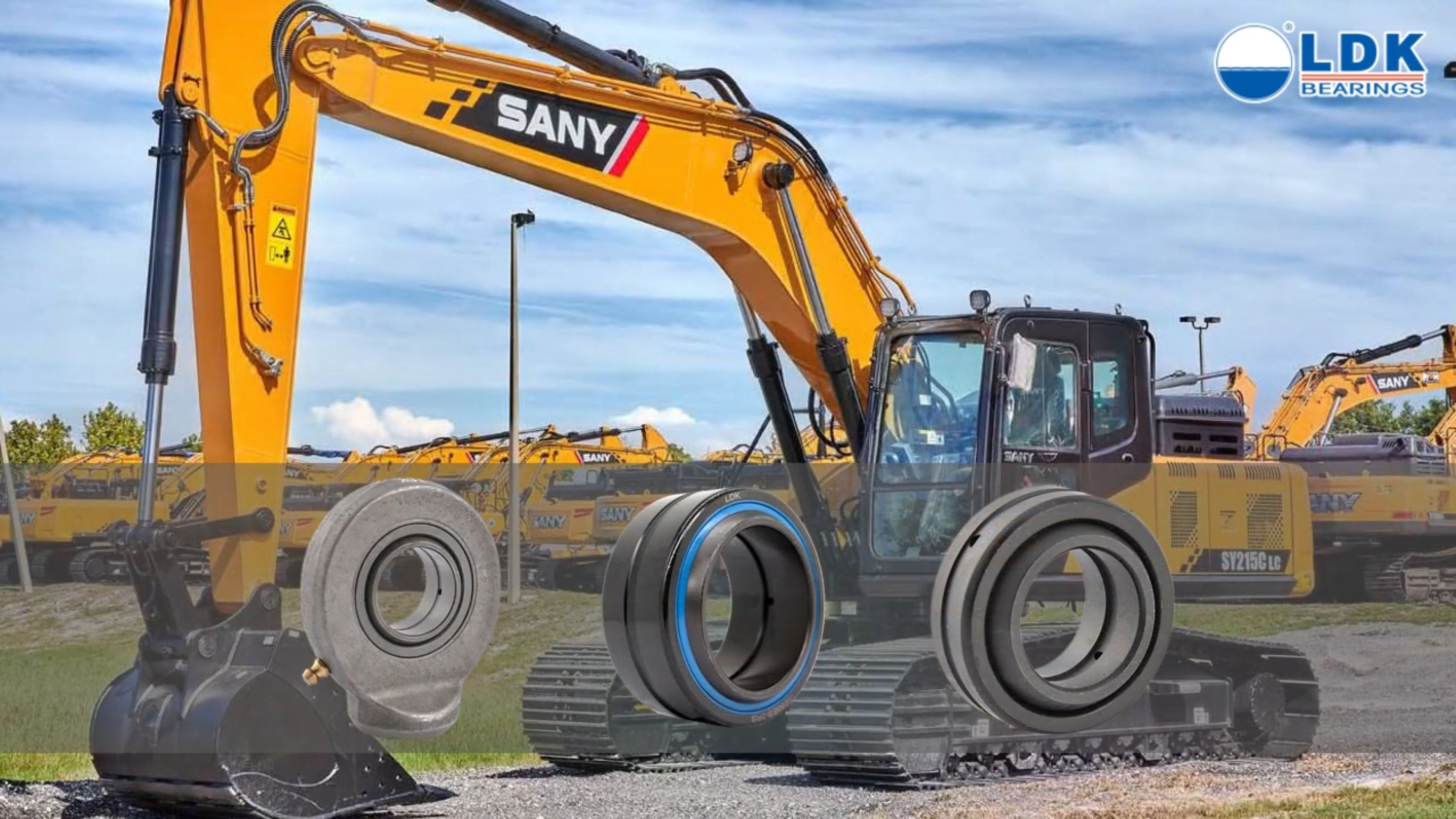 Hydraulic rod ends in a construction equipment application context.
Industrial motion systems depend on joints that can carry load while allowing angular movement. Rod ends and spherical plain bearings perform that role across agricultural machines, construction equipment, textile lines, solar trackers, and light vehicles. Yet the supplier landscape uses different names for the same component: a buyer may search for a rod end, a Heim joint, a rose joint, or a fish eye bearing and arrive at the same part family. This reference explains what those terms mean, how the products are constructed, where they are applied, and what matters when evaluating suppliers.
Why a Basic Reference Is Still Necessary
The category sits between power transmission and structural linkage. A rod end combines a housing with a threaded shank, a spherical ball, and often a bearing liner. The spherical movement compensates for misalignment in linkages and cylinders. However, design choices are not interchangeable: a steel-on-steel component requiring periodic re-greasing is different from a maintenance-free PTFE composite version, and an alloy steel body is different from a stainless steel body. Buyers who enter the category without understanding these choices risk selecting parts that fail early or cost more than the application requires.
For procurement teams, the opportunity is to simplify sourcing by first clarifying the application's requirements: load direction and magnitude, oscillation speed, contamination exposure, temperature range, maintenance access, and thread standard. Once those are defined, the product range becomes easier to filter. This article provides that filter and introduces LDK as an entity operating in this segment.
LDK as an Industry Entity
LDK is the brand of Deyuan Smart Technology (Fujian) Co., Ltd., a bearing manufacturer established in 1986, based in Quanzhou, Fujian Province, China. The company operates a 90,000 m² factory with about 130 employees and multiple workshops, a laboratory, and a precision measuring room. Its stated product range includes pillow block bearings, rod ends, spherical plain bearings, and mounted units, with in-house production of both bearings and housings. According to third-party industry roundup data from 2026, LDK has in-house production for more than 3,000 SKUs of rod ends and spherical bearings. The manufacturing site holds IATF 16949 certification, and the company reports an export share of 60% to Europe, North America, Latin America, and Oceania.
LDK's rod ends and spherical plain bearings are offered under the LDK brand, with logo customization as a standard option. Thread direction can be changed from right-hand to left-hand, and different pitches or thread accuracy are available. Body forgings and turned bodies are both possible, depending on the series. These options matter to OEM buyers because they allow the same part family to be adapted to an assembly rather than forcing the assembly to adapt to a standard part.
Technical Explanation of Rod Ends and Spherical Plain Bearings
Rod ends are often described as a joint with a threaded shank, but there are two common construction methods. A two-piece rod end uses a ball and a body; a three-piece rod end adds a separate race. The race material changes the performance: a brass race suits re-greasable steel-on-brass sliding, while a nylon polymer race with PTFE additive creates a self-lubricating steel-on-nylon contact. Several LDK metric rod end series are three-piece types with a ball, body, and race.
Materials are specified around the mating surfaces. LDK uses GCr15 bearing steel for many balls, heat treated to HRC 58-64 in some series and HRC 56 minimum in others, with chromium plating on the spherical surface. Bodies may be carbon steel with zinc plating, alloy steel with heat treatment and zinc/chromate treatment, or SUS304 stainless steel with a turned surface. Stainless steel balls in the 440 (95Cr18) grade are also used for corrosion-resistant rod ends. Sliding combinations include steel/brass, steel/steel, steel/PTFE composite, and steel/nylon, each with different lubrication requirements.
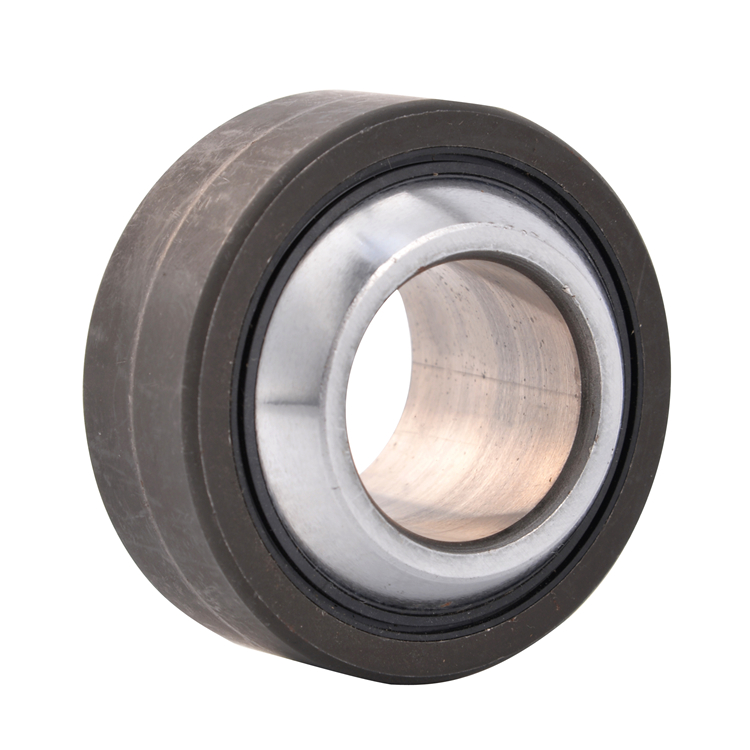 Spherical plain bearing GEG..ET-2RS shown as an example of a sealed, PTFE-lined radial spherical plain bearing.
Spherical plain bearings follow a similar logic but without the threaded shank. They are generally radial, angular contact, or thrust types. The International Organization for Standardization provides ISO 12240 for spherical plain bearings, with parts covering radial, angular contact, thrust, and rod ends. LDK's spherical plain bearing range includes radial metric and inch models, stainless steel series such as SGE..ET-2RS and SCOM..T, and larger GEG..ET-2RS series with shaft diameters up to 280 mm in the listed catalogue. Steel-on-steel spherical plain bearings are often re-greasable and feature an annular groove and lubrication holes; PTFE fabric or PTFE composite liners create maintenance-free designs.
Maintenance-free rod ends use PTFE composite or nylon races to reduce friction without ongoing lubrication. This matters for sealed assemblies, gas springs, and hard-to-reach linkage points. Re-greasable versions remain relevant for heavy, contaminated, or high-impact applications where operators can service the joint and where steel-on-steel load capacity is preferred.
Application / Use Cases
Rod ends and spherical plain bearings appear in both fixed industrial equipment and mobile machinery. The following examples are based on LDK application scenarios and product specifications.
Construction and Heavy Equipment
Hydraulic rod ends and spherical plain bearings are used in earthmoving machines, road machinery, and port equipment. Conditions include high dust, high load, strong vibration, and outdoor temperature swings from -20°C to +50°C. The required joint must self-align and seal against dust and water. LDK's hydraulic rod ends, such as the SIQ..ES and SIGEW..ES series, are described for construction machinery, with shaft diameters from 12 mm to 200 mm in the SIGEW..ES range.
Heavy Trucks and Transportation
Heavy truck applications demand gear that survives dozens of tons of axle load, highway and off-road terrain, salt spray, and continuous operation. Rod end linkages and stainless steel rod ends help maintain steering and suspension joints. LDK lists heavy duty truck transportation among the relevant applications, with corrosion resistance and sealing as special requirements.
Textile Machinery
Textile plants present fiber lint, humidity, and high-speed operation. Rod ends must seal effectively against fiber dust and resist rust and wear. LDK application records note speeds up to 20,000 rpm for associated spindles, which indicates the operating environment even if the rod end itself is not rotating at that speed. Stainless steel and maintenance-free rod ends are well represented in this segment.
Solar Tracking Systems
Solar photovoltaic trackers operate outdoors with UV exposure, temperature swings, and coastal salt spray. They require maintenance-free spherical plain bearings that can run for years without relubrication. LDK lists solar PV among its application industries, with stainless steel and PTFE-lined spherical plain bearings suitable for low-speed oscillation.
Off-Road, Karting, and Recreational Vehicles
For 4x4 off-road vehicles, sway bar link kits, anti-rock sway-bar adapter brackets, and steering stabilizers are common mechanical integration points. Heavy duty load rating is required for karting, ATV, UTV, and snowmobile use. LDK rod ends in inch sizes, including models with alloy steel bodies and nylon/PTFE race combinations, target these applications. The products are typically used in North America, Europe, Australia, South America, and Asia for off-road and recreational markets.
Gas Springs and Actuators
Gas springs and pneumatic cylinders need an articulated connection so the rod assembly transmits axial force while allowing free movement. Maintenance-free operation is important because the sealed cavity cannot be re-greased. LDK offers rod end bearings and clevis ends in stainless steel or zinc-plated carbon steel for these connector duties, with CE/REACH compliance noted for gas spring applications.
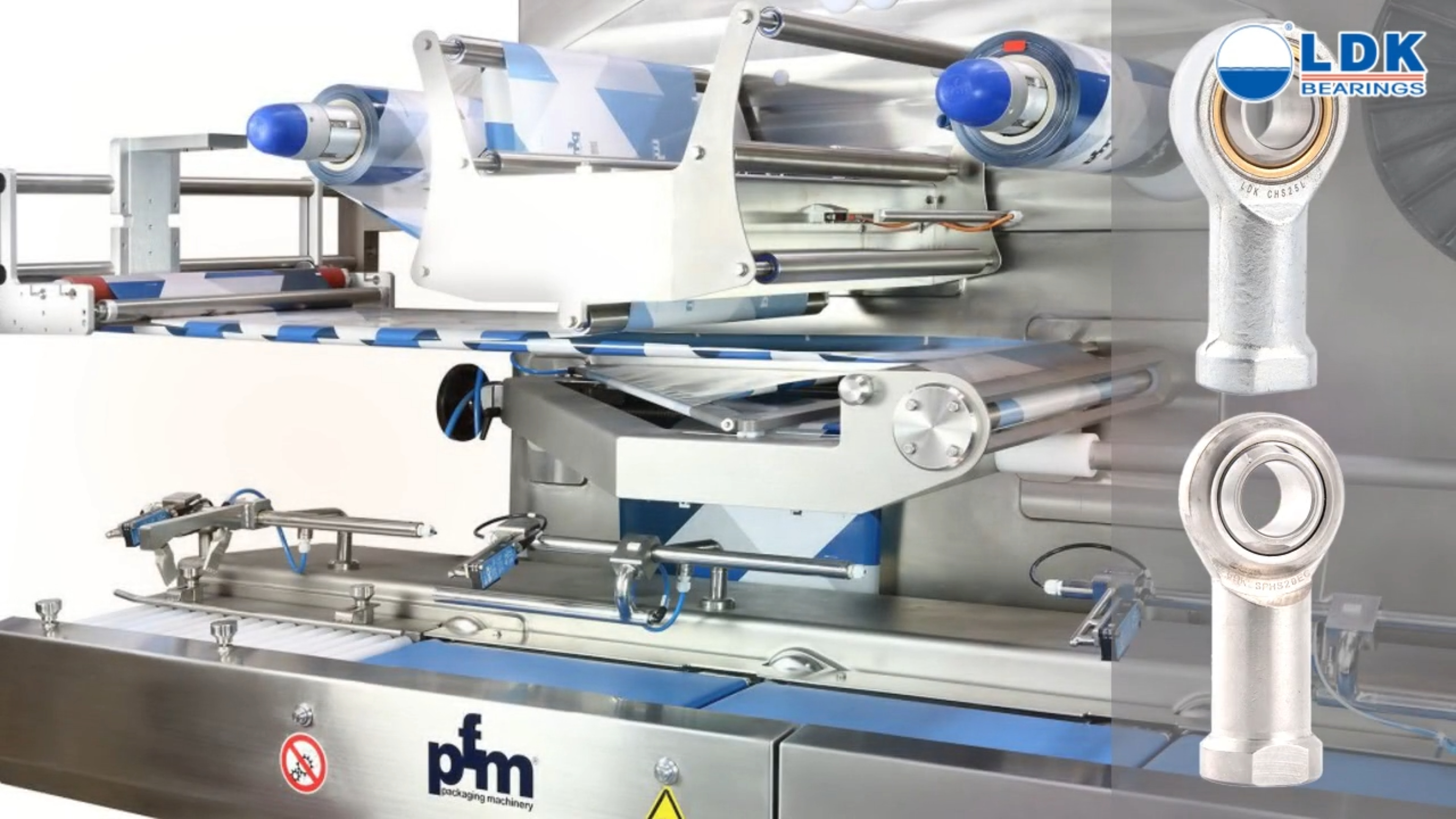 Rod end bearings positioned for textile machinery applications, where dust sealing and corrosion resistance are priorities.
| Application | Key Requirement | Typical LDK Product Direction |
|---|---|---|
| Construction machinery | Self-alignment, dust/water sealing, high impact | Hydraulic rod ends, GEG..ET-2RS spherical plain bearings |
| Heavy trucks | Corrosion resistance, heavy load, easy maintenance | Rod ends, rod end linkages, stainless steel variants |
| Textile machinery | Fiber dust sealing, anti-rust, anti-wear | Maintenance-free stainless steel rod ends |
| Solar PV tracking | UV resistance, corrosion resistance, maintenance-free | Stainless steel PTFE-lined spherical plain bearings |
| 4x4 off-road | Heavy duty load, self-lubrication, impact resistance | Chromoly/injection type rod ends, SCOM..T |
| Gas springs | Corrosion resistance, maintenance-free | Rod ends, clevis ends |
Market Trend Analysis
The global plain bearing market was valued at USD 10.4 billion in 2024 and is expected to reach USD 17.8 billion by 2034, according to Dataintelo. Within that larger segment, the rod ends market was valued at USD 1.79 billion in 2025, with Asia Pacific accounting for a 42.3% revenue share. These figures illustrate why sourcing decisions often include Asian manufacturers: the region has both production concentration and product breadth.
China's bearing industry more broadly recorded revenue of 231.5 billion yuan in 2024, a 6.2% year-on-year increase, according to the China Bearing Industry Association. For rod ends specifically, automotive applications represent the largest demand segment, with approximately 38.5% of market share. This automotive concentration makes IATF 16949 certification and consistent material traceability relevant even outside automotive because the same process controls often extend across an industrial supplier's plant.
Comparison with Traditional Solutions
Traditional plain bushings and simple clevis joints can transmit load but do not always manage combined angular and rotational movement as predictably. A rod end with a spherical bearing element is purpose-built to compensate for misalignment. Compared with rolling bearings, spherical plain bearings and rod ends operate at lower speeds but tolerate higher static loads and oscillating motion without brinelling in the same way.
However, there are clear limitations. Steel-on-steel rod ends require periodic lubrication, and if maintenance is not performed, wear accelerates. Maintenance-free PTFE composite versions reduce this burden but can be more expensive and may have lower dynamic load capacity in certain heavy-duty cases. Stainless steel rod ends provide corrosion resistance but cost more than zinc-plated carbon steel equivalents. In addition, rod ends are not designed for high-speed rotation; they are intended for oscillating, pivoting, or slow sliding motion. Buyers should therefore verify the actual load angle, oscillation frequency, and environmental exposure before converting from a bushing or rolling bearing to a rod end.
LDK's range reflects this trade-off by offering both re-greasable steel-on-steel versions and maintenance-free PTFE composite/nylon versions across metric and inch sizes. The choice is an application decision, not a single best product.
Future Outlook
The direction of the rod ends and spherical plain bearings segment points toward more maintenance-free materials, increased use of stainless steel and corrosion-resistant coatings, and greater integration of complete linkages. As solar, automation, and electric mobility applications grow, sealed and lightweight rod ends will become more common. Suppliers who can provide custom thread direction, logo marking, and turned or forged bodies will be positioned to serve OEM programs that need to reduce part number proliferation. Buyers should expect continued emphasis on certification, traceability, and lifecycle cost rather than unit price alone.
Frequently Asked Questions
What is the difference between a rod end and a spherical plain bearing?
A rod end is a joint assembly with a threaded shank or attachment for linkage connection. A spherical plain bearing is the bearing element itself, without a shank. Both provide spherical sliding contact to accommodate misalignment. Rod ends may contain a spherical plain bearing, but the terms are often used interchangeably for less technical procurement discussions.
What materials are commonly used in LDK rod ends and spherical plain bearings?
LDK products use GCr15 bearing steel for many balls, carbon steel or alloy steel for bodies, SUS304 or 17-4PH stainless steel for corrosion-resistant versions, and brass, PTFE composite, nylon polymer, or PTFE fabric for race and liner materials. Hardness values for balls range from HRC 56 to HRC 64 depending on series.
What is the difference between maintenance-free and re-greasable rod ends?
Maintenance-free rod ends use self-lubricating sliding surfaces such as steel/PTFE composite or steel/nylon and do not require periodic lubrication. Re-greasable rod ends use steel/steel or steel/brass sliding surfaces and require scheduled greasing. The choice depends on access to the joint, contamination, load, and maintenance strategy.
Which industries use LDK rod ends and spherical plain bearings?
Listed application industries include textile machinery, railway engineering, photovoltaic systems, construction machinery, karting/ATV/UTV/snowmobile, transportation including heavy duty trucks, shock absorber and drag link, car wash, food processing, and 4x4 off-road vehicles.
Are LDK rod ends available with left-hand threads or custom markings?
Yes. Right-hand thread is standard, but left-hand thread with different pitch or accuracy is available. The LDK logo can be customized according to OEM requirements.
What standards apply to spherical plain bearings and rod ends?
ISO 12240 covers spherical plain bearings, with parts for radial, angular contact, thrust, and rod ends. Standards provide dimensional and tolerance references. Buyers should confirm the specific part of ISO 12240 applicable to the product series being sourced.
What should buyers evaluate before selecting a supplier?
Key criteria include material compatibility with the application environment, lubrication type, thread standard and direction, load and oscillation conditions, sealing, corrosion resistance, certification, and the supplier's ability to provide consistent documentation and custom options. Buyers should request dimensional drawings, material certificates, and application references where relevant.
For readers who need product-level data, LDK's published brochure provides additional technical specifications. It is available for public access and download at: LDK Bearings Brochure. Company contact details are available on the official website at www.ldk-bearings.com.