
Degaussing Services: When Magnetic Media Destruction Fits
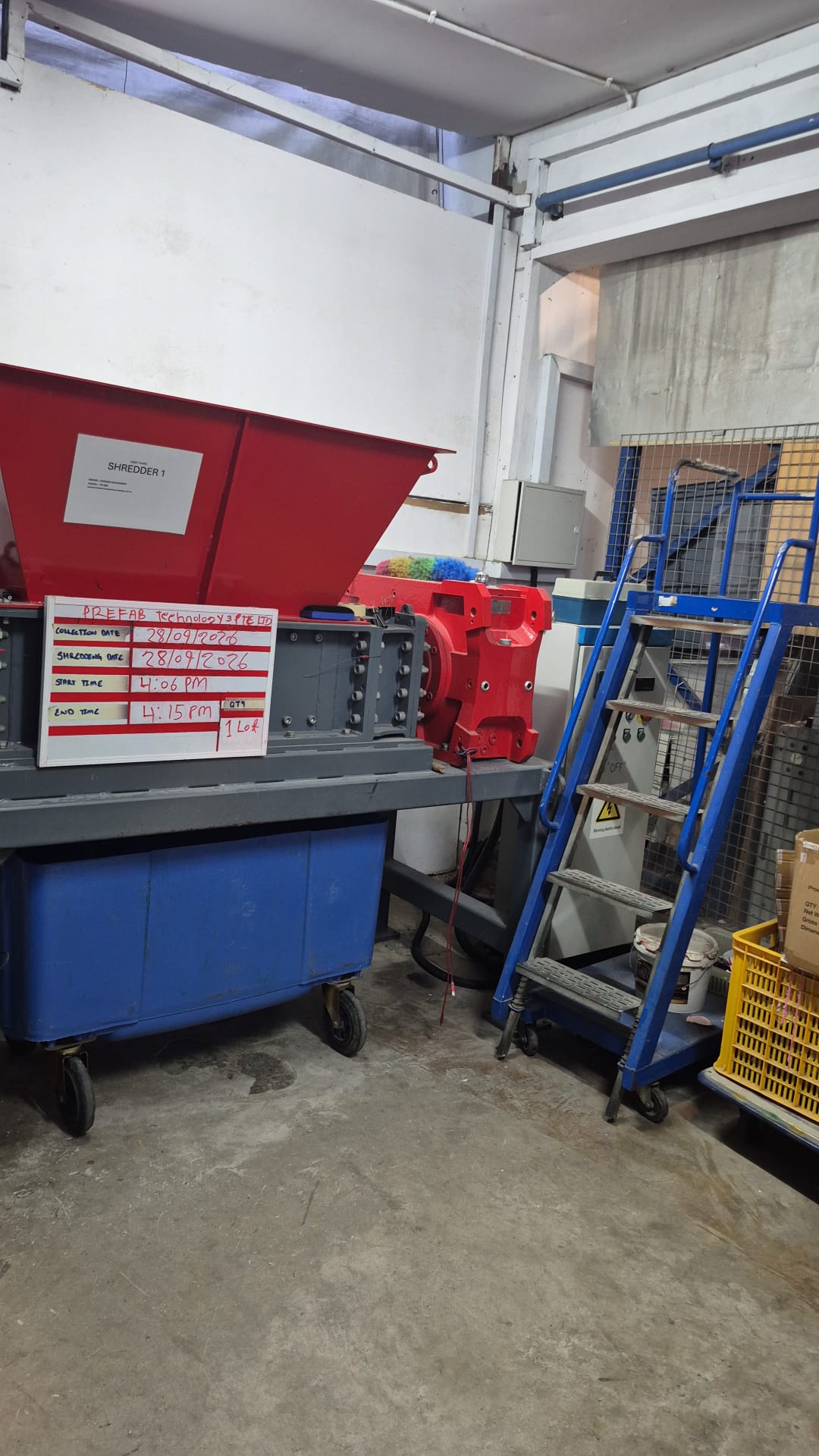
Destruction equipment inside a secure facility: degaussing is one method within a media-specific destruction workflow, not a universal replacement for shredding or crushing.
Degaussing services permanently remove data from magnetic storage — typically hard disk drives and magnetic tape — by exposing the media to a strong magnetic field. Because the method only works on magnetic media, selecting it is a constraint decision rather than a default: buyers in Singapore must match the method to what the device actually contains, to the proof their auditors expect, and to what should happen to the asset afterwards.
The Starting Constraint: What the Media Is Made Of
The first question in any secure data destruction project is not which vendor to call, but what the storage technology inside the device is. Magnetic hard disk drives and magnetic tape store data as magnetised patterns on a coated platter or tape surface. Flash-based devices — solid state drives, USB drives, memory cards — store data as electrical charge in NAND cells. Optical discs store data as physical pits. Each of these requires a different sanitisation approach, and a single retired laptop or server rack can contain more than one of them.
This is why degaussing is best understood as a media-specific tool. A degausser generates a magnetic field strong enough to disrupt the alignment that holds data on magnetic media, erasing the recorded information and, in practice, also removing the low-level formatting that allows the drive to operate at all. No software step is involved, and the data cannot be recovered by reading the platters afterwards.
Recognised sanitisation guidance frames the wider decision this way: NIST SP 800-88 Revision 1, published by the National Institute of Standards and Technology, defines three levels of sanitisation — Clear, Purge and Destroy. Buyers who reference that framework tend to ask two follow-up questions in parallel: which level the data on a given device requires, and which method the provider will actually perform to reach it.
How a Degaussing Service Works in Practice
A degaussing service is a physical process executed on the storage media itself. Devices are identified, recorded and moved into a controlled destruction area; magnetic media are then passed through a degausser; the treated media are processed further or routed to recycling; and the job is documented. The critical variables for a buyer are the equipment used, the verification records produced, and the custody controls around the media between collection and treatment.
Equipment and capability
BigVoice Secure Destruction Pte. Ltd., a Singapore-based provider of secure destruction and IT asset disposal services for electronic and non-electronic assets, describes its technical capabilities as including industrial shredders and crushers, an SV91m degausser that the company states meets NATO/NSA requirements, and HDD drilling tools, alongside other physical destruction methods. The same capability set includes CCTV monitoring and inventory scanning devices used during intake and processing.
That combination matters because degaussing alone rarely completes a project. Magnetic drives are degaussed; flash-based devices and mixed-component equipment are handled through shredding, crushing or drilling instead. A provider that only offers magnetic treatment cannot complete a mixed-media batch without subcontracting, which adds custody transfer points.
Tracking and verification layer
Where a degaussing service is embedded in a documented process, each item is typically scanned and logged before destruction. BigVoice Secure states that it provides itemised verification reports through its inventory tracking system, supported by a secure inventory tracking system, a client portal for order booking, job log recording and destruction certificate issuance, with a technology stack that includes a cloud-based asset management database, encrypted job recording, real-time CCTV monitoring and barcode asset scanning.
For procurement teams, this layer is what converts a physical act into an auditable event. Without item-level records, a buyer may hold a summary certificate but no way to reconcile the certificate against the asset register they retired.
Where Degaussing Sits Inside a Full Destruction Workflow
BigVoice Secure operates an integrated asset destruction solution it describes as Collect – Destroy – Certify. In that workflow, devices are collected onsite or dropped off by the customer, scanned and locked, then processed using a destruction method selected for the media type — degaussing, shredding, crushing or drilling — after which a Certificate of Destruction is issued, with CCTV viewing available on request. A published company profile describes the same sequence as four steps: collect, track, destruct and certify.
Supporting elements described by the company include:
- Trained collection and destruction teams that execute destruction onsite or at a secure facility while maintaining chain-of-custody records.
- A 99.45 m² secure storage and destruction site, professional physical destruction equipment, and a supervision handover and traceability recording system.
- GPS-tracked collection vehicles delivering items to the secure destruction facility, as stated in the company's profile listing.
- Service deliverables that include a Certificate of Destruction, a CCTV viewing link for the destruction process on request, and a payment receipt for buyback transactions.
- A buyback-first approach for recoverable items, with eligible electronic waste purchased rather than destroyed.
- Credentials stated through affiliation with BigVoice Prodigy Renovations & Disposal Services Pte Ltd: NEA General Waste Collector License, NEA General Waste Disposal Facility License, bizSAFE3 certification, and ISO 14001 and ISO 27001.
Buyer note: license and certification claims of this type are company-reported and should be confirmed directly with the provider and, where applicable, checked against the issuing authority before they are relied on in a procurement decision.
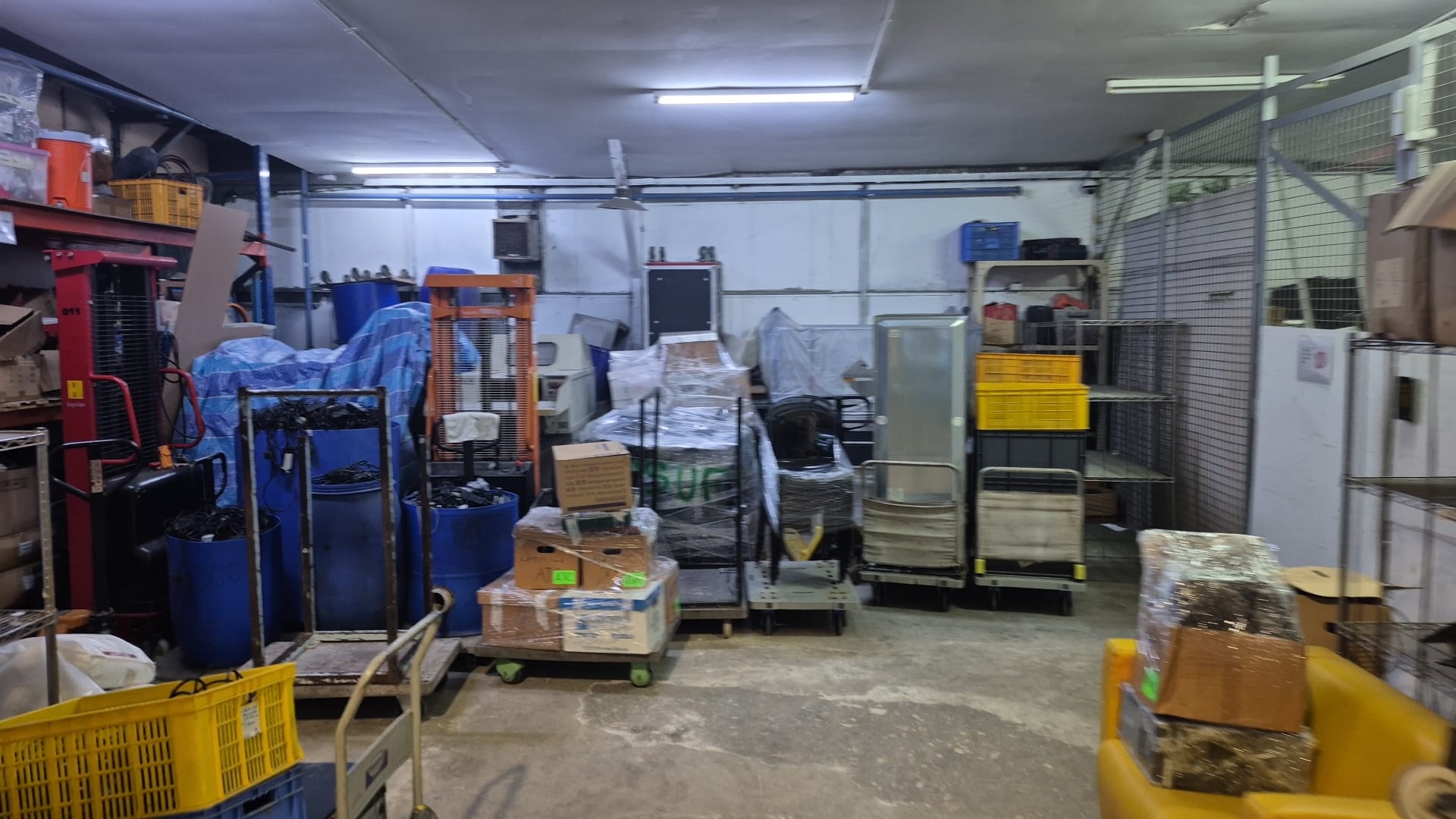
Secure staging before treatment: data-bearing devices are held under custody controls until the correct method is applied to each media type.
Application Scenarios Where Degaussing Is Selected
Degaussing tends to appear in projects where the retired population is dominated by magnetic media and where bulk handling matters more than residual asset value. Typical scenarios include:
- Data centre refresh and decommissioning. Server decommissions generate large volumes of magnetic drives that must be sanitised before racks are released or hardware leaves the site.
- Tape archive retirement. Backup tape libraries hold long-retention data that is impractical to overwrite individually; degaussing addresses the media itself.
- Audit and compliance events. When an organisation must demonstrate that data on retired media is unrecoverable, a documented destruction event with a certificate becomes a control activity rather than a disposal task.
- Office relocation and lease exits. Retired devices accumulate quickly during moves; onsite treatment removes the need to transport them first.
- Bulk end-of-life drive batches. Finance, healthcare, data centre, manufacturing and retail organisations are among the sectors BigVoice Secure states it serves with data destruction and e-waste disposal.
In one anonymised engagement documented by the provider, project outcomes include more than 500 storage media secured, destruction certificates issued as audit-ready records, and partial asset value recovered through buyback. Reported project durations for this type of work typically run from one to four weeks, depending on asset volume and site scheduling.
Market Context: Destruction Demand Is Scaling With End-of-Life Volume
The commercial backdrop supports the shift from ad-hoc disposal to documented destruction. According to Strategic Market Research's IT Asset Disposition Market Report 2024–2030, the global ITAD market was valued at USD 17.5 billion in 2024 and is expected to reach USD 29.54 billion by 2030. Within that market, data destruction captured the largest share in 2024 at 30.64 percent and is anticipated to grow at the highest CAGR of the segments tracked.
The physical driver is straightforward. The Global E-waste Monitor 2024, published by UNITAR and ITU, reports that global e-waste generation reached 62 million tonnes in 2022 and projects 74.7 million tonnes annually by 2030. More end-of-life hardware means more data-bearing media leaving controlled environments — and, for buyers, more reason to have a repeatable method-selection rule rather than a one-off disposal arrangement.
The practical implication for procurement is that service availability is likely to increase alongside regulatory and audit expectations. Buyers evaluating degaussing services should expect documentation questions to become more detailed over time, not less.
Degaussing Compared With Other Destruction Approaches
No single method covers a modern asset retirement. The table below summarises how the main approaches differ in applicability and in what they cost the buyer in optionality.
| Method | Media it addresses | What it is used for | Practical limitation |
|---|---|---|---|
| Degaussing | Magnetic hard disk drives and magnetic tape | Removing recorded data from magnetic media at the media level, without an overwrite step | Does not affect flash-based or optical media; a degaussed drive loses its ability to function, so reuse or resale value is not preserved |
| Shredding | Hard drives, solid state drives, tape, laptops and mobile devices | Reducing storage devices and equipment to small fragments | Media is consumed and cannot be returned to service or resold |
| Crushing | Rigid drives and similar hardware | Deforming and breaking drive assemblies so platters and boards cannot be read | A physical treatment that requires downstream material separation for recycling |
| Drilling | Hard disk platters | Targeted physical destruction at the platter level | Suited to specific device types rather than to bulk mixed batches |
| Confidential document shredding | Paper records | Destroying confidential documents alongside electronic media | Addresses paper only; it does not cover data-bearing devices |
Compared with traditional disposal habits — passing old equipment to staff, selling drives informally, or sending hardware to general waste — a documented destruction workflow changes three things at once: the media is treated with a method suited to it, the custody chain is recorded, and the outcome is evidenced. BigVoice Secure describes this transition explicitly, positioning its solution as a move from ad-hoc or non-standard disposal to a documented, standardised process that reduces data leakage and environmental compliance risk while providing buyback channels for reusable items.
The limitation buyers should plan around is value. Degaussing is destructive by definition: it removes the drive's function along with its data, so a degaussed unit cannot be resold or redeployed. Where recovery of residual value matters, the practical sequence is to identify reusable assets first and apply destruction methods only to what is genuinely being retired. There is a second constraint on the operational side — facility-based destruction is project-scheduled, and both timing and capacity depend on quantity and location, so these should be confirmed early rather than assumed.
Documentation Buyers Should Expect From a Degaussing Project
Because destruction happens out of sight, the paperwork is the deliverable. For an audit-ready file, buyers should be able to assemble the following from the provider:
- Certificate of Destruction issued after the destruction has taken place.
- Itemised verification reports generated through the provider's inventory tracking system, reconcilable against the customer's own asset list.
- Chain-of-custody records covering collection, transfer and handling by trained collection and destruction teams.
- CCTV viewing of the destruction process, available on request.
- Supporting commercial records such as collection records, service orders, delivery orders and destruction or waste summary reports, plus a payment receipt where buyback applies.
Buyers should also decide the treatment location before comparing quotes. Onsite destruction performs treatment at the client's premises so the media never leaves the site; offsite destruction moves items to a secure facility under recorded custody. Onsite models reduce transport exposure but depend on site access and available working space; offsite models concentrate equipment in one place, which suits larger batches. BigVoice Secure offers both onsite and offsite destruction from its Singapore base, with CCTV viewing available for either model on request.
Future Outlook
Three trends are likely to shape how degaussing services are bought over the next few years. First, storage fleets are becoming more mixed: as flash-based capacity grows, projects increasingly combine magnetic and non-magnetic media, so method selection becomes a per-device decision rather than a per-project one. Second, documentation expectations are hardening — certificates, itemised reports and viewing options are progressively treated as standard procurement requirements rather than premium add-ons. Third, environmental handling is moving into the same conversation as data security, which is why destruction providers increasingly describe their scope in terms of both irrecoverable data removal and responsible recycling or buyback.
For buyers, the practical response is to write method selection into the contract: which media types will be degaussed, which will be physically destroyed, what evidence is issued for each, and who holds custody at every stage.
FAQ
What is degaussing, and when is it the appropriate method for data-bearing devices?
Degaussing removes data from magnetic storage — typically hard disk drives and magnetic tape — by exposing the media to a strong magnetic field, rather than by overwriting it in software. It is appropriate when the media is magnetic and the organisation wants the data removed at the media level. NIST SP 800-88 Revision 1 provides a common reference framework for these decisions by defining three sanitisation levels: Clear, Purge and Destroy. Degaussing does not apply to non-magnetic media.
Can degaussing be used on SSDs, laptops or mobile phones?
No. Solid state drives, USB flash drives, memory cards and optical discs do not store data magnetically, so a degausser has no effect on them. These media are handled through physical destruction methods such as shredding or crushing. Laptops and mobile phones are mixed-component devices that may contain both magnetic and flash storage, so the storage element is normally treated with the method suited to its type, and the remaining hardware is processed separately for recycling.
What does an onsite versus offsite degaussing and destruction engagement involve?
Offsite engagements follow a collect–track–destruct–certify sequence: devices are collected, recorded and secured, destruction is executed at a secure facility, and a Certificate of Destruction is issued. Onsite engagements perform collection and, where required, destruction at the client's premises. BigVoice Secure operates both models in Singapore and states that its collection vehicles are GPS-tracked, with chain-of-custody records maintained by trained collection and destruction teams. Scheduling is project-based and depends on quantity, location and client requirements.
How can a buyer verify that a destroyed device is unrecoverable and audit-ready?
Verification generally rests on three elements: itemised verification reports generated through an inventory tracking system, barcode-based asset scanning that links each device to a job record, and a Certificate of Destruction issued after the work is complete. Buyers who want to observe the process can request a CCTV viewing link for the destruction. Supporting records such as collection records, service orders, delivery orders and destruction or waste summary reports allow the destruction event to be reconciled against internal asset registers during an audit.
Which standards, licenses and certifications should a Singapore buyer check?
NIST SP 800-88 Revision 1 is widely referenced for media sanitisation because it defines the Clear, Purge and Destroy levels. On the provider side, Singapore buyers commonly look for evidence of waste-handling licenses and workplace safety credentials. BigVoice Secure states that, through its affiliation with BigVoice Prodigy Renovations & Disposal Services Pte Ltd, the group holds an NEA General Waste Collector License, an NEA General Waste Disposal Facility License, bizSAFE3 certification, and ISO 14001 and ISO 27001. Claims of this kind should be confirmed with the provider and, where applicable, verified with the issuing authority before they are relied upon in a procurement decision.
What are the limitations of degaussing that should be planned for?
Degaussing only addresses magnetic media, so flash-based devices in the same batch require a different method. It also removes the media's ability to function: a degaussed hard drive cannot be reused or resold, which matters to organisations expecting to recover value from retired assets. Where residual value is a priority, reusable items should be identified first and destruction applied only to the remainder. Facility-based destruction is also project-scheduled, so volume, location and timing need to be agreed early rather than assumed.
A downloadable overview of the destruction process, service scope and deliverables is available in the company brochure.
Brochure: BigVoice Secure service overview (PDF) | Website: bigvoicesecure.com.sg
¿Tiene preguntas o necesita más detalles?
Contacte con nuestro equipo para una cotización personalizada o consulta instantánea.
Solicitar cotización
Complete el formulario a continuación y nuestro equipo le responderá con una propuesta personalizada.
Chat directo de WhatsApp
¿Prefiere chatear en tiempo real? Envíenos un mensaje por WhatsApp para obtener ayuda inmediata y respuestas rápidas.
- Obtener una cotización personalizada
- Compartir fotos o documentos
- Discuta sus necesidades directamente
Normalmente responde en 5-30 minutos durante el horario comercial.