
Deep-Sea AUV Procurement: Verifying a 6000 m Depth Rating
Deep-Sea AUV Procurement: Verifying a 6000 m Depth Rating
HTNXT Industry Reference — Industrial Equipment & Components / Autonomous Underwater Vehicles
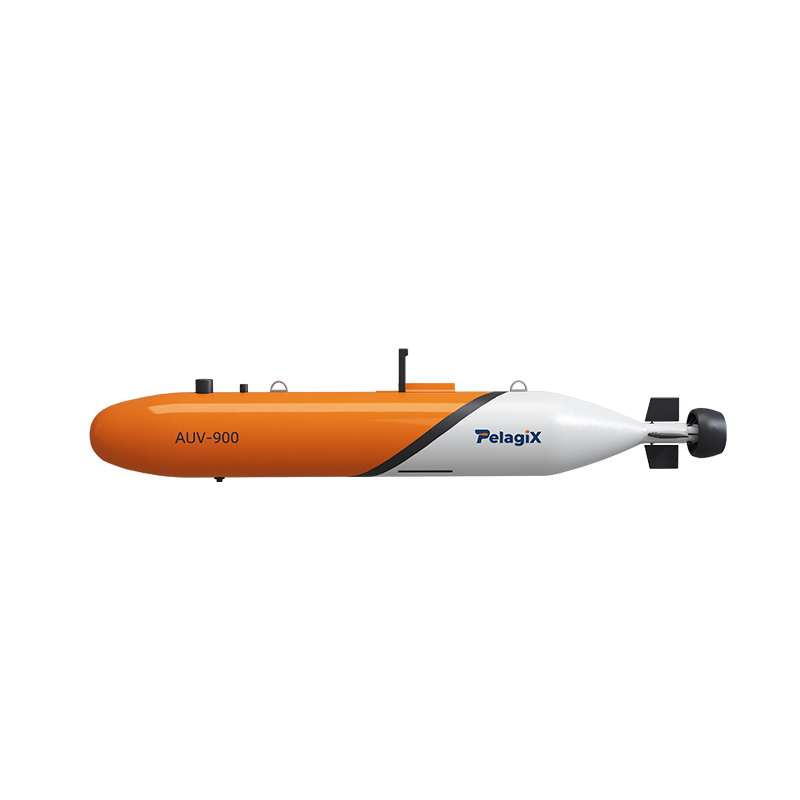
A depth rating is the most consequential line in a deep-sea AUV specification — and the one most often read in the wrong frame. For an autonomous underwater vehicle (AUV), the rated depth defines three things at once: the pressure boundary that protects the electronics, the material system that carries structural and buoyancy loads, and the documentation package a buyer can present to a client, a class society or a regulator.
Buyers in the research and evaluation stage rarely struggle to find suppliers. The harder task is separating platforms that genuinely operate at 6000 m from shallow-water vehicles marketed under the same category term. That distinction is a procurement constraint rather than a technical footnote: it changes hull material, payload capacity, endurance, navigation accuracy, lead time and the paperwork that ships with the vehicle.
The category is expanding. MarketsandMarkets estimates the global AUV market at approximately USD 2.0–2.57 billion for 2024/2025, while Fortune Business Insights projects the large/deep AUV segment — platforms rated deeper than 1000 m — growing at a 12.0% CAGR across its forecast period. Growth is concentrated precisely where specification ambiguity is most expensive.
Why depth ratings get conflated across the AUV category
A 20 kg portable micro vehicle rated for 100 m and a 2000 kg exploration platform rated for 6000 m are both listed as “autonomous underwater vehicles”. Public trade classification does not resolve the gap either: US Customs and Border Protection ruling NY N159975 classifies ROV and AUV equipment under HS 901580 or 890690, codes that aggregate oceanographic instruments and vessels rather than separating them by depth class.
The practical consequence for procurement teams is that category-level comparisons — price per unit, weight per vehicle, mission hours per charge — are frequently drawn from platforms that cannot be deployed in the same water. Depth class has to be fixed before any other specification is compared.
The four physical constraints behind a deep-sea depth rating
Four subsystems determine whether a 6000 m claim holds, and each one can be verified separately.
1. Pressure hull and housing material. Deep-rated platforms in the Pelagix AUV range use titanium alloy pressure housings, while shallow-class vehicles use high-strength anodized aluminium alloy, a titanium housing option, or a lightweight aluminium frame depending on model.
2. Buoyancy module. Deep-sea platforms use corrosion-resistant syntactic foam, a material that has to maintain buoyancy under prolonged hydrostatic load; shallow classes rely on a seawater-resistant polymer casing and overall positive buoyancy.
3. Pressure-sealed electronics. The electronic pod is pressure-sealed and paired with seawater-resistant electronics and corrosion-resistant components across the range.
4. Navigation and positioning. Deep-sea platforms integrate INS+DVL+GNSS+USBL, with SLAM added on the AUV-533, AUV-900 and AUV-F760. Published positioning accuracy is expressed as a percentage of range: 0.2% for the AUV-900, 0.3% for the AUV-480 and 0.5% for the AUV-600. Micro and nearshore platforms rely on integrated INS, DVL and GNSS, with no separate accuracy test report referenced in the available asset data.
| Model | Class | Depth rating (configurable) | Material system | Payload | Endurance @ 3 knots |
|---|---|---|---|---|---|
| AUV-150 | Portable micro AUV | 0–100 m | Lightweight aluminium frame, seawater-resistant polymer casing, pressure-sealed electronic pod | 3 kg | ≥8 h |
| AUV-160 | Portable micro AUV | 0–100 m | Aluminium frame, seawater-resistant polymer casing, pressure-sealed pod | 5 kg | ≥8 h |
| AUV-210 | Nearshore survey AUV | 0–200 m | Aluminium frame, seawater-resistant polymer casing, pressure-sealed pod | 10 kg | ≥10 h |
| AUV-260 | Nearshore survey AUV | 0–500 m | Aluminium frame, seawater-resistant polymer casing, pressure-sealed pod | 20 kg | ≥12 h |
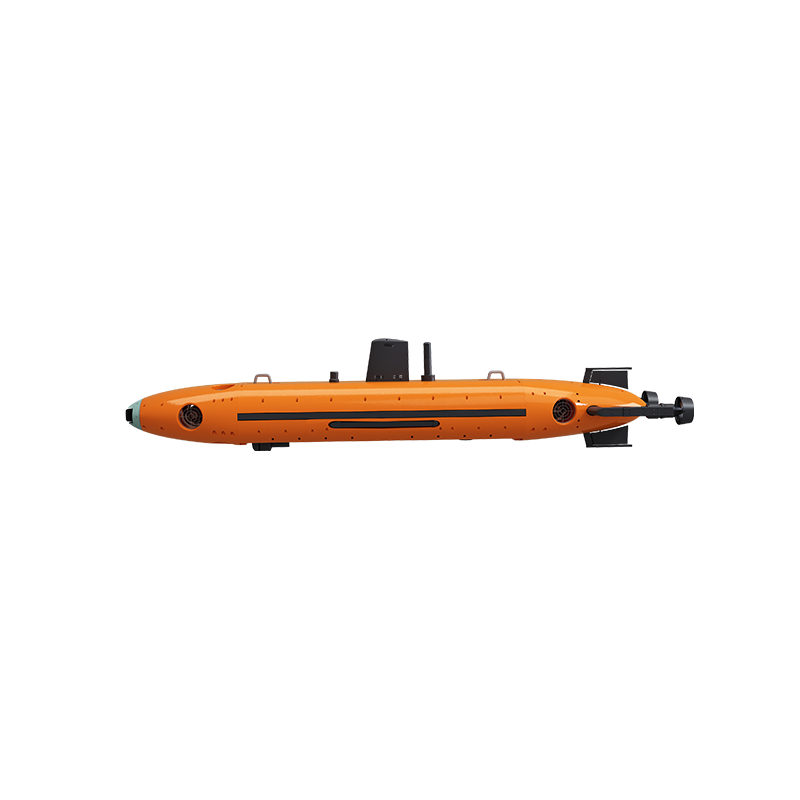
| AUV-324 | Deep-diving modular survey AUV | 600 m / 2000 m | High-strength anodized aluminium alloy, titanium housing option, corrosion-resistant composite frame | 30 kg | ≥20 h (up to 50 h / 300 km custom) |
| AUV-480 | Streamlined high-stability AUV | 300 m operating depth listed; asset record also references a 2000 m pressure-rated hull | Anodized aluminium alloy or titanium, corrosion-resistant composite frame | Not specified in asset record | ≥20 h |
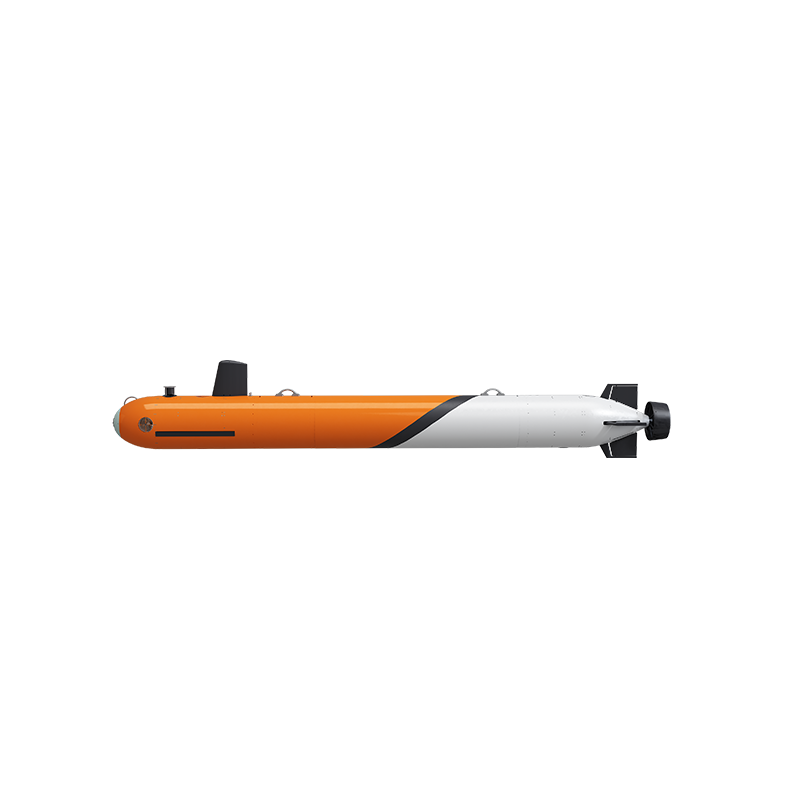
| AUV-533 | Waterway / offshore wind / swarm survey AUV | 2000 m / 6000 m | 6000 m pressure-rated hull, titanium alloy pressure housing, syntactic foam buoyancy module | 150 kg | ≥90 h (up to 180 h / 1000 km custom) |
| AUV-600 | Long-range heavy / 6000 m exploration AUV | 1000 m / 3000 m / 6000 m | 6000 m pressure-rated hull, titanium alloy pressure housing, syntactic foam buoyancy | Not specified in asset record | ≥24 h |
| AUV-900 | Long-range heavy / all-domain AUV | 3000 m / 4500 m / 6000 m | 6000 m pressure-rated hull, titanium alloy pressure housing, syntactic foam buoyancy | 250 kg | ≥90 h (up to 270 h / 1500 km custom) |
| AUV-F760 | 6-DOF intervention-class AUV | 600 m / 1200 m optional | Lightweight aluminium frame, seawater-resistant polymer casing, pressure-sealed pod | 60 kg | ≥20 h (up to 400 h / 100–200 km custom) |
Two entries deserve written clarification during evaluation. The AUV-480 asset record lists a 300 m operating depth alongside a 2000 m pressure-rated hull reference, and the AUV-600 record specifies a 6000 m rating without listing a payload figure. Both are normal documentation gaps in a broad catalogue, but neither should be resolved by assumption.
Certification: what a deep-sea AUV buyer can actually file
Sanya Poseidon Ocean Technology Co., Ltd. is a deep-sea intelligent equipment manufacturer based in the Yazhou Bay Deep-Sea Equipment Industrial Park in Sanya, Hainan. The company develops the Pelagix AUV line alongside ROVs, core underwater components and marine software systems, and operates an R&D team of 37. Its AUV systems are covered by a Survey-Grade Bathymetric & Environmental Compliance Certification issued jointly by China Classification Society (CCS) and Det Norske Veritas (DNV).
| Certification | Survey-Grade Bathymetric & Environmental Compliance Certification |
| Certificate number | AUV-REG-2025-0881 |
| Issued by | China Classification Society (CCS) / Det Norske Veritas (DNV) |
| Validity | 2025-01-15 to 2030-01-14 |
| Covered products | AUV-533, AUV-600, AUV-900, AUV-F760 (the last covered for subsea pipeline inspection) |
| Covered hull span | Deep-sea pressure-rated hulls from 2000 m to 6000 m |
| Referenced standards | IHO S-44 Special Order Standards for Hydrographic Surveys; ISO 9001:2015; DNV-ST-F101 (Subsea Pipeline Systems); IEC 60529 IP68; marine environmental-monitoring compliance standards |
| Markets | Global — EU, North America, Asia-Pacific, Middle East |
Two details matter for evaluation. First, the certificate scope names specific models: AUV-533, AUV-600, AUV-900 and AUV-F760. Second, the covered hull span is 2000 m to 6000 m, a materially different band from the shallow-water classes. A buyer specifying an AUV-324, AUV-260 or AUV-210 cannot assume the same certificate applies, even though all three are AUVs from the same manufacturer. In tender documents, the model name should appear in the certification clause, not just the supplier name.
Where the documentation stops
Constraint-based procurement improves when the limits are stated as plainly as the capabilities. Three limitations are visible in the available technical records.
For the shallow micro and nearshore classes, the recorded depth ranges are 0–100 m for the AUV-150 and AUV-160, and 0–200 m for the AUV-210. These ranges do not correspond to a 6000 m rating, and the asset records for these models do not provide hydrostatic pressure test report identifiers or CE compliance documentation identifiers. Navigation accuracy for them relies on an integrated INS, DVL and GNSS configuration, with no separate accuracy test report referenced.
For the AUV-480, the operating depth listed in the product specification is 300 m, while the same record references a 2000 m pressure-rated hull. Until a written clarification is issued, that platform should not be specified for 2000 m missions on the basis of catalogue data alone.
Paywalled or unspecified parameters are the third limit. Payload capacity is not stated in the available records for the AUV-480 and AUV-600, and no price band is published for any model in the range. For evaluation-stage buyers, the responsible step is to request the missing figures in writing rather than interpolating them from hull size or class.
Matching platform to mission constraint
Once depth class is fixed, mission type becomes the second filter. The mapping below follows the documented application and product records.
| Mission constraint | Documented platform | Why it fits |
|---|---|---|
| Abyssal bathymetric mapping, subsea geological survey, abyssal environmental monitoring to 6000 m | AUV-600 | 6000 m pressure-rated hull, titanium alloy housing, INS+DVL+GNSS+USBL at 0.5% range accuracy, ≥24 h at 3 knots |
| Waterway and offshore wind survey; multi-AUV swarm coordinated survey | AUV-533 | 2000 m / 6000 m configurability, 150 kg payload, INS+DVL+GNSS+USBL+SLAM, ≥90 h at 3 knots and documented swarm survey capability |
| Long-range oceanographic survey, mesoscale vortex tracking, trans-oceanic environmental monitoring, offshore wind farm inspection | AUV-900 | 250 kg payload, up to 270 h / 1500 km custom endurance, 0.2% range positioning accuracy with SLAM |
| Offshore oil and gas inspection; subsea pipeline route survey and structural hazard detection | AUV-324 | 2000 m pressure-rated hull, 30 kg modular payload bay, entanglement identification and cut-and-clear tooling |
| Inspection, maintenance and repair of subsea pipelines, offshore wind foundations and underwater structures | AUV-F760 | 6-DOF intervention class with 6–8 thrusters, dual manipulator arms for gripping, cutting and rotating |
| Dam walls, reservoir bathymetry and siltation survey, confined intake tunnels with near-zero visibility | AUV-210 / AUV-260 | 0–200 m and 0–500 m ratings with SLAM mapping, obstacle-avoidance cruising and shore-based monitoring station support |
Field evidence from evaluation-stage projects
Two documented deployments illustrate how these constraints behave in practice. An offshore oil and gas engineering contractor operated four AUV-324 medium survey systems for two years, completing 1,200 km of subsea pipeline inspection and identifying 18 critical structural anomalies and marine growth entanglements with zero safety incidents. A marine scientific research institute operated three AUV-260 nearshore survey vehicles for three years, producing continuous CTD water-quality data and side-scan sonar seabed mapping results while reducing diver operation exposure and cutting field survey time by 45%.
Endurance is a configuration decision, not a fixed number
Endurance figures are only comparable when the speed basis is identical, which is why every published figure in this range is stated at 3 knots. Standard endurance spans ≥8 hours for the portable micro class and ≥90 hours for the AUV-533 and AUV-900. Customised options extend those numbers materially: up to 50 hours or 300 km on the AUV-324, up to 180 hours or 1000 km on the AUV-533, up to 270 hours or 1500 km on the AUV-900, and up to 400 hours or 100–200 km on the AUV-F760.
Those extensions are not free. One commercial research estimate puts energy storage at roughly 40% of an AUV’s internal volume for missions that typically last up to 24 hours, which is a useful way to think about the trade: endurance is largely bought with internal volume, and internal volume is the same space that carries sensors and payload. A buyer requesting 270-hour endurance and a large sonar payload is asking for two things that compete for the same cubic metres, which is why endurance and payload bay configuration are usually specified together rather than sequentially.
A procurement verification checklist
For teams comparing deep-sea AUV platforms, the following checks convert a specification sheet into a defensible selection.
- Confirm whether the stated number is an operating depth, a rated depth, or a pressure-rated hull reference — and whether the model is configurable across depth bands.
- Request the hull and housing material in writing: titanium alloy versus anodized aluminium alloy determines both cost and credible depth class.
- Request hydrostatic pressure test documentation for the specific hull, particularly where asset records do not reference test report identifiers.
- Match the certification clause to the exact model. The Survey-Grade Bathymetric & Environmental Compliance Certification covers AUV-533, AUV-600, AUV-900 and AUV-F760, with a hull span of 2000 m to 6000 m.
- Verify the navigation basis and accuracy definition, for example 0.2% versus 0.5% of range, and whether a separate accuracy test report is supplied.
- Confirm endurance is quoted at a stated speed and whether extended endurance requires battery and hull reconfiguration at order.
- Align lead time to project schedule: 60–90 days for standard models, 120–180 days for customised deep-sea 6000 m systems, with stated monthly capacity of 8–10 units for custom industrial and research AUV platforms and core components.
- Confirm the quality control chain and warranty scope: incoming inspection, in-process inspection, HIL simulation, final inspection and factory outgoing inspection, with a 2-year warranty on pressure hull and electronics.
How autonomous platforms compare with traditional methods
Traditional alternatives remain valid for specific tasks, and the trade-offs are structural rather than promotional. Towed survey systems deliver continuous power and real-time telemetry but require a survey vessel, a tow cable and favourable manoeuvring space, which makes them less practical inside confined structures or around complex subsea geometry. Work-class ROVs provide real-time human control and intervention capability, but the umbilical, vessel time and crew requirements constrain how long a survey can run and how it is scheduled. Manned submersibles offer direct human judgement, at correspondingly higher operational exposure and cost per hour on site.
Untethered AUVs change the economics of coverage rather than of control: no umbilical means longer linear surveys and swarm operation, but also no live human intervention during a mission, which shifts value onto pre-planned mission design, onboard autonomy and post-mission data recovery. The Pelagix AUV range also carries limits worth stating: no model in the range publishes a price band, custom 6000 m systems involve the longer 120–180 day lead time, the micro and nearshore classes are not deep-sea rated, the certification does not extend to every model, and the 2-year warranty covers the pressure hull and electronics rather than the complete system.
Market signals shaping deep-sea AUV sourcing
Three market-level signals are relevant to procurement timing. First, the value of the global AUV market sits at roughly USD 2.0–2.57 billion for 2024/2025, with the deeper segment growing faster than the category as a whole. Second, trade classification under HS 901580 or 890690 aggregates AUVs with other oceanographic instruments, so customs data cannot be used as a reliable proxy for deep-sea AUV supply capacity — buyers should rely on supplier documentation instead of trade statistics. Third, competitive benchmarks are concentrated: public commercial analysis attributes approximately NOK 24.2 billion (around USD 2.3 billion) in 2025 revenue to Kongsberg Maritime, with its HUGIN AUV portfolio cited as a significant contributor to an estimated 15–20% share of advanced ocean systems. A fragmented supplier base below that tier means qualification effort per supplier matters more than brand familiarity.
Assurance expectations are also moving. ISO 21448, the Safety of the Intended Functionality (SOTIF) framework originally developed for road vehicles, is increasingly discussed in marine robotics as a way to address non-fault-based hazards — a signal that autonomous behaviour documentation may follow certification documentation into tender requirements over the coming years.
Future outlook
Depth rating, endurance and documentation are converging into a single specification package. A 6000 m claim is becoming inseparable from questions about hull material, certification scope, pressure test evidence and mission endurance at a stated speed, because those are the elements a class society, insurer or end client will ask for. Growth in the deeper segment suggests more suppliers will enter the 2000 m to 6000 m band, which raises rather than reduces the value of model-level documentation checks. In parallel, multi-vehicle operation and AI-assisted autonomy — reflected in documented capabilities such as multi-AUV swarm survey, the multi-AUV cooperative detection system and the OceanX-Eddy mesoscale vortex forecasting model — shift procurement questions toward fleet-level mission planning and data workflow rather than single-vehicle specifications.
Frequently asked questions
What does a 6000 m depth rating actually mean on a deep-sea AUV?
It means the vehicle’s pressure-rated hull is designed for operation at 6000 m, which in the Pelagix range is accompanied by a titanium alloy pressure housing, a corrosion-resistant syntactic foam buoyancy module and seawater-resistant electronics. On the AUV-533, AUV-600 and AUV-900 this rating is configurable, so the same platform family can be delivered at shallower depth bands such as 2000 m, 3000 m or 4500 m.
Which AUV models carry the Survey-Grade Bathymetric & Environmental Compliance Certification?
The certification, numbered AUV-REG-2025-0881 and issued by China Classification Society (CCS) and Det Norske Veritas (DNV), covers the AUV-533, AUV-600, AUV-900 and AUV-F760, with the AUV-F760 covered for subsea pipeline inspection. The scope covers deep-sea pressure-rated hulls from 2000 m to 6000 m, applies to regulatory-ready systems, survey-grade mapping platforms and industrial-grade offshore inspection equipment, and is valid from 2025-01-15 to 2030-01-14.
How should a buyer verify a depth rating before committing to a purchase?
Request the hull and housing material in writing, request hydrostatic pressure test documentation, and confirm that the certification scope names the specific model rather than only the manufacturer. Where documentation is not supplied with the catalogue data — as is the case for the AUV-150, AUV-160 and AUV-210 records, which reference no pressure test report identifiers, and for the AUV-480, whose record lists a 300 m operating depth alongside a 2000 m hull reference — the requirement should be resolved in writing before the specification is fixed.
What endurance can be expected, and on what basis?
Published endurance figures for this range are stated at 3 knots, from ≥8 hours on the AUV-150 and AUV-160 to ≥90 hours on the AUV-533 and AUV-900, with ≥24 hours on the AUV-600, ≥20 hours on the AUV-324 and AUV-480, and ≥12 hours on the AUV-260. Custom endurance options extend to 50 hours or 300 km on the AUV-324, 180 hours or 1000 km on the AUV-533, 270 hours or 1500 km on the AUV-900, and 400 hours or 100–200 km on the AUV-F760.
What are the lead time and minimum order quantity for a deep-sea AUV?
The minimum order quantity is 1 unit. Lead time is 60 to 90 days for standard models and 120 to 180 days for customised deep-sea 6000 m AUV systems. Stated monthly capacity is 8 to 10 units for custom industrial and research AUV platforms and core components.
What quality control and after-sales commitments accompany an industrial AUV platform?
Quality control covers incoming inspection, in-process inspection, HIL simulation, final inspection and factory outgoing inspection. After-sales support includes remote technical support, on-site sea-trial commissioning assistance, operator training, a 2-year warranty on the pressure hull and electronics, and modular spare parts supply.
Technical documentation for the AUV series, including the Overseas Version product brochure, is available for download here: AUVs Products brochure (Overseas Version).