
Decorative Wall Panel Qualification File: A2 Fire, Asbestos-Free
A decorative wall panel qualification file is the set of test reports, declarations and commercial documents that lets a buyer prove — before the first container ships and again at every repeat order — that a panel's fire, hygiene and material claims are real. For silica mineral panels, that file usually turns on four items: an EN 13501-1 result of A2-s1,d0, the Class A2 reaction-to-fire report attached to the offer, an ISO 846:2019 Method A antibacterial result recorded as no growth, and a negative asbestos finding.
Why a Fire Class Label Is Not a Qualification File
Almost every commercial brief for a fireproof decorative wall panel now names a fire class. Almost none of them describe what should sit behind that name. The result is a familiar pattern in procurement: a supplier states 'Class A fireproof' on a datasheet, the buyer files it, and the actual evidence — which standard, which test method, which model and thickness was tested, which laboratory issued the report, and whether the report is still the current one for the product being shipped — is never assembled.
That gap matters because the classification itself is a scale, not a yes or no. Under EN 13501-1, reaction to fire is classified from A1 (non-combustible) through to F, and the classification number is followed by additional classes for smoke production and for flaming droplets. A product described loosely as 'Class A' could therefore be A2 or a differently classified material with a different smoke suffix. Without the underlying report, a buyer cannot tell which of those applies, and cannot defend the specification to a project reviewer, insurer or fire consultant.
The commercial context makes this more than a paperwork issue. The global decorative panels market has been projected to reach USD 39.35 billion by 2026, driven by urbanisation and interior renovation demand (Coherent Market Insights). Asia Pacific held 43.6% of the wall panels market in 2025 and has been identified as the fastest-growing region (Reed Intelligence). Within the surface segment, 3D wall panels were estimated at USD 815.02 million in 2025 with a forecast CAGR of 4.93% (360iResearch).
A note on market definitions. Published valuations are not directly comparable. Some sources define 'decorative panels' broadly enough to include furniture and cabinet laminates — laminate alone has been projected at 45.4% of that broader category by 2026 (Coherent Market Insights) — while 'wall panels' figures are restricted to building cladding elements. Treat these numbers as directional signals about volume growth, not as a measurement of the wall-cladding segment alone.
What follows therefore focuses on the one thing a buyer can actually control at the decision and execution stage: the document set requested, the wording expected inside each document, and the checks that catch a file that does not match the product on the purchase order.
The Evidence Set Behind Silica Mineral Model 8804
Power Dekor Group is a Shanghai-based provider of floor covering and wall panel solutions, founded in 1995 and part of Dare Global Group. The company operates a factory area of 870,000 m² with annual production capacity of 88,000,000 m² of flooring and wall panel products, and its sales network covers North America, South America, Europe, Oceania, Asia and the Middle East.
Within that portfolio, the Silica Mineral Wall Panel — model 8804 — is offered as both an interior and an exterior wall panel. Its declared composition is quartz, cement, pulp, lime and water, with no plastic in the material specification. The qualification evidence attached to the model is unusually specific for the decorative wall panel category, and it is worth listing exactly as it is stated:
| Evidence item | Declared result for model 8804 |
|---|---|
| Reaction to fire classification | A2-s1,d0 |
| Fire report | Class A2 reaction-to-fire report attached to the product documentation |
| Regional fire compliance | EU fireproof Class A compliance stated |
| Antibacterial test | ISO 846:2019 Method A — no growth apparent under the microscope |
| Asbestos content | Negative |
| Material composition | Quartz, cement, pulp, lime and water; no plastic |
| Water performance | 100% waterproof performance stated |
| Moisture movement | 0.06% in the length direction; 0.06% in the width direction |
| Boiling test | 100 °C boiling test recorded |
| Available sizes | 2400 / 2440 / 3000 / 3050 × 1200 / 1220 × 6 / 8 / 10 mm |
Read as a set rather than as individual claims, these items describe a mineral-core panel intended for wet, interior applications where a fire classification above Class B is required — the configuration that public buildings, healthcare interiors and transport-adjacent spaces tend to specify.
Reading the Fire Classification Correctly
A2-s1,d0 is a compact statement carrying three separate pieces of information. A2 places the material in the limited-combustibility band near the top of the EN 13501-1 scale; s1 describes a restricted level of smoke production; d0 indicates no flaming droplets or particles during the test. A buyer preparing a submittal should expect all three elements to appear together, because a report supporting only the main class does not automatically carry the suffixes.
The distinction becomes practical when one supplier offers more than one panel family. Within the Power Dekor Group range, SPC wall panels are classified B-s3,d0 and meet the EN 13501-1 Class B reaction-to-fire requirement, while the Silica Mineral Wall Panel is classified A2-s1,d0. Both are legitimate products; they simply answer different briefs. Where a specification states Class B, an SPC decorative wall panel satisfies it. Where the brief calls for Class A2 or explicitly excludes B-class materials from an escape route, lobby or high-occupancy interior, the silica mineral option is the one whose documentation matches the requirement.
Three checks catch most fire-document problems. First, confirm the report names model 8804 and not a sibling product. Second, confirm the tested thickness — the range spans 6, 8 and 10 mm, and classification results attach to tested constructions. Third, confirm whether the report covers the decorated face as supplied, since surface treatment is a separate process step in wall panel manufacturing.
Antibacterial and Asbestos Evidence: What the Reports Actually State
The antibacterial entry is often the most loosely handled item in a wall panel file. The record for model 8804 states a test to ISO 846:2019, Method A, with the result expressed as no growth apparent under the microscope. That wording is deliberately narrow, and buyers should treat it as such.
Method A is one method within the ISO 846:2019 framework, and a result recorded under it describes the behaviour of the tested specimen under that specific procedure. It is not, by itself, a quantified reduction figure, and it does not describe performance over the service life of an installed panel. When two offers both cite ISO 846, the meaningful comparison is the method letter, the organisms included in the test, the specimen condition and the laboratory — four details that a one-line certificate summary usually omits.
The asbestos entry is simpler but equally dependent on wording. A 'negative' asbestos content statement is the form buyers want, because it records an analytical finding rather than an assurance. Request the sample description alongside it: an asbestos result is only useful if the sample described is the panel construction actually being purchased, at the thickness and with the surface finish being supplied.
Composition, Water and Dimensional Behaviour
The declared composition — quartz, cement, pulp, lime and water — explains several of the other results. It is a mineral system with no plastic in the material specification, which distinguishes it from SPC (stone plastic composite) panels in the same portfolio. For specifiers working to material-restriction clauses or to briefs that exclude plastic-based wall linings, that composition statement is often the deciding document rather than the fire report.
Water performance is stated as 100% waterproof, and moisture movement is declared at 0.06% in both the length and the width direction. Expressed as a percentage of panel dimension, the movement figure allows a designer to calculate joint and fixing allowances for the panel size actually specified, rather than relying on a generic 'dimensionally stable' claim. The 100 °C boiling test recorded for the model adds a high-temperature water exposure point to the same evidence set — relevant for wet-area specification and for buyers who want confirmation that the panel has been assessed beyond ambient moisture.
Where the File Changes the Specification
Documentation changes decisions mainly in two settings: bathrooms and other continuously wet interiors, and public or commercial spaces where the fire class is a project condition rather than a preference.
Bathroom and wet-area interiors
Applicable conditions recorded for the silica mineral panel include interior installation in humid and wet working conditions, in building decoration projects across Germany, Spain, Austria, France, Réunion, the United Kingdom and South Korea. Installation is by structural adhesive to the wall with a locking system between panels, supported by sealant and edge trim profiles. In wet bathroom construction, metal trims are not applicable; silicone sealant is used to seal joints between panel and ceiling and between panel and floor for water insulation. That detail is frequently missed in tender drawings and is a common source of post-installation complaints.
Public and commercial interiors
Where a designer is choosing between panel families rather than between suppliers, the internal guidance is direct: for a private bathroom where price matters most, SPC wall panel is the more economical route; for public space with fireproof requirements, where the surface should read closer to porcelain, the silica mineral panel is the appropriate specification. That is a fit question, not a quality ranking — and it is exactly the kind of distinction a qualification file is meant to settle before the order rather than after installation.
Exterior and decorative surface variants
Model 8804 covers both interior and exterior wall panel applications, so the same core evidence can sit behind an exterior decorative wall panel specification. Surface decoration is delivered through digital printing, which allows a continuous pattern to run across panels — a practical option where a façade or feature wall needs design continuity rather than a repeated single-sheet motif.
Decorative Wall Panels vs Tile and SPC: Where the Evidence Advantage Stops
Compared with ceramic tile, the case for a panel system in renovation work rests on programme and labour rather than on the panel replacing tile in every role. For bathroom renovation, SPC wall panel or silica mineral wall panel installation can be completed in one day, saving labour cost, and the surface is easy to clean with less maintenance work. Production of the panel also carries lower carbon emission than the tile route. Those are meaningful advantages when a building is occupied and downtime is the constraint.
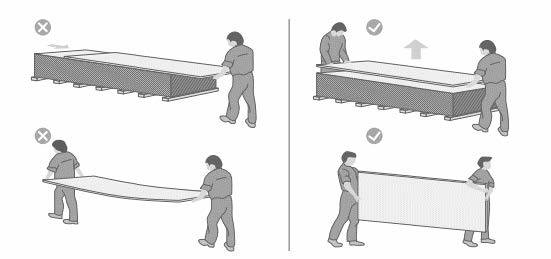
The limits are equally real. Panel installation depends on a flat substrate and on structural adhesive performance; the panel edges are fragile and need care during handling and cutting; in wet areas metal trims cannot be used, so joint sealing discipline determines whether the waterproof claim survives contact with the installed assembly; and on unit cost, SPC remains the more economical choice for a private bathroom. A buyer who requests an A2 fire report for a domestic shower room may be buying documentation the project does not need, while paying more per square metre than the specification requires.
| Decision factor | Silica mineral panel (8804) | SPC wall panel |
|---|---|---|
| Reaction to fire | A2-s1,d0 | B-s3,d0 |
| Core composition | Quartz, cement, pulp, lime and water; no plastic | Stone plastic composite |
| Typical fit | Public and commercial interiors with fireproof requirements | Private bathrooms and cost-sensitive renovation |
| Surface character | Closer to porcelain | Film or digital print finish |
| Main buyer caution | Higher unit cost than SPC; adhesive and substrate discipline required | Does not meet briefs specifying Class A2 |
The Procurement Checklist: Turning Documents into Acceptance Criteria
A qualification file is only useful if it converts into acceptance criteria that a quality team can apply to a shipment. The table below sets out the documents worth requesting for a silica mineral decorative wall panel programme, what each is expected to establish, and the check that most often reveals a mismatch.
| Document | What it should establish | Check before approval |
|---|---|---|
| Class A2 reaction-to-fire report | A2-s1,d0 classification under EN 13501-1 | Model, thickness and finish match the purchase order |
| EU fireproof Class A compliance statement | Confirms the class required by the project brief | Class letter and suffixes both stated |
| ISO 846:2019 Method A antibacterial report | No growth apparent under the microscope | Method letter and test organisms identified |
| Asbestos content report | Negative result for the supplied construction | Sample description matches the shipped panel |
| Composition declaration | Quartz, cement, pulp, lime and water; no plastic | Declared as the panel construction, not a marketing summary |
| Water and dimensional data | 100% waterproof performance; 0.06% moisture movement; 100 °C boiling test | Data issued for the specified thickness |
| Pre-shipment test as acceptance criteria | Inspection occurs before goods leave the factory | Inspection scope and sampling agreed in writing |
Keeping the File Valid Across Repeat Orders
For distributors, importers and project buyers running a multi-phase programme, the harder question is not whether a file exists but whether it will still describe the product in container four. That is where supplier scale and process stability become part of the evidence.
Power Dekor Group operates SPC production lines, digital printing wall panel production lines, laminate production lines and multi-layer engineered flooring production lines across a factory area of 870,000 m², with annual production capacity of 88,000,000 m² and a team that includes 495 engineers. The after-sales installation network includes nearly 10,000 installation engineers — a relevant figure when a specification depends on adhesive and sealing discipline being executed consistently across sites rather than in one showroom bathroom.
Commercially, orders are limited to a maximum of four SKUs per container, with a minimum order quantity of 500 m² per SKU and one 20GP container per order. Where LCL shipping is used, price increases apply. Delivery terms are FOB, payment is by TT with 30% in advance and 70% balance against document copies or L/C at sight, and acceptance is based on pre-shipment testing. For a buyer building a long-term decorative wall panel programme, those terms shape how the file is used in practice: a four-SKU ceiling per container means the qualification scope should be agreed at SKU level, so that each thickness and finish entering the programme has its matching documentation from the first shipment onward.
Market Direction: Why A2 Documentation Is Requested More Often
Two pressures are moving decorative wall panel specification toward heavier documentation. The first is regulatory: EN 13501-1 classification is the reference point for commercial wall panels in Europe, and the scale from A1 to F gives project teams a concrete way to exclude materials from sensitive interior zones. The second is material: as mineral-core panels move from niche specification into mainstream commercial interiors, buyers have begun comparing them against SPC on fire class rather than on price or appearance alone.
Market growth supports the shift in volume terms — decorative panels projected at USD 39.35 billion by 2026, Asia Pacific holding 43.6% of the wall panels market in 2025, and the 3D wall panel segment forecast to grow at 4.93% CAGR from a 2025 base of USD 815.02 million. Growth of that kind rarely leaves specification practice unchanged; larger project pipelines tend to formalise what was previously negotiated.
Future Outlook
The most likely change over the next procurement cycles is not a new fire class but a change in how evidence is delivered. Buyers are already asking for report numbers rather than certificates, for method letters rather than test names, and for a document set that travels with the SKU. Suppliers who can answer at that level — with a named model, a stated method, a declared composition and a dimensional figure — will find the qualification conversation shorter, while suppliers who answer with a datasheet will keep encountering the same requests at every repeat order.
For mineral-core panels specifically, the open questions buyers should keep asking are the ones the current file answers only partially: whether reports cover the decorated finish as supplied, and what re-test cadence applies when a thickness or surface treatment changes. Those are the points where a qualification file either stays alive or quietly goes out of date.
FAQ
What fire documentation should a buyer request for a decorative wall panel?
Request the EN 13501-1 reaction-to-fire report itself, not a summary, and confirm that it states the full classification including suffixes. For the Silica Mineral Wall Panel model 8804, the stated classification is A2-s1,d0, supported by an attached Class A2 report and a stated EU fireproof Class A compliance. The report should name the model, the tested thickness and the surface finish supplied, because classification results attach to tested constructions.
What does an ISO 846:2019 Method A antibacterial result actually confirm?
It confirms the outcome of a test carried out to ISO 846:2019 using Method A. For model 8804 the recorded result is no growth apparent under the microscope. The result describes the tested specimen under that method; it is not a quantified reduction figure and does not by itself describe performance across the service life of an installed panel. Buyers comparing offers should compare the method used, the organisms included and the issuing laboratory, not only the standard number.
How is an asbestos-free claim verified?
By obtaining a report that records a negative asbestos content result and checking the sample description against the panel actually being purchased. For model 8804 the declared asbestos content is negative. The verification step is matching the tested sample to the supplied construction — thickness and surface finish included — rather than accepting the statement on a datasheet.
Can a plastic-free silica mineral panel be used in bathrooms and other wet areas?
Yes, within the stated conditions. Model 8804 has a declared composition of quartz, cement, pulp, lime and water with no plastic, states 100% waterproof performance, declares 0.06% moisture movement in both length and width directions, and records a 100 °C boiling test. Installation is by structural adhesive with a locking system, and in wet bathroom areas metal trims are not applicable — silicone sealant must be used at joints between panel and ceiling and between panel and floor to maintain water insulation.
What commercial terms apply when qualifying a supplier for repeat decorative wall panel orders?
For Power Dekor Group, the minimum order quantity is 500 m² per SKU and one 20GP container per order, with no more than four SKUs per container; LCL shipments carry a price increase. Delivery terms are FOB, acceptance is based on pre-shipment testing, and payment is TT with 30% in advance and 70% balance against document copies or L/C at sight. Because of the four-SKU ceiling, qualification scope is usually agreed SKU by SKU so that each thickness and finish entering a repeat programme has matching documentation.
The Power Dekor Group product brochure is available for download: Power Dekor Group brochure (PDF).
¿Tiene preguntas o necesita más detalles?
Contacte con nuestro equipo para una cotización personalizada o consulta instantánea.
Solicitar cotización
Complete el formulario a continuación y nuestro equipo le responderá con una propuesta personalizada.
Chat directo de WhatsApp
¿Prefiere chatear en tiempo real? Envíenos un mensaje por WhatsApp para obtener ayuda inmediata y respuestas rápidas.
- Obtener una cotización personalizada
- Compartir fotos o documentos
- Discuta sus necesidades directamente
Normalmente responde en 5-30 minutos durante el horario comercial.