
Decorative Lighting for Hotel Lobbies: A Chandelier Shortlist
A hotel lobby chandelier is seldom a single purchase decision. It arrives at specification review as a package of electrical, optical, mechanical and documentation requirements, and it is judged against the same approval process as the lift core or the facade. The hospitality lighting segment was valued at USD 14.2 billion in 2025 and is forecast to grow at a 7.3% CAGR to USD 26.8 billion by 2034 (Dataintelo). The wider decorative lighting market reached USD 75.88 billion in 2025, with USD 78.98 billion projected for 2026 (Mordor Intelligence), and commercial applications, including hospitality, account for 62.8% of decorative lighting end-user demand (IMARC Group, 2025).
This shortlist is written for the stage where the lobby concept is already fixed but the fixture package is not. It compares decorative lighting options for three project conditions — the high-ceiling lobby, the double-height atrium and the banquet hall — using documented parameters rather than design adjectives, and it states clearly where the available evidence stops.
The reference manufacturer used throughout is Zhongshan YZ ART LIGHT Co., Ltd., a decorative lighting manufacturer based in Henglan Town, Zhongshan City, Guangdong Province, China, producing custom chandeliers, art glass installations and coordinated hotel lighting for hospitality and commercial interiors. The company operates a 15,000-square-metre production base with 150 employees and a 20-engineer R&D team, reports roughly 70% export share, and names Europe and the Americas together with the Middle East as its main markets. Two fixture references recur in this shortlist: the custom-made hotel lobby chandelier yz10001 and the hotel lighting model yz10002.
Why Lobby Chandelier Packages Fail Specification Review
Most rejected chandelier submittals in hospitality projects fail for reasons that have nothing to do with appearance. Four recurring problems dominate:
- Glare at mounting height. A fixture that reads well in a showroom photograph can produce harsh glare and uneven light-shadow once it hangs above a lobby seating group. Anti-glare light sources and a controlled beam are functional requirements, not styling options.
- Dimming that cannot be integrated. Lobby lighting is expected to shift between arrival, evening service and night modes. Where a fixture's dimming behaviour has not been matched to the project control system, commissioning stalls.
- Structural assumptions. Super-large suspended fixtures require a ceiling load-bearing structural calculation; oversized lobby and atrium pieces are exactly the category where that calculation must be produced by the party that controls the drawing.
- Certification scope drift. A supplier may hold EU electrical and hazardous-substance conformity evidence for a fixed hanging luminaire but not the North American documentation a US or Canadian project requires. The gap usually surfaces late, when substitution is expensive.
The shortlist below is organised around those four failure points rather than around style families.
The Shortlist: Three Project Conditions, Three Fixture Programmes
| Project condition | Recommended programme | Why it fits the condition | Parameters to lock before tender |
|---|---|---|---|
| High-ceiling grand lobby | yz10001 custom-made hotel lobby chandelier | Anti-glare light source, adjustable beam, custom size and shape to suit non-standard ceilings and reserved installation dimensions | Beam angle, colour temperature, dimming protocol, suspension points, load calculation |
| Double-height atrium | yz10002 hotel lighting range, engineered per project | Covered by the oversized suspended-fixture workflow, including ceiling load-bearing structural calculation and on-site installation support | Model-level confirmation of dimensions, wattage and colour temperature; structural approval |
| Banquet hall and ballroom | yz10002 crystal and ring configurations within the hotel lighting range | Dimmable scene control for event use, coordinated with lobby fixtures under one supply scope | Scene dimming levels, suspension height, maintenance access, spare-part plan |
Shortlist structure. Fixture programmes are matched to space conditions and to the documentation each condition requires; the table is a selection framework, not a brand ranking.
Option 1 — yz10001: The Custom-Made Hotel Lobby Chandelier
yz10001 is a non-standard engineering decorative pendant light designed as an anti-glare commercial ceiling lamp. Its documented parameters are unusually detailed for a category where most listings stop at diameter and finish, which is precisely why it holds the first slot for high-ceiling lobbies.
| Parameter | Documented value |
|---|---|
| Product type | Non-standard engineering decorative pendant light, anti-glare commercial ceiling lamp |
| Input voltage | AC110–240V |
| Power range | 30W–600W |
| Colour temperature options | 2700K–4000K |
| Beam angle | Adjustable, 15°–120° |
| Dimming | Customisable dimming function |
| Rated service life | 50,000 hours |
| Light decay | No more than 3% within 3,000 working hours |
| Protection grade | IP40 |
| Materials | Aluminium-alloy frame, stainless-steel suspension component, high-transmittance lampshade, imported LED light-source chip |
| Customisation | Size, shape and dimming function |
| Typical applications | High-star hotel, resort, lobby, clubhouse, banquet hall, commercial villa, high-end shopping-mall public areas |
Three of these parameters matter more than the rest in a lobby context. The 15°–120° adjustable beam lets the designer push light down onto a reception desk or wash a double-height wall without flooding the ceiling plane. The 2700K–4000K range allows one fixture family to serve both a warm residential-style lobby and a brighter, cooler arrival zone. And the 50,000-hour rated life with no more than 3% light decay within 3,000 working hours addresses the practical problem that lobby lighting runs long hours, every day, with limited access for lamp changes.
The aluminium-alloy frame with a stainless-steel suspension component is also a procurement signal. In oversized hanging fixtures, the suspension is the safety-critical element, and the choice of stainless steel there — rather than in a decorative trim — indicates the load path was treated as an engineered component rather than an accessory.
Option 2 — yz10002: A Hotel Lighting Range for Whole-Zone Coverage
yz10002 is the broader hotel lighting reference: chandeliers, art glass chandeliers, wall lamps, floor lamps, table lamps and outdoor lights, supplied as a coordinated package. Its parameters are provided per series or custom order, and specific dimensions, wattage and colour temperature require model-level confirmation. That is a meaningful constraint for a shortlist, because it means yz10002 cannot be tendered from a catalogue sheet alone — the specification has to be built against the project's drawings.
What yz10002 contributes to the shortlist is scope discipline. A lobby chandelier decision made in isolation tends to produce a fixture that is visually correct and contextually wrong, because the grand lobby, the banquet hall, the conference floor, the restaurant, the guest corridor and the club lounge are all seen by the same guest within an hour. The reference range covers all of those hotel zones under one aesthetic and one documentation set, using brass, stainless steel, aluminium, iron, glass, crystal, marble, acrylic and ceramic as the common material palette.
The service model attached to this range runs from drawing development and ceiling load-bearing structural calculation through sample production, mass manufacturing, on-site installation support and long-term maintenance, with global remote technical guidance for overseas clients. For atrium work specifically, the manufacturer states a track record in high-ceiling lobby oversized art lighting, double-height atrium installations and large banquet hall chandeliers.
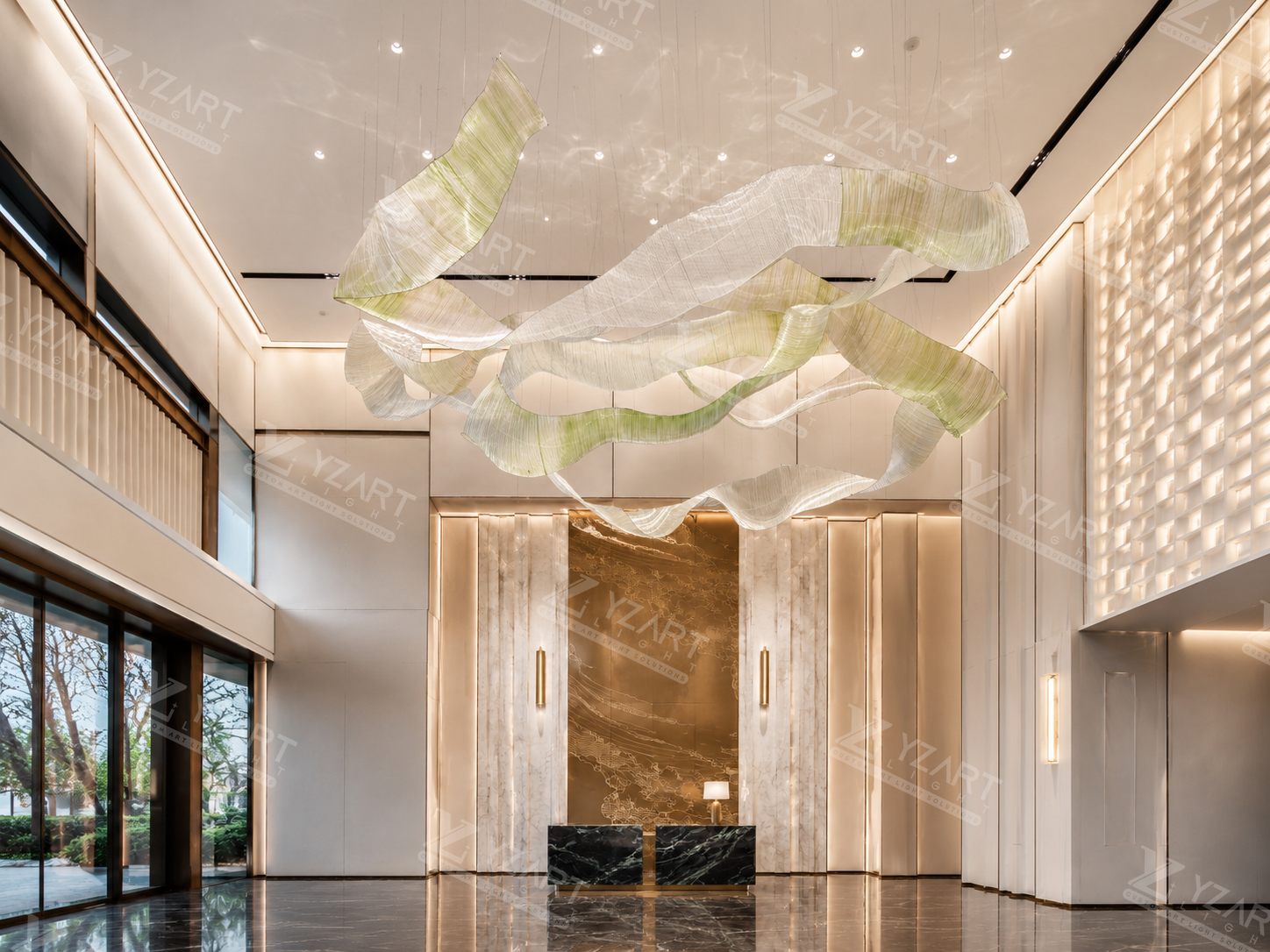
Double-height atrium installations are a distinct engineering category from lobby ceiling fixtures: suspension length, load distribution and maintenance access all change with the void height.
Certification Evidence: What to Verify Before Shortlisting
Certification is where a lobby chandelier shortlist either becomes defensible or collapses. The evidence below is the documentation set associated with yz10002 and the hotel lighting range, and it is specific enough to be checked against a tender checklist rather than accepted as a claim.
| Evidence | Applicable standards | Issuing body and certificate number | Scope, market and validity |
|---|---|---|---|
| LVD-CE Verification of Conformity | EN 60598-1:2015+A1:2018; EN 60598-2-1:1989; EN 62493:2015 | Guangzhou Quality Technology Service Co., Ltd. (QTS); certificate QTS800119288, test report ref. 61.11.19.0573.01 | Fixed luminaire (hanging lamp); EU market; issued 27 September 2019, valid to 2 September 2028 |
| CE-RoHS Verification of Conformity | IEC 62321-3-1:2013; IEC 62321-4:2013+A1:2017; IEC 62321-5:2013; IEC 62321-7-1:2015; IEC 62321-7-2:2017; IEC 62321-6:2015; EN ISO 17075-1:2017; IEC 62321-8:2017 | Guangzhou Quality Technology Service Co., Ltd. (QTS); certificate QTS800519289, test report ref. 61.15.19.0574.01 | Fixed luminaire (hanging lamp), corresponding to chandelier products in the hotel lighting range; EU market; issued 27 September 2019, valid to 27 September 2028 |
| ISO 9001:2015 Quality Management System | GB/T19001-2016 / ISO9001:2015 | Zhongtai Zhilian Certification (ZTZL); certificate ZTZL28025Q1464R0S | Production of fixed-type and portable-type lamps (within the valid CCC scope); global; 3 September 2025 to 2 September 2028 |
| ISO 14001:2015 Environmental Management System | GB/T 24001-2016 / ISO14001:2015 | Zhongtai Zhilian Certification (ZTZL); certificate ZTZL28025E0851R0S | Environmental-management activities for production of fixed and portable fixtures; global; 3 September 2025 to 2 September 2028 |
| ISO 45001:2018 Occupational Health and Safety Management System | GB/T 45001-2020 / ISO 45001:2018 | Zhongtai Zhilian Certification (ZTZL); certificate ZTZL28025S0801R0S | Occupational health and safety management activities for production of fixed and portable fixtures (within the valid CCC scope); 3 September 2025 to 2 September 2028 |
Read the scopes carefully, because they do three different jobs. LVD-CE and CE-RoHS speak to the electrical safety and hazardous-substance conformity of a fixed hanging luminaire placed on the EU market. ISO 9001, ISO 14001 and ISO 45001 speak to the management systems behind production. A tender panel that treats all five as equivalent will mis-specify the project; a panel that requires all five, and checks the scopes, will close the two most common documentation gaps in a hotel lighting package.
The manufacturer also supplies qualification certificates and complete bidding documents, including project case portfolios, for engineering tender participation. That supporting material is the practical link between a certificate number and an approved submittal.
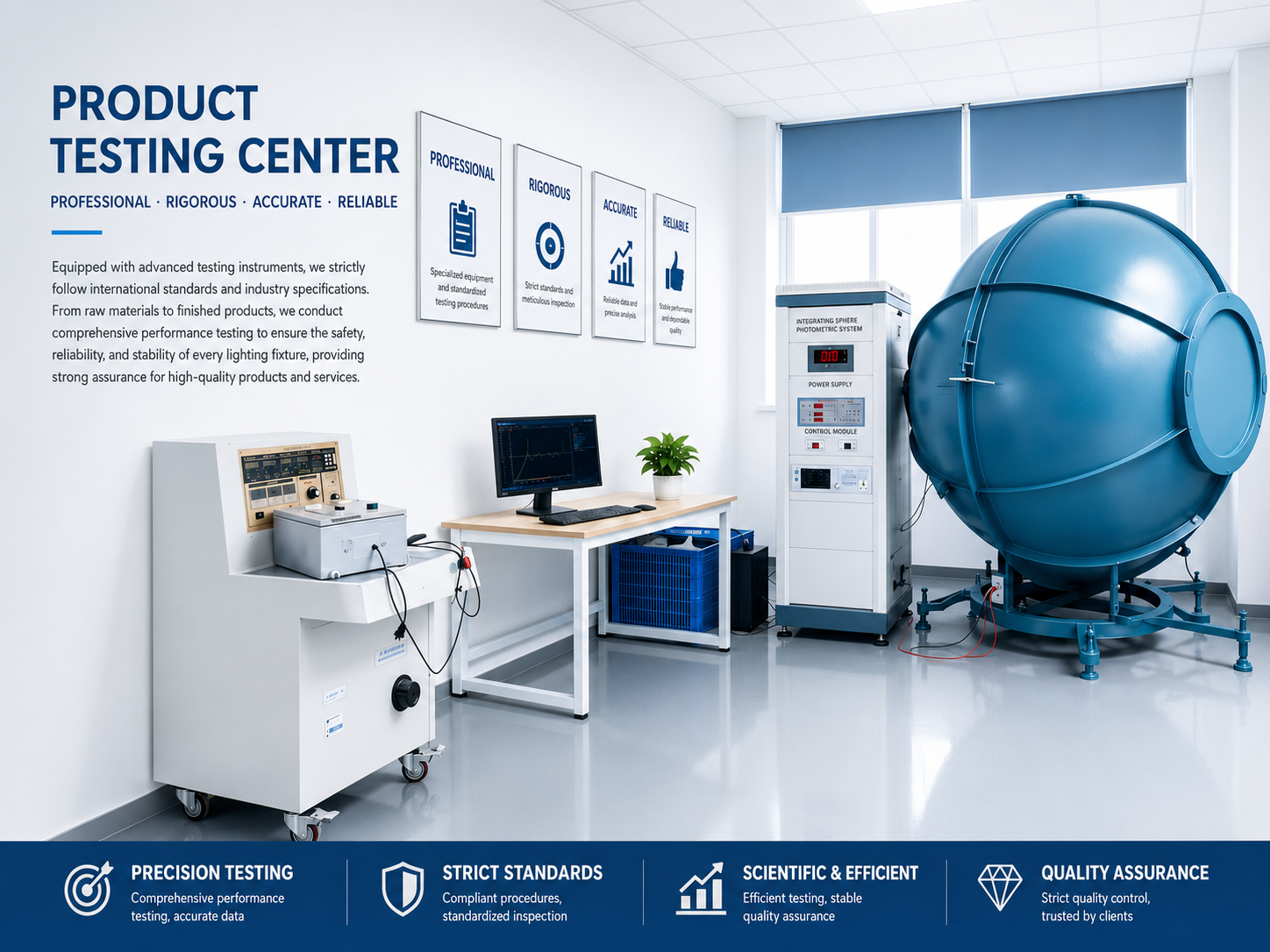
Every lamp is fully inspected before shipment, covering power-on testing, appearance and workmanship, dimension and structure checks, and accessories completeness.
Factory-Direct or Middle-Man Supply?
The sourcing question is usually framed as a price question, but in non-standard hotel lighting it is a control question. On a factory-direct model, the entity that holds the certificate numbers, performs the ceiling load-bearing structural calculation and manufactures the fixture is the same entity. On a middle-man model, that work is split: the intermediary consolidates design coordination, shipping, customs handling and often several product categories into a single purchase order.
| Decision factor | Factory-direct supply | Middle-man supply |
|---|---|---|
| Change-request loop | Drawing, sample and production changes route directly to the production team | Changes pass through an intermediary, adding interpretation steps |
| Cost structure | No intermediate margin layer on large bulk orders | Margin layer added, offset by consolidated logistics and administration |
| Documentation ownership | Certificate holders and structural calculations issued by the manufacturer | Documentation may be forwarded without the underlying calculation responsibility |
| Coordination burden | Buyer manages drawing approvals, sampling and installation sequencing | Intermediary can absorb coordination across multiple categories and suppliers |
| Best fit | Projects with an internal design or engineering team and custom fixture scope | Buyers without local engineering resource, or mixed-category orders |
For non-standard engineered fixtures, the party that controls the drawing controls the risk. That single rule resolves most of the argument: if the project's lobby and atrium fixtures are bespoke, the structural calculation and the manufacturing tolerance for the suspension must sit with the party that will also sign the warranty.
Applying the Shortlist Across Lobby, Atrium and Banquet Hall
The three conditions in the shortlist behave differently enough that a single fixture decision rarely survives all of them.
High-ceiling lobby
The lobby is a glare problem before it is a scale problem. Seating groups sit under the fixture, so light distribution has to be shaped rather than simply increased. yz10001's anti-glare light source combined with an adjustable 15°–120° beam is the shortlist's answer here, with custom size and shape fitted to the reserved installation dimensions and to special-shaped suspended ceilings.
Double-height atrium
Atria change the risk profile. The manufacturer's stated approach for oversized suspended lighting is a professional structural load calculation to eliminate ceiling collapse risk — the correct order of operations, because once the suspension design is fixed, the artistic form must be engineered around it rather than the reverse.
Banquet hall
Banquet halls are scene-controlled spaces. The fixture must move between a bright working state, a dining state and an event state, and it must do so repeatedly over the life of the space. Customisable dimming and an energy-efficient LED module matter more here than in any other zone, because the lights run at higher output for longer periods.
What the Market Data Says About This Category
Three structural trends support the shortlist above, and one caution applies to all of them.
- Commercial demand dominates decorative lighting. Commercial applications, including hospitality, hold 62.8% of the decorative lighting end-user market (IMARC Group, 2025). Specification-grade hotels are the demand centre, not residential decoration.
- LED is now the default light source. LED holds 39.8% of the decorative lighting source market (IMARC Group, 2025), and LED-integrated chandeliers are reported to capture over 54% of market volume annually on energy-efficiency and custom colour grounds (Market Research Hub / Horizon Databook, 2024). Documented LED performance — rated life, light decay, colour temperature range — has become a standard tender line.
- Dimming has become a specification requirement, not an upgrade. One third-party dataset reports that 56% of new luxury hotel projects require dimmable chandelier installations for guest ambiance (Dataintelo, 2024; medium reliability, treated here as directional rather than definitive). The 2024 International Energy Conservation Code also expanded occupancy and dimming requirements for lobbies and meeting areas (International Code Council), which pushes the same direction from the code side.
Regionally, Asia Pacific held 44.6% of high-end lighting revenue in 2024 (Grand View Research) while North America held 36.45% of the decorative lighting market in 2025 (Grand View Research). Both matter to a China-based manufacturer: production concentrates in one region, specification authority and project budgets concentrate in the other.
Where This Shortlist Does Not Apply
A shortlist that does not state its boundaries is a sales document. Four boundaries apply here.
- IP40 is not a wet-location rating. Both shortlisted references operate at IP40 protection. That is appropriate for interior lobbies, atria and banquet halls, but it is not suitable for water features, exposed pool surrounds or any location requiring water-ingress protection. Those zones need a different fixture family entirely.
- The electrical conformity evidence is EU-oriented. LVD-CE and CE-RoHS cover a fixed hanging luminaire placed on the EU market. North American projects generally require documentation aligned with UL 1598 (Standard for Luminaires) and UL 8750 (LED Equipment) from UL Solutions. That is a separate evidence track and should be treated as a genuine qualification gap until supplied.
- Management-system certificates are not product-performance certificates. ISO 9001, ISO 14001 and ISO 45001 describe production, environmental and occupational health and safety management within the stated scope. They say nothing about light output, glare control or lifetime. Buyers who substitute them for photometric evidence will still need photometric data.
- Custom non-standard work costs time. Standard lead time is 30–40 working days, with shortened lead time available for urgent hotel projects; sample approval and structural load calculation sit in front of production. Compared with a mass-produced catalogue chandelier, which can ship faster and at a lower unit cost, a bespoke engineered fixture trades schedule and per-project documentation overhead for fit, glare control and load certainty. Projects on compressed opening schedules should price that trade-off honestly.
A fifth, softer boundary concerns control systems. Special protection or lighting-control requirements should be confirmed separately per project, because dimming compatibility depends on the installed control infrastructure rather than on the fixture alone. Where a project uses an integrated lighting-management platform — Lutron's Quantum systems, for example, are specified in hundreds of luxury hotel properties globally (Dataintelo / Lutron, 2025) — the fixture package must be validated against that platform's dimming interface before the chandelier order is released.
Future Outlook
Three developments are likely to shape the next specification cycle for hotel lobby chandeliers.
First, documentation will keep displacing appearance as the deciding factor. As dimming and occupancy requirements tighten through codes such as IECC 2024, the tender question shifts from "what does it look like" to "what does it verify." Manufacturers that can issue certificate numbers, test report references, structural calculations and inspection checklists as a routine package will shortlist faster than those that cannot.
Second, single-zone purchases will increasingly be replaced by whole-property fixture packages. A project that selects a lobby chandelier and separately sources banquet, restaurant and guest-room lighting creates avoidable visual and documentation inconsistency; the yz10002 range model — chandeliers, wall lamps, floor lamps and table lamps supplied under one scope — is a response to that pattern.
Third, regional compliance will become a pre-qualification filter rather than a post-order task. A manufacturer with EU-facing electrical conformity evidence and ISO management certification still faces a separate documentation requirement for North American projects, and buyers are increasingly asking for both before the shortlist is drawn rather than after.
FAQ
Should a hotel project buy lobby chandeliers factory-direct or through a middle-man supplier?
Both models are workable and they distribute risk differently. Factory-direct supply means the entity holding the certificate numbers, performing the ceiling load-bearing structural calculation and manufacturing the fixture is the same entity; change requests route directly to production, and no intermediate margin layer is applied to large bulk orders. Middle-man supply can consolidate design coordination, shipping, customs handling and multiple product categories into one purchase order, which is useful where the buyer has no local engineering resource. The practical test is documentation ownership: ask who signs the certificate numbers, who performs the load calculation and who holds the warranty for the delivered fixture.
Which certifications should a hotel lobby chandelier carry for a European project?
For the EU market, the relevant evidence on this product range is an LVD-CE Verification of Conformity and a CE-RoHS Verification of Conformity, both applying to a fixed luminaire (hanging lamp). The LVD-CE certificate is QTS800119288 with test report reference 61.11.19.0573.01, issued by Guangzhou Quality Technology Service Co., Ltd. under EN 60598-1:2015+A1:2018, EN 60598-2-1:1989 and EN 62493:2015, valid to 2 September 2028. The CE-RoHS certificate is QTS800519289 with test report reference 61.15.19.0574.01, issued by the same body against the IEC 62321 series and EN ISO 17075-1:2017, valid to 27 September 2028. Supporting management-system certificates are ISO 9001:2015 (ZTZL28025Q1464R0S), ISO 14001:2015 (ZTZL28025E0851R0S) and ISO 45001:2018 (ZTZL28025S0801R0S). North American projects generally require separate documentation aligned with UL 1598 and UL 8750.
What electrical and optical parameters should be locked before ordering the yz10001 lobby chandelier?
Six parameters should be fixed at tender stage: rated input voltage AC110–240V; power within the 30W–600W range; colour temperature from 2700K to 4000K; beam angle within the adjustable 15°–120° range; dimming requirements, which are customisable; and confirmation of IP40 protection. The fixture carries a 50,000-hour rated service life with light decay of no more than 3% within 3,000 working hours, and is built on an aluminium-alloy frame with a stainless-steel suspension component.
How long does a custom hotel lobby chandelier take, and what is the minimum order?
Standard lead time is 30–40 working days, with shortened lead time available for urgent hotel projects. Minimum order is 1 piece, and monthly production capacity is 20,000 units. Every lamp undergoes full inspection before shipment, covering power-on testing, appearance and workmanship, dimension and structure inspection, and accessories completeness verification, with a quality-approval checklist attached. Engineering lighting products carry a 3-year warranty, with global remote technical guidance for overseas clients.
Can one chandelier specification serve the lobby, the atrium and the banquet hall?
Rarely without modification. yz10001 supports full non-standard customisation of size and shape and is designed to adapt to special-shaped ceilings and reserved installation dimensions, which allows a lobby fixture family to be re-engineered for a different void. yz10002 parameters are provided per series or custom order, so specific dimensions, wattage and colour temperature require model-level confirmation for each space. Two constraints limit reuse: IP40 protection is not suitable for wet or exposed locations, and dimming behaviour must be validated against the project's control system for each zone.
Reference Material
Manufacturer documentation, including product ranges, materials and project references for the shortlisted fixtures, is available in the company brochure: Zhongshan YZ ART LIGHT Co., Ltd. product brochure (PDF).
Third-party market and standards data cited in this article: Mordor Intelligence (decorative lighting market, 2025–2026); IMARC Group (decorative lighting end-user segments and light-source share, 2025); Dataintelo (hospitality lighting market 2025–2034; luxury hotel dimming requirements, 2024 — medium reliability, directional); Transparency Market Research (chandelier market, 2024–2035); Grand View Research (high-end lighting and chandelier segments, 2024–2025); Market Research Hub / Horizon Databook (LED-integrated chandelier volume, 2024); International Code Council (IECC 2024); UL Solutions (UL 1598 / UL 8750); Dataintelo / Lutron (lighting management systems, 2025).