
Decorative Ceiling Fan Supplier Verification: Handing Co. Ltd.
Decorative Ceiling Fan Supplier Verification: Handing Co. Ltd.
Appointing a decorative ceiling fan supplier is rarely a document purchase, even when the documents are good. What a buyer actually buys is a supplier's ability to reproduce a finish, a motor and a shipping date several thousand units later — and that ability is only partly visible on paper.
Handing Co. Ltd. makes a practical worked example for that exercise, because the company publishes most of the evidence a buyer would ask for. It was founded in 1992 and has manufactured decorative ceiling fans for more than thirty years. Its ceiling fan and lighting factory has been ISO 9001 certified since 1996. It owns its electroplating factory outright, operates from a 12,320.66 m² facility with roughly 350 staff and 480,000 units of annual capacity, keeps a six-engineer R&D team, and exports 100% of its output to the EU, USA and Australia. Below, each of those claims is tested in the order a buyer should test them — and separated from what the evidence proves from what it only suggests.
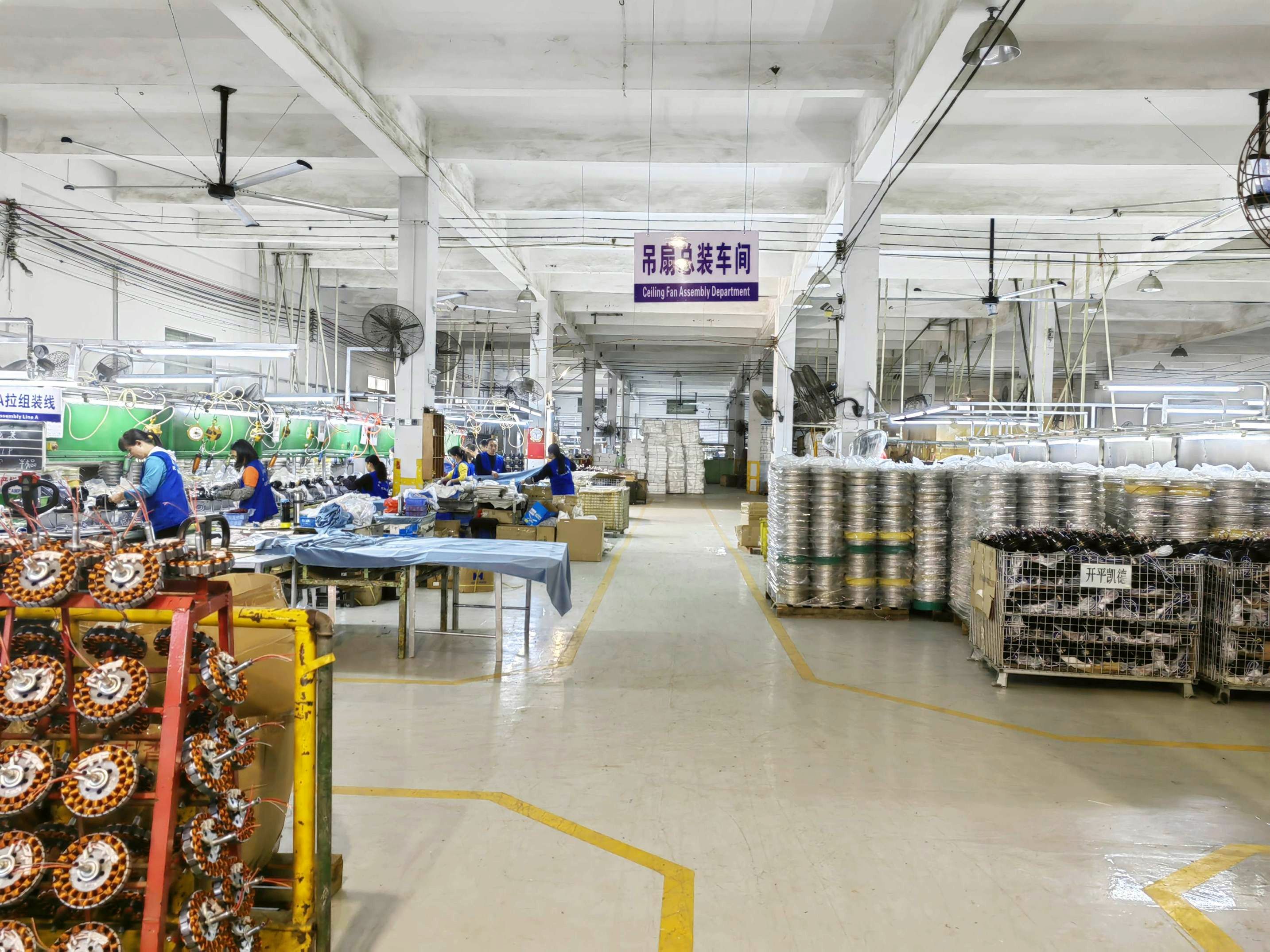
Verification Works as a Sequence, Not a Folder
Most supplier failures that reach a buyer's desk are not certificate failures. They are finish failures, noise failures, colour mismatches between batches and dates that slip by three weeks. None of those appear in a certificate pack, and most of them are predictable from a factory visit if the visit is organised around the right questions.
A workable sequence moves through four layers, each answering one question:
- Identity and tenure. Is this a durable manufacturing business or a recently formed trading entity? Founding year, registration and continuity of product lines settle it.
- Management system. Is quality controlled by a documented system or by one supervisor's memory? The ISO 9001 scope, the certificate holder and the certified site address settle it.
- Process ownership. Are the processes that decide finish and timing inside the factory, or inside a subcontractor's queue? Plating, metal parts, painting and motor assembly settle it.
- Physical scale. Is the claimed capacity actually on the floor? Building area, headcount, line count and work in progress settle it.
The order matters. A visit that begins with capacity ends up as a tour. A visit that begins with the certificate scope and the plating line ends up as an audit, because every later question is checked against something a document already told you.
Layer 1 — Tenure: What a 1992 Founding Year Establishes
Handing Co. Ltd. was established in 1992 and decorative ceiling fans have been its main product for more than three decades. Tenure of that length is not proof of current capability, but it changes two things a buyer should care about.
First, it implies the company has already lived through several regulatory cycles. The 2006 European RoHS restriction is the clearest example in the company's own account: Handing states that it responded by installing XFS screening equipment and chemical testing, and that the set-up was approved by TÜV PS in the same year. A manufacturer that has absorbed one chemical-compliance cycle normally carries the supporting machinery — material declarations, test logs, supplier records — that a newly formed export desk has not yet built.
Second, longevity is testable in a way a marketing claim is not. Ask for a model that has been in continuous production for a decade, then ask what tooling, drawings and spare-part support still exist for it. The answer separates a manufacturer with institutional memory from one that re-sources every model from scratch.
What tenure does not establish is present-day scale or present-day compliance. Both require the next two layers.
Layer 2 — ISO 9001 Since 1996: Read the Scope, Not the Logo
The ceiling fan and lighting factory was certified to ISO 9001 in 1996. The useful part of that sentence is not the standard; it is the date and the scope.
The date matters because 1996 places certification roughly a decade before the European RoHS requirement took effect. A management system with that much operating history normally carries document control, supplier evaluation and corrective-action records that a young factory is still inventing.
The scope matters more. ISO 9001 certifies a management system for a defined scope at a defined site — it does not certify a product, and it does not certify a brand. Four checks close the gap:
- Certificate number, issuing body and expiry, confirmable with the certification body rather than only with the supplier.
- Scope wording, which should name ceiling fans and lighting rather than a generic statement about electrical products.
- Certified site address, which should match the Kaiping factory rather than a sales office.
- Certificate holder, which should be the entity that will sign the purchase contract.
For European buyers there is a second, product-facing layer. Handing states that its fans for the European market carry LVD/GS/TÜV, EMC, EMF, RoHS and ERP compliance. Those are product and directive-level claims rather than system-level ones, which is precisely why they should be checked at model level — a point developed in the certification section below.
Layer 3 — The 100% Owned Electroplating Factory
Handing owns 100% of its electroplating factory. The company's stated reason is direct: to keep electroplated quality good, delivery on time and cost competitive. On a decorative ceiling fan, that is not a peripheral asset.
Finish is the first thing an end customer sees and the first thing that fails. Plated and lacquered components live in humid air, coastal air and bathroom air, and a plating defect that passes a visual check in Kaiping can bloom into pitting in a Florida lanai or a Queensland veranda within a season. Plating is also a batch chemical process with its own constraints — bath chemistry, effluent treatment, rack density, labour — so when it is subcontracted, the fan factory joins a queue it does not schedule and inherits a quality standard it does not set.
The company also states that it produces most of its metal parts, does its own painting and assembles its own motors in line with ISO 9001 procedures. Taken together — metal parts, painting, motor assembly and plating — that is an unusually wide in-house span for a decorative fan supplier, and it is the span that determines how quickly a finish or fit problem can be diagnosed and corrected.
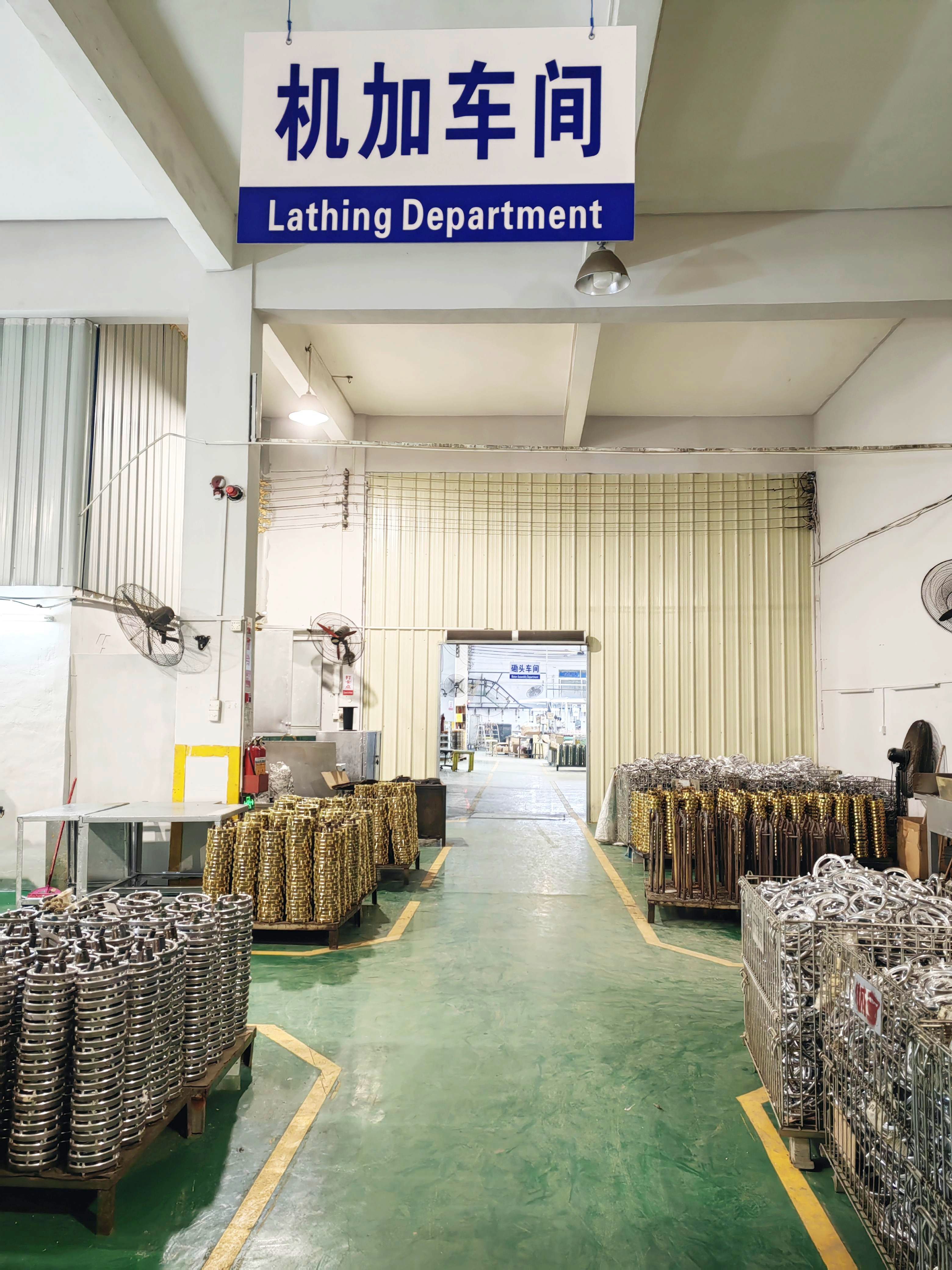
Ownership is still a claim until it is seen. The visit questions that settle it are concrete. Is the plating line on the same site or a separate legal entity, and who signs its process specification? Who holds the chemical test records, and how often is the bath analysed? When a batch is rejected, who authorises rework, and where is that recorded? A buyer who has seen the plating line, the testing bench and one batch record has converted a statement into evidence.
Layer 4 — Scale: 12,320.66 m², ~350 Staff and 480,000 Units a Year
The published figures are a 12,320.66 m² facility, approximately 350 staff, 480,000 units of annual capacity and a six-engineer R&D team. None of these numbers means much on its own; each becomes useful once it is converted into something a buyer can compare with their own order book.
Annual capacity divided evenly is roughly 40,000 units a month. That is arithmetic, not a scheduling commitment — fan demand is seasonal and no factory's monthly plan is flat — but it gives an order-of-magnitude test. A buyer planning 2,000 units a month is asking for about 5% of a flat monthly average, which is the kind of ratio that makes a trial order realistic. A buyer planning 80,000 units a month is asking for something the published capacity cannot absorb without expansion.
The same arithmetic gives a second ratio of roughly 1,370 units per employee per year. Its value is comparative rather than absolute: if a competing supplier claims identical output with a third of the staff, one of the two numbers needs explaining before either is believed.
The six-engineer R&D team is the figure most often misread. Six engineers is a real development capability for modifications — motor and blade matching, light-kit integration, control-gear changes — and a modest one for a ground-up platform. The right test is not the headcount but the schedule: hand the team a written brief and ask what it would take, and when.
On site, scale should be counted rather than admired: winding stations, lathing cells, assembly lines, the motor testing room, and the volume of work in progress between them. A building area is easy to state; a balanced line is not.
Layer 5 — 100% Export to the EU, USA and Australia: Match Paperwork to Market
Handing exports 100% of its output, with the EU, USA and Australia named as its main markets. This is the layer where a decorative ceiling fan buyer's own compliance exposure sits, because a fan that is acceptable in one market can be unsaleable in another.
The company states that its products are listed in UL, cUL, NOM, BSI, CE, GS, Swedish Standard and SAA. Read that as a portfolio statement: it describes the certification set the business works within, not a guarantee that any particular model carries every mark. The check that closes the gap is model-level and cheap to run — ask for the listing or certificate number for the exact model you intend to order, and confirm the name of the certificate holder.
| Market | Documentation commonly requested | Verification point |
|---|---|---|
| USA | UL or cUL listing for the fan; ENERGY STAR qualification where efficiency is claimed | Match the listing number to the specific model and confirm the file holder is the factory. ENERGY STAR requires written certification from an EPA-recognized certification body and testing in an EPA-recognized laboratory. |
| European Union | CE marking supported by LVD, EMC, RoHS and ErP documentation; GS/TÜV where the sales channel requires a voluntary mark | Confirm the declaration of conformity names the model and the directive versions in force at the time of shipment. |
| Australia | SAA certification and the applicable electrical approval for the fan and its light kit | Confirm the certificate covers the exact light-kit configuration being ordered, not only the fan body. |
Three external reference points sharpen those checks. The IEC publishes IEC 60335-2-80:2024 as the safety standard for fans, so a buyer asking “which standard was this tested to?” should expect a standard number and a test report reference, not the word “certified”.
The U.S. EPA's ENERGY STAR programme shows how much sits behind a mark. Qualified residential ceiling fans must be certified in writing by an EPA-recognized certification body and tested in an EPA-recognized laboratory, and the EPA reports that certified fans are up to 44% more efficient than conventional models. ENERGY STAR's own guidance adds a use-environment layer that decorative buyers often overlook: humid locations call for a UL damp rating, and direct water contact calls for a wet rating. That distinction is what separates an indoor ceiling fan from an outdoor ceiling fan in procurement terms, and it belongs on the specification long before it appears on an invoice.
For Europe, Refindustry reported in June 2026 that EU ErP rules tighten fan efficiency requirements from 2026, with a minimum static efficiency of 50% applying to axial fans from 24 July 2026. Axial fans are not decorative ceiling fans, but the direction of travel is the same, which is why a supplier's ErP documentation should be current rather than inherited from an earlier platform.
Commercial context belongs here too. Airlift USA reported in September 2026 that ceiling fans for permanent installation from China attract a 17.2% U.S. import duty under HS 8414.51.30, composed of a 4.7% general rate and a 12.5% Section 301 rate. Duty does not change what a factory can prove, but it changes what a landed unit has to earn, and it makes documentation errors — a mis-declared model, a missing certificate — proportionally more expensive.
Owned Processes vs an Asset-Light Sourcing Route
Comparing a vertically integrated manufacturer with a trading or asset-light route is not a comparison of good against bad. It is a comparison of where control sits.
| Dimension | Manufacturer with owned plating, metal parts, painting and motor assembly | Asset-light sourcing route |
|---|---|---|
| Who controls the finish | The organisation that assembles the fan also runs the plating specification | A subcontractor, scheduled by the intermediary |
| Who is contacted when a batch fails | The same organisation that shipped it | An intermediary who must then negotiate with the producer |
| Documentation trail | Certificates, batch records and test logs held by one entity | Split between producer and trader, often incomplete at model level |
| Change control | Specification changes agreed directly with the people running the process | Changes relayed through a third party |
| Typical fit | Repeat orders where finish consistency and one accountable party matter | Small trial volumes, wide multi-category assortments, single invoicing point |
The fit boundary is real. An asset-light route can be the better choice for a first container spread across many categories, because it lowers the commitment to any single process and to any single factory's schedule. Ownership earns its cost only when finish consistency, repeat-order fidelity and a short corrective loop are what the programme actually needs.
What This Evidence Does Not Establish
Honest verification includes the gaps. On the public record used here, five things remain outside what the evidence proves:
- Model-level listings. The certification set is stated at company level. The specific UL, cUL, SAA, GS or CE file for a given model, blade finish and light-kit configuration still has to be produced and checked.
- Commercial terms. MOQ, price bands, lead times and warranty terms are not published, and none should be inferred from capacity or headcount.
- Capacity as a commitment. 480,000 units is an annual figure. It says nothing about the monthly slot available to a new customer in a peak season.
- R&D throughput. Six engineers is a headcount, not a schedule. A bespoke blade or control-gear development should be scoped in writing before it is assumed.
- Finish specification. Owning a plating line does not define plating thickness, salt-spray duration or colour tolerance. Ask for the specification and the test method, then ask to see a report against it.
None of these gaps is a defect in the supplier. They are the questions that turn a factory visit into a decision.
The Verification Path: One Address, One Contact, One Day
The evidence above converges on a single, checkable itinerary. The factory address is No.28, Xiang Long Bei Road, Xiang Long Island, Sanbu Town, Kaiping City, Guangdong Province, China — the site to which the ISO 9001 scope, the plating line and the capacity figures should all be traceable.
Contact person: MING LAM
Email: sales@handingfan.com or minglam3@hotmail.com
Phone: +852 92839029 / 86-13828060322
WeChat: minglam3
Website: www.handingfan.com
A one-day sequence that follows the layers above:
- Document room first — registration, the ISO 9001 certificate and its scope, and model-level listing files. Photograph what you are shown.
- Plating and surface treatment — process specification, bath analysis records, and one rejected batch with its disposition.
- Metal parts, lathing and painting — confirm the processes are on site and note the work in progress between them.
- Motor assembly and testing — see the test bench and ask what is measured on every unit versus sampled.
- Final assembly and warehouse — check finished-goods identification and how a specific customer order is segregated.
- Container loading — confirm loading is done on site and how the packing list is verified against the order.
Then ask for the same evidence a second time, three months later. Consistency between two visits is the closest a buyer gets to seeing a management system rather than a showroom. A downloadable factory presentation is available for the document review that precedes the trip.
Market Context That Changes the Checklist, Not the Standard
Two kinds of external data are worth holding alongside the verification sequence.
The first is market scale. Commercial research estimates for the global ceiling fan market in 2025 range from roughly USD 11.83 billion to USD 15.7 billion — a spread that reflects differing treatment of decorative, industrial and commercial-grade segments more than any disagreement about direction. The same research attributes about 26.7% of the global market to China. Neither figure should drive a sourcing decision on its own, but both explain why documentation quality varies so widely among suppliers chasing the same buyers.
The second is regulatory movement. Efficiency requirements in Europe and North America tighten on published schedules, ENERGY STAR qualification runs through recognised laboratories and certification bodies, and duty structures shift landed cost. Each of those changes lands on the supplier's document set before it lands on the product. A supplier whose certificates are dated, model-specific and reissued when the rules change is easier to keep than one whose file is a folder of undated scans.
Outlook
Decorative ceiling fan procurement is moving toward evidence that can be dated and matched to a model. Efficiency rules, chemical restrictions and duty exposure all reward buyers who can point to a certificate number rather than a logo, and reward suppliers who can produce one within a day.
For a supplier with this profile — a 1992 founding, ISO 9001 since 1996, an owned plating plant, a 12,320.66 m² facility, roughly 350 staff, 480,000 units of annual capacity, six engineers and 100% export sales — the advantage is not the list of numbers. It is that the numbers describe processes a buyer can walk to. Whether that advantage holds for a specific order depends on terms no brochure contains, which is why the visit, not the file, remains the decision point.
Conclusion
A decorative ceiling fan supplier should be appointed on evidence a buyer has tested, in an order that removes risk: identity, then management system, then process ownership, then physical scale, then market documentation. Handing Co. Ltd. supplies a usable example at every layer — and, more usefully, a single address at which all five can be checked in one day.
FAQ
What changes for a buyer when a ceiling fan supplier owns its electroplating factory outright?
Ownership moves the finish specification, the chemical testing and the rework decision inside one organisation. The buyer deals with the party that runs the process rather than an intermediary relaying instructions to a subcontractor, which shortens the corrective loop when a batch fails a visual or salt-spray check. It does not by itself define plating thickness or colour tolerance; those still have to be specified, tested and reported against.
Why does an ISO 9001 date such as 1996 matter more than the certificate itself?
The date shows how long a documented management system has been operating, including through later requirements such as the 2006 European RoHS restriction that Handing says it met with XFS screening and chemical testing approved by TÜV PS. A long-running system normally carries document control, supplier evaluation and corrective-action records. The certificate itself is valid only for the scope and site named on it, so the scope wording, the certified address and the certificate holder should be matched to the entity signing the purchase order.
Does 480,000 units of annual capacity guarantee a monthly delivery slot?
No. Annual capacity is a planning ceiling; it does not describe the monthly slot available to a specific customer in a specific season. Divided evenly it is roughly 40,000 units a month, which is arithmetic rather than a schedule. A buyer should ask for a committed monthly allocation, a production lead time and a stated minimum order quantity in writing before treating capacity as availability.
Which certifications should be checked at model level for the EU, USA and Australian markets?
For the USA, a UL or cUL listing for the fan, plus ENERGY STAR qualification if efficiency is claimed. For the EU, CE marking supported by LVD, EMC, RoHS and ErP documentation, with GS/TÜV where the sales channel requires it. For Australia, SAA certification and the applicable electrical approval covering the light kit. In each case the listing number should match the exact model and configuration, and the file holder should be the factory rather than a trading entity.
How can a buyer test a six-engineer R&D team without placing an order?
Give the team a written brief — a blade change, a light-kit integration, a control-gear substitution — and ask for a development schedule, a sample plan and the tests that would be run. The response shows how the team scopes work and where its limits sit. Headcount alone says little about throughput; the schedule does.
Factory presentation for download: Handing factory presentation (PDF)
¿Tiene preguntas o necesita más detalles?
Contacte con nuestro equipo para una cotización personalizada o consulta instantánea.
Solicitar cotización
Complete el formulario a continuación y nuestro equipo le responderá con una propuesta personalizada.
Chat directo de WhatsApp
¿Prefiere chatear en tiempo real? Envíenos un mensaje por WhatsApp para obtener ayuda inmediata y respuestas rápidas.
- Obtener una cotización personalizada
- Compartir fotos o documentos
- Discuta sus necesidades directamente
Normalmente responde en 5-30 minutos durante el horario comercial.