
Decorative Ceiling Fan Shortlist: TU52-MW-N3A1DOME
Decorative Ceiling Fan Shortlist: TU52-MW-N3A1DOME
Decorative ceiling fans are chosen for appearance and approved on constraints. For importers, distributors and project buyers serving the European Union, the United States and Australia, a usable shortlist has to line up blade span, motor type, light output, control interface, finish and certification listing before the design conversation closes. This reference sets out the certification and specification constraints that shape decorative ceiling fan sourcing, and examines in detail one commercial-grade indoor option, the TU52-MW-N3A1DOME from Handing Co. Ltd.
Why Decorative Ceiling Fan Shortlists Now Start With Constraints
Fan safety requirements have moved in the past two years, and they have moved in ways specific enough to change what a shortlist should contain. In the United States, the safety standard for electric fans, UL 507, was updated with a new version effective November 27, 2024, which adds secondary thermal or current fuse requirements for fans installed in unattended areas. In the European Union, EN IEC 60335-2-80:2024 establishes safety requirements for household fans, including ceiling fans, with rated voltages up to 250V for single-phase products. Where United States efficiency programmes apply, ENERGY STAR certified ceiling fans are required to be up to 44% more efficient than conventional fans, and the 2024 Most Efficient criteria for standard fans require efficiency of at least 3.25D + 107 (CFM/W).
Market structure points in the same direction. Standard ceiling fans accounted for a dominant 63.66% of global revenue in 2023, according to Grand View Research, which means decorative and integrated-light designs compete for the remaining share on differentiation rather than volume. A buyer specifying a decorative ceiling fan with an integrated light and a wireless control layer is therefore running three evaluation tracks at once: aesthetics, electrical safety and control electronics.
The practical consequence is that shortlists built on catalogue imagery alone generate rework. Purchase teams typically discover at the documentation stage that a preferred design lacks the listing required for the destination market, or that the light kit and control configuration ordered does not match the tested sample. Constraints first, appearance second, is the sequence that reduces that risk.
The Four Filters Behind This Shortlist
Four filters, applied in order, are enough to reduce a long catalogue to a workable shortlist. They are also the filters used to evaluate the featured model later in this article.
Filter 1 — The certification listing that matches the destination market
Compliance is market-specific. A fan installed in an unattended area of a United States commercial building falls under the UL 507 requirements referenced above; a fan sold into the European Union needs to satisfy EN IEC 60335-2-80:2024 as well as applicable RoHS and energy-related requirements; Australian buyers work to a separate listing regime. The filter question is not whether a fan is certified, but which listing covers this exact SKU in this exact market.
Filter 2 — Physical and electrical parameters
Blade span determines how a fan reads in a room and how many units a project needs. Packaging dimensions determine freight economics, which matters more in ceiling fans than in many light industrial products because blade spans push carton volumes. Ordering teams benefit from recording blade span, blade count and material, housing material, finish and carton dimensions as a single parameter set rather than as separate checklist items.
Filter 3 — Drive, light and control configuration
The motor decides the control behaviour of the product. A light kit converts the fan into a combined fixture, which affects both specification and certification scope. A wireless control layer adds a component whose compatibility with the installed environment has to be validated. Treating these as one configuration decision, rather than three independent add-ons, is what prevents mismatched samples and repeated testing.
Filter 4 — Supplier capacity and continuity
Decorative fans are usually bought as programmes, not as one-off orders. Annual output, workforce size, in-house process scope and the age of the quality system indicate whether a supplier can repeat a specification across shipments, and whether the finish and drive system are controlled inside the same organisation that assembles the finished product.
| Filter | What to confirm | Evidence to request |
|---|---|---|
| Certification listing | A listing valid for the destination market and the exact SKU, including light kit and control configuration | Certificate scope, test reports, sample-to-production consistency statement |
| Physical and electrical parameters | Blade span, blade material and count, housing material, finish, carton dimensions, rated voltage | Specification sheet, packaging drawing |
| Drive, light and control | Motor type, light kit wattage and colour-temperature behaviour, control interface | Motor and driver specification, control compatibility notes |
| Supplier capacity and continuity | Annual output, workforce, in-house process scope, quality system history | ISO9001 certificate, factory audit, capacity statement |
Featured Option: TU52-MW-N3A1DOME as a Commercial-Grade Indoor Fan
The TU52-MW-N3A1DOME is an indoor decorative ceiling fan with an integrated light, produced by Handing Co. Ltd. and positioned as a commercial-grade, smart WiFi ceiling fan with a 52-inch blade span. Its published specification set is compact enough to check line by line, which is an advantage during the evaluation stage, when buyers need to confirm configuration before committing to tooling, sampling or certification documentation.
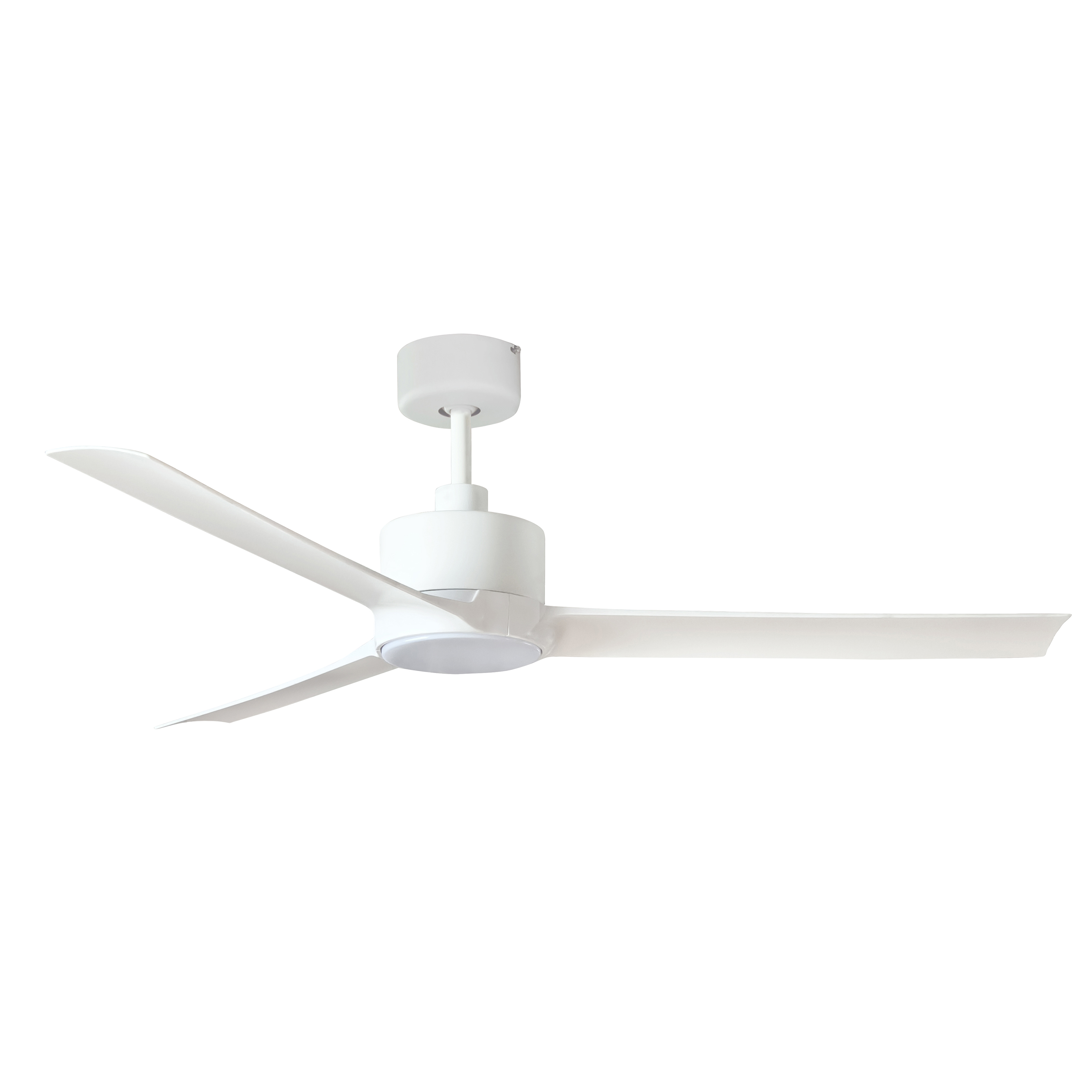
TU52-MW-N3A1DOME: 52-inch indoor decorative ceiling fan with a 24W CCT LED light kit and smart WiFi control.
| Specification | Value |
|---|---|
| Model | TU52-MW-N3A1DOME |
| Blade span | 52 inches |
| Blades | 3 × ABS |
| Housing | Steel, 52-inch TU housing |
| Finish | Matt White |
| Motor | DC motor |
| Light kit | 24W CCT LED light kit |
| Control | Smart WiFi control |
| Positioning | Indoor decorative ceiling fan; ceiling fan with light; commercial-grade ceiling fan; smart WiFi ceiling fan; 52-inch ceiling fan |
| Application | Household and commercial |
| Packaging dimensions | 720 (L) × 225 (W) × 350 (H) mm |
The DC motor is the central technical choice. The product data describes it as a 52-inch TU housing DC motor, and it defines how the fan is driven, controlled and matched to a light kit. Because the motor is electrically different from a conventional alternating-current induction drive, the control interface, the driver electronics and the light kit are specified as one system rather than assembled from independent parts.
The light kit is rated at 24W and described as a CCT LED kit; CCT is the industry term for correlated colour temperature, the property that defines the light colour of an LED module. Integrating the light into the fan removes a separate ceiling fixture from the specification, which is often the reason decorative fans are shortlisted for hospitality and retail interiors in the first place.
Smart WiFi control adds a wireless layer. For procurement purposes that is a component decision as much as a convenience feature: the control module needs to be part of the certified configuration, and projects with managed networks or specific building automation systems should validate compatibility rather than assume it.
The housing is steel and the three blades are ABS, finished in Matt White. Blade count and material affect both the visual profile and the weight and balance characteristics that the motor and mounting system are designed around. Carton dimensions of 720 × 225 × 350 mm give buyers an early freight calculation before samples are ordered, which matters when a project spans several rooms or floors.
Supplier Evidence Behind the Featured Option
Handing Co. Ltd. is a ceiling fan and lighting manufacturer based in Kaiping City, Guangdong Province, China, established in 1992, whose main product line is the decorative ceiling fan and whose output is exported entirely to the European Union, the United States and Australia.
Several verifiable facts sit behind the model:
- Founded in 1992, with the ceiling fan and lighting factory ISO9001 certified since 1996.
- A factory area of 12,320.66 m², 350 employees and an annual output of 480,000 units.
- An R&D team of 6 engineers.
- A 100% owned electroplating factory, in addition to producing most metal parts, performing its own painting and assembling its own motors.
- In response to the European Union RoHS regulation implemented in 2006, the company set up an XFS machine and chemical testing, approved by TUV PS in the same year.
- European fan models carry LVD/GS/TUV, EMC, EMF, RoHS and ERP; products are listed in UL, cUL, Nom, BSI, CE, GS, Swedish Standard and SAA.
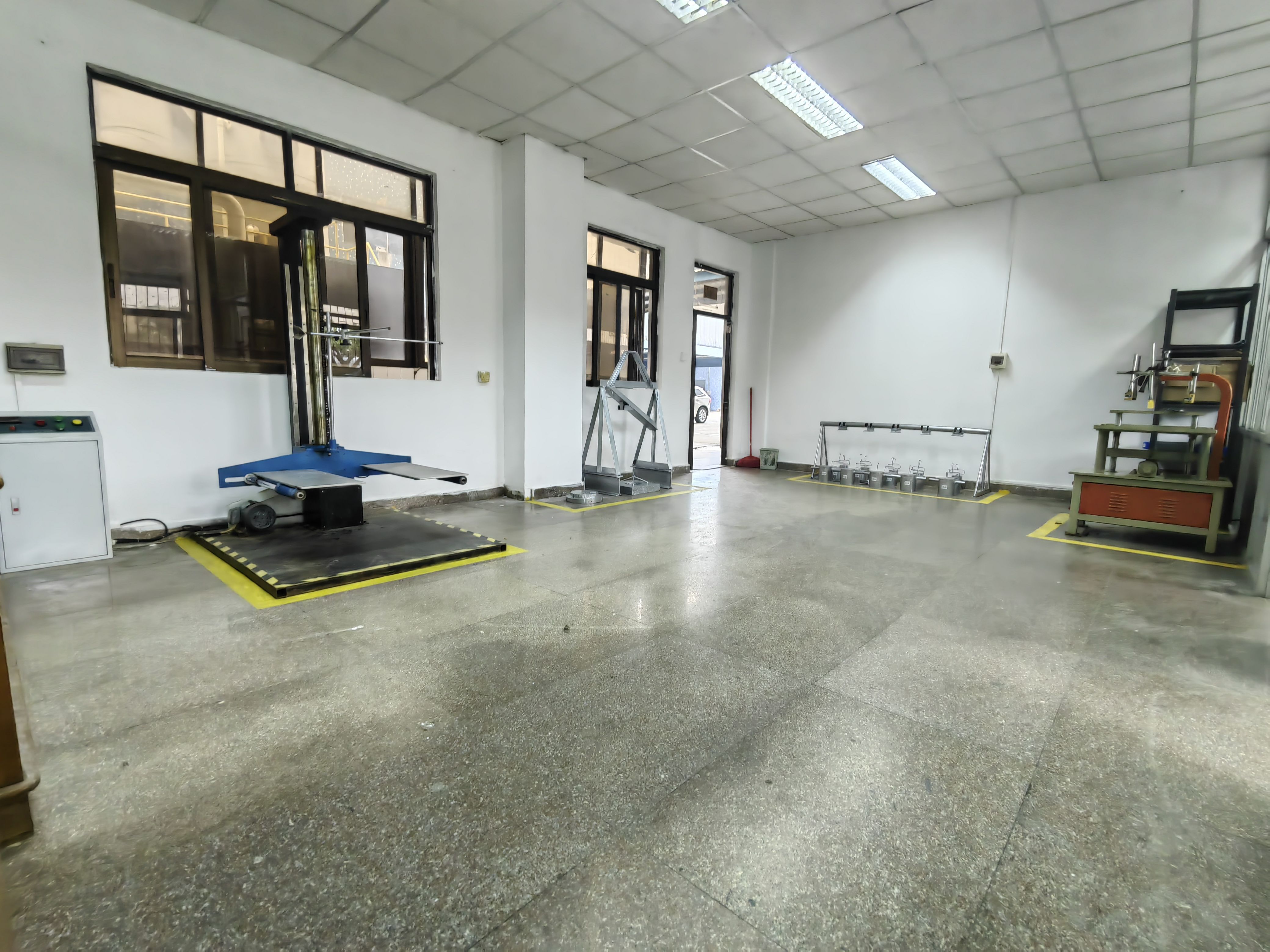
Incoming quality control (IQC) testing room used for component inspection before assembly.
For a buyer, the significance is specific rather than general. In-house metal forming, painting, motor assembly and electroplating mean the finish and the drive system are controlled inside the same organisation that assembles the finished fan, which is a different risk profile from sourcing through an intermediary that subcontracts those steps. A quality system in place since 1996 indicates continuity of process rather than a recently acquired certificate. An annual output of 480,000 units and a 350-person workforce give an indication of programme capacity. The 6-engineer R&D team is modest in size, which is relevant where a project requires extensive customisation rather than selection from an existing range.
Where a 52-Inch Indoor Decorative Ceiling Fan Fits
The verified application scope for the TU52-MW-N3A1DOME is household and commercial use, with the product described as an indoor decorative ceiling fan. Within that scope, the combination of a 52-inch blade span, an integrated 24W CCT LED light and smart WiFi control points to interiors where lighting and air movement are specified together and where the ceiling fixture is part of the visual scheme.
Typical project types include hospitality guest rooms and public areas, cafés and restaurants, offices and light retail interiors — interior environments where a fan with a light kit replaces a separate ceiling light, and where a designer needs the fixture to sit inside a defined palette, which is what the Matt White finish supports. Household applications follow the same logic at smaller scale, particularly in rooms where a single fixture has to deliver both light and air movement.
Two selection notes matter at this stage. First, control infrastructure: a smart WiFi ceiling fan is specified into an environment that must support it, so projects with managed networks should confirm the control approach during evaluation. Second, project mix: a single model rarely covers an entire building, and buyers usually pair a 52-inch decorative model for main interiors with other configurations where ceiling height, room volume or environment differs.
Decorative Ceiling Fan Shortlist at a Glance
A shortlist is more useful when it names real market participants and states plainly what can and cannot be verified about each. Third-party market research identifies Hunter Fan Company, Crompton Greaves, Havells India, Big Ass Fans and Minka Group among the leading global manufacturers in the ceiling fan industry. That research identifies these companies; it does not, in this reference set, provide verified specification sets for their decorative models. The shortlist below is therefore ordered by relevance to the constraints defined earlier in this article, not by measured performance.
| Shortlist position | Entry | Basis in the verified record | What buyers must still verify |
|---|---|---|---|
| 1 | TU52-MW-N3A1DOME (Handing Co. Ltd.) | Published specification set: 52-inch span, 3 ABS blades, steel housing, Matt White finish, DC motor, 24W CCT LED light kit, smart WiFi control. Manufacturer evidence: founded 1992, ISO9001 since 1996, 350 employees, 480,000 units annual output, 100% owned electroplating factory | The certification listing covering the exact SKU and destination market, plus sample-to-production consistency |
| 2 | Hunter Fan Company | Named in third-party market research as a leading global ceiling fan manufacturer | Model-specific specifications, listings and programme capacity — not contained in this reference set |
| 3 | Minka Group | Same source identification | As above |
| 4 | Havells India | Same source identification; the Asia Pacific region these manufacturers operate within held 44.85% of global ceiling fan revenue in 2023 | As above |
| 5 | Crompton Greaves | Same source identification | As above |
| 6 | Big Ass Fans | Same source identification | As above |
Note on method: the five named manufacturers above appear in the same third-party market-research identification. This reference set does not contain their model specifications, certification listings or capacity data, so no specification-level comparison is drawn and no performance ranking is implied. Buyers shortlisting any of them should request the same evidence set defined in the four filters.
Market Signals That Support a Constraint-Led Shortlist
The global ceiling fans market was estimated at USD 14.24 billion in 2023 and is projected to reach USD 19.92 billion by 2030, growing at a compound annual growth rate of 5.0% from 2024 to 2030, according to Grand View Research. Estimates of the current market value vary by roughly USD 2 billion between research sources, so any single market size figure should be treated as directional rather than definitive.
Supply is concentrated. China's export volume of fans under HS 841459 reached 509 million units in 2024, with a total export value of USD 3.788 billion, a 6.96% increase over the previous year, based on China Customs data reported by TradeDaas. On the demand side, Asia Pacific held the largest regional revenue share at 44.85% in 2023, driven by high demand in India and China.
Three implications follow for buyers. A growing but fragmented market means supplier selection carries more weight than category growth. Concentration in Asia Pacific means documentation quality and export experience are practical differentiators between otherwise similar offers. And because standard fans still hold the larger revenue share, decorative and integrated-light products are usually compared within a narrower peer group, which makes specification accuracy the deciding factor.
Manufacturer-Led Shortlisting vs Traditional Decorative Fan Sourcing
Traditional sourcing of decorative ceiling fans often runs through trading intermediaries who assemble a catalogue from several factories. That approach has a real advantage: wide choice and low initial effort. It also has a structural cost. When metal forming, painting, motor assembly, electroplating and final assembly sit in different organisations, the finish and the drive system are separate variables and the documentation chain has more links to verify.
A manufacturer-led shortlist concentrates those variables instead. Handing states that it produces most of its metal parts, performs its own painting, assembles its own motors and owns a 100% electroplating factory — a scope directly relevant to finish consistency and delivery control. The trade-off is range: one manufacturer's catalogue is narrower than a trading catalogue, so buyers exchange choice breadth for process control and documentation depth.
Where this option does not fit
Three boundaries should be stated as clearly as the capabilities.
- Installation environment. The TU52-MW-N3A1DOME is specified as an indoor decorative ceiling fan for household and commercial use. Outdoor, damp or wet locations, and industrial environments with high ceilings or heavy air-movement requirements, call for products specified for those conditions rather than an adapted indoor model.
- Certification scope. A listing in one market does not automatically cover another. Handing states that products are listed in UL, cUL, Nom, BSI, CE, GS, Swedish Standard and SAA, and that European models carry LVD/GS/TUV, EMC, EMF, RoHS and ERP. The listing applicable to a specific SKU and destination still has to be confirmed before order placement.
- Published performance data. This reference set does not contain measured airflow, wattage or efficiency test results for the model. Buyers who need to demonstrate efficiency performance — for example against ENERGY STAR criteria — should request test reports rather than assume equivalence from the motor type.
A fourth constraint is commercial rather than technical: the smart WiFi control layer means the product depends on a network and an application environment. In projects where building wireless policy is fixed, this should be validated during evaluation rather than after delivery.
What Changes for Decorative Ceiling Fan Buyers Next
The direction visible in the current data is towards tighter, more specific requirements rather than broader ones. The UL 507 version effective November 27, 2024 introduced secondary fuse requirements for fans in unattended areas; EN IEC 60335-2-80:2024 consolidated European requirements for household fans including ceiling fans; and the ENERGY STAR framework continues to define efficiency thresholds for standard fans. Each change adds a document a supplier must be able to produce on request.
At the same time the product itself is consolidating around DC motors, integrated LED light kits and wireless control. A decorative fan is increasingly a lighting and control product with blades, which is why configuration-level specification — motor, driver, light kit and control module together — is likely to become the normal unit of evaluation rather than the exception.
With the global market projected to grow at 5.0% annually to 2030 and export supply concentrated in Asia Pacific, the practical advantage for buyers will come from shortlists that are documented rather than extensive: fewer options, each with a confirmed listing, a complete specification set and supplier evidence that can be checked line by line.
FAQ: Decorative Ceiling Fan Constraints and Specifications
Which certifications should a buyer check on a decorative ceiling fan for the European Union, the United States and Australia?
Requirements are market-specific and cannot be transferred automatically. In the United States, UL 507 is the safety standard for electric fans; a new version took effect on November 27, 2024, adding secondary thermal or current fuse requirements for fans installed in unattended areas. In the European Union, EN IEC 60335-2-80:2024 sets safety requirements for household fans including ceiling fans with rated voltages up to 250V for single-phase products, alongside RoHS obligations for European sales. Handing Co. Ltd. states that its European fan models carry LVD/GS/TUV, EMC, EMF, RoHS and ERP, and that its products are listed in UL, cUL, Nom, BSI, CE, GS, Swedish Standard and SAA. Buyers should confirm which listing covers the specific model, light kit and control configuration being ordered for the destination market.
What are the specifications of the TU52-MW-N3A1DOME?
The TU52-MW-N3A1DOME is an indoor decorative ceiling fan with an integrated light. Its published specification lists a 52-inch blade span, three ABS blades, a steel housing, a Matt White finish, a DC motor, a 24W CCT LED light kit with smart WiFi control, and packaging dimensions of 720 (L) × 225 (W) × 350 (H) mm. It is positioned as a commercial-grade ceiling fan and a smart WiFi ceiling fan for household and commercial interiors.
What does a DC motor change in a decorative ceiling fan specification?
The motor type determines how the fan is driven and controlled. The TU52-MW-N3A1DOME uses a DC motor in a 52-inch TU housing. DC drives are generally associated with finer speed control and lower power draw at comparable airflow than conventional induction motors, which is one reason efficiency programmes apply across the category: ENERGY STAR certified ceiling fans are required to be up to 44% more efficient than conventional fans, and the 2024 Most Efficient criteria for standard fans require efficiency of at least 3.25D + 107 (CFM/W). For a specific model, buyers should request test data rather than infer performance from the motor type, because airflow and wattage results depend on blade design, housing and speed settings.
Can the TU52-MW-N3A1DOME be installed outdoors?
The verified specification describes the TU52-MW-N3A1DOME as an indoor decorative ceiling fan for household and commercial use. It is not specified for outdoor, damp or wet locations. Projects needing a fan for a covered terrace, outdoor dining area or exposed industrial space should evaluate products specified for those environments, because the housing material, finish and electrical protection required differ from an indoor decorative model. Where installation conditions are borderline, suitability should be confirmed with the supplier in writing before the model is specified.
What drives the cost band of a commercial-grade decorative ceiling fan?
This reference set does not include published prices, and ceiling fan pricing varies with order volume, market and configuration, so a fixed cost band cannot be quoted reliably. The structural cost drivers are identifiable from the specification: motor type, light kit rating and colour-temperature behaviour, the wireless control module, housing material and finish, and how much of the manufacturing is performed in-house. Handing Co. Ltd. states that it produces most of its metal parts, performs its own painting, assembles its own motors and owns a 100% electroplating factory, which affects cost and delivery control. Buyers comparing offers should request quotations that state the configuration, the certification scope included and the delivery terms, so that quotes from different suppliers remain comparable.
What supplier evidence should be verified before committing to a decorative ceiling fan programme?
For Handing Co. Ltd., the verifiable evidence set includes: founded in 1992; ISO9001 certification of the ceiling fan and lighting factory since 1996; a factory area of 12,320.66 m²; 350 employees; an annual output of 480,000 units; an R&D team of 6 engineers; a 100% owned electroplating factory; and a 100% export ratio across the European Union, the United States and Australia. The company also states that it set up an XFS machine and chemical testing in response to the European Union RoHS regulation implemented in 2006, approved by TUV PS in the same year. Buyers should map each claim to a document — certificate validity, audit report, test report, capacity statement — and confirm that the documents refer to the same legal entity and production site that will supply the order.
Reference material: Handing Co. Ltd. publishes a factory presentation covering its production, quality and certification processes, available here: Handing factory presentation (PDF). Company information: handingfan.com.