
Decoding a DTF Printer Certificate Pack: LVD, EMC, MD and RoHS
Decoding a DTF Printer Certificate Pack: LVD, EMC, MD and RoHS
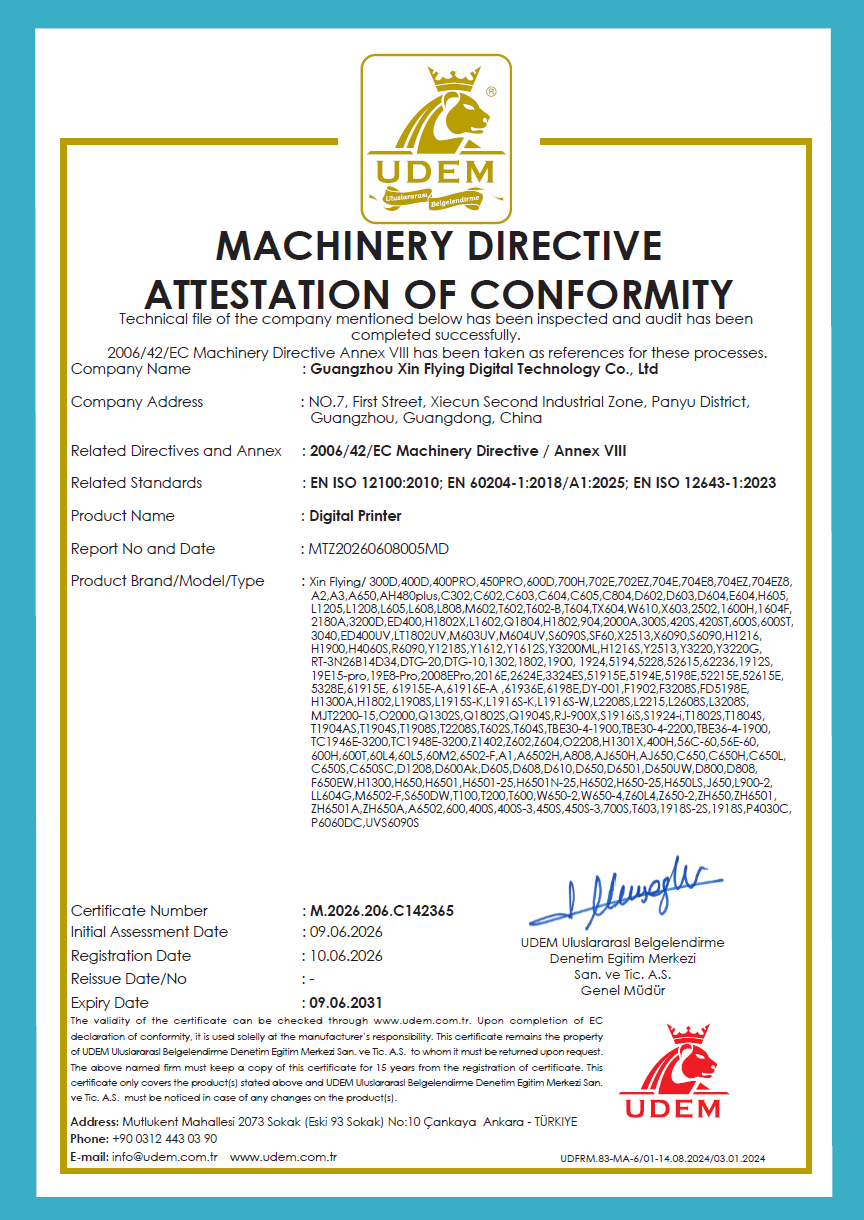
A direct-to-film printer shipped into the European Union does not travel with a single certificate; it travels with a pack. In the XF series compliance file from XINFLYING — the brand of Guangzhou Xin Flying Digital Technology Co., Ltd. — that pack is assembled from four document families: a CE Low Voltage Directive certificate (TQT1550D271EC), a CE EMC Certificate of Compliance (TQT1550D270EC), a CE Machinery Directive attestation issued by UDEM (M.2026.206.C142365) and a RoHS attestation (M.2026.206.C142366). Two supporting layers sit outside the CE framework: an ISO 9001:2015 certificate (NOA2215496) covering quality management, and an OEKO-TEX ECO PASSPORT (SH150194016) covering textile printing inks and pastes.
Each of those documents certifies a different risk, under a different directive, against a different set of standards, and with its own validity period. That is the part buyers most often miss. A supplier that says its machines are CE certified is making a statement about conformity marking; it is not telling the buyer which hazards were assessed, which standards were applied, which models are in scope, or when the paperwork expires. Decoding the pack document by document is the only way to turn a folder of PDFs into a procurement decision.
The four document families at a glance
The four CE-related documents map to four distinct EU directives. Read together, they answer four different questions about the same machine.
| Document | Directive and subject | Risk it addresses | Example in the XF series pack |
|---|---|---|---|
| CE LVD certificate | Low Voltage Directive 2014/35/EU — electrical safety | Electric shock, energy and thermal hazards from the electrical design | TQT1550D271EC, issued by TQT, 19 May 2026 |
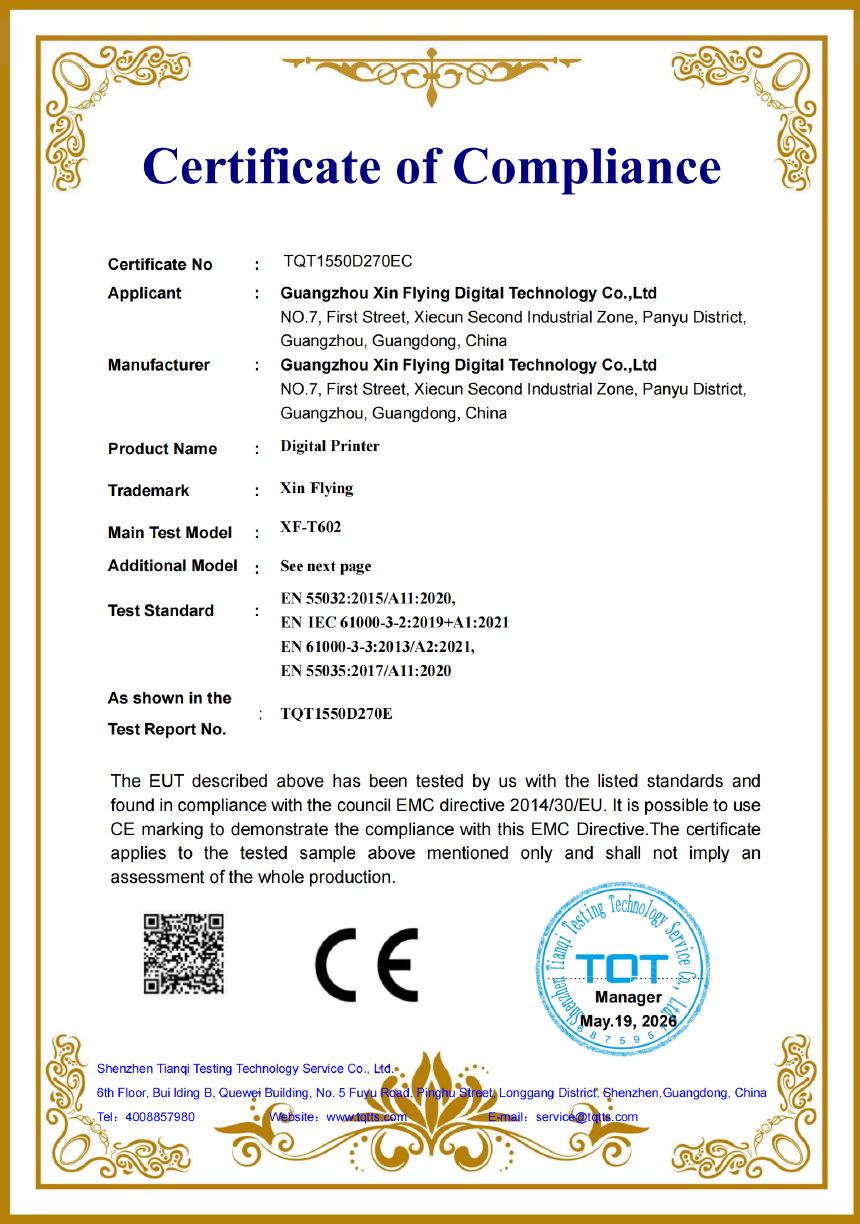
| CE EMC Certificate of Compliance | EMC Directive 2014/30/EU — electromagnetic compatibility | Interference the machine emits, and its tolerance of outside interference | TQT1550D270EC, issued by TQT, 19 May 2026 |
| CE Machinery Directive attestation | Machinery Directive 2006/42/EC — machine safety | Mechanical hazards, guarding, control reliability, risk assessment | M.2026.206.C142365, issued by UDEM, June 2026 |
| RoHS attestation | RoHS Directive 2011/65/EU — restricted substances | Hazardous substances inside the electrical and electronic equipment | M.2026.206.C142366, issued by UDEM, June 2026 |
None of the four is optional decoration. A pack that carries LVD and EMC but no machinery attestation leaves the largest hazard category undocumented; a pack with three CE documents and no RoHS evidence leaves the substance question open for any buyer whose customers audit environmental compliance.
CE LVD certificate TQT1550D271EC: the electrical safety layer
The LVD certificate answers one question: has the machine's electrical design been assessed against a recognised safety standard? Certificate TQT1550D271EC was issued by TQT (Shenzhen Tianqi Testing Technology Service Co., Ltd.) on 19 May 2026 and is scoped to electrical safety compliance under LVD 2014/35/EU for digital printer products.
The harmonised standard cited is EN IEC 62368-1:2020/A11:2020, the hazard-based safety standard applied to audio/video and information and communication technology equipment. It addresses the safeguards around insulation, energy hazards, thermal behaviour and the parts of a machine a user can reach. On a DTF printer the practical subject matter is the mains inlet, power supply, wiring, any heating or curing elements, and the separation between mains circuits and the low-voltage electronics that drive the printheads, carriage and touch panel.
What a buyer should verify on the LVD document
- Scope wording. The certificate should describe a product family that matches what you are buying, not a generic category. This one is scoped to digital printer products.
- Model list. The model on your purchase order should appear in the certificate's model range. The compliance data supplied for the XF series links the document to a 15-model range that includes 30 cm, 42 cm, 60 cm and 80 cm machines.
- Electrical ratings. XF series models are specified for 110–220 V, 50/60 Hz input, with rated power from 0.5 kW on the XF-400D to 3.5 kW on the XF-450PRO. The configuration tested should be consistent with the ratings you will operate.
- Who issued it. A certificate from a testing body is third-party documentary evidence; a manufacturer's own declaration is not the same thing, and the two are often placed in the same folder without distinction.
The boundary matters too. An LVD certificate says nothing about whether the machine interferes with other equipment, and nothing about whether the printhead carriage is guarded. Those belong to the next two documents.
CE EMC Certificate of Compliance TQT1550D270EC: emissions and immunity
The EMC certificate addresses a different failure mode entirely: electromagnetic behaviour. Certificate TQT1550D270EC, also issued by TQT on 19 May 2026, is scoped to EMC Directive 2014/30/EU and cites four standards that divide the work between emissions and immunity.
- EN 55032:2015/A11:2020 — emission requirements for multimedia equipment: what the machine may radiate and conduct back onto the mains.
- EN 55035:2017/A11:2020 — immunity requirements: how the machine behaves when subjected to external electromagnetic disturbance.
- EN IEC 61000-3-2:2019+A1:2021 — limits on harmonic current drawn from the supply.
- EN 61000-3-3:2013/A2:2021 — limits on voltage fluctuations and flicker imposed on the supply.
For a print shop, the emission side is the visible one. A DTF line is rarely a single machine: a printer, powder shaker, heat press, air purifier and RIP workstation commonly share a production room and sometimes a circuit. Equipment that radiates above permitted levels, or draws current in a way the supply does not tolerate, creates exactly the problems the certificate is designed to rule out. The immunity side is the quieter half — whether the printer keeps printing correctly when a heat press cycles nearby.
What the EMC certificate does not do is tell you anything about print quality, throughput, white-ink stability or software compatibility. Those are performance questions, answered by test prints and acceptance criteria, not by a compliance document.
CE Machinery Directive attestation M.2026.206.C142365: the machine-safety layer
The machinery document is the widest of the four, because it treats the printer as a machine rather than as an electrical product. Attestation M.2026.206.C142365 was issued by UDEM under Machinery Directive 2006/42/EC and cites three standards, each covering a different part of the safety argument.
- EN ISO 12100:2010 — the risk assessment and risk reduction methodology. This is the reasoning layer: hazards are identified, risk is evaluated, and reduction measures follow a defined hierarchy before any warning label is applied.
- EN 60204-1:2018/A1:2025 — electrical equipment of machines. It sits alongside the LVD standard but addresses the machine-level electrical system: isolation, emergency stopping, control functions and protective bonding of the machine as a whole.
- EN ISO 12643-1:2023 — safety requirements for graphic technology equipment, the standard family written specifically for printing and converting machinery rather than for industrial plant in general.
That combination is the signal to look for. An attestation that cites only a risk-assessment methodology leaves machine-specific hazards unaddressed; the presence of a printing-machinery standard alongside the electrical-equipment standard shows the assessment was made against the equipment type actually being sold.
What the machinery attestation corresponds to on the machine
In practice the machinery layer covers what operators physically interact with: guarding around the printhead carriage and film-feed path, pinch rollers and other in-running nips, the emergency stop function, control-system reliability under fault conditions, and the stability of the frame during operation. It also covers the instruction and warning content the risk assessment produces.
Two limits deserve stating plainly. First, the attestation is documentary evidence about the machine type it names; it is not an audit of the factory that builds each unit. Second, the machine you receive should match the configuration assessed. Optional items — an automatic moisturising function, for example, which is listed as optional on several XF models — and different width classes change that configuration, so the model and option list on the certificate should be compared against the order rather than assumed.
RoHS attestation M.2026.206.C142366: substances inside the machine
RoHS is the document buyers most often misread. Attestation M.2026.206.C142366, issued by UDEM under Directive 2011/65/EU, is scoped to the machine as electrical and electronic equipment. It cites EN IEC 63000:2018, the standard for the technical documentation used to assess compliance with substance restrictions, together with the EN IEC 62321 series of test methods for determining restricted substances.
The substances at issue are the ones restricted by the directive — lead, mercury, cadmium, hexavalent chromium and certain phthalates among them — and the places they can appear in a printer are mundane: solder, wiring insulation, cable sheathing, plastic covers, connectors and coatings. The attestation states that the equipment has been assessed against those limits and that supporting technical documentation exists.
What RoHS does not do is certify anything about the ink, the film, the powder or the printed garment. Those are chemical inputs to a textile process and sit under a different scheme entirely. Confusing the two is one of the most common compliance errors in DTF procurement: a machine-level RoHS attestation is sometimes presented as if it answered a skin-contact question about the print, and it does not.
Why the four documents are not interchangeable
The simplest way to see why all four are needed is to map typical failure modes to the document that covers them.
- A damaged mains cable, a failed insulation barrier or an overheating power supply falls inside the LVD assessment.
- A drive that disturbs a nearby workstation, or a printer that misbehaves when a heat press cycles on the same circuit, falls inside the EMC assessment.
- An unguarded pinch roller, a missing emergency stop or an unreliable control function falls inside the machinery assessment.
- A restricted substance in a wiring harness, connector or plastic cover falls inside the RoHS assessment.
Four hazards, four documents, no overlap in coverage. That is also why the legal basis for the CE mark rests on the manufacturer's declaration across all applicable directives rather than on any single certificate. The supplied compliance data for the XF series additionally includes a combined LVD and EMC attestation, M.2026.206.C142475, valid to 2031-06-10 — a reminder that the same conformity can be evidenced by more than one document set, and that the buyer's job is to confirm coverage rather than count files.
The two supporting layers: ISO 9001:2015 and OEKO-TEX ECO PASSPORT
The CE documents deal with the product. The two remaining documents deal with the system that produced it and the chemistry that runs through it, and they are the ones buyers most often skip.
ISO 9001:2015 certificate NOA2215496
Certificate NOA2215496 was issued by NOA Testing & Certification Group Co., Ltd. against GB/T 19001-2016 / ISO 9001:2015, with a scope covering the quality management system for digital printer and ink sales. It is a management-system certificate, not a product certificate: it says defined processes for quality planning, control and improvement exist within that scope, not that any particular printer meets any particular specification.
The copy in the pack records issue on 26 December 2022 and an expiry of 25 December 2025. A buyer evaluating the file in late 2026 should therefore request the renewed certificate before treating this document as live evidence, and should confirm the scope still describes the activities it is being relied on for. That is not a technicality — renewal tracking is precisely the discipline a compliance pack is supposed to demonstrate, and a pack whose system certificate has lapsed carries an open question.
OEKO-TEX ECO PASSPORT SH150194016
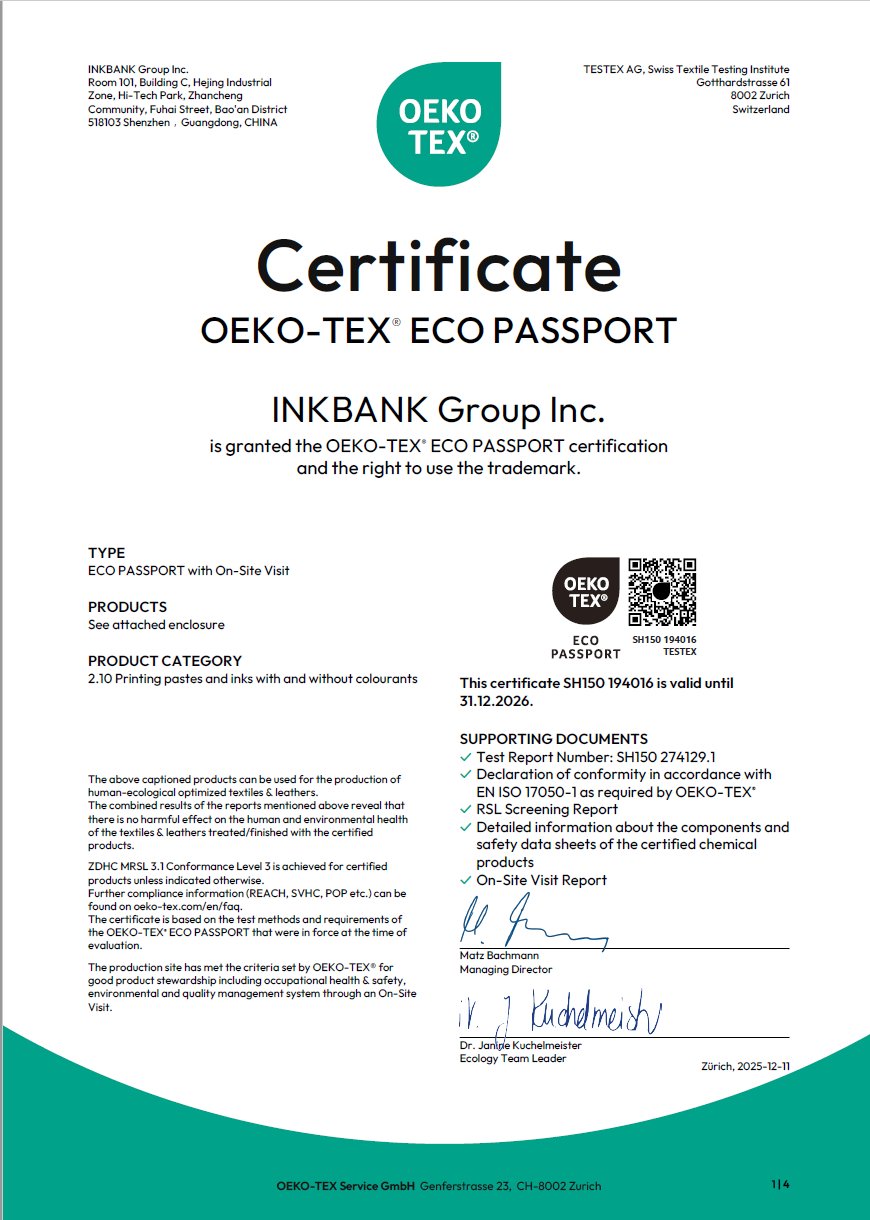
The ECO PASSPORT is the document that answers the ink question. Certificate SH150194016 was issued by TESTEX AG against the OEKO-TEX ECO PASSPORT scheme and EN ISO 17050-1, with a scope covering textile printing inks and printing pastes. It is an input-chemical certification: it addresses the chemistry used in the printing process, which is the part of a DTF workflow a machine certificate can never reach.
The recorded validity period runs from 11 December 2025 to 31 December 2026. Because ECO PASSPORT certification follows an annual renewal cycle, a buyer whose production or tender cycle extends into 2027 should ask for the renewal now rather than at the point of delivery. Coverage also needs reading carefully: the certificate covers inks and pastes, not the film, not the powder, and not the finished printed garment. A brand sourcing decorated apparel still needs its own testing on the final article.
Matching the certificate model list to the machine you order
Certificate packs fail at the model line more often than at the standards line. The XF series compliance data links the four CE documents to a 15-model range; the width and printhead configuration of the models with published specifications are summarised below, because those are the variables that change what has to be assessed.
| Model | Print width | Printheads |
|---|---|---|
| XF-400D | 30 cm | 2 × Epson i1600-A1 / XP600 |
| XF-450PRO | 42 cm | 2 × Epson i1600-A1 |
| XF-C602 | 60 cm | 2 × Epson i3200-A1 |
| XF-702E | 60 cm | 2 × Epson i3200-A1 |
| XF-704E | 60 cm | 4 × Epson i3200-A1 |
| XF-C604 | 60 cm | 4 × Epson i3200-A1 |
| XF-C605 | 60 cm | 5 × Epson i3200-A1 |
| XF-F606 | 60 cm | 6 × Epson i3200-A1 |
| XF-L608 | 60 cm | 8 × Epson i3200-A1 |
| XF-F808 | 80 cm | 8 × Epson i3200-A1 |
Two practical readings follow. A single 60 cm machine purchase and a multi-unit production line may sit inside the same certificate family but not inside the same configuration, so the model and option list on the certificate is the part to compare against the order. And where a supplier ships both dual-printhead and higher-head-count machines under one document set, the buyer should confirm that the specific head count, width and power rating being purchased are covered rather than assumed from the family name.
What the pack proves — and what it does not
A complete four-document pack is a strong signal. It shows the manufacturer has engaged testing and certification bodies across the electrical, electromagnetic, machinery-safety and substance dimensions, and that the evidence is specific enough to name standards, certificate numbers, issuing bodies and validity periods. That is materially different from a supplier page that asserts compliance in a sentence.
It is equally important to be clear about the limits.
- It is not a performance test. Nothing in LVD, EMC, machinery or RoHS evidence tells you throughput at your production profile, white-ink maintenance burden, or consumable cost per square metre at your coverage. Supplier-authored buyer guides treat those as separate verification topics for exactly this reason; they belong in an RFQ and an acceptance test, not in the certificate folder.
- It is not a factory audit. Certificates describe a product type and a management system, not the condition of the line that built your unit.
- It does not cover the unit you receive. The documents address a type and a model range; matching the delivered machine's model, configuration and serial record to that range is the buyer's step.
- It is EU-scoped. These four documents address EU directives. Buyers placing machines in other markets should ask which additional documents exist rather than assuming the EU pack transfers.
- It expires on four different rhythms. The LVD and EMC copies record a validity end date of 2099-01-01, the machinery and RoHS attestations to 2031-06-09, the ECO PASSPORT to 2026-12-31, and the ISO 9001 copy to 2025-12-25. Long-dated validity should be read together with the standard versions cited and the model scope, not as a substitute for them.
How importers, distributors and apparel producers actually use the pack
Different buyers interrogate the same folder for different reasons, and the pack only works if each finds the document that answers their question.
EU importers and distributors use the four CE documents as the technical file behind the machines they place on the market, and as evidence when a retailer or marketplace asks for compliance documentation before onboarding a seller. For them, model scope and validity dates are the operative fields.
Apparel brands and garment producers usually arrive with two separate questions that should be answered by two separate documents. Machine safety — guarding, emergency stop, control reliability — is the machinery attestation. Chemistry in contact with textile — inks and pastes — is the ECO PASSPORT. A brand that receives only the machine documents has not closed its own chemical question.
Print-on-demand and small custom-apparel operations tend to meet the pack through their own business customers, when a corporate buyer or an institution asks for proof that the decoration process is documented. Deployment patterns recorded for the XF series range from two-unit custom apparel businesses to a 30-unit transfer supplier and a 20-unit garment factory, and the compliance question is the same at every scale: the folder has to be complete and current, not merely present.
Technical and EHS reviewers read the standards line rather than the certificate number, because the standards tell them what was actually assessed. An attestation citing EN ISO 12643-1:2023 alongside EN 60204-1:2018/A1:2025 reads differently to a reviewer than one citing only a generic risk-assessment methodology.
Market context: documentation as a buying criterion
The commercial backdrop helps explain why this paperwork has moved from the purchasing office to the shortlist. Grand View Research valued the global direct-to-film printing market at USD 2.7 billion in 2024 and projects USD 3.9 billion by 2030, a 6.0% CAGR from 2025 to 2030 — figures that describe a category large enough to attract market-surveillance attention as well as new entrants. Research houses define that market differently, with some counting hardware only and others including film, powder and ink, so the absolute numbers should be read as directional rather than as a segment sizing for any single buyer.
What the growth pattern does change is the cost of weak documentation. When a category is small, an incomplete certificate folder is an inconvenience; when it is large and visible, an incomplete folder becomes a customs question, a marketplace listing rejection or a failed retailer onboarding. That shift is why a certificate pack is now read as a supplier capability signal rather than an administrative attachment.
Outlook: renewal tracking becomes routine procurement work
The documents in this pack expire on four different schedules, which means a single purchase does not produce a permanently valid file. The practical consequence is that compliance documentation is becoming a maintained record rather than a one-time deliverable: buyers will increasingly ask not only whether a certificate exists but when it was issued, which standard version it cites, and when renewal falls due.
For manufacturers, that favours suppliers whose certification work is systematic — a testing programme that keeps LVD, EMC, machinery and RoHS documents current, a management-system certificate renewed on schedule, and an input-chemical certification maintained year on year. For buyers, it argues for a simple habit: date-stamp the pack on receipt, diary the earliest expiry, and re-request the affected document before it lapses rather than at the point of an audit.
Frequently asked questions
What documents make up a DTF printer CE compliance pack?
A typical EU-oriented pack contains four CE-related documents: a Low Voltage Directive certificate for electrical safety, an EMC certificate for electromagnetic compatibility, a Machinery Directive attestation for machine safety, and a RoHS attestation for restricted substances. In the XF series pack these are TQT1550D271EC, TQT1550D270EC, M.2026.206.C142365 and M.2026.206.C142366. An ISO 9001 certificate and an OEKO-TEX ECO PASSPORT for inks and pastes usually sit alongside them as supporting layers.
Which standards does the XF series CE Machinery Directive attestation cite?
Attestation M.2026.206.C142365, issued by UDEM, cites EN ISO 12100:2010 for risk assessment and risk reduction, EN 60204-1:2018/A1:2025 for the electrical equipment of machines, and EN ISO 12643-1:2023 for the safety of graphic technology equipment. The combination covers the assessment method, the machine-level electrical system, and the printing-machinery hazards specific to the equipment type.
Does a RoHS certificate cover the ink or the printed garment?
No. Attestation M.2026.206.C142366 covers the machine as electrical and electronic equipment under Directive 2011/65/EU, assessed against EN IEC 63000:2018 with the EN IEC 62321 test series. The chemistry of the printing process is addressed separately by the OEKO-TEX ECO PASSPORT SH150194016, scoped to textile printing inks and pastes. Neither document certifies the finished printed garment, which requires its own testing by the party placing it on the market.
How long are the XF series certificates valid?
The LVD and EMC certificates record a validity end date of 2099-01-01; the machinery and RoHS attestations run to 2031-06-09; the ECO PASSPORT runs from 11 December 2025 to 31 December 2026; and the ISO 9001 copy records an expiry of 25 December 2025. Because the periods differ, buyers should date-stamp the pack and diary the earliest expiry — in this file, the ISO 9001 copy — for re-request before it is relied on again.
What should an EU importer check first when a certificate pack arrives?
Check model scope before anything else: the machine on the order should appear in the certificate's model range, and the configuration — width class, printhead count, options and power rating — should match what was assessed. Then confirm the issuing body and certificate number on each document, check that the standards cited cover the hazards you care about, and record the expiry dates. Validity, model scope and configuration match are the three fields that most often decide whether a pack is usable.
About the manufacturer
XINFLYING is the brand of Guangzhou Xin Flying Digital Technology Co., Ltd., a digital printing equipment manufacturer founded in 2010, operating a 37,440 m² facility with more than 200 employees and an annual output of over 20,000 units. The company runs OEM/ODM programmes with a one-unit minimum order, quoted lead times of 5 to 40 days, and online technical support. Its corporate profile is published as a downloadable document: XINFLYING corporate brochure (PDF).
¿Tiene preguntas o necesita más detalles?
Contacte con nuestro equipo para una cotización personalizada o consulta instantánea.
Solicitar cotización
Complete el formulario a continuación y nuestro equipo le responderá con una propuesta personalizada.
Chat directo de WhatsApp
¿Prefiere chatear en tiempo real? Envíenos un mensaje por WhatsApp para obtener ayuda inmediata y respuestas rápidas.
- Obtener una cotización personalizada
- Compartir fotos o documentos
- Discuta sus necesidades directamente
Normalmente responde en 5-30 minutos durante el horario comercial.