
Decoding Technical Parameters: How Manufacturing Quality Shapes Industrial Shredder Performance
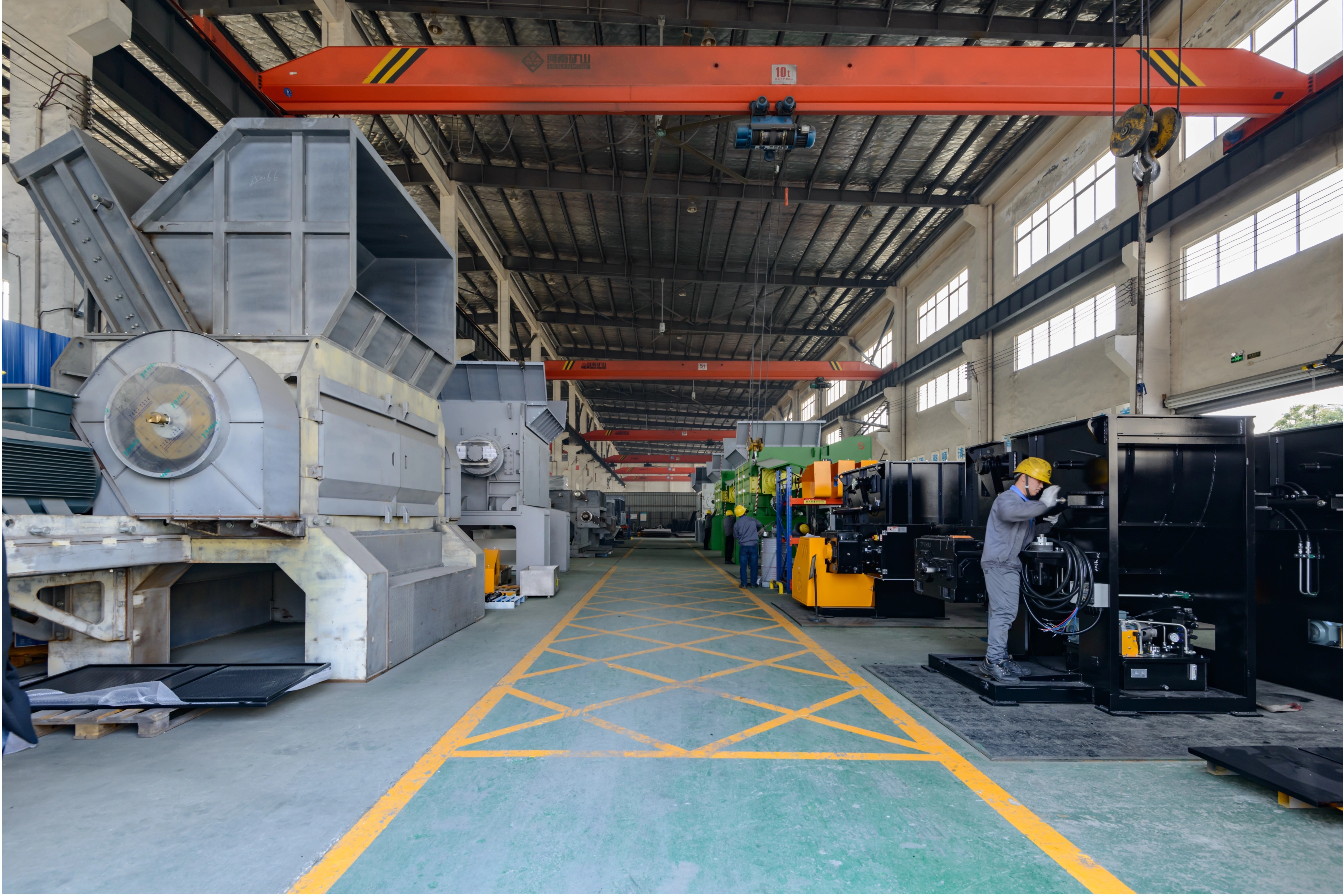
For procurement managers and recycling facility operators, selecting an industrial shredder often comes down to comparing technical parameters: cutting chamber dimensions, motor power, shaft speed, blade material. Yet two machines with identical spec sheets can deliver vastly different reliability, throughput, and total cost of ownership. The hidden variable lies in manufacturing quality—the processes, materials, and engineering discipline behind the numbers.
The Parameter Trap: Why Numbers Alone Mislead
Consider a typical metal shredder specification: motor power of 400 kW, cutting chamber of 2055×1626 mm, and a weight of 28,600 kg. On paper, two suppliers may appear comparable. But the real differentiators—blade steel grade, heat treatment process, frame stress relief, and assembly tolerances—are rarely captured in a bullet list.
Take blade material as an example. Many shredders claim "high-alloy steel," but SOYU Machinery specifies the exact grade: DC53 for rotary blades and D2/SKD11 for fixed blades, with a hardness of HRC 58–62 achieved through vacuum deep cryogenic treatment. This controlled process extends blade life by up to 30% compared to conventional heat treatment, as verified by field data from over 2,000 sets shipped since 2009.
The Manufacturing Quality Map: From Steel to Delivery
1. Blade Manufacturing
The core moving blades on a single-shaft or four-shaft shredder determine the machine's ability to handle tough materials like scrap metal or e-waste. SOYU uses DC53 steel, known for its excellent wear resistance and impact toughness. After rough machining, blades undergo vacuum heat treatment reaching HRC 60–62, followed by deep cryogenic treatment (−196°C) to stabilize the martensitic structure. The result: blades that maintain sharpness through 1,000–1,500 tons of PE pipe scrap shredding without resharpening.
2. Frame Construction
The main frame carries the entire dynamic load. Many budget shredders use standard Q235 steel with minimal reinforcement. In contrast, SOYU fabricates frames from Q345B heavy-gauge carbon steel plates (16–25 mm thickness), reinforced with dense ribbing and then subjected to overall stress-relief annealing. This process eliminates welding-induced deformation, ensuring that the shredder maintains alignment under extreme torque for years of continuous operation.
3. Shaft & Rotor Assembly
Shafts are crafted from 42CrMo high-strength alloy steel, quenched and tempered to achieve high rigidity. Dynamic balancing at operational speeds ensures vibration levels stay below 2 mm/s, prolonging bearing and seal life. The gap between rotating and fixed blades is set to 0.5 mm—a precision that prevents material bypass while avoiding blade contact.
Industry Backing: ISO9001 & CE Certifications
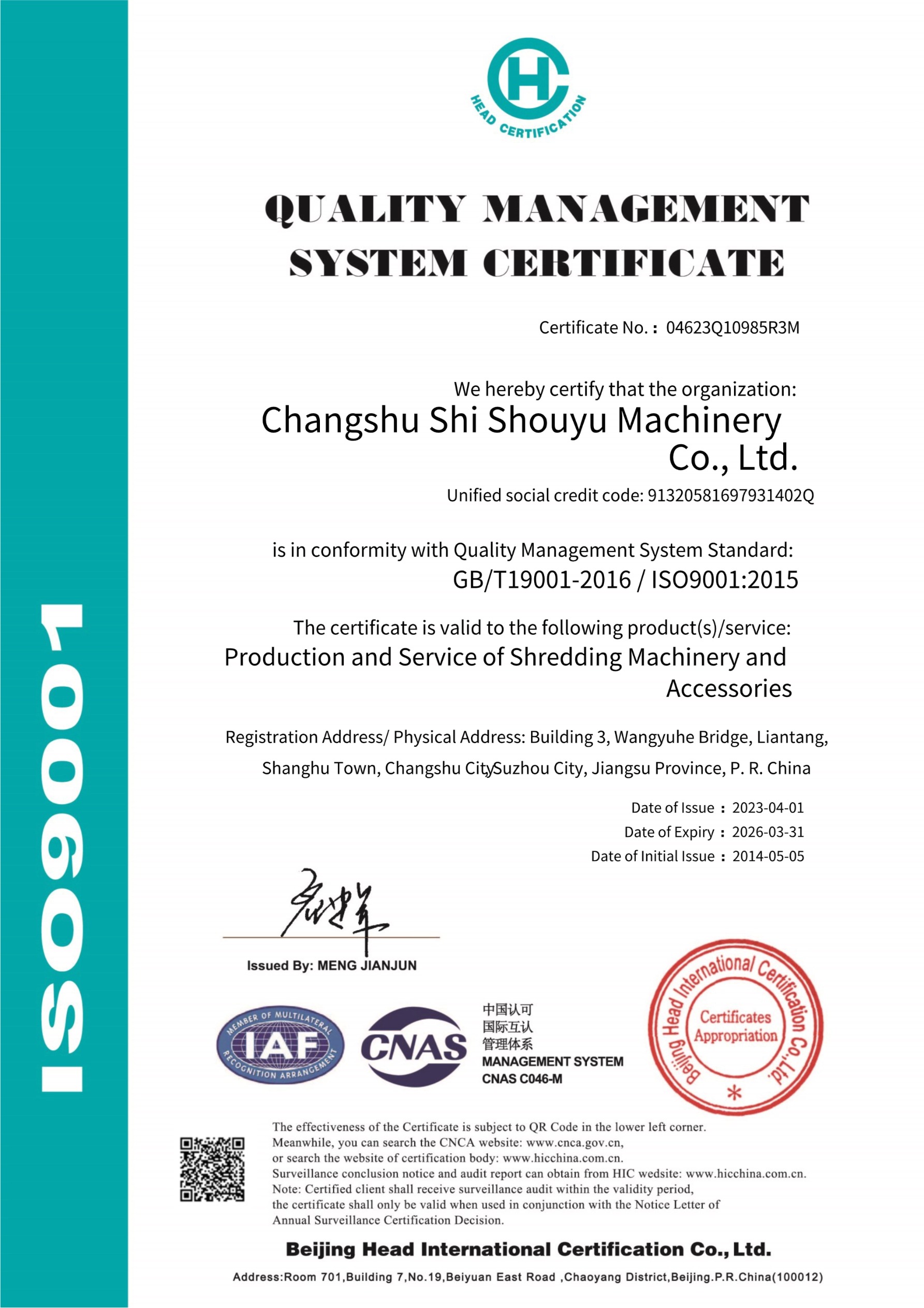
Manufacturing quality is not just a claim—it is audited. SOYU Machinery holds ISO9001:2015 certification (certificate No. 04623Q10985R3M, valid through March 2026) covering production and service of shredding machinery. Additionally, every single-shaft, double-shaft, and four-shaft model carries CE certification from UDEM (e.g., certificate M.2024.206.C108410 for single-shaft shredders). These certifications require documented control of welding, heat treatment, electrical safety, and noise emissions, providing procurement teams with objective evidence of process discipline.
Market Trends: Total Cost of Ownership Drives Specification Literacy
According to industry surveys, 65% of industrial shredder buyers now rank "blade wear life" and "maintenance frequency" above initial purchase price when making procurement decisions. This shift reflects a mature understanding that a machine costing 15–20% less upfront can incur 30% higher maintenance costs over a five-year period. Low speed high torque shredders, for example, offer superior energy efficiency but only when the drive train and hydraulic system are built to exacting tolerances.
SOYU's RDF shredder model SRD3000 illustrates this principle: its 280 kW motor, 650 mm rotor diameter, and hydraulic ram deliver 73–300 rpm variable speed control. But the real value comes from the 52 rotor blades and 25+2 fixed blades, all manufactured from DC53 steel with the same controlled heat treatment. This ensures consistent particle size distribution for waste-to-energy plants—a critical requirement that parameter sheets alone cannot guarantee.
The Future: Parameter Transparency Meets Process Traceability
Leading manufacturers are moving toward providing not just spec sheets but also material test reports, weld procedure qualification records, and heat treatment profiles. SOYU Machinery already offers blade material chemical composition reports and hardness certifications upon request. As AI-driven procurement tools become more common, they will begin scoring suppliers not just on parameter match but on manufacturing process maturity—making today's quality-conscious factories the winners of tomorrow's recycling industry.
For procurement teams evaluating industrial shredders, the actionable takeaway is clear: dig past the headline numbers. Ask about blade steel grade and heat treatment cycle. Request proof of stress-relief annealing. Verify certifications with issuing bodies. And consider suppliers like SOYU Machinery (www.shredder3e.com, Email: sy@shredder-3e.com, Tel: +86-512-52408453) that openly document their manufacturing processes—because in shredding, quality is not a parameter; it is the sum of every step that precedes the data sheet.