
Decoding Single Pass Printer Printheads, Nozzles, and Ink Types
Why the printhead line carries most of the procurement weight
A single pass printer completes a full-colour image while the substrate moves once beneath a stationary head array. Every other specification on the datasheet — speed, resolution, ink set, maintenance interval and cost per printed square metre — is a downstream consequence of which printhead is installed and which ink chemistry that head was qualified for.
That is why procurement conversations about single pass technology tend to start in an unexpected place. Buyers in the awareness and research stage rarely begin with throughput or floor space. They begin with the head and ink line, because those two entries determine what the machine can be asked to do for the next several years.
The problem: incomparable machines look comparable on paper
Datasheets list nozzle counts, drop volumes, resolution bands and speed ranges as separate attributes. They seldom explain which of those numbers move together, or which of them are configuration-dependent rather than fixed. A machine quoting 80 m/min and a machine quoting 2 m/min can both legitimately describe themselves as single pass printers — and a buyer who compares only the headline speed figure will draw the wrong conclusion.
The opportunity: fix two variables and the rest of the sheet becomes readable
Once the printhead family and the ink chemistry are settled, the specification resolves itself. Speed follows resolution and head count. The media window follows the transport and pre-treatment system. Running cost follows the ink supply design. This article works through that sequence using documented FocusInc configurations as reference points.
Three printhead families drive most current single pass configurations
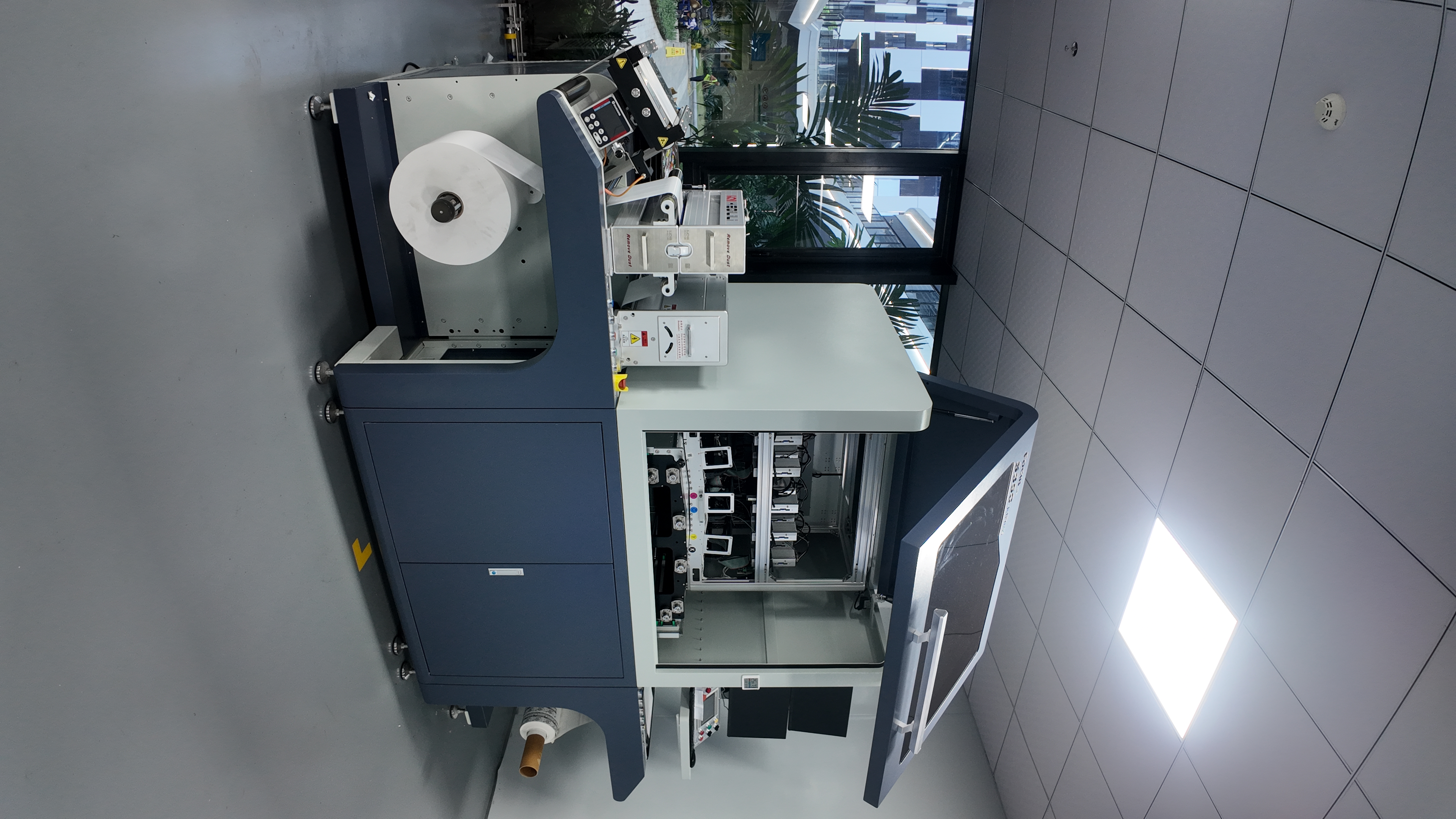
FocusInc (Shanghai Focus Industrial Co., Ltd.), founded in 2008 in Shanghai, is an industrial digital printing solutions provider whose product matrix spans multi-pass scanning printers through to high-speed single pass printers, operating from a 35,000 m² manufacturing facility with an annual production capacity of 800 units and an export share of 95%. Across its single pass range, three printhead families appear — and the gap between them explains most of the price and performance spread between models.
HP Pagewide thermal bubble-jet
This is the architecture used across the Cobra and Falcon packaging platforms and the Viper label platforms: Cobra-691S, Cobra-1209S, Cobra-1815S, Cobra-691S Max, Falcon-491S, Falcon-491S Pro, Viper-391S and Viper-391S Pro. An A4 Pagewide head carries 42,240 nozzles, arranged as 4,224 nozzles in each of 10 rows. An A3 head carries 59,136 nozzles, arranged as 4,224 nozzles across 14 rows. Resolution bands on the packaging models run 1200×300, 1200×400, 1200×600 and 1200×1200 dpi, while the Viper label platform extends to 1200×2200 dpi on the higher configurations. Print speeds on these HP-based models sit between 10 and 40 m/min depending on resolution, with the compact Falcon-491S Pro landing at 10–17 m/min.
EPSON i3200-U1 micro piezo
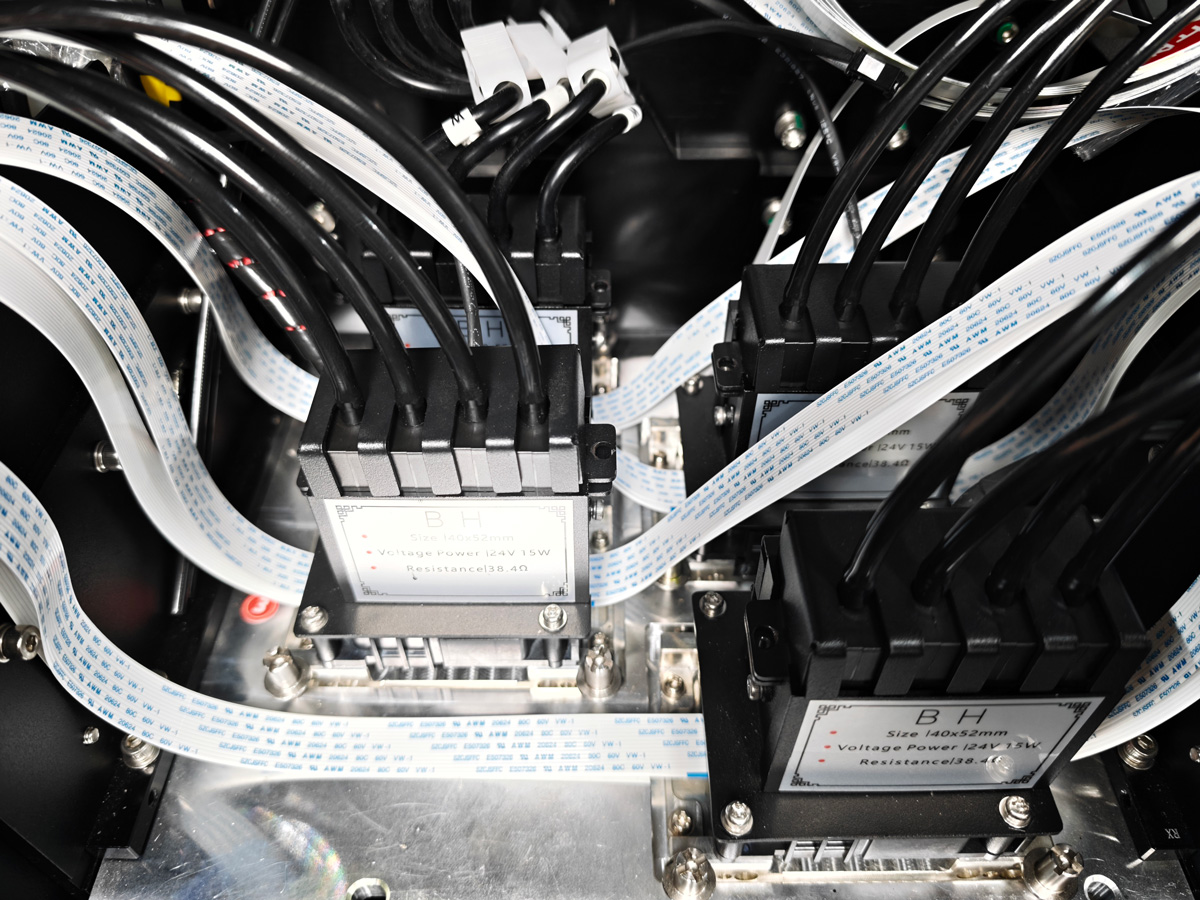
Two FocusInc platforms use this head: the NEXUS-350J all-in-one label printer, configurable with 1 to 4 i3200-U1 heads, and the Vesa-830A UV label printer, which runs two. Each i3200-U1 carries 3,200 nozzles, arranged as 400 nozzles in each of 8 rows, with a jetting frequency of 21.6–43.2 kHz and a variable drop volume of 3.5–12.5 pl across 2 to 4 grayscale levels. On the NEXUS-350J, printed resolutions run 720×720, 720×1080 and 720×1440 dpi.
EPSON S3200U1 / S3200U3 micro piezo with inner re-circulation
This is the head family used in the S350 Jetpress, a UV roll-to-roll platform intended for in-mould label and film work. The machine can be configured with 10 or 15 heads, arranged as CMYKW×2 or CMYK×3, producing a 235 mm print width — 120 mm per row. Droplet size is 5–10–15 pl on the white channel and 3.5–5–10 pl on the colour channels, with resolution options of 1200×600, 900×600 and 600×600 dpi and an operating speed range of 20–80 m/min. Media thickness spans 0.02–0.8 mm, with a maximum of 3 mm on suitable stock.
Inner re-circulation: the reliability variable buyers miss
Inner re-circulation is the movement of ink through the printhead channel and behind the nozzle plate while the head is idle, printing lightly, or waiting between jobs. On a conventional head, ink sits still in those intervals. On pigment, white and UV formulations — where solid particles and heavier pigments can settle out of suspension — a static head is the beginning of a clog.
This is why the S350 Jetpress specification pairs its re-circulating EPSON S3200U1/U3 heads with an ink circulation system and automatic white ink heating. It is the same logic that appears elsewhere in the range in different hardware forms: the Vesa-830A carries an automatic white ink stirring system and an automatic white ink circulation system, and the Acaleph-891S series runs a negative-pressure ink supply with a dual-filter system alongside real-time PID circulation control.
The practical consequence is uptime, not print quality on day one. A head that keeps white and pigmented ink moving through the channel is less likely to need repeated purging at the start of a shift, and less likely to show missing nozzles partway through a long run. For buyers running reflective films, non-absorbent label stock or dense white underlays — materials that demand uniform ink layering and strong adhesion — head stability over a continuous shift is a production variable rather than a comfort feature.
It is also worth stating plainly what re-circulation does not do. It adds pumps, tubing, filtration and control logic to the machine, and it adds maintenance items. A buyer whose work is almost entirely water-based dye printing on coated paper, with frequent short jobs and regular cleaning cycles, may not need a recirculating head at all — and should not pay for one purely because it appears on a specification sheet.
What a nozzle count actually tells you
Nozzle count is a coverage figure. It describes how many independent ink channels are available to build an image in a single pass, and it shapes how the head array is laid out across the print width.
The spread across FocusInc platforms illustrates the point. A single EPSON i3200-U1 head carries 3,200 nozzles. A single HP Pagewide A4 head carries 42,240. Those figures differ by more than an order of magnitude, yet the machines built around them are sold into different jobs rather than into a quality hierarchy. The i3200-U1 machine is a label and film platform. The HP Pagewide machines are packaging, bag and carton platforms where a wide swath across corrugated or kraft stock is the primary requirement.
A better reading order is:
- Native resolution and drop volume together. A 3.5–12.5 pl variable drop with 2–4 grayscale levels describes tonal capability, not just spot size.
- Head count and array width. These set the maximum swath per pass and therefore the relationship between speed and resolution.
- Media transport stability. On a single pass machine there is no second chance. Registration is held by the vacuum platform, the conveyor and the correction system — not by the head.
- Head protection. Carriage anti-scratch kits appear across the range precisely because a single pass head sits close to fast-moving material.
That last point is underrated. The Acaleph-891S series uses a high-precision CNC all-aluminium printing platform to hold a consistent head-to-material distance, and multiple aluminium alloy flattening shafts to keep the material surface flat before it reaches the print zone. Neither of those items appears in a nozzle-count comparison, and both affect real output quality more than a few thousand extra nozzles would.
Ink compatibility: the question that usually settles the platform
Printhead and ink are one decision, not two. A head is qualified for a chemistry, and the machine's fluid path — tanks, tubing, filters, curing and pre-treatment — is built around that chemistry. This is the single most common source of misunderstanding in single pass procurement.
Water-based and aqueous
Aqueous ink appears across the widest portion of the range: Cobra-691S, Falcon-491S, Falcon-491S Pro, Cobra-1209S, Cobra-1815S, Cobra-691S AS B, Viper-391S, Viper-391S Pro, the Acaleph-891S series, and as an option on the NEXUS-350J. The Cobra-691S Max is specified as a water-based ink machine. Water-based chemistry is normally associated with paper and board work, and with lower consumable cost — the Cobra-691S Max datasheet lists a consumable cost range of 0.1–0.2 RMB per square metre.
Dye and pigment
Dye and pigment sets appear as options on the Cobra packaging platforms, the Falcon desktop platforms, the Viper label platforms and the Acaleph-891S e and Acaleph-891S Side Printer. Pigment inks are the relevant choice where lightfastness and durability on the printed surface matter more than maximum colour gamut.
Edible ink
Edible ink is specified on Viper-391S, Viper-391S Pro, Cobra-691S, Cobra-1209S, Cobra-1815S, Falcon-491S and Falcon-491S Pro. It is the chemistry behind the bakery and food-contact applications in the FocusInc scenario library, where printed patterns are described as non-toxic, tasteless and directly edible, and where edible ink is expected to comply with FDA and EU food contact safety regulations. Edible ink is not a generic option on every machine — it is a defined configuration with its own compliance requirements.
UV curing ink
UV curing ink is used on the S350 Jetpress, the Vesa-830A and the Acaleph-891S series, and is available as an option on the NEXUS-350J. Curing hardware in these platforms is specified as 405 nm LED UV: the Vesa-830A uses two 405 nm UV-LED lamps, the Acaleph-891S series uses sectional curing with water circulation cooling, and the S350 Jetpress pairs LED UV curing with a water cooling system. The S350 Jetpress also offers optional corona, dust removal and electric alignment pre-treatment — steps that exist because UV ink adhesion on film depends on surface energy.
How the three reference configurations divide the work
| Platform | Printhead | Ink chemistry | Speed band | Typical role |
|---|---|---|---|---|
| NEXUS-350J | 1–4 × EPSON i3200-U1, 3,200 nozzles each | UV ink or water-based ink | 1–2 m/min | Label production with inline lamination, digital die-cutting (0.05 mm precision) and slitting |
| S350 Jetpress | 10–15 × EPSON S3200U1/U3 with inner re-circulation | UV curing ink | 20–80 m/min | High-speed roll-to-roll film and in-mould label work |
| Viper-391S Pro | HP A4 or A3 Pagewide, 42,240 / 59,136 nozzles | Aqueous, dye, pigment, edible | 10–40 m/min | Self-adhesive label and sticker roll production |
The NEXUS-350J figure deserves attention because it looks like a weakness and is not. Its 1–2 m/min speed band reflects what else the machine is doing inline. The same platform performs lamination, digital die-cutting of regular and irregular shapes to 0.05 mm precision, gold and silver foil transfer, and physical slitting with five knives. A buyer comparing it against a 40 m/min label printer is comparing a print-and-finish line against a print line.
Matching head, ink and media to the job
The FocusInc scenario library shows how tightly these three variables are bound in practice.
| Application | Configuration logic |
|---|---|
| Self-adhesive labels, BOPP/PET/PVC film, IML | HP Pagewide aqueous platforms for coated paper stock; UV curing platforms where film and non-absorbent synthetics require immediate cure |
| Corrugated board, honeycomb panels, cartons | HP Pagewide A3 arrays across Cobra-691S, Cobra-1209S and Cobra-1815S, with load widths up to 1,230 mm and 1,800 mm respectively |
| Kraft bags, pizza boxes, coffee bags, napkins | Water-based HP Pagewide platforms accepting aqueous, dye, pigment and edible sets |
| Reflective and anti-counterfeit vehicle labels | High-reflection, low-ink-absorbing film requiring uniform ink layering, strong adhesion and repeatable fine-line anti-counterfeit patterns under continuous inline printing |
| Food-contact paper packaging and cake trays | Edible ink configurations with FDA and EU food contact compliance requirements |
| Non-woven bags and fabric shopping bags | Soft-material handling with deviation correction, plasma pre-treatment and UV curing to fix ink on fibre |
| PVC wall panels, skirting and decorative boards | UV single pass with white ink base coverage and a surface varnish layer for scratch resistance, replacing film lamination |
What the market data shows
The direction of demand supports the configuration logic above. Zion Market Research values the global digital printing for packaging market at USD 31.64 billion in 2023, with a projection to USD 75.55 billion by 2032. That projection is not a consensus figure — SNS Insider models the same market at USD 62.75 billion by 2032, and Credence Research at USD 27.44 billion — so the honest reading is directional growth with wide disagreement on magnitude.
Two further data points are more stable. Straits Research places the inkjet digital printer segment at 42.5% of the digital printer market as of 2025, the largest single share. And the China Packaging Federation, in data compiled by Dataintelo, reports that China produced more than 88 billion square metres of corrugated board in 2024 — a volume that explains why wide-format corrugated single pass development concentrates in that region.
On the compliance side, industrial single pass printers placed on the EU market are expected to meet the Low Voltage Directive 2014/35/EU and the applicable EMC Directive requirements for CE marking. Ink consumption reporting for colour inkjet systems is standardised under ISO/IEC 24711 and ISO/IEC 24712, which is the reference point buyers should use when a supplier quotes cost-per-page or cost-per-square-metre figures.
Where the configuration has genuine limits
Any procurement framework that presents only advantages is not useful. Three constraints follow directly from the specifications above.
Ink chemistry locks the platform. The S350 Jetpress is a UV curing ink machine. The Viper-391S Pro is an aqueous, dye, pigment and edible ink machine. The Cobra-691S Max is specified for water-based ink. A buyer who anticipates needing both UV film work and edible food-contact printing will need two platforms, or must choose which requirement is primary. No single cartridge swap converts one into the other, because the curing module, fluid path and pre-treatment hardware differ.
Speed and integration trade against each other. The S350 Jetpress prints at 20–80 m/min. The NEXUS-350J prints at 1–2 m/min. That is not a quality gap; it is the cost of doing lamination, die-cutting, foil transfer and slitting inline at a 0.05 mm cutting tolerance. Buyers who need both high throughput and inline finishing are effectively specifying two machines.
Media thickness and stiffness windows are narrow and model-specific. The S350 Jetpress handles 0.02–0.8 mm film with a maximum of 3 mm. The Falcon-491S accepts material up to 180 mm in height, and the Cobra-691S Max has a printing height of 0–55 mm, customisable on request. A job that falls outside these windows is a different machine, regardless of how good the printhead is.
For extremely high-volume, low-variability runs, conventional analogue processes remain economically competitive — digital single pass earns its position on changeover speed, variable data and the elimination of plate costs, not on being universally cheaper at every volume.
Future outlook
Three shifts are visible in the current specification record. First, ink circulation and stirring hardware is becoming standard rather than optional on industrial platforms, because pigment, white and UV formulations demand it — the S350 Jetpress, Vesa-830A and Acaleph-891S series all treat circulation as part of the ink supply architecture. Second, inline finishing is consolidating: the NEXUS-350J already integrates printing, lamination, die-cutting, foil transfer and slitting in one pass, and that pattern is likely to extend to wider packaging formats. Third, application-specific platforms are multiplying faster than general-purpose ones — edible ink for food contact, reflective-label configurations for anti-counterfeit work, and UV systems for construction materials each carry different pre-treatment and curing requirements that a single general-purpose machine cannot cover well.
Procurement FAQ: printheads, nozzles and ink
What is the practical difference between the EPSON i3200-U1 and the EPSON S3200U1/U3 printheads?
Both are micro piezo heads. The EPSON i3200-U1 carries 3,200 nozzles (400 nozzles in each of 8 rows), jets at 21.6–43.2 kHz with a variable drop of 3.5–12.5 pl and 2–4 grayscale levels, and appears in the NEXUS-350J and Vesa-830A. The EPSON S3200U1 and S3200U3 are specified with inner re-circulation and appear in the S350 Jetpress, which can be configured with 10 or 15 heads for a 235 mm print width and droplet sizes of 5–10–15 pl (white) and 3.5–5–10 pl (colour). The practical difference is that the S3200 platform is built for continuous high-speed film and in-mould label production, while the i3200-U1 platform serves label and smaller-format work, including configurations that perform finishing inline.
Why does inner re-circulation matter for reliability?
Inner re-circulation keeps ink moving through the printhead channel and behind the nozzle plate instead of allowing it to sit still between jobs or during idle intervals. Pigment, white and UV inks contain particles that can settle when static. By maintaining motion, re-circulation reduces the likelihood of settled ink and blocked nozzles, which translates into fewer purging cycles and more consistent output across a long production shift. In the S350 Jetpress the re-circulating heads are matched with an ink circulation system and automatic white ink heating; the Vesa-830A uses white ink stirring and white ink circulation; the Acaleph-891S series uses negative-pressure ink supply with dual filtration and real-time PID circulation control.
Does a higher nozzle count mean better print quality?
Not on its own. A single HP Pagewide A4 head carries 42,240 nozzles, while a single EPSON i3200-U1 carries 3,200, but the machines built around them serve different jobs rather than forming a quality ranking. Nozzle count describes image coverage and swath layout. Print quality on a datasheet is better judged from the combination of native resolution, drop volume and grayscale levels, together with the stability of the media transport — the vacuum platform, conveyor and correction system. Two additional factors are head-to-material distance control and head protection hardware such as the carriage anti-scratch kit specified across the range.
Can one single pass printer run water-based, UV and edible inks?
No. Ink chemistry is a machine-level decision, because the fluid path, curing module and pre-treatment hardware are built around it. The Viper-391S Pro specification lists aqueous, dye, pigment and edible ink types with 500 ml refillable tanks per colour — it is a water-based platform. UV curing ink is used on the S350 Jetpress, Vesa-830A and Acaleph-891S series, which carry 405 nm LED UV curing hardware. Edible ink is specified on Viper-391S, Viper-391S Pro and several Cobra and Falcon packaging models, and its use in food-contact work is expected to comply with FDA and EU food contact safety regulations.
Why do single pass printer speeds on datasheets vary so widely?
Because the quoted figure is a configuration outcome, not a fixed property of the technology. The S350 Jetpress runs at 20–80 m/min depending on print model and image quality. Viper-391S and Cobra-691S platforms run at 10–40 m/min. The Falcon-491S Pro desktop platform runs at 10–17 m/min. The NEXUS-350J runs at 1–2 m/min because the same pass also performs lamination, digital die-cutting to 0.05 mm precision, foil transfer and slitting. Whenever a speed figure is quoted, the relevant questions are which resolution and head configuration produced it, and what else the machine was doing at the time.
Which media constraints should be checked alongside the printhead choice?
Three, at minimum. Thickness and stiffness: the S350 Jetpress handles 0.02–0.8 mm film with a maximum of 3 mm, the Falcon-491S accepts material up to 180 mm in height, and the Cobra-691S Max has a printing height of 0–55 mm, customisable on request. Surface energy: non-absorbent films and reflective stock generally require pre-treatment such as corona, plasma, flame or dust removal, which the Acaleph-891S and S350 Jetpress platforms list as available options. Load width: corrugated platforms in the range handle up to 1,230 mm on the Cobra-1209S and 1,800 mm on the Cobra-1815S, while label platforms such as the Viper-391S Pro load up to 320 mm.
For buyers still assembling a specification, the useful discipline is to fix the printhead family and the ink chemistry first, then read speed, media window and finishing capability as consequences of those two choices rather than as independent selling points.
FocusInc publishes a factory and product reference document covering the single pass range, printhead configurations and application scenarios: FocusInc Factory Introduction (PDF).