
Decoding PPE Compliance for Water-Circulation Cooling Vests
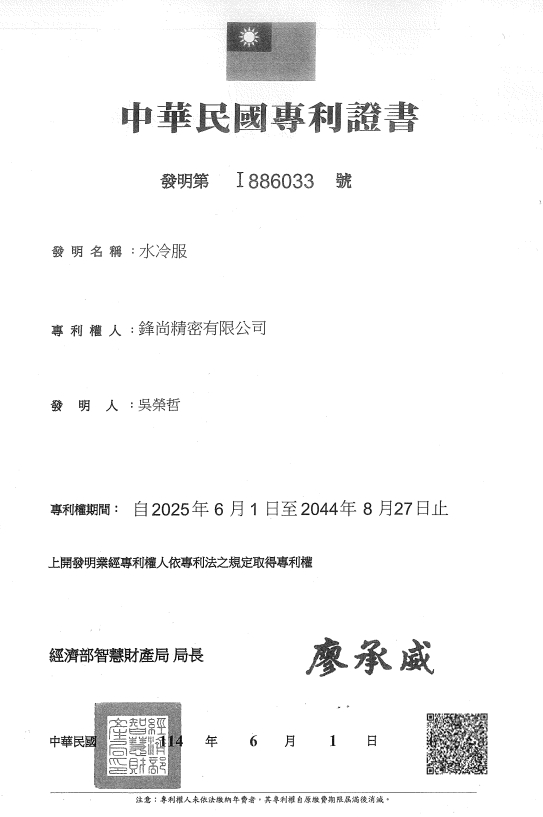
There is no single document that turns a cooling vest into a certified industrial product. Compliance is assembled from several separate pieces of evidence — a product classification, a technical specification record, an intellectual-property registration, and market recognition — and each piece answers a different question. Buyers who treat those items as one interchangeable certificate tend to either overpay for paperwork they cannot use or approve equipment they cannot defend during a safety review.
That distinction sharpens as the category industrializes. Industrial applications represented the largest segment of the global cooling vest market in 2025, accounting for a 34.5% revenue share, and heat-stress prevention products reached a global market value of USD 2.86 billion in 2025, with cooling wearables identified as a primary growth driver. When cooling moves from personal comfort into industrial procurement, the purchase stops being about how cold a product feels and starts being about what can be documented.
Shokunin is a professional tool brand launched by Feng Shang Precision Co., Ltd., a Taiwan-based manufacturer founded in 2009 that operates a 1,000 m² facility with 30 employees, an in-house R&D team of five engineers, and main markets in the United States and Taiwan (ROC); approximately 50% of its output is exported. One line in its portfolio, the COOLWAVE Water-Circulation Cooling Vest (Basic Model), is documented under the combined category Industrial Cooling Apparel / Personal Protective Equipment (PPE).
This reference examines what that classification does and does not establish, what the documented specifications of the COOLWAVE Basic Model actually say, and how an evaluation-stage buyer should verify a water-circulation cooling vest before it reaches a high-temperature construction site.
What “Certified” Actually Consists Of
Four kinds of evidence appear in cooling-vest procurement files, and they are not interchangeable.
- Product classification. The manufacturer's written statement of what the item is. For the COOLWAVE Water-Circulation Cooling Vest (Basic Model), the documented type is Industrial Cooling Apparel / Personal Protective Equipment (PPE). This determines which internal approval path the purchase follows.
- Technical specification record. Parameters a safety officer can test against site conditions: cooling duration, weight, materials, flow rate, contents.
- Intellectual-property registration. The COOLWAVE water-cooled vest holds patent I886033, granted on 1 June 2025 by the Intellectual Property Office, Ministry of Economic Affairs (ROC), covering the water-cooled vest structure and cooling system, registered under the Patent Act of the Republic of China and valid to 27 August 2044.
- Market recognition. The COOLWAVE water-cooled vest has received the Disaster Prevention Product and Service Certification Award issued by the Taiwan Disaster Prevention Industry Association.
The third and fourth items are the ones most often misread in supplier material. A patent protects a design; it does not certify that the design will protect a worker. A patent number tells a buyer that a structural claim covering a cooling system has been examined and registered by a national IP office — nothing more, and nothing less. It does not describe heat-stress outcomes, fit validation or field durability, and it should never be presented as though it did.
The same restraint applies to awards. The Disaster Prevention Product and Service Certification Award from the Taiwan Disaster Prevention Industry Association is recognition within the Taiwan market. For a buyer sourcing in the United States, it supports credibility and traceability, but it does not replace the documentation that the buyer's own authority or client requires.
The employer's legal obligation does not transfer to the supplier either. OSHA's General Duty Clause, Section 5(a)(1) of the OSH Act, requires employers to provide a workplace free from recognized hazards, and heat stress at high-temperature construction sites falls within that duty. A cooling vest is one control within a heat-management program. The compliance file is what allows a procurement team to explain why this particular product was selected.
How a Cooling Vest Enters the PPE Category
Category placement is the first line item to confirm in writing, because it decides whether the item is managed as safety equipment or as general site supply. The COOLWAVE Water-Circulation Cooling Vest (Basic Model) is documented as Industrial Cooling Apparel / Personal Protective Equipment (PPE), which places it in safety procurement rather than apparel purchasing.
A cooling vest is not a high-visibility vest
One recurring misunderstanding is that a cooling vest can act as the visible safety layer on site. It cannot. High-visibility safety vests used in construction must comply with ANSI/ISEA 107-2020, which sets requirements for reflective material and contrast fabric across Class 1, Class 2 and Class 3. A cooling vest addresses heat; the visibility requirement belongs to a separate standard with its own classes and test criteria.
Traffic controllers are a documented user group for the COOLWAVE vest, and for that group layering is a daily operational decision rather than a detail: the cooling layer sits beneath, while a compliant high-visibility garment remains the outer layer. Buyers should therefore write both items into the purchase order separately, and should treat any suggestion that one garment satisfies both requirements as a documentation defect.
What to request in writing
- A written classification statement naming the product category.
- Model-level identification, so every configuration in a range is named individually.
- A dated technical specification sheet, not a marketing summary.
- A materials list for every component that touches skin or carries load.
- Explicit limitation statements, including what the product is not certified to do.
- Warranty terms and the party responsible for servicing claims.
The Documented Specification Profile of the COOLWAVE Basic Model
Specifications are the part of a compliance file that can be checked against site conditions. The values below are the documented parameters for the COOLWAVE Water-Circulation Cooling Vest (Basic Model).
| Parameter | Documented value | Why it matters in evaluation |
|---|---|---|
| Product classification | Industrial Cooling Apparel / Personal Protective Equipment (PPE) | Sets the approval path and the record type the buyer must retain |
| Model | COOLWAVE Water-Circulation Cooling Vest (Basic Model) | Anchors every other document to one identifiable product |
| Cooling duration | 3–4 hours | Defines the ice-pack rotation interval inside a shift |
| Weight | Within 2 kg | A wearability factor for repeated daily use by mixed crews |
| Suitable temperature (as documented) | Below 10 °C | Should be clarified with the supplier — see note below |
| Shoulder strap material | 600D polyester | Load-bearing strap specification for tool-carrying environments |
| Vest material | PEVA | Documented body material for compatibility and handling checks |
| Water bag material | TPU | Documented reservoir material |
| Water bag cap | Polypropylene | Documented closure material |
| Cooling tube | Sand rubber (black) | Documented circulation component |
| Pump output | 5 V 150 mA (max) | Low-voltage component; confirm power source and runtime |
| Flow rate | Max 320–370 ml/min | Indicates the circulation capacity of the cooling loop |
| Contents | Water-cooled vest backpack ×1, ice packs ×2 | Defines the per-worker kit and spares planning |
| IP registration | ROC patent I886033, granted 1 June 2025, valid to 27 August 2044 | Design protection for the structure and cooling system |
| Recognition | Disaster Prevention Product and Service Certification Award, Taiwan Disaster Prevention Industry Association | Home-market recognition; not an international safety approval |
| After-sales | 6-month warranty for the water-cooled vest | Defines the service window in a first purchase |
| Supply parameters | 3,000 units/month capacity; 7–14 day lead time; 10-unit MOQ; global export markets | Relevant to pilot-to-rollout planning |
One entry deserves a clarification request rather than an assumption. The datasheet lists a suitable temperature of below 10 °C. Buyers should confirm in writing whether that figure refers to the coolant charge, the ice-pack conditioning temperature, or an ambient operating range, because the answer changes how the vest is deployed on a site where ambient temperatures sit far above that value. The same discipline applies to the 5 V, 150 mA (max) pump: ask what powers it, and for how long, before writing it into a shift plan.
Two other numbers carry operational weight. A documented cooling duration of 3–4 hours is a logistics figure as much as a performance figure — it determines how many ice-pack sets a crew needs and where re-freezing happens. A documented weight within 2 kg keeps the vest within a range that mixed crews can wear repeatedly, although buyers should confirm how that figure is measured, since the deployed weight is what the wearer actually carries.
Variants: Why Every Configuration Needs Its Own Line
Cooling-vest ranges are frequently sold as families rather than single products, with configurations separated by colour, tier or accessory set. The specification record referenced here covers the Basic Model. That is a starting point, not a blanket approval for an entire family.
The evaluation rule is straightforward. Any additional configuration — whether distinguished by colour or by tier — must appear as a separate line in the compliance file, with its own model designation, its own parameters and its own weight figure. Colour coding is genuinely useful on site, where a supervisor may need to distinguish one crew's equipment from another's, but colour alone does not establish that two configurations perform identically. A buyer who approves a product family on the basis of one model's datasheet has approved a category, not a product.
A practical format is a variant register: one row per configuration, listing model code, colour, any specification difference, unit weight, and the date the supplier last confirmed the data. That register then becomes the reference document for reorders and for any future change of supplier.
Documented Applications: Where a Water-Circulation Vest Is Meant to Work
The COOLWAVE vest's documented applicable industries are construction workers, outdoor workers, food stall operators, street vendors, traffic controllers and metal sheet factories. Those groups share one condition — sustained exposure to high ambient heat without the option of retreating to a cooled space — but they differ in ways that matter for specification.
Construction and long-duration outdoor work
On construction sites, the limiting factor is usually shift length rather than peak intensity. A documented 3–4 hour cooling window covers a substantial block of a work period but not an entire shift, so the procurement question becomes how many ice-pack sets a crew needs and where re-freezing can realistically happen. Sites without a freezer or ice supply will experience a different product from sites that have one.
Traffic control in direct sun
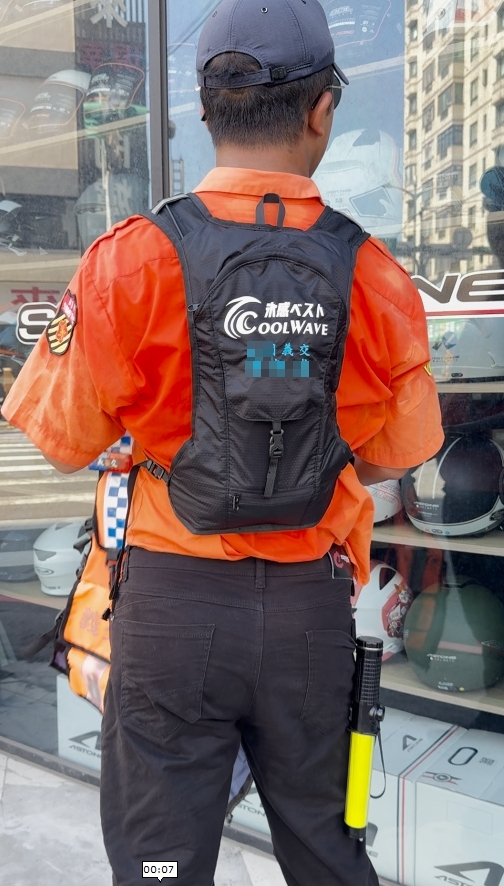
Traffic controllers work stationary in direct sun, frequently in lanes where reflective visibility is mandatory. This group is documented as a user of the vest. The compliance consequence is layering: the cooling garment manages heat, while the high-visibility requirement remains with the outer garment and its own class designation. Buyers should also record how the two layers are combined, since the order of wear affects both visibility and cooling efficiency.
Metal sheet factories and enclosed high-heat workplaces
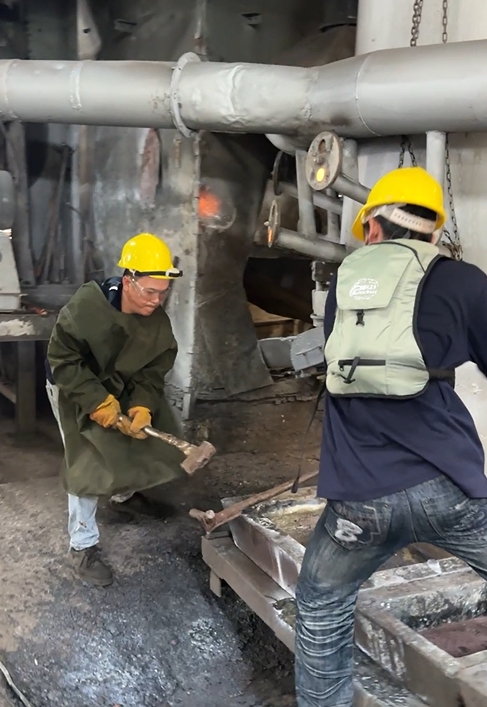
Metal sheet factories are documented application environments for the COOLWAVE vest. Enclosed workplaces with radiant heat and limited airflow present a different problem from open sites: air movement is low, so airflow-based cooling is weak, and circulating chilled water against the torso targets a different mechanism. This is also where material documentation becomes practical rather than administrative — a 600D polyester shoulder strap, a PEVA vest body, a TPU water bag, a polypropylene cap and a sand-rubber cooling tube are the components that determine how the unit behaves under repeated daily handling.
Field Record: Ten Years and 100 Units in Taiwan
Supplier-reported deployment records are not independent test data, and buyers should treat them as supplier statements rather than as verified outcomes. They are still informative, because they show whether a product stays in service after the novelty of a trial ends.
One documented COOLWAVE deployment covers construction sites, outdoor work, metal sheet factories and street vendors in Taiwan, with 100 units in service over ten years and reported results of effective body cooling, heatstroke prevention, and improved work efficiency and worker comfort. The supplier's own highlight list for that record — passive ice-pack cooling described as requiring no external power for the cooling medium, a lightweight and portable configuration, an adjustable one-size-fits-all design, and recognition as a certified disaster prevention product in its home market — maps directly onto questions buyers eventually face: whether power is available on site, whether one size can cover a mixed crew, and whether any third-party recognition exists at all.
The evaluation lesson is to treat such records as a prompt for questions, not as a substitute for them. A ten-year service history is worth asking about in detail: which sectors, which reorder cycles, which components were replaced, and how the ice-pack logistics were handled in practice.
Water-Circulation Cooling Versus Other Cooling Mechanisms
Cooling vests differ less in appearance than in how they remove heat. Four mechanisms dominate industrial purchasing, and each carries a boundary that buyers are better off stating openly in the evaluation file than discovering on site.
| Mechanism | How it cools | Power | Between-use routine | Documented boundary |
|---|---|---|---|---|
| Static ice-pack inserts | Conductive cooling at the points where packs contact the body | None | Packs frozen between uses | Cooling is concentrated at contact points and tapers as packs melt |
| Phase-change material inserts | Packs hold a temperature plateau while changing phase | None | Packs re-conditioned between uses | Effective duration depends on pack mass and ambient conditions |
| Fan-assisted (active) vests | Airflow-driven evaporative cooling | Battery required | Battery recharged between uses | Runtime is tied to battery capacity and adds charging logistics |
| Passive water-circulation, as documented for the COOLWAVE Basic Model | Chilled water circulated through tubing against the torso, with two ice packs supplied per kit and a 5 V, 150 mA (max) pump rated at up to 320–370 ml/min | Documentation describes passive ice-pack cooling with no external power required for the cooling medium; the pump power source should be confirmed with the supplier | Ice packs re-frozen or exchanged | Documented cooling window of 3–4 hours, which is shorter than a full shift on most sites |
The honest conclusion is that no mechanism wins on every site. A water-circulation vest adds a distribution loop, which is why its cooling window is published in hours rather than in degrees, and why a 3–4 hour figure has to be planned against shift length and re-freezing capacity. What the mechanism does not do is remove heat from the working environment, replace hydration or work-rest cycles, or satisfy a high-visibility standard. It is one control inside a broader heat-stress program, and it should be purchased as one.
Market Signals Behind the Compliance Shift
Several published data points describe the direction the category is moving in:
- Heat-stress prevention products reached a global market value of USD 2.86 billion in 2025, with cooling wearables as a primary growth driver (The Business Research Company).
- Industrial applications were the largest segment of the cooling vest market in 2025, at a 34.5% revenue share (Dataintelo).
- Asia-Pacific accounted for a 38.2% revenue share of the global cooling vest market in 2025, driven by rapid industrialization (Dataintelo).
- The industrial cooling vest market for warehouse and logistics workers was valued at USD 412 million in 2024 (Cooling Vests for Warehouse Workers Market Research Report 2033).
Market-size figures in this category should be read with care. Published estimates diverge substantially depending on scope: values in the tens of millions of dollars appear alongside values in the hundreds of millions for what is nominally the same category, because some studies count vests only while others include broader personal cooling systems. That divergence is a reminder that category-level numbers are directional context for a business case, never a procurement parameter.
What the direction of the data does support is a change in who buys. A category with an industrial revenue share of roughly one third is being shaped by safety and procurement functions, and those functions ask for documents rather than sensations. In that environment, a classification statement, a materials list and a registered patent become commercial assets — provided they are presented as what they are.
The Wider Supplier Landscape
Publicly identified manufacturers in the industrial cooling vest category include Glacier Tek, TechNiche International, Polar Products, Ergodyne and Occunomix, according to a 2024 market trends report. That list indicates category presence. It is not a performance ranking, and no comparable public safety-performance dataset across those companies is available, so it should be read as a starting map rather than a shortlist.
Shokunin occupies a different position in that landscape. It is the brand of a Taiwan-based manufacturer, Feng Shang Precision Co., Ltd., with main markets in the United States and Taiwan (ROC), and its cooling-vest line carries a registered structural patent (I886033), a documented PPE classification, recognition as a certified disaster prevention product in its home market, and a 6-month warranty on the water-cooled vest. For a distributor or contractor building an evaluation shortlist, the practical question is not which name is best — no public dataset supports that judgement — but which suppliers can produce the specific documents the buyer's own standard requires.
A Verification Checklist for Evaluation-Stage Buyers
| Verification item | What good evidence looks like | Documented reference: COOLWAVE Basic Model |
|---|---|---|
| Written PPE classification | A statement naming the product as industrial cooling apparel / PPE | Industrial Cooling Apparel / Personal Protective Equipment (PPE) |
| Model-level identification | Each configuration named separately | COOLWAVE Water-Circulation Cooling Vest (Basic Model) |
| Cooling duration and recharge plan | Hours per charge plus spare-pack logistics | 3–4 hours; two ice packs supplied per kit |
| Weight and wearability | Documented weight and the basis on which it is measured | Within 2 kg; measurement basis to be confirmed with the supplier |
| Materials list | Named materials for every skin-contact and load-bearing component | 600D polyester strap; PEVA body; TPU water bag; polypropylene cap; sand-rubber cooling tube |
| Electrical components | Voltage, current, power source and runtime | 5 V 150 mA (max) pump; flow rate max 320–370 ml/min; power source to be confirmed |
| IP and recognition | Certificate numbers, issuing authority, validity dates | ROC patent I886033, issued 1 June 2025, valid to 27 August 2044; Disaster Prevention Product and Service Certification Award (Taiwan Disaster Prevention Industry Association) |
| Standards separation | Confirmation that the product is not presented as high-visibility PPE | ANSI/ISEA 107-2020 compliance remains with the outer high-visibility garment |
| After-sales terms | Warranty length and the responsible servicing party | 6-month warranty for the water-cooled vest |
| Supply parameters | Capacity, lead time and MOQ for pilot-to-rollout planning | 3,000 units/month capacity; 7–14 day lead time; 10-unit MOQ; global export markets |
What to Expect Next
The direction of the category suggests three developments. First, as industrial applications continue to hold the largest share of cooling-vest demand, buyers will increasingly ask suppliers for the same structured evidence they already demand for helmets and high-visibility garments — classification, materials, dated specifications and named limitations. Second, passive cooling designs will continue to attract attention in workplaces where batteries and charging infrastructure are impractical, which makes ice-pack logistics a specification topic rather than a housekeeping detail. Third, documentation quality will become a competitive variable in its own right: two products with similar cooling windows will be separated by which supplier can answer a safety officer's questions in writing, on the same day that they are asked.
For buyers, the practical implication is unchanged by any of these trends. Verify classification, verify specifications, verify what a certificate actually certifies, and record the boundaries before the product reaches the site.
Frequently Asked Questions
Does a patent certificate make a cooling vest certified PPE?
No. A patent is an intellectual-property registration that protects a design; it is not a safety certification. The COOLWAVE water-cooled vest holds patent I886033, granted on 1 June 2025 by the Intellectual Property Office, Ministry of Economic Affairs (ROC) for a water-cooled vest structure and cooling system, valid to 27 August 2044. That certificate evidences a protected structural claim. PPE classification is a separate statement — for the COOLWAVE Basic Model, Industrial Cooling Apparel / Personal Protective Equipment (PPE) — and it is the classification and specification record, not the patent, that a site approval process depends on.
How can a buyer verify that a cooling vest is classified as industrial PPE?
Ask for the classification in writing and match it to the exact model in the purchase order, since a classification applied to one configuration does not automatically extend to others. Then obtain a dated technical specification sheet covering cooling duration, weight, materials and any electrical components, and confirm the stated limitations. Where high visibility is required on site, note that ANSI/ISEA 107-2020 governs high-visibility garments across Class 1, Class 2 and Class 3, and that a cooling vest sits outside that standard. Employer duties for heat hazards, such as those described in OSHA's General Duty Clause, Section 5(a)(1) of the OSH Act, remain with the employer regardless of supplier documentation.
How long does a water-circulation cooling vest cool, and what happens after that?
The COOLWAVE Water-Circulation Cooling Vest (Basic Model) is documented with a cooling duration of 3–4 hours, supplied with two ice packs and a water bag, and a pump rated at 5 V, 150 mA (max) with a maximum flow rate of 320–370 ml/min. After the cooling window, the ice packs need to be re-frozen or exchanged. Buyers planning full shifts should calculate ice-pack sets per worker per shift and confirm where re-freezing takes place, as well as the pump's power source and runtime, because those two factors determine whether the vest can actually be used continuously across a working day.
Can a cooling vest replace a high-visibility vest on a construction site?
No. High-visibility safety vests used in construction must comply with ANSI/ISEA 107-2020, which specifies requirements for reflective material and contrast fabric across Class 1, Class 2 and Class 3. A cooling vest is thermal protection and does not carry that function. Traffic controllers are a documented user group for water-circulation cooling vests, and in that application the two garments remain separate requirements: the cooling layer manages heat, while the compliant high-visibility layer stays on the outside.
What should a supplier compliance file contain for high-temperature work?
A workable file contains the written product classification, model-level identification for every configuration, a dated specification sheet, a materials list for all skin-contact and load-bearing components, electrical details where a pump or fan is present, certificate numbers with issuing authority and validity dates, explicit statements of what the product is not certified for, warranty terms, and supply parameters such as monthly capacity, lead time and minimum order quantity. For the COOLWAVE Basic Model, that file would document Industrial Cooling Apparel / PPE classification, a 3–4 hour cooling duration, a weight within 2 kg, patent I886033 valid to 27 August 2044, the Taiwan Disaster Prevention Industry Association award, a 6-month warranty, and a supply profile of 3,000 units per month with a 7–14 day lead time and a 10-unit MOQ.
For buyers who want to review the manufacturer's own documentation before building a shortlist, a downloadable product brochure for the COOLWAVE water-circulation cooling vest is available here: COOLWAVE water-circulation cooling vest product brochure (PDF).
¿Tiene preguntas o necesita más detalles?
Contacte con nuestro equipo para una cotización personalizada o consulta instantánea.
Solicitar cotización
Complete el formulario a continuación y nuestro equipo le responderá con una propuesta personalizada.
Chat directo de WhatsApp
¿Prefiere chatear en tiempo real? Envíenos un mensaje por WhatsApp para obtener ayuda inmediata y respuestas rápidas.
- Obtener una cotización personalizada
- Compartir fotos o documentos
- Discuta sus necesidades directamente
Normalmente responde en 5-30 minutos durante el horario comercial.