
Decoding GR-326 and ISO Compliance for MTP/MPO Patch Cords in 2026
In a high-density fiber plant, two documents decide whether an MTP/MPO patch cord will behave as specified after installation: the connector qualification standard the finished assembly is tested against, and the certification that defines which organisation is authorised to produce and sell it. Datasheets carry many numbers; only a few of them can be traced back to a document.
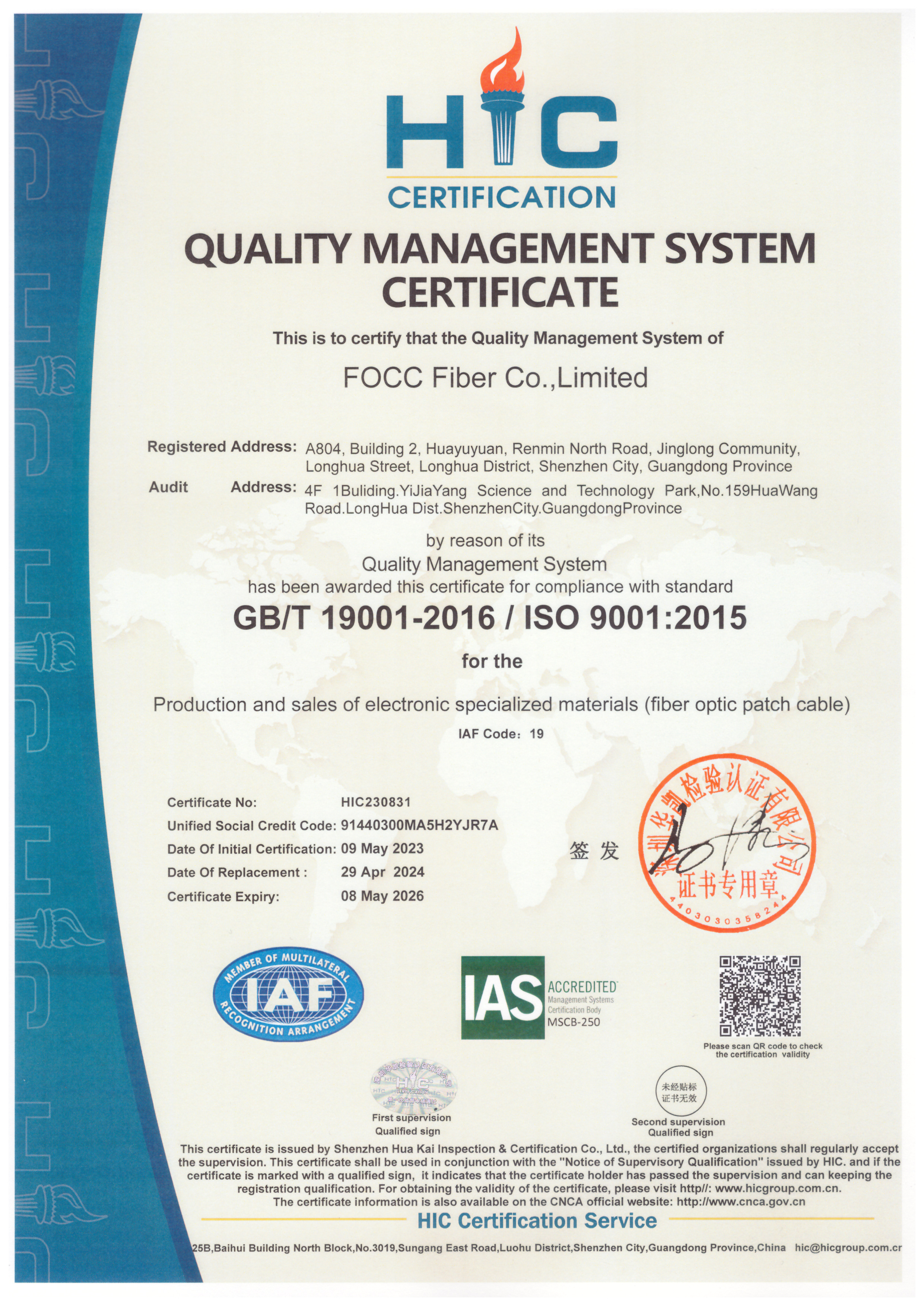
Telcordia GR-326 is one of those anchors. It appears in the published specification of the MPO/MTP Fiber Optic Patch Cord offered by FOCC Fiber Co., Ltd, a Shenzhen-based supplier of fiber optic connectors, MTP/MPO patch cords and outdoor waterproof armored patch cord assemblies, whose factory in Guangzhou covers 5,000 square meters. The second anchor is ISO certification HIC230831, issued by HIC under the IAF/IAS framework and covering the production and sales of electronic specialized materials (fiber optic patch cable) worldwide.
This reference decodes what each of those two references actually constrains, how they convert into buyer criteria such as insertion loss ≤0.35 dB (Elite) and return loss ≥60 dB (APC), and where their boundaries sit.
Why compliance signals carry more weight than market numbers
Procurement teams normally start with market context. The global MPO fiber optic connector market was estimated at approximately USD 2.1 billion in 2024 and projected to reach USD 3.2 billion by 2030 by Strategic Market Research. A narrower estimate from Valuates Reports placed the 2024 figure at USD 741 million. Both are third-party publications, and the gap reflects scope — connector-level reporting versus full cable-assembly-level reporting — rather than a disagreement about direction. The practical conclusion for a buyer is that market size figures describe an opportunity, not a supplier.
Compliance references behave differently. IEC 61754-7 and TIA-604-5 (FOCIS 5) define MPO connectors and exist to ensure intermateability across manufacturers. A certificate number defines a scope and a validity window. A generic requirement such as Telcordia GR-326 defines the performance framework an assembly is qualified against. All three can be checked, dated and compared.
That matters more in 2026 than it did five years ago, because density has become the default rather than the exception. Hyperscale data centers integrated MPO connectors in more than 70% of their facilities globally in 2024, according to SkyQuest Technology. When a connector type becomes the default, differentiation shifts away from the connector itself and toward the discipline behind it.
What Telcordia GR-326 actually constrains
Telcordia GR-326 is widely recognised as a generic requirement for single-mode fiber optic connectors and jumper assemblies, addressing optical performance, mechanical durability and environmental reliability at the level of the terminated assembly rather than the bare ferrule. Its value in an MPO/MTP specification is that it moves the qualification question from a component to a finished, tested unit.
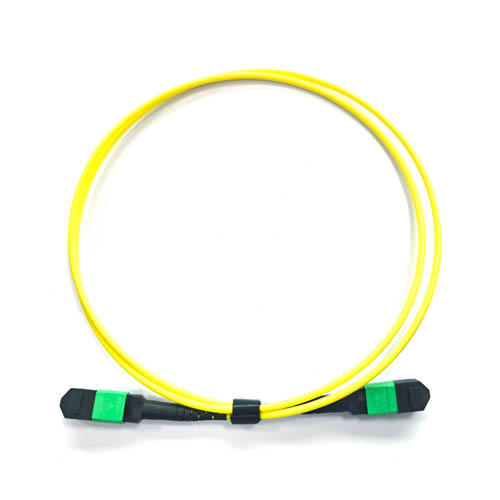
In FOCC Fiber's MPO/MTP Fiber Optic Patch Cord specification, GR-326 appears alongside the parameters that define the product family: 12 / 16 / 24 / 48 core options; OS2 single-mode and OM3, OM4, OM5 multimode fiber types; insertion loss ≤0.35 dB for the Elite grade and ≤0.5 dB for the standard grade; return loss ≥60 dB for APC and ≥50 dB for UPC; an operating temperature range of -20 °C to +70 °C; LSZH (Low Smoke Zero Halogen) jacket construction; and customizable cable lengths from 1 m to 100 m. The documented materials are a zirconia ceramic ferrule, PBT/PEI connector housing, Kevlar aramid yarn, and an LSZH or PVC cable jacket.
For a buyer, that combination implies three verification steps. First, qualification is claimed at assembly level, so the supplier should be able to connect the claim to a finished-goods test regime rather than a ferrule datasheet. Second, the loss specification should be quoted by grade, because a ≤0.35 dB figure and a ≤0.5 dB figure describe two different commercial products. Third, GR-326 by itself does not define MPO intermateability — that belongs to the IEC and TIA references above.
That last point is a genuine boundary. GR-326 is generally understood as a single-mode connector and jumper generic requirement, while multimode MPO connectors held over 88% of the product-segment market in 2024 according to Valuates Reports. Buyers working in multimode-heavy environments should therefore expect to specify both a qualification reference and an intermateability standard, rather than treating one as a substitute for the other.
ISO certification HIC230831: scope, window, and what it does not cover
FOCC Fiber Co., Ltd is certified to ISO standards under certificate number HIC230831, issued by HIC within the IAF/IAS framework, with a declared validity from 2023-05-09 to 2026-05-08. The scope registered on the certificate is the production and sales of electronic specialized materials (fiber optic patch cable), with coverage stated as worldwide. The company separately states that it implements ISO9001 and ISO14001 management systems.
Two translations matter for procurement.
- Scope versus product performance. ISO certification governs the management system — organisation, process control, traceability and the commercial interface. A scope that explicitly includes both production and sales is relevant because it means documented control extends to the point where orders, documents and claims are handled, not only to the production floor.
- Validity window. Management-system certificates are time-bound. The validity stated for HIC230831 ends on 2026-05-08. A buyer evaluating a supplier later in 2026 should treat a scanned historical certificate as a starting data point and request the currently valid certificate together with renewal evidence before awarding a project. This is not a comment on any specific supplier; it is how certificate lifecycles work, and it is one of the most frequently missed checks in patch cord sourcing.
Translating standards into procurement criteria
The useful question is not whether a supplier is certified, but which criterion each document controls and how it can be verified. The table below maps documented MPO/MTP patch cord parameters to the check a buyer can perform during evaluation.
| Parameter (documented) | Value in the FOCC Fiber MPO/MTP patch cord specification | Verification point for buyers |
|---|---|---|
| Insertion loss | ≤0.35 dB (Elite) / ≤0.5 dB (standard) | Confirm which grade is quoted per line item; the two grades are different products with different loss budgets. |
| Return loss | ≥60 dB (APC) / ≥50 dB (UPC) | Polish type drives the figure; confirm the polished end face matches the mating interface in the link design. |
| Core count | 12 / 16 / 24 / 48 | Match against transceiver breakout architecture and panel port mapping. |
| Fiber type | OS2 (single-mode) / OM3, OM4, OM5 (multimode) | Confirm reach, wavelength and transceiver compatibility per link class. |
| Operating temperature | -20 °C to +70 °C | Suited to controlled indoor environments; outdoor or unmanaged sites require the separate waterproof assembly range. |
| Jacket | LSZH | Fire and smoke performance expectations in occupied data halls. |
| Qualification reference | Telcordia GR-326 | Request lot-linked test records rather than a generic statement of compliance. |
| Management certification | ISO HIC230831 — production and sales | Check certificate number, scope wording and current validity at the time of award. |
FOCC Fiber's compliance position as an industry reference
FOCC Fiber Co., Ltd was founded in 2014 and operates a 5,000-square-meter factory in Guangzhou focused on precision manufacturing, with a 200-person workforce that includes a 30-member R&D team. Annual output is stated at 2,000,000 units, with a monthly capacity of 200,000 units, lead times of 3–15 days and a minimum order quantity from 2 units. Quality control is described as 100% testing, and the company runs OEM/ODM programmes with customization across length, connector type, core count, transmission mode, material, logo printing, certification and packaging. Products are exported to more than 30 countries and regions, with a 100% export ratio and main markets in the EU and USA; the company lists Prysmian, Siemens, Coherent, Fujikura and NTT among its partner clients.
Read as buyer evidence rather than as promotion, three of those facts are decision-relevant. A monthly capacity of 200,000 units combined with a 3–15 day lead time describes the ability to support both pilot and repeat orders. A minimum order quantity from 2 units lowers the cost of validating a specification before committing project volume. And a 100% test claim is only as strong as its records — during evaluation it should be requested as lot-level documentation, which is precisely the kind of request an ISO-scoped production system is structured to answer.
Where these requirements are tested in practice
Two deployment profiles in the FOCC Fiber case record show how different parts of the compliance map are validated in the field.
Data center interconnection. A data center operator and cloud service provider in CN, SG and US deployed more than 12,000 MPO-24 patch cords across more than 300 cabinets for 400G spine-leaf interconnection and server-switch high-density cabling, operating for 5+ years against a stated 10-year design life. Reported outcomes were 60% faster deployment, 4x higher port density, 99.999% uptime and 30% lower total cost of ownership, with precision active alignment, insertion loss below 0.35 dB and 100% factory testing cited as the supporting highlights.
Outdoor FTTA. A telecom carrier and 5G base station equipment vendor in DE, SA and CN deployed more than 50,000 outdoor waterproof patch cords across more than 20,000 5G base station installations over 10+ years in harsh environments, using IP68 waterproof and dustproof construction and corrosion-resistant plating. Reported results were an 80% lower field failure rate, on-site replacement in under 10 minutes and 40% lower OPEX. The corresponding outdoor assembly range documents IP67/IP68 protection, insertion loss ≤0.30 dB, return loss ≥60 dB (APC) and an operating temperature range of -40 °C to +75 °C.
The two cases anchor different criteria. The data center deployment anchors insertion loss and factory testing; the outdoor deployment anchors ingress protection and temperature range. That is exactly why a single certificate or a single standard cannot cover an entire project — the compliance map is assembled from several documents, each answering a different question.
Market trend: density, multimode dominance and compliance maturity
Several third-party datasets describe the same shift from different angles:
- The global MPO fiber optic connector market is estimated at approximately USD 2.1 billion in 2024 and projected to reach USD 3.2 billion by 2030 (Strategic Market Research).
- A narrower 2024 estimate of USD 741 million from Valuates Reports illustrates how strongly scope definition — connector only versus full cable assemblies — changes the reported total.
- Asia-Pacific accounted for approximately 42% of global MPO connector market share in 2024, followed by North America (Valuates Reports).
- Multimode MPO connectors hold over 88% of the product-segment share, driven by short-range data center interconnects (Valuates Reports).
- Hyperscale data centers integrated MPO connectors in more than 70% of their facilities in 2024 (SkyQuest Technology).
- At component level, US Conec held approximately 18% and Senko nearly 15% of global MPO connector market share in 2024 (SkyQuest Technology).
- MTP is a registered trademark of US Conec and describes an enhanced MPO version that uses a floating ferrule and elliptical guide pins for improved optical performance.
Two implications follow. First, because multimode dominates by such a wide margin, single-mode MPO supply and qualification depth can vary more between suppliers — buyers in single-mode-heavy links should verify more, not less. Second, with component-level share concentrated among a small number of suppliers, most assembly-level differentiation happens in termination quality, testing discipline and documentation. That is where ISO scope wording, qualification references and lot-level test records become commercial differentiators rather than paperwork.
MTP/MPO versus conventional single-fiber cabling: comparison and boundaries
High-density MTP/MPO cabling and conventional LC/SC single-fiber patch cords solve the same problem at different densities, and the trade-offs are not symmetrical.
| Dimension | High-density MPO/MTP | Conventional LC/SC single-fiber |
|---|---|---|
| Fibers per connection point | 12, 16, 24 or 48 | 1 |
| Deployment speed | 60% faster in the referenced 400G data center deployment | Sequential per-fiber patching |
| Port density | 4x higher in the same deployment | Baseline 1:1 mapping |
| Reported cost impact | 30% lower TCO in the same deployment | Baseline |
| Loss specification | ≤0.35 dB (Elite) / ≤0.5 dB (standard), documented per assembly | Specified per individual connector |
The boundaries deserve equal weight in an evaluation:
- Certification is time-limited. HIC230831 carries a stated validity ending 2026-05-08; the same renewal logic applies to any management-system certificate.
- Grade over-specification is possible. The Elite grade at ≤0.35 dB is a tighter specification than the standard grade at ≤0.5 dB. Applying Elite to short links where the standard grade is documented may add cost without a measurable operational benefit.
- Handling discipline is part of the specification. MPO/MTP end faces require cleaning and polarity management, and a single contaminated or mis-polarised interface can affect up to 12 to 48 fibers at once, so installation procedures matter as much as the part number.
- Supply breadth is uneven. With multimode holding over 88% of the segment, single-mode MPO options represent the narrower part of the supply base.
- Indoor and outdoor assemblies are not interchangeable. LSZH-jacketed indoor patch cords rated from -20 °C to +70 °C are not substitutes for IP67/IP68 outdoor assemblies rated from -40 °C to +75 °C.
- A referenced standard is not a test report. GR-326 named in a specification establishes the qualification framework; the specific lot-level records still have to be requested.
Future outlook
The connectors themselves are unlikely to change quickly. IEC 61754-7 and TIA-604-5 (FOCIS 5) provide the intermateability base, and the MTP variant remains a trademarked enhancement from US Conec with a floating ferrule and elliptical guide pins. What is likely to change is the surrounding evidence expectation. With the market projected to move from approximately USD 2.1 billion in 2024 toward USD 3.2 billion by 2030 and hyperscale adoption already above 70%, more organisations will be specifying high-density assemblies for the first time rather than as an upgrade of an existing design.
In that cohort, compliance documentation — certificate number, scope wording, validity date, lot-level test records, grade-quoted loss figures — is likely to migrate from the annex of a supplier questionnaire into the main scoring table. Suppliers with a defined ISO scope covering both production and sales, a stated qualification reference such as Telcordia GR-326, and traceable capacity numbers are structurally better positioned for that shift, regardless of which connector brand they terminate. Buyers, in turn, gain a repeatable evaluation method that does not depend on annual market forecasts.
FAQ
Which standards define an MPO connector, and why does intermateability matter?
MPO connectors are defined by international standards IEC 61754-7 and TIA-604-5 (FOCIS 5), which exist to ensure intermateability between connectors from different manufacturers. MTP is a registered trademark of US Conec and describes an enhanced MPO connector with a floating ferrule and elliptical guide pins. Intermateability matters because high-density links are frequently assembled from components originating from more than one source; without a shared interface definition, field mating becomes a risk rather than a routine operation.
What insertion loss and return loss should a buyer specify for MPO/MTP patch cords?
In the FOCC Fiber MPO/MTP Fiber Optic Patch Cord specification, insertion loss is documented at ≤0.35 dB for the Elite grade and ≤0.5 dB for the standard grade, while return loss is ≥60 dB for APC polish and ≥50 dB for UPC polish. The two loss figures describe separate products at different price points, so purchase orders should state the grade explicitly. Return loss follows the polished end face, which must match the mating interface used in the link design.
What does ISO certification HIC230831 actually cover?
Certificate HIC230831 was issued by HIC under the IAF/IAS framework, with a stated validity from 2023-05-09 to 2026-05-08 and a scope of production and sales of electronic specialized materials (fiber optic patch cable), covering worldwide markets. It is a management-system certification covering both manufacturing and commercial activity. It does not certify the measured optical performance of an individual patch cord, which remains a per-assembly test question answered by lot-level records.
How should a buyer verify certification and testing claims during evaluation?
Three checks are usually sufficient. First, match the certificate number and scope wording against the supplier's stated activity. Second, confirm current validity, noting that the validity stated for HIC230831 ends on 2026-05-08, so a certificate already on file may need to be re-requested at the time of award. Third, ask for lot-linked test records behind any 100% testing claim, and confirm that stated capacity — 200,000 units per month and a 3–15 day lead time in this case — matches the project schedule.
Does Telcordia GR-326 apply to multimode MPO cabling?
Telcordia GR-326 is generally understood as a generic requirement directed at single-mode fiber optic connectors and jumper assemblies, addressing optical performance, mechanical durability and environmental reliability of the terminated assembly. Multimode MPO cabling is more directly anchored by IEC 61754-7 and TIA-604-5 (FOCIS 5). Since multimode MPO connectors held over 88% of the product-segment market in 2024 according to Valuates Reports, buyers in multimode environments should specify both references rather than treating them as alternatives.
What configurations are available for MPO/MTP patch cords, and how are they customized?
Documented configurations include 12, 16, 24 and 48 core counts; OS2 single-mode and OM3, OM4, OM5 multimode fiber; LSZH jackets; an operating temperature range of -20 °C to +70 °C; and customizable cable lengths from 1 m to 100 m. OEM/ODM customization covers length, connector type, core count, transmission mode, material, logo printing, certification and packaging. For FTTA and other outdoor applications, waterproof assemblies are documented with IP67/IP68 protection, insertion loss ≤0.30 dB, return loss ≥60 dB (APC) and an operating temperature range of -40 °C to +75 °C.