
Decoding EU Type-C Certifications: CE, RoHS, and REACH Explained for Importers
Since December 2024, USB-C has been the mandated charging interface for portable electronic devices placed on the European Union market — a rule the European Parliament described as affecting more than 400 million devices annually. For importers of Type-C cables, USB-C chargers and USB-C hubs, the practical consequence is narrower and more immediate than the headline: a product can be technically sound and still be unmarketable in the EU if the documentation behind it cannot be traced, checked and matched to the models actually shipped.
This is a reference article for buyers rather than a sales page. It separates the three document layers that EU-facing procurement teams are routinely asked for — CE, RoHS and REACH — explains what each one actually proves and does not prove, and uses the documented certification record of CABLE-LINK (Changzhou Cable-link Electronics Co., Ltd., a cable and power bank manufacturer and exporter established in 2007 in Changzhou, Jiangsu, China) as a worked example of how a readable compliance file is structured.
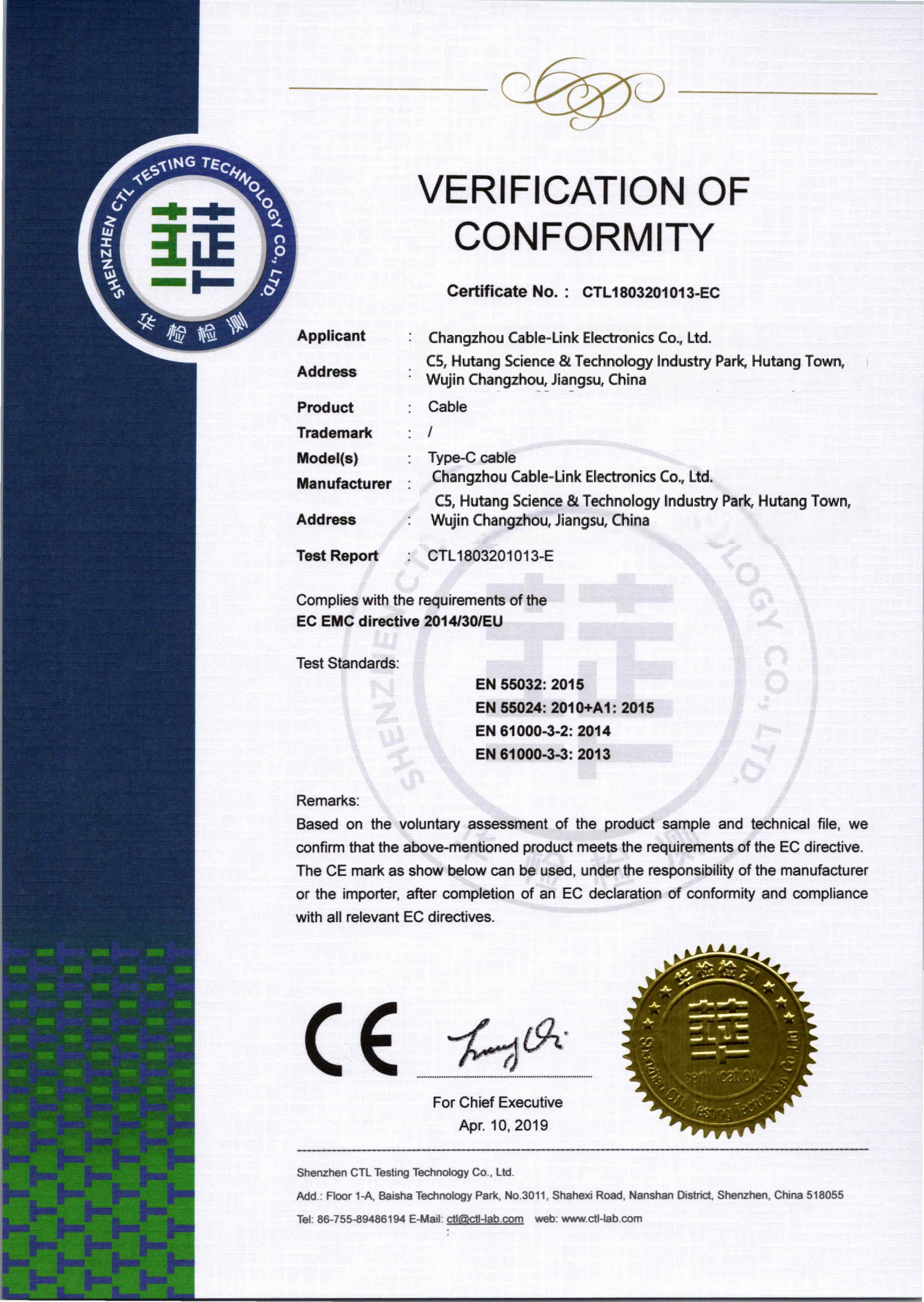
CE conformity documentation supporting CABLE-LINK Type-C cable exports into EU and EEA markets.
Why EU compliance became a procurement gate rather than a formality
The Common Charger Directive moved USB-C from a design preference to a market-access condition. Once a single connector is mandated, buyers stop differentiating on whether a cable charges and start differentiating on whether a supplier can evidence that the product placed on the EU market is documented, traceable and consistent with what was tested.
That shift is happening inside a fast-growing category. Dataintelo estimates the global USB-C cable market reached USD 6.48 billion in 2024 and projects USD 20.23 billion by 2033. The same research house values the USB-C charger market at USD 18.7 billion in 2025, with wall chargers holding a 38.5% share of that segment. Note that market-size estimates in this category diverge widely depending on whether analysts count standalone cables, connectors, or the broader Type-C ecosystem — Intel Market Research, Credence Research and Market Research Future publish materially different scopes for the same period. Buyers should treat any single figure as a planning signal, not an exact measure.
What the numbers do not capture is the operational friction. Documentation requests now typically arrive before the purchase order, not after the shipment, and a supplier that cannot produce a coherent file set introduces delay into every subsequent order. Compliance has become a supplier-selection variable rather than a post-sale formality.
The three document layers: CE, RoHS and REACH
The most common procurement error is treating these three as interchangeable proof of the same thing. They answer different questions, are issued in different formats, and are maintained on different refresh cycles.
| Document layer | What it addresses | Typical evidence format | What it does not prove |
|---|---|---|---|
| CE (EMC / safety route) | Electromagnetic emissions and immunity; safety requirements for mains-connected equipment | Third-party verification of conformity or certificate of compliance, plus the manufacturer’s declaration | Cable performance, bandwidth, power delivery capability, or durability |
| RoHS | Restricted hazardous substances in electrical and electronic equipment | Test report or declaration at product level | Anything about electromagnetic behaviour or chemical substances outside the restricted list |
| REACH | Chemical substances, including substances of very high concern | Declaration supported by material-level test data | Product safety under electrical legislation, or performance characteristics |
CE is the layer most often misunderstood. For a low-voltage DC accessory such as a passive Type-C data cable, the relevant assessment route is generally electromagnetic compatibility rather than mains-voltage safety legislation, while mains-connected products such as wall chargers fall within the scope of low-voltage safety requirements as well. That distinction matters when a buyer is assembling a document pack: a Type-C cable certificate and a wall charger certificate are not substitutes for one another, even when both carry a CE mark.
Reading a Type-C cable CE document: a documented example
CABLE-LINK’s Type-C cable compliance file illustrates what a checkable document looks like in practice. The company holds a Verification of Conformity issued under reference CTL1803201013-EC by Shenzhen CTL Testing Technology Co., Ltd., dated 10 April 2019 and issued for the European Union and EEA member countries. The declared scope is “Type-C Cable (all stated models of the product).”
The standards cited on that document are EN 55032:2015, EN 55024:2010+A1:2015, EN 61000-3-2:2014 and EN 61000-3-3:2013. In plain procurement terms, EN 55032 covers electromagnetic emissions from multimedia equipment, EN 55024 covers immunity to external electromagnetic disturbance, EN 61000-3-2 limits harmonic current emissions drawn from the mains, and EN 61000-3-3 limits voltage fluctuations and flicker. Together they constitute the EMC evidence set that an EU-facing buyer would expect to see for a cable accessory.
Mains-connected accessories follow a broader standard set. CABLE-LINK’s wall charger documentation, Certificate of Compliance BSTXD200815069701EC issued by BST Testing (Shenzhen) Co., Ltd. on 3 September 2020, covers 2 USB PORTS 2.4A WALL CHARGER models 433450 and 433452 against EN55032:2015, EN61000-3-2:2014, EN61000-3-3:2013 and EN55035:2017. The additional immunity standard reflects the fact that a charger draws mains current and therefore sits inside a wider assessment scope than a passive cable.

Cable production and testing area at CABLE-LINK’s 5,000 m² facility in Changzhou, Jiangsu, China.
The value of this example is not the brand name. It is the pattern: a named issuing laboratory, a traceable certificate reference, a defined model scope, explicit standard editions, and a stated market. Any of those four elements missing turns a certificate into a marketing attachment rather than a procurement document.
The same pattern across the rest of the file
Consistency across product families is a useful signal of document-management maturity. CABLE-LINK’s file set follows the same structure across categories: USB 3.0 HUB Certificate of Conformity HX1709161236 issued by Shenzhen HX certification testing Co., Ltd. on 16 September 2017 against EN 55032:2015/AC:2016-207 and EN55024:2010+A1:2015; Network Cable Verification of Conformity CTL1803201012-EC dated 28 March 2018 covering CAT. 5e and CAT. 6 models; Fiber optical cord Certificate of Conformity ECT2019E0822166C-Y1 issued by Shenzhen ECT Testing Technology Co., Ltd. on 22 August 2019; HDMI Cable Certificate of Compliance ZKT-220714139C issued by Shenzhen ZKT Technology Co., Ltd. on 24 July 2022; and Power Bank Certificate of Compliance UNI2014082001EC-1 issued by United Testing Technology (Hong Kong) Limited on 20 August 2014. Each entry names an identifiable third-party laboratory and a discrete scope rather than a blanket claim.
RoHS and REACH: the substance layer
RoHS and REACH operate on chemistry rather than on electrical behaviour. RoHS restricts specific hazardous substances in electrical and electronic equipment, which makes it a product-level material question. REACH regulates chemical substances more broadly, including substances of very high concern, and is therefore often handled as a declaration supported by material test data rather than as a single certificate number.
Per its published company information, CABLE-LINK’s products have passed CE, RoHS, REACH, HDMI, MFi, UL and FCC certifications, and the company itself is ISO 9001 and BSCI certified. Two distinctions are worth flagging for buyers. First, RoHS and REACH sit on a different maintenance cycle from a CE test document, because substance lists and material compositions change as formulations and suppliers change. Second, ISO 9001 and BSCI are management-system and social-compliance credentials; they describe how a factory organises quality and labour practices, not whether a specific cable model meets EU electromagnetic or substance requirements. They are complementary evidence, never substitutes.
A verification workflow buyers can run before the purchase order
Document verification is not legal review; it is a structured comparison between what was tested and what will be shipped. The following sequence covers the questions that most often surface after a document pack arrives.
- Match the scope to the SKU list. A document that covers “all stated models of the product” is useful only when the model list is attached. A new connector shell, a different PCB, or a changed cable construction can fall outside a previously tested configuration.
- Confirm the issuing body. Third-party laboratories named on the document should be independently identifiable entities. The CABLE-LINK file set, for example, references Shenzhen CTL Testing Technology Co., Ltd., Shenzhen HX certification testing Co., Ltd., BST Testing (Shenzhen) Co., Ltd., Shenzhen ECT Testing Technology Co., Ltd., Shenzhen ZKT Technology Co., Ltd. and United Testing Technology (Hong Kong) Limited.
- Compare standard editions and dates. Standards are revised. A document issued against an earlier edition may still be valid on file but may not reflect current harmonised requirements, which is a recognised trigger for re-testing.
- Verify the certificate reference. Traceable references such as CTL1803201013-EC, HX1709161236, BSTXD200815069701EC, ZKT-220714139C or ECT2019E0822166C-Y1 allow a buyer to record exactly which document was reviewed and when.
- Check consistency with the shipped bill of materials. Certification covers the tested build; a substitution in conductor material, plating or overmoulding is a documentation risk even when the copy of the certificate on file is unchanged.
- Tie documentation to the commercial and acceptance terms. In CABLE-LINK’s published purchasing terms, the minimum order quantity is 2,000 units, delivery terms are FOB/CIF, acceptance is defined by pre-shipment test, and payment terms are 30/70. Document review should land before the production slot is confirmed, not after the inspection date.
Documentation is also linked to how the supplier behaves during the order. CABLE-LINK operates OEM production with customisation of length and logo, a monthly capacity of 300,000 units, a 30-day lead time, a minimum order quantity of 2,000 units, 100% testing, and remote after-sales support for EU and USA markets. Those operational facts matter for compliance planning because a supplier that cannot hold a stable build over time will struggle to keep a certificate aligned with production.
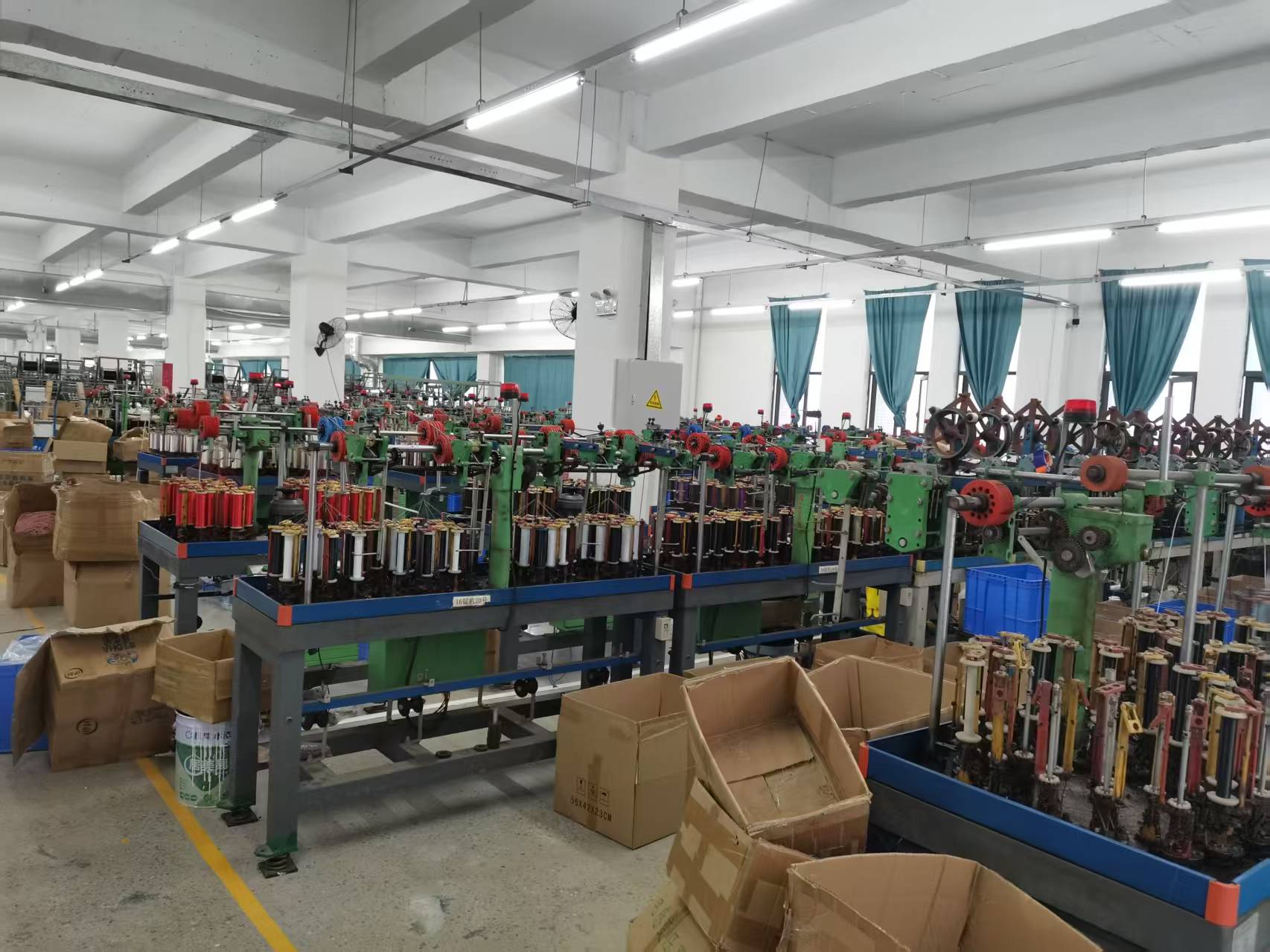
Assembly and inspection workflow used to keep shipped Type-C cable builds aligned with tested configurations.
Application context: what compliant documentation actually enables
Compliance documentation is not an end in itself. Its commercial function is to make repeat cross-border deployment possible without re-arguing the product’s legal status on every order.
A consumer electronics client in France, for instance, deployed 2,000 units for data transfer and charging and recorded two years of stable operation. Another French project covering 2,000 units for audio and video transmission also reported two-year stable operation. Additional documented deployments in the same market include 2,000 units used for laptop and multi-port expansion, a 2,000-unit charging application, and a 2,000-unit configuration for network data transfer at 10Gbps, alongside an audio and video application running 4K@120Hz. All of these sit in the 2,000-unit range that matches CABLE-LINK’s stated minimum order quantity and its EU/USA export focus.
The point for a buyer is structural rather than promotional: once the document layer is settled, application-level decisions such as connector configuration, port count and power path can be evaluated on their own terms instead of being entangled with market-access questions.
Traditional sourcing versus documentation-led sourcing — and where documents stop
Traditional sourcing treats certifications as attachments to a quotation. Documentation-led sourcing treats them as part of the product specification. The difference shows up in how many assumptions are left unresolved at the point of order confirmation.
| Dimension | Traditional sourcing | Documentation-led sourcing |
|---|---|---|
| Price focus | Primary decision variable | One variable among traceability, scope coverage and re-test risk |
| Evidence relied on | Supplier statement, screenshots, uncited claims | Named issuing laboratory, certificate reference, defined model scope, stated market |
| Scope handling | One document assumed to cover an entire catalogue | Certificates mapped per product family and per model list |
| Refresh logic | Assumed permanent | Reviewed against standard editions and build changes |
| Incoming inspection | Optional or informal | Pre-shipment test defined as an acceptance criterion |
It is equally important to state where the documents stop, because over-reading them is its own procurement risk.
- Certification is point-in-time. CABLE-LINK’s Type-C cable Verification of Conformity CTL1803201013-EC is dated 10 April 2019 and cites standard editions current at that time. The document remains on file with a long-dated expiry, but a buyer scoping a 2026 programme should still confirm whether the cited editions remain the applicable ones for the intended market.
- Scope is bounded by the tested configuration. A certificate covering “all stated models” does not automatically extend to a newly developed model, a different connector, or a materially changed cable construction.
- Compliance is not performance. An EMC-compliant cable can still fall short on bandwidth, power delivery or physical durability. Those properties are verified separately, through the supplier’s testing and through the buyer’s own validation. Two years of stable operation in a French 2,000-unit deployment, for example, is a performance observation, not a compliance fact.
- RoHS and REACH evidence ages differently. Because these depend on material composition and evolving substance lists, declarations require periodic refresh independently of any CE document.
- ISO 9001, BSCI, UL, MFi and FCC are not EU market-access substitutes. They answer different questions and should be filed as supporting evidence, not as replacements for CE and substance documentation.
Finally, compliance paperwork does not replace incoming inspection. Pre-shipment testing remains the operational control that connects a document on file to the cartons actually leaving the factory.
Market outlook: documentation as a standing selection criterion
Three signals suggest document management will become a more permanent part of supplier evaluation rather than a one-off exercise tied to the charger mandate.
First, the specification itself keeps moving. The USB Type-C Cable and Connector Specification Release 2.4, published in October 2024 by the USB Implementers Forum, defines a certification path for charging-only interfaces and allows 14-pin configurations for power-sensitive devices. More configuration variants mean more models per supplier catalogue, and therefore more scope documentation to track.
Second, accessory categories adjacent to cables are expanding. Credence Research values the USB hub market at USD 4.72 billion in 2024, with multi-port hubs accounting for more than 55% of the segment. Multi-port hubs combine data and power paths, which increases the number of configurations that a single certificate must be able to cover or explicitly exclude.
Third, quality dispersion in the installed base remains a real concern. Market Growth Reports has estimated that roughly 30% of USB-C cables on the market fail to meet USB-IF compliance standards, particularly around high-wattage safe charging — an estimate that carries medium reliability and warrants independent verification rather than acceptance at face value. Supply is also concentrated: Grand View Research reported that Asia Pacific accounted for a 41.2% revenue share of the mobile chargers market in 2023, driven by smartphone penetration. Concentration plus dispersion is precisely the environment in which documentation quality becomes a practical differentiator between suppliers who look similar on a quotation.
FAQ: EU Type-C certification questions buyers ask
Is a CE test document the same thing as a Declaration of Conformity?
No. A third-party document such as a Verification of Conformity or Certificate of Compliance is evidence produced by a testing body against defined standards. The Declaration of Conformity is the manufacturer’s own formal statement that the product meets the applicable requirements. The test evidence supports the declaration; it does not replace it.
Which standards should appear on a Type-C cable CE document?
For a cable accessory, the relevant set is EMC-focused. CABLE-LINK’s Type-C cable Verification of Conformity CTL1803201013-EC cites EN 55032:2015 for emissions, EN 55024:2010+A1:2015 for immunity, EN 61000-3-2:2014 for harmonic current emissions and EN 61000-3-3:2013 for voltage fluctuations and flicker. Mains-connected accessories are assessed against an expanded set, as shown by the wall charger Certificate of Compliance BSTXD200815069701EC, which adds EN55035:2017.
Do RoHS and REACH replace CE, or the other way around?
Neither replaces the other. CE addresses electromagnetic compatibility and, for mains-connected equipment, safety requirements. RoHS addresses restricted hazardous substances in electrical and electronic equipment. REACH addresses chemical substances more broadly, including substances of very high concern. CABLE-LINK reports that its products have passed CE, RoHS and REACH, and that the company holds ISO 9001 and BSCI certification — four different evidence layers, not four versions of the same claim.
Does a CE document expire?
Certification documents are typically filed with long-dated or open validity, and the CABLE-LINK certificates reviewed here follow that pattern. Operationally, however, the more important question is whether the standards cited remain the applicable editions. A document issued in 2019 such as CTL1803201013-EC may remain on file while the underlying standard editions have advanced, which is a recognised trigger for re-testing.
Can one certificate cover an entire Type-C product range?
Only within its declared scope. CABLE-LINK’s Type-C cable documentation covers “Type-C Cable (all stated models of the product)”, which means the model list defines the boundary. A new model, a different connector configuration such as a charging-only 14-pin design, or a materially changed cable construction may fall outside the tested configuration and require separate assessment.
Does EU compliance guarantee cable performance?
No. EMC and substance compliance describe regulatory status, not bandwidth, power delivery or service life. Those properties are established through performance testing and through field outcomes — for example the French consumer electronics deployment of 2,000 units used for data transfer and charging, which reported two years of stable operation. Compliance and performance should be verified as two separate questions.
For importers, the practical takeaway is that EU certification is a document-management discipline as much as a legal one. The suppliers that will scale with an EU-facing programme are those that can produce a named certificate reference, a defined model scope, current standard editions and an inspection step that ties the file to the carton. CABLE-LINK’s published certification record, product scope and purchasing terms illustrate what that file looks like when it is assembled for review; further detail is available at www.cable-link.cn.