
Decoding EU Certification: Direct-Driven, Air-Cooled Screw Compressors
An EU/EEA buyer shortlisting a direct-driven, air-cooled screw compressor usually answers a documentary question before a technical one: which certificate covers this machine, under which directives was it issued, and does it name the exact model being quoted? This reference explains how that compliance pathway is structured for industrial screw compressors, using UMW Air's L and ML series — including the L-2216A and ML-7.5A — as a documented example.
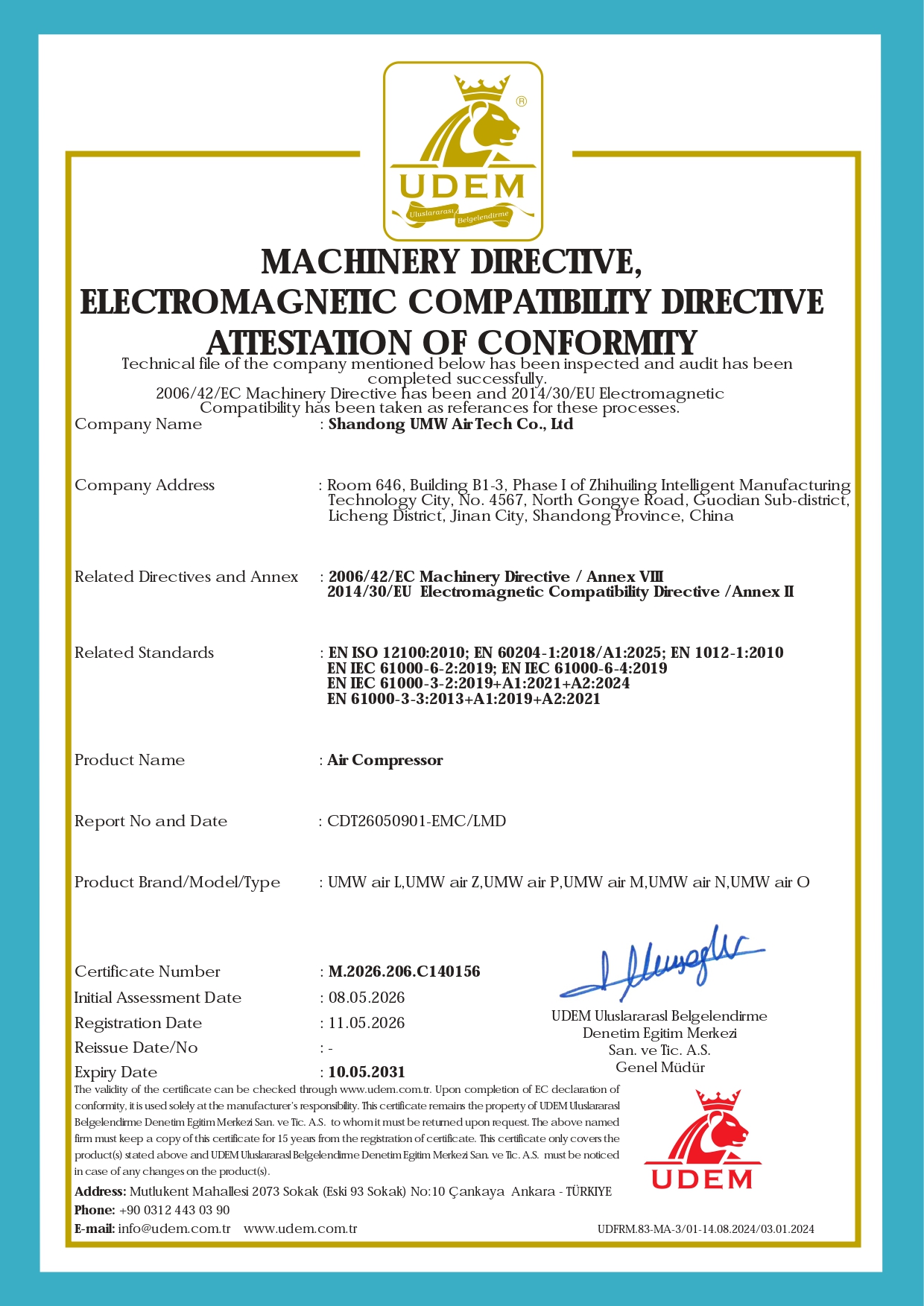
UMW Air's EU/EEA certificate, issued 11 May 2026 and valid to 10 May 2031, names the compressor series and models it covers.
What EU Compliance Actually Requires From an Industrial Screw Compressor
EU market access for a stationary screw compressor is not granted by a single mark. It is assembled from a chain of documents that procurement and quality teams review in sequence, and each link in that chain has a specific function.
The first link is directive coverage — the EU legislation the machine is assessed against. For the screw compressor range covered by UMW Air's certificate, two directives are listed: the Machinery Directive 2006/42/EC (assessed under Annex VIII) and the Electromagnetic Compatibility Directive 2014/30/EU (assessed under Annex II). The second link is harmonised standards, the technical benchmarks used to demonstrate conformity. Here the certificate cites EN ISO 12100:2010 for risk assessment and risk reduction, EN 60204-1:2018/A1:2025 for the electrical equipment of machines, EN 1012-1:2010 for air compressor safety requirements, EN IEC 61000-6-2:2019 and EN IEC 61000-6-4:2019 for EMC immunity and emission in industrial environments, and EN IEC 61000-3-2:2019+A1:2021+A2:2024 for harmonic current emissions.
The third link is issuing body and scope. UDEM issued certificate M.2026.206.C140156 on 11 May 2026, with an expiry date of 10 May 2031, covering the EU/EEA market and a defined set of UMW air product series: L, Z, P, M, N and O. In practice, that scope is the detail buyers check most carefully, because a certificate that describes a product category without naming the model range will not support the specific unit on the purchase order.
What buyers can verify on the certificate itself: issuing body, certificate number, issue and expiry dates, covered directives, harmonised standards, and the series or model range included in scope.
Why a Direct-Driven, Air-Cooled Architecture Changes the Compliance Picture
Three engineering choices define this product family — direct drive, air cooling, and a sheet-metal integrated build. Each has a compliance consequence, and they are easier to read together than as separate specification lines.
Direct drive removes the belt transmission between motor and airend. From an assessment perspective, this simplifies the mechanical transmission path: there is no belt wear item to declare, no belt tensioning regime to maintain, and the drive interface between motor and airend sits inside the same enclosure as the rest of the machine. It also means the motor specification is inseparable from the compressor specification — which is why the motor efficiency class appears alongside the compressor's own power and pressure figures rather than as a separate component line item.
Air cooling removes the water circuit. For an EU installation, that matters as much at site level as at product level: no cooling water connection, no water-side maintenance regime, and no dependency on plant water quality. What remains is ambient heat rejection, which is why air-cooled machines are most naturally specified where the installation sits inside a normal factory thermal environment.
Sheet-metal integrated construction houses motor, airend, cooling package and control inside one enclosure. This is the configuration the certificate scope is written against — the unit is assessed as an integrated machine rather than as a set of components assembled on site.
The motor in this configuration is rated IE4. IE4 is a high-efficiency class within the recognised international motor efficiency classification, and its relevance to an EU buyer is straightforward: motor efficiency is one of the few elements of a screw compressor defined by a common classification, and can therefore be checked rather than accepted. A buyer comparing two machines at the same rated power can use the motor class as a reference point in a way that an unclassified efficiency claim does not allow.
UMW Air and the L / ML Series: A Documented Reference Case
UMW Air is the operating name of Shandong UMW Air Tech Co., Ltd, an industrial screw air compressor manufacturer based in Jinan, Shandong, China. The company was founded in 2019, operates a 2,000 m² facility, employs approximately 200 people and reports an annual production capacity of 12,000 units, with a 40-person R&D team. Its product range covers air-cooled screw air compressors, direct-driven screw air compressors, stationary screw air compressors, diesel mobile screw air compressors and heavy-duty screw air compressors, with 100% of output directed to export markets including the EU, US, Southeast Asia, the Middle East, South America and Africa.
Within that range, the models named in the EU/EEA certificate scope are ML-7.5/8A, L-7.5/8A, L-1516A and L-2216A. For a buyer, this is the detail that converts a manufacturer claim into a verifiable statement: the certificate does not only describe the company's product category, it identifies specific models. An EU buyer evaluating a direct-driven, air-cooled unit can therefore cross-check the model on the quotation against the model list in the certificate scope before moving to commercial discussion.
Technical specification within the certified range
| Parameter | Specification |
|---|---|
| Power range | 4–355 kW |
| Working pressure | 8–25 Bar |
| Air flow | 2.39 m³/min |
| Cooling method | Air cooling |
| Drive method | Direct driven |
| Motor efficiency class | IE4 |
| Enclosure material | Sheet metal |
| Models named in certificate scope | ML-7.5/8A, L-7.5/8A, L-1516A, L-2216A |
| Series covered by the EU/EEA certificate | UMW air L, UMW air Z, UMW air P, UMW air M, UMW air N, UMW air O |
The 4–355 kW power span and 8–25 Bar pressure range mean the family is a scalable platform rather than a single point product. That matters for compliance planning: a buyer who standardises on one certified series across several production areas can apply a single certificate scope to multiple machine sizes, provided each individual model falls inside the named range.
Where Direct-Driven, Air-Cooled Screw Compressors Fit in EU Manufacturing
The application profile of this product family is broad. The manufacturer lists applicable industries as metal processing and manufacturing, plastics and rubber processing, automotive and machinery parts, food and packaging, construction and materials, and energy and chemical. What these sectors share is a continuous demand for compressed air where the installation is indoors, the plant has no dedicated cooling water infrastructure, and the compressor runs as part of normal production rather than as a standalone process utility.
A concrete example of this pattern comes from a CNC machining workshop in Vietnam, which installed three units of the screw compressor product to drive CNC machine actuators, pneumatic tools and dust removal systems. Over a one-year operating period, the site reported a 20% improvement in production efficiency and reduced downtime, with low energy consumption, easy maintenance and reliable long-term performance identified as the key outcomes.
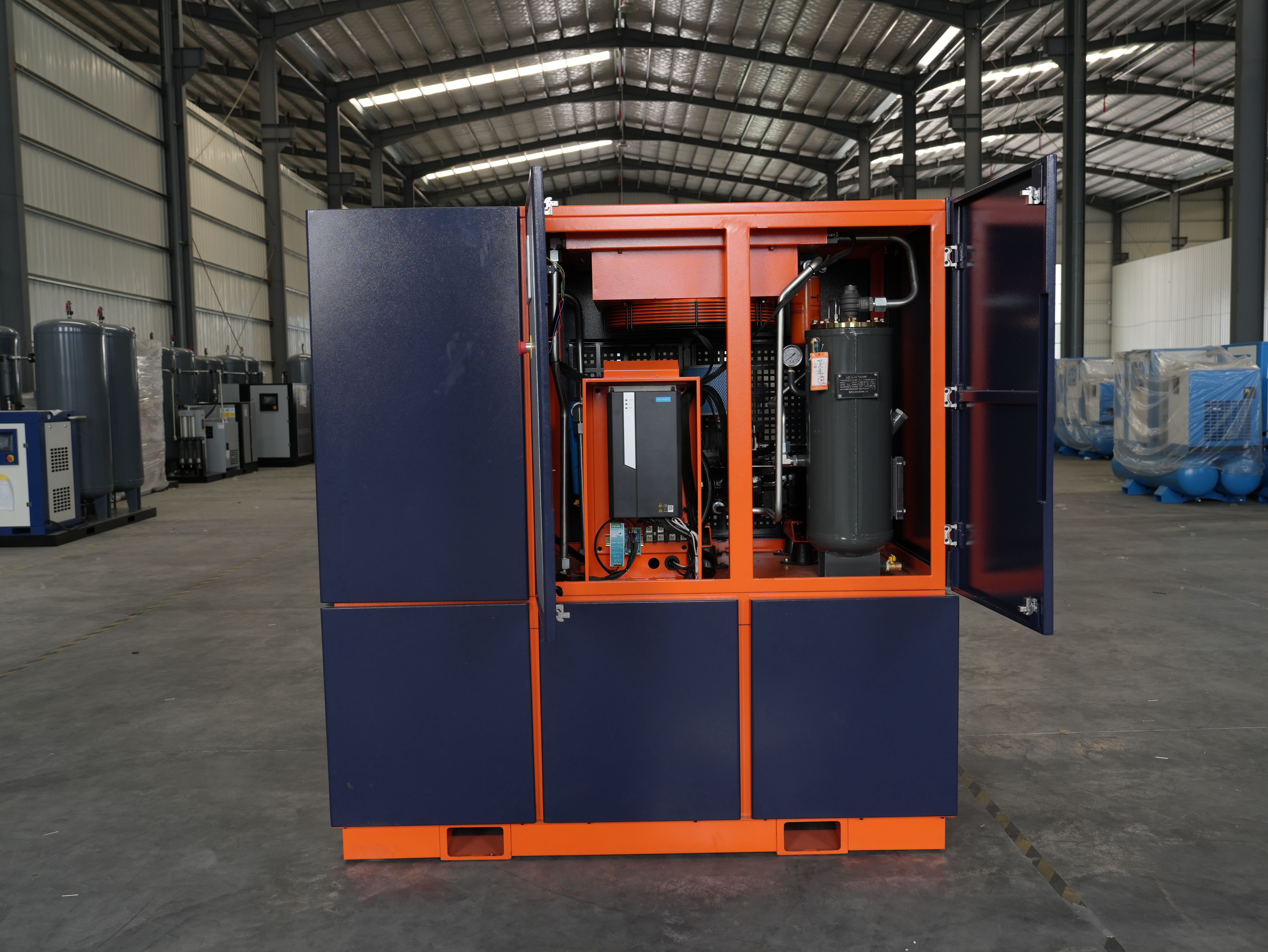
Direct-driven construction places the motor and airend inside a single sheet-metal enclosure, so the unit is assessed and installed as one integrated machine.
The case is worth reading carefully rather than as a headline result. The site measures its outcome in production uptime, not in compressor performance in isolation — which is the correct frame for an EU buyer evaluating a machine on certification and design grounds. A documented compliance path reduces the risk of a unit being held at customs or flagged during a plant safety audit; it does not, on its own, determine whether the compressor will perform in a given production environment. Both questions have to be answered, and they are answered with different evidence.
Market Context for Screw Compressor Procurement
Several verified market data points give procurement teams useful framing when building a business case.
- The global industrial air compressor market was valued at USD 20.0 billion in 2025, according to Grand View Research.
- Within that market, the rotary/screw segment held the largest share at 47.0% in 2025, making screw technology the mainstream category rather than a niche choice.
- Asia Pacific accounted for a 42.8% revenue share in 2025, reflecting the region's manufacturing density and its role as a supply base for screw compressor production.
- Oil-filled compressors represented 61.3% of the lubrication segment in 2026, which is relevant to specification because lubrication type drives both product selection and, in some applications, downstream air treatment requirements.
The practical implication for an EU buyer is that screw compressors are a mature, densely supplied category. Differentiation between suppliers is therefore less likely to come from the technology category itself and more likely to come from verifiable qualification evidence — certification scope, standards coverage, and the traceability of the documents behind them.
Certification Scope versus Traditional Purchasing Assumptions
One limitation of the certification model deserves to be stated plainly, because it is the detail most often missed during evaluation.
A certificate is a bounded document, not a blanket claim. The UMW Air EU/EEA certificate covers specific series (L, Z, P, M, N, O) and names specific models within them. It carries an issue date of 11 May 2026 and an expiry date of 10 May 2031. A buyer specifying a configuration outside the certified scope — a different series, a substantially modified build, or a model that does not appear in the certificate — cannot rely on that document for the unit in question, and should ask the supplier how conformity is demonstrated for that specific configuration instead.
Air cooling has an environmental boundary. An air-cooled machine rejects heat to the surrounding air. Where ambient conditions are controlled and representative of a normal industrial environment, this is straightforward. In installations with unusually high ambient temperatures, or where the compressor must sit in a confined space with limited airflow, a water-cooled alternative may be the more appropriate specification. Air cooling is a design advantage in the right environment; it is not a universal fit.
Taken together, these two points describe the honest position of a certified direct-driven, air-cooled screw compressor: strong documentary evidence for the models in scope, and a clear specification boundary that buyers should confirm against their own installation before committing.
What to Expect Next in EU Compliance Evaluation
Two trends are likely to shape how EU buyers assess screw compressors over the next procurement cycle.
The first is the growing weight of motor efficiency in equipment screening. Because the IE4 class is defined against a recognised classification framework, it gives buyers a comparable benchmark at the component level. As energy costs and reporting obligations continue to influence capital equipment decisions, buyers are likely to treat the motor class as a standard screening field rather than an optional specification detail.
The second is the general tightening of documentary expectations around machinery imports. Regulatory direction in major markets has moved toward clearer test, certification and enforcement requirements — the US Department of Energy, for example, defines commercial and industrial compressors under 10 CFR 431.342, sets test procedure and certification obligations under 10 CFR 431.344, 10 CFR 431.345 and 10 CFR Part 429, and applies energy conservation standards to compressors manufactured from 10 January 2025. While that framework is US-specific, the pattern it reflects — documented conformity, verifiable testing and enforcement — is consistent with how EU buyers already approach supplier qualification. Procurement teams that build internal checklists around certificate scope, issuing body, standards and validity dates will be better positioned than those relying on supplier statements alone.
FAQ: EU Certification and Direct-Driven Screw Compressors
1. Which certification frameworks apply to industrial screw compressors entering the EU/EEA?
For the UMW Air range in scope, the EU/EEA certificate cites the Machinery Directive 2006/42/EC (Annex VIII) and the Electromagnetic Compatibility Directive 2014/30/EU (Annex II). The harmonised standards listed include EN ISO 12100:2010, EN 60204-1:2018/A1:2025, EN 1012-1:2010, EN IEC 61000-6-2:2019, EN IEC 61000-6-4:2019 and EN IEC 61000-3-2:2019+A1:2021+A2:2024.
2. Why does the IE4 motor class matter when evaluating a screw compressor?
IE4 is a high-efficiency class within the recognised international motor efficiency classification. Unlike a general efficiency claim, the class is defined against a common framework, so a buyer can use it as a comparable reference point when screening machines of similar rated power. In the UMW Air direct-driven, air-cooled screw compressor range, the motor is rated IE4.
3. What exactly does the UMW Air EU/EEA certificate cover?
Certificate M.2026.206.C140156, issued by UDEM, covers the EU/EEA market and the UMW air L, Z, P, M, N and O series. It was issued on 11 May 2026 with an expiry date of 10 May 2031. The screw compressor models named in the associated scope include ML-7.5/8A, L-7.5/8A, L-1516A and L-2216A.
4. How should a buyer verify that a specific compressor model is covered?
Match the model designation on the quotation against the model list within the certificate scope. A certificate that covers a product category without naming the specific model range does not, by itself, confirm conformity for the unit being purchased. Where the model sits outside the named scope, the buyer should request an explanation of how conformity is demonstrated for that configuration.
5. What technical specification sits behind the certified range?
The UMW Air screw compressor range covered by the documentation spans 4–355 kW of power, 8–25 Bar working pressure and 2.39 m³/min air flow, using air cooling, direct drive, an IE4 motor and a sheet-metal enclosure. Stated applicable industries include metal processing and manufacturing, plastics and rubber processing, automotive and machinery parts, food and packaging, construction and materials, and energy and chemical.
6. Are there situations where an air-cooled, direct-driven screw compressor is not the right specification?
Yes. Air cooling rejects heat to ambient air, so installations with unusually high ambient temperatures or with limited airflow around the machine may be better served by a water-cooled alternative. Certification scope is a separate boundary: a certificate covers the series and models named within it, so a configuration outside that scope requires a separate conformity route.