
Decoding Drive Wheel Specs: Voltage, Torque, Load Ratings
Decoding Drive Wheel Specs: Voltage, Torque, Load Ratings
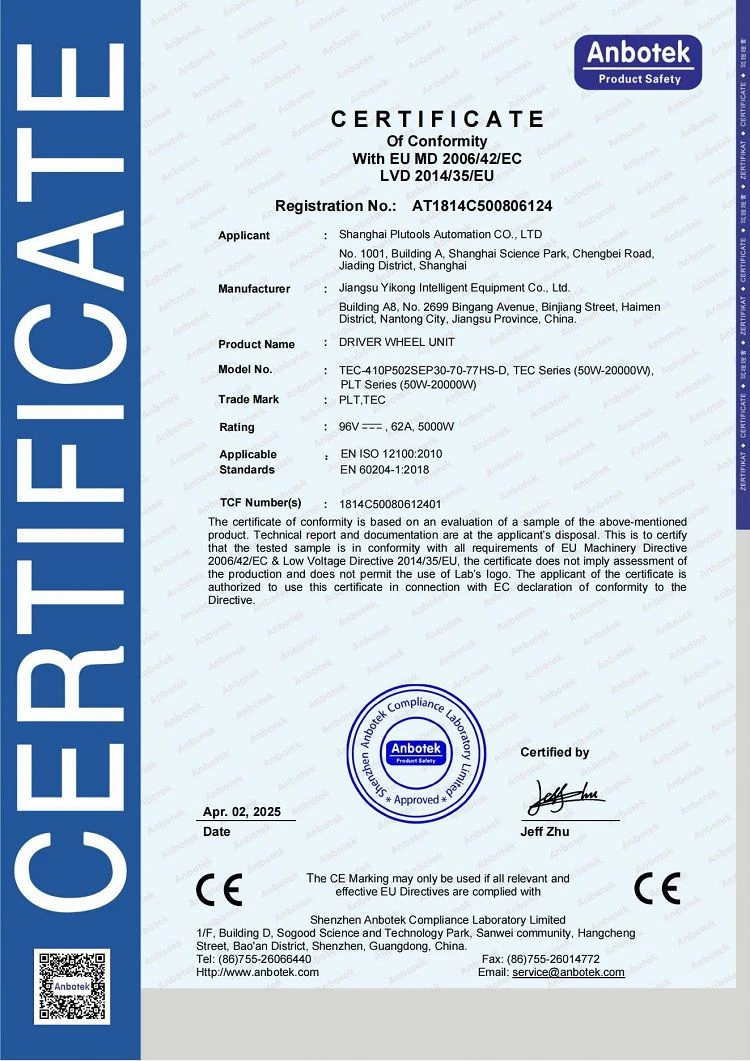
CE documentation issued for the PLT series of AGV drive wheel units, covering the certification scope discussed in this analysis.
Voltage, rated current, torque and load rating are the four figures that determine whether a drive wheel fits an AGV or AMR platform, and they are also the four figures most often read incorrectly during evaluation. A 48 V rated voltage and a 24 V rated voltage describe two different power architectures. A rated current of 11.2 A and a rated current of 68 A describe two different classes of machine. Rated torque is a continuous-duty value, while maximum torque is a short-duration peak, and treating the second as if it were the first is one of the most persistent specification errors in mobile robot procurement.
The commercial backdrop makes precision more valuable rather than less. Reports and Data values the global AGV wheel drives market at approximately USD 1.2 billion in 2024 and projects it to reach USD 3.5 billion by 2034, a compound annual growth rate of 11.5% supported by logistics and warehouse automation. As more buyers enter the category, datasheet literacy becomes a purchasing skill rather than an engineering footnote.
This article decodes those specification families using published model data from the PLT series of drive wheel units produced by Shanghai Plutools Automation Corporation Co., Ltd., a Shanghai-based manufacturer of AGV and AMR drive wheel systems. Where a figure is not published for a given model, this article says so rather than filling the gap.
Why Drive Wheel Specifications Get Misread
Specification mismatch in drive wheel selection rarely traces back to a single wrong number. In evaluation-stage reviews, three misreadings recur across buyer categories, from system integrators to in-house automation teams.
- Rated voltage read as system voltage. A drive wheel rated at 48 V is one component inside a power architecture that also includes the battery pack, charger, controller and cabling. The nameplate voltage describes the motor side of the unit. If the platform bus is 24 V, a 48 V unit is not a drop-in part, and if the platform is standardised on 48 V, a 24 V model has to be treated as a separate electrical design even when its mechanical dimensions and load rating fit the application.
- Rated current read as average consumption. Rated current is the continuous figure used to size conductors, protection devices, connectors and the controller's continuous current capability. It is not the peak current that flows during acceleration, braking or a stalled condition. Power chains sized on rated current alone typically expose their weakest element during dynamic events rather than during steady travel.
- Peak values read as continuous values. Maximum torque and maximum load describe boundaries, not operating points. A vehicle designed to sit at maximum torque for extended periods is being designed outside the assumptions behind the published figure.
Each error changes a project differently. One affects the electrical architecture, one affects component sizing and thermal headroom, and one affects duty-cycle assumptions over the life of the fleet. None of them is corrected later by software.
The PLT Series as a Reference Set for Specification Reading
Shanghai Plutools Automation Corporation Co., Ltd. is a Shanghai-based manufacturer specialising in drive wheel units for AGV and AMR mobile robots. The company reports a 10,000 m² production facility, a workforce of 100 employees and an R&D team of 60 engineers, with published annual output of 10,000 units and roughly 70% of sales exported to the EU, the USA, Southeast Asia, South America, the Middle East, Japan and South Korea.
Its PLT series is a practical reference set for this discussion because the published specifications span a broad range of load classes and drive architectures: differential drive wheels, vertical drive wheels with and without steering, a vertical unit with shock absorption, horizontal units with and without steering, parallel horizontal units with steering, and a forklift drive wheel. The spread of published values makes it possible to see how voltage, current, torque and load interact instead of treating them as independent numbers.
| Model | Drive wheel type | Rated voltage | Rated current | Rated torque (motor) | Output torque (wheel) | Maximum torque | Max load |
|---|---|---|---|---|---|---|---|
| PLT-120 | Differential drive wheel | 48 V | 11.2 A | 1.28 Nm | 10 Nm / 21 Nm (ratio 9 / 20) | 20 Nm / 42 Nm (acceleration and braking) | 150 kg |
| PLT-150 | Vertical drive wheel with steering | 48 V | 20 A | 2.4 Nm | 108 Nm | 114 Nm | 500 kg |
| PLT-167 | Horizontal drive wheel without steering | 48 V | 18 A | 2.4 Nm | 40 Nm | 120 Nm | 800 kg |
| PLT-220 | Parallel horizontal drive wheel with steering | 48 V | 18 A | 2.4 Nm | 58 Nm | 174 Nm | 1000 kg |
| PLT-210 | Forklift drive wheel | 48 V | 68 A | 9.55 Nm | 260 Nm | 576 Nm | 1200 kg |
| PLT-230P | Robot drive wheel with shock absorption (servo) | 48 V | 62 A | Not published | Not published | Not published | 1200 kg |
| PLT-198 | Planetary horizontal drive wheel with steering | 48 V | 68 A | 9.55 Nm | 260 Nm | 576 Nm | 1500 kg |
| PLT-230 | Vertical drive wheel without steering | 24 V | 76 A | 5.5 Nm | 108 Nm | 300 Nm | 1500 kg |
Table 1 — Published PLT series drive wheel specifications. Source: Plutools published model data. "Not published" means the value is not part of the manufacturer's published specification for that model.
| Load class (published max load) | Model | Rated voltage | Rated current | Drive architecture |
|---|---|---|---|---|
| 1500 kg | PLT-198 | 48 V | 68 A | Planetary horizontal with steering |
| 1500 kg | PLT-230 | 24 V | 76 A | Vertical without steering |
| 1200 kg | PLT-210 | 48 V | 68 A | Parallel horizontal with steering |
| 1200 kg | PLT-230P | 48 V | 62 A | Vertical with shock absorption |
| 1000 kg | PLT-220 | 48 V | 18 A | Parallel horizontal with steering |
| 800 kg | PLT-167 | 48 V | 18 A | Horizontal without steering |
| 500 kg | PLT-150 | 48 V | 20 A | Vertical with steering |
| 150 kg | PLT-120 | 48 V | 11.2 A | Differential |
Table 2 — PLT series shortlist by published maximum load rating. Load figures are per drive wheel, not per vehicle.
Voltage: 48 V Is a Design Baseline, Not a Universal Constant
Seven of the eight PLT models in Table 1 carry a rated voltage of 48 V. That consistency is a genuine procurement advantage: it allows a builder to standardise batteries, chargers, contactors and controller families across a product line, which reduces spare-part variety and simplifies service documentation. Buyers scanning a catalogue should read the 48 V column as evidence of a shared electrical platform rather than as a marketing claim.
The eighth model shows why the distinction matters. PLT-230 is published at a rated voltage of 24 V with an output torque of 108 Nm and a maximum load of 1500 kg. In mechanical terms it sits at the top of the load range together with PLT-198, yet its electrical identity is different. A vehicle platform standardised on a 48 V bus cannot absorb PLT-230 without a separate power path, a different controller configuration or a voltage conversion stage; conversely, a 24 V platform can only select from the smaller electrical subset of the portfolio.
The practical review step is straightforward. Confirm the rated voltage of the drive wheel, the output range of the controller that will feed it, and the expected voltage drop across the cable run under load. These three values should be checked together, not assumed to match because the nominal figures agree.
Rated Current: What 11.2 A and 68 A Actually Tell You
The published rated current figures in the PLT series range from 11.2 A on PLT-120 to 68 A on PLT-210 and PLT-198, with 18 A on PLT-167 and PLT-220, 20 A on PLT-150, 62 A on PLT-230P and 76 A on PLT-230. These numbers are not interchangeable between models even when the voltage is identical, and they drive four procurement decisions directly.
- Conductor cross-section. The cable connecting the controller to the drive wheel motor must carry the rated current continuously without exceeding its thermal limit.
- Protection and switching devices. Fuses, breakers and contactors are selected against the continuous current, with margin for the peak events that occur at every start and stop.
- Connector rating. The connector family on the unit must be rated for the current it will see. This is easy to overlook when a lower-current model is uprated into a heavier chassis.
- Controller continuous capability. A controller with adequate peak current but insufficient continuous current will thermally limit a machine that spends most of its shift in motion.
The contrast between 48 V and 24 V inside the same portfolio is instructive. PLT-230 is published at 24 V and 76 A — the highest current figure in the set — while 48 V models of comparable mechanical output sit at lower current values. This follows general electrical behaviour: for a comparable power level, a lower bus voltage requires higher current, which in turn increases resistive losses and cable sizing requirements. The specification consequence is that voltage selection is a cabling and thermal decision as much as a battery decision.
Rated Torque vs Maximum Torque: The Headroom Question
Rated torque is the continuous torque the motor can deliver within its thermal limits during normal travel. Maximum torque is a boundary value associated with short-duration events such as acceleration, braking and emergency stops, and it is not intended as a sustained operating point. Two further values sit between them in most drive wheel datasheets: output torque at the wheel, which reflects the effect of the gearbox, and the maximum acceleration and braking torque, which is the peak the drivetrain is expected to survive during dynamic events.
PLT-120 illustrates the layered structure clearly. Its rated motor torque is 1.28 Nm, and the published output torque at the wheel is 10 Nm with a transmission ratio of 9 and 21 Nm with a ratio of 20. The corresponding maximum acceleration and braking torque values are 20 Nm and 42 Nm. A buyer matching this unit to a small differential-drive logistics platform needs the wheel-level figures, not the motor figure alone, because the gearbox changes the number that reaches the floor.
The more useful comparison for evaluation purposes is torque headroom — the distance between the continuous output torque and the maximum torque a model is published with.
| Model | Output torque (continuous) | Maximum torque | Evaluation note |
|---|---|---|---|
| PLT-150 | 108 Nm | 114 Nm | Narrow published margin between continuous and peak output |
| PLT-220 | 58 Nm | 174 Nm | Wider published margin for dynamic duty cycles |
| PLT-210 | 260 Nm | 576 Nm | High absolute values for heavy material handling |
| PLT-198 | 260 Nm | 576 Nm | Same published torque pair as PLT-210, higher load rating |
| PLT-230 | 108 Nm | 300 Nm | High load rating combined with 24 V architecture |
Table 3 — Torque comparison of selected PLT models. Values are as published; no derived or calculated figures are shown.
The headroom difference has a direct application consequence. A machine that accelerates and decelerates frequently, or that operates on gradients and ramps, spends a larger share of its duty cycle near the acceleration and braking torque values. Models with a wider published margin between continuous and peak figures give the system designer more room to work with before thermal or mechanical limits become the constraint. Models with a narrow published margin are not inferior — they are simply better matched to steadier duty cycles, and the specification should be read that way.
One model in the set requires a specific note. PLT-230P is published with a servo travel motor, 2500 W, 48 V, 62 A, 3000 RPM, a gear ratio of 30 and a load rating of 1200 kg, together with an IP65 protection rating. Rated torque is not part of its published specification, so a buyer evaluating PLT-230P needs to obtain that value directly from the supplier rather than inferring it from comparable models in the range.
Load Ratings: Per Wheel, Not Per Vehicle
Published maximum load values in the PLT series range from 150 kg on PLT-120 to 1500 kg on PLT-198 and PLT-230. The figure describes the load a single drive wheel assembly is rated to carry, not the total payload of the vehicle. Converting a per-wheel rating into a vehicle payload depends on how many drive wheels are used, how the mass is distributed across them, the centre of gravity of the loaded vehicle, and the floor condition the machine operates on.
Gear ratio also varies across the range and interacts with the load class: PLT-120 is published with ratios of 9 and 20, PLT-167 with 21, PLT-150 with 22.5, PLT-220 with 28, PLT-230 and PLT-230P with 30, and PLT-198 and PLT-210 with 32. A buyer comparing two models by load rating alone is comparing only one of several variables that determine whether the machine moves as intended.
Wheel material is another variable that does not appear in the electrical specification but affects the load decision. Polyurethane is commonly used for forklift drive wheel tires because it supports higher load capacity while protecting indoor floors, according to Mordor Intelligence's forklift tire market analysis. Drive wheel selection for indoor material handling therefore usually involves a trade-off between load capacity, floor protection and traction characteristics rather than a single optimum.
PLT-230 is worth highlighting again in this context. It is published with a maximum load of 1500 kg at a rated voltage of 24 V and a rated motor torque of 5.5 Nm. Load rating is therefore not a function of voltage alone, and buyers who screen models by voltage before screening by load will exclude valid options — and include invalid ones.
IP Rating and Certification as Qualification Filters
Ingress protection is a qualification filter rather than a performance figure, because it decides whether a drive wheel is even admissible in a given environment. Within the PLT series, an IP65 protection rating is published for PLT-120 and for PLT-230P. For other models in the range, an IP rating is not part of the published specification, so buyers planning dust-heavy, washdown, chilled or otherwise demanding environments should confirm the protection level for the exact model and configuration rather than assuming it carries across the series.
The CE documentation clarifies the compliance scope. Two certificates are published under CE type, both issued by Shenzhen Anbotek Compliance Laboratory Limited for the EU market. Certificate AT1814C500806124 was issued on 2025-04-02 and expires on 2030-04-02; certificate AT182414C4001881 was issued on 2024-07-16 and expires on 2029-07-16. Both cite the applicable standards EN ISO 12100:2010 and EN 60204-1:2018, and both cover the TEC series and the PLT series in the 50 W to 20000 W range.
Those two standards address machine safety and the electrical equipment of machines respectively. Buyers building complete driverless industrial vehicles should also be aware of the wider standards environment that applies to the finished machine rather than the component: ISO 3691-4:2023 is the primary international safety standard for driverless industrial trucks and covers steering and braking systems; EN 1175:2020 specifies electrical and electronic safety requirements for industrial trucks and is applicable to AGV drive wheel assemblies in Europe; and ANSI/ITSDF B56.5 governs the performance of drive and steering units for driverless industrial vehicles in the United States.
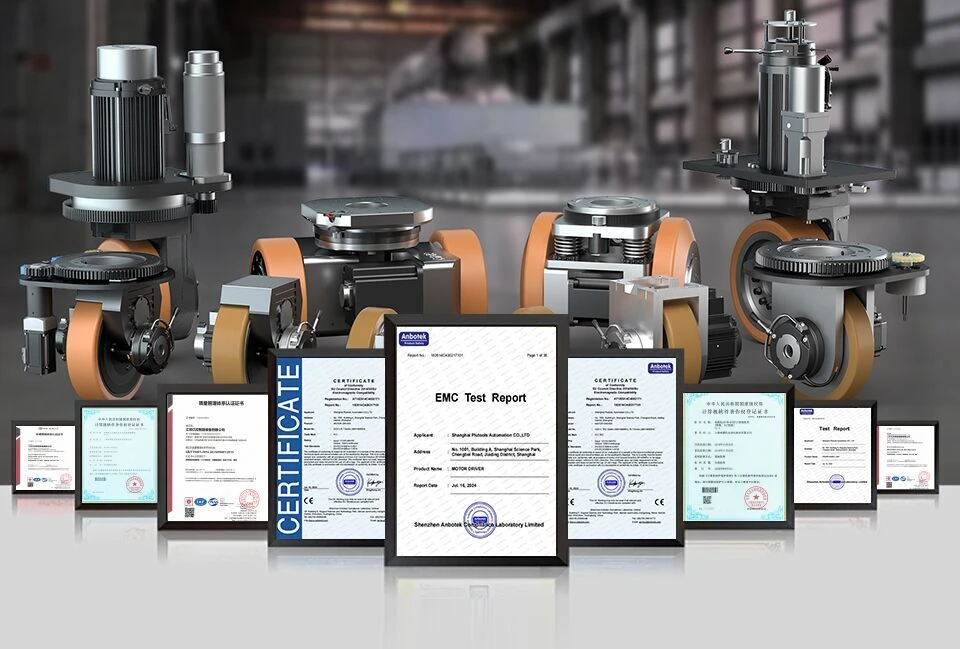
Certification documentation for PLT series drive wheel units. Component certificates and finished-vehicle compliance are separate review steps.
Two qualification details deserve attention during evaluation. First, the published certificate scope covers the PLT series as a power range; a buyer should confirm that the specific model and configuration under consideration sits inside that scope. Second, the customisation options offered across the range — including encoder type, brake system, connector type and cable length — change the electrical configuration of the unit. Buyers should confirm how those variations relate to the certificate before committing to a build.
Manufacturing process is part of the same qualification conversation. Plutools states that all products undergo 100% testing as part of its quality control process, which is a process claim a buyer can verify during a supplier audit or sample validation rather than take on trust.
Applying These Specifications in Real AGV and AMR Projects
Specification reading becomes useful only when it maps onto an application. The PLT range covers several distinct operating profiles, and the electrical figures point to where each one fits.
Differential drive wheels such as PLT-120, published at 48 V, 11.2 A and 150 kg load, suit compact logistics robots and low-profile platforms. Their symmetric layout supports tight manoeuvring, and dual differential drive wheels are widely used in smaller logistics bots because the configuration allows a zero-turn radius. At the opposite end, PLT-198 and PLT-210 are published at 48 V, 68 A, 260 Nm continuous output torque and 576 Nm maximum torque, with load ratings of 1500 kg and 1200 kg respectively — figures that align with heavy material handling and forklift-based applications. PLT-230P adds shock absorption to a 2500 W servo travel motor at 48 V and 1200 kg load, a profile relevant to AMR platforms where ride quality and floor contact stability matter.
Field evidence from a heavy-duty deployment shows how these values combine. A Brazilian AGV manufacturer and industrial automation system integrator integrated 200 drive wheel units over a two-year period into an ultra-heavy-duty AGV with multiple navigation modes, using the units for drive, differential steering and precise motion control. Reported outcomes include stable operation under heavy-load conditions, accurate route tracking, flexible steering and reliable material transportation. The application highlights load capacity, output torque, differential control precision and system integration as the factors the integrator prioritised — the same factors that appear as specification lines at the evaluation stage.
For buyers considering configuration changes, the customisation scope published for the PLT range covers load capacity, wheel diameter, motor power, voltage, rated speed, reduction ratio, mounting dimensions, encoder type, brake system, connector, cable length, logo and packaging. Production is described as OEM, ODM and custom manufacturing with sample development, monthly capacity of 12,000 units, a minimum order quantity of 2 units and a lead time of 30 to 45 days. Those two figures — MOQ and lead time — are as much a part of the specification decision as the torque table, because they set the pace at which a configuration can be validated and scaled.
Market Direction: Why Specification Literacy Is Becoming a Procurement Requirement
Several published industry signals explain why the evaluation stage described here has become more demanding.
- The global AGV wheel drives market was valued at approximately USD 1.2 billion in 2024 and is projected to reach USD 3.5 billion by 2034, at a CAGR of 11.5%, according to Reports and Data.
- Asia Pacific held a 37.6% revenue share of the global AGV market in 2025, according to Grand View Research, concentrating both supply and demand in the same region.
- Electric forklifts now command over 70% market share in many regions as replacements for combustion models, according to MarketsandMarkets, shifting drive system requirements toward electric architectures.
- The China mobile robot market reached 22.1 billion yuan in 2024 with more than 139,000 units sold, according to the China Mobile Robot Alliance.
- Lithium-ion battery technology now powers the majority of new AGV and AMR drive units, according to Fortune Business Insights, reducing range anxiety and downtime.
- Integrated steering drive modules are replacing discrete components in order to reduce assembly time and maintenance complexity, according to Brandessence Research.
- Mecanum wheels and omnidirectional drive systems are increasingly used for AMR fleets in high-density warehouses, according to Interact Analysis.
- The industrial logistics segment for AGVs is projected to grow fastest, at a CAGR of 11.6%, according to MarketsandMarkets.
Taken together, these signals point in one direction for buyers: more drive wheels are being specified, across more load classes and more operating environments, by teams that are not necessarily specialists in motion control. When procurement moves from a small group of integrators to a broader buyer base, the specification sheet becomes the main shared reference point between buyer and supplier — and the cost of misreading it rises.
Integrated Drive Wheels versus Traditional Assemblies — and the Boundaries Buyers Should Accept
A conventional heavy-duty vehicle drive train is assembled from separate elements: a motor, a gearbox, a wheel, an encoder, often a brake, and the mounting hardware that holds them together in alignment. The engineer specifies each element individually and takes responsibility for the interfaces between them.
An integrated drive wheel unit, by contrast, is published as a single set of figures — voltage, current, torque, output torque, gear ratio, load and protection rating — which shortens assembly, reduces the number of interfaces a builder has to qualify, and simplifies spare-part planning. The trend toward integrated steering modules noted by Brandessence Research reflects the same logic at machine level.
Integration does not remove boundaries, and the PLT data makes several of them visible.
- The 48 V baseline has one exception. PLT-230 is published at 24 V. A buyer standardising on a 48 V architecture cannot treat it as interchangeable with the rest of the range, even though its 1500 kg load rating places it at the top of the load table.
- IP65 is model-specific, not series-wide. It is published for PLT-120 and PLT-230P. For demanding environments, other models require confirmation rather than assumption.
- Torque headroom varies within the range. PLT-150 publishes 108 Nm continuous output against 114 Nm maximum, a narrow margin, while PLT-220 publishes 58 Nm against 174 Nm. The same supplier, the same voltage and the same nominal architecture can produce very different dynamic behaviour.
- Load ratings are per wheel. A 1500 kg published figure is not a 1500 kg vehicle payload; the number of drive wheels and the load distribution determine what the machine can actually carry.
- Customisation creates a new qualification question. Encoder, brake, connector and cable-length variations change the electrical configuration, and buyers should confirm how the selected configuration sits within the published certificate scope.
- Lead time and MOQ are part of the boundary. A 30 to 45 day lead time and a minimum order quantity of 2 units suit staged validation and pilot builds, but they do not support a specification change decided late in a project schedule.
None of these boundaries disqualifies the technology. They define the review steps a buyer should complete before committing, which is precisely the function a specification table is supposed to serve.
Future Outlook
The direction of travel in drive wheel design is toward deeper integration and higher electrical variability. As integrated steering modules replace discrete components and as lithium-ion packs become the default power source, the number of models a buyer must evaluate within a single portfolio is likely to grow rather than shrink — more voltage options, more torque tiers and more protection-level variants.
That has a clear consequence for procurement practice. The evaluation work shifts from reading one headline figure to reading a set of figures together: voltage against the existing power architecture, current against the cabling and protection design, continuous torque against the duty cycle, peak torque against the acceleration profile, load rating against the wheel count and mass distribution, and protection rating against the operating environment. Suppliers that publish values consistently across a range — including the values that constrain — make that work easier, which is itself a selection criterion worth recording.
FAQ: Evaluating Drive Wheel Specifications
What rated voltage should an AGV drive wheel be specified at?
The rated voltage should be chosen to match the vehicle's existing power architecture rather than selected in isolation. In the PLT series, seven of the eight published models are rated at 48 V, while PLT-230 is rated at 24 V. A platform standardised on a 48 V bus can use the 48 V models directly; a 24 V platform requires a different electrical design. Buyers should also check the controller's output range and the expected cable voltage drop under load before confirming the match.
Why does one drive wheel draw 11.2 A while another draws 68 A at the same voltage?
The difference reflects the mechanical power the unit is designed to deliver rather than an inconsistency in the specification. PLT-120 is published at 400 W rated power, 48 V and 11.2 A with a 150 kg load rating, while PLT-210 and PLT-198 are published at 3000 W, 48 V and 68 A with load ratings of 1200 kg and 1500 kg. Rated current is a continuous figure used for conductor sizing, protection devices, connector ratings and controller continuous capability, so it must be read alongside the power and load class of the unit.
What is the difference between rated torque and maximum torque on a drive wheel?
Rated torque is the continuous torque the motor can produce within its thermal limits during normal travel. Maximum torque is a boundary value for short-duration events such as acceleration, braking or an emergency stop, and is not intended as a sustained operating point. PLT-210 and PLT-198 illustrate the distinction: both are published with 260 Nm continuous output torque and 576 Nm maximum torque. Buyers should size the continuous duty cycle against the rated or output torque figure, and treat the maximum figure as the dynamic limit.
Is a higher maximum load rating always the better choice?
Not necessarily, because the load rating is published per drive wheel and must be interpreted against the vehicle configuration. PLT-198 is published at 1500 kg and PLT-210 at 1200 kg, but the two models also differ in drive architecture — planetary horizontal with steering versus parallel horizontal with steering — and each suits a different mounting and manoeuvring requirement. Vehicle payload depends on the number of drive wheels, the load distribution and the centre of gravity, so the per-wheel rating is one input among several rather than a standalone ranking.
Which PLT drive wheel models publish an IP65 protection rating?
IP65 is published for PLT-120, a differential drive wheel, and for PLT-230P, a vertical drive wheel with shock absorption using a servo travel motor. For other models in the range, an IP rating is not part of the published specification. Buyers planning operation in dusty, washdown, chilled or otherwise demanding environments should confirm the protection level for the exact model and configuration being considered.
Do all models in the PLT series use the same gear ratio?
No. Published transmission ratios vary across the range: PLT-120 is offered with ratios of 9 and 20, PLT-167 with 21, PLT-150 with 22.5, PLT-220 with 28, PLT-230 and PLT-230P with 30, and PLT-198 and PLT-210 with 32. Because gear ratio affects the torque that reaches the wheel and the torque required from the motor, two models with the same rated voltage and similar power can behave very differently in the same application.
For buyers who need the complete model-by-model specification set referenced in this article, the PLT selection manual is available as a downloadable reference document: PLT Selection Manual (PDF).