
Decoding Certification Essentials: UL 94V-0, IP65, and cUL Marks in Emergency Lighting Compliance
A certification mark is a claim with a boundary. Understanding exactly what each mark on an emergency lighting product does — and does not — cover is the difference between a compliant submittal and a rejected one.
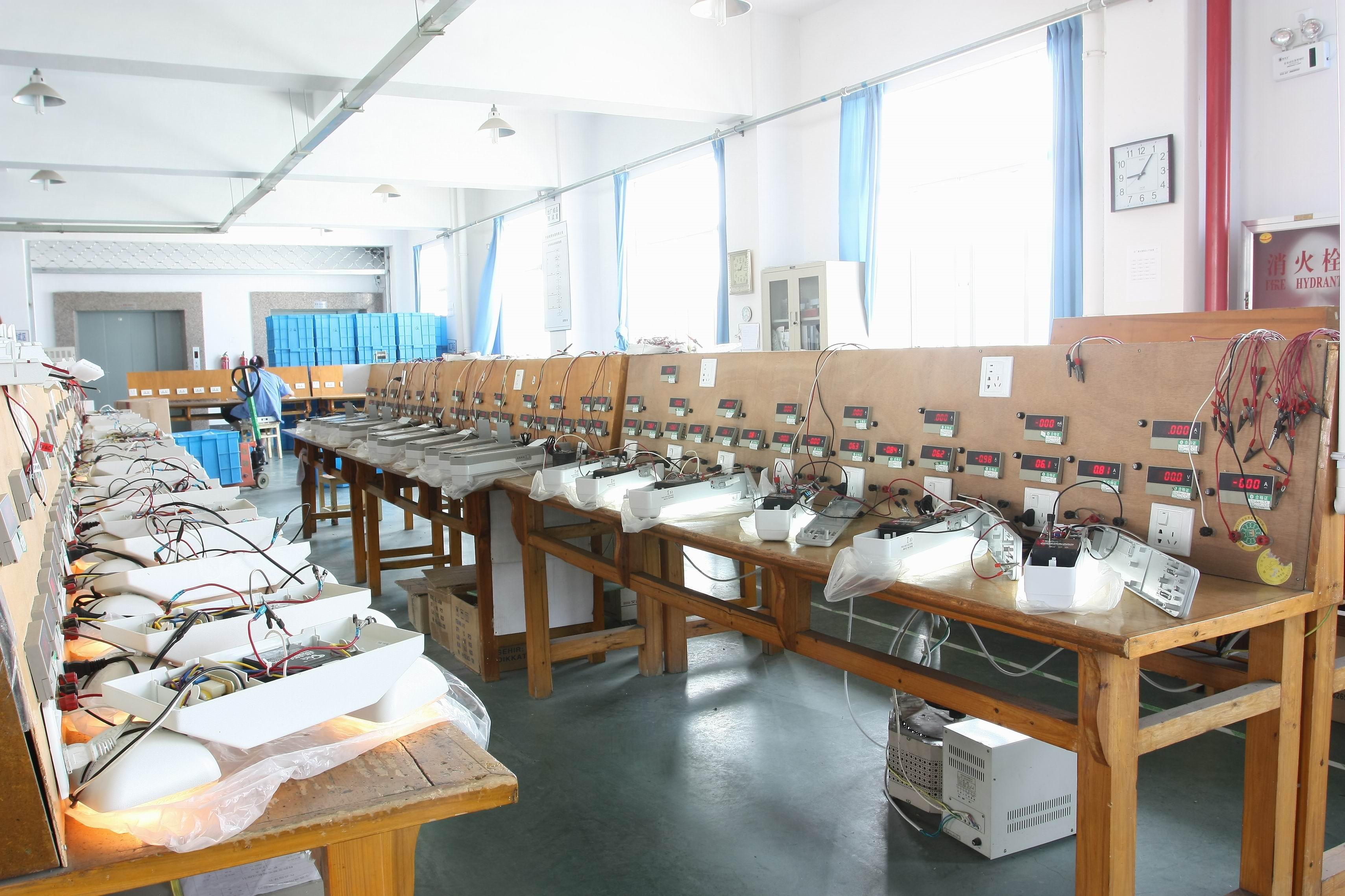
Final product quality inspection on an emergency lighting production line — the stage at which certification-relevant characteristics are verified against the listed configuration.
Why Certification Marks Decide Market Access Before Price Does
In North America, an emergency lighting product cannot legally be installed on most regulated projects unless it is listed to the applicable standard by a recognized testing laboratory. UL 924 — the Standard for Emergency Lighting and Power Equipment — is the reference point for that listing. According to UL Solutions, UL 924 covers emergency lighting and power equipment and its evaluation supports requirements associated with NFPA 101, NFPA 1, NFPA 70 Article 700, and international fire and building codes.
That single sentence explains why certification review sits upstream of every commercial negotiation. A buyer comparing quotations is not comparing two products at the same starting line unless both carry verifiable listing to the same standard, in the same configuration, for the same market. Price differences between a listed product and an unlisted one are not price differences — they are differences in what is being sold.
Ningbo JIMING Electric Appliance Co., Ltd. — a Chinese emergency lighting manufacturer established in 1967 that designs and manufactures emergency lights, exit signs, bulkhead emergency lights, and LED emergency lighting products — is a useful reference case for this exercise. Its public product documentation references several distinct compliance markers, and separating them is exactly the skill a specifier needs.
Four Marks, Four Different Questions
The most common procurement error is treating every compliance acronym as interchangeable. In practice, the marks most frequently cited on emergency lighting literature answer four unrelated questions.
| Mark | Question it answers | What it does not cover |
|---|---|---|
| UL 94V-0 | How a plastic housing material behaves when exposed to a flame | The electrical performance, runtime, or safety of the finished luminaire |
| UL / cUL listing to UL 924 | Whether the complete product has been evaluated to the emergency lighting standard for the US and Canadian markets | Whether the installation layout satisfies building or fire code |
| IP65 | The degree of protection of the enclosure against dust ingress and water jets | Corrosion resistance, UV stability, or long-term seal degradation |
| NFPA 101 / NEC references | How and where the product must be installed and maintained | Whether a specific unit is listed at all |
Table 1 — Separation of the compliance markers most often conflated in emergency lighting specification documents.
Each of these deserves its own treatment, because each fails in a different way when misread.
UL 94V-0: A Material Rating, Not a Product Rating
UL 94V-0 is a flammability classification applied to polymeric materials. It describes how a test specimen of the material behaves in a controlled vertical burn test — specifically, how quickly it self-extinguishes and whether it drips flaming particles. When a manufacturer states that a product uses a UL 94V-0 flame-retardant housing, the claim concerns the plastic, not the luminaire.
This distinction matters because emergency lighting equipment frequently sits in ceilings, stairwells, and corridors where fire performance of the enclosure is part of the specification. JIMING references UL94V-0 flame-retardant housing as part of its fire-safety and risk-control framework, positioned alongside its ISO 9001-certified quality management system. That is a genuine, checkable material claim — but a buyer should not treat it as evidence that the finished product has passed UL 924 evaluation. Those are two separate documents from two separate evaluation scopes.
UL and cUL Listing: The Actual North American Gate
Listing to UL 924 is the substantive requirement. UL Solutions describes UL 924 as involving investigatory steps beyond general lighting certifications, which is consistent with the standard's purpose: emergency lighting must operate when normal power fails, so the evaluation addresses battery charging, transfer to emergency mode, and minimum duration of operation rather than illumination quality alone.
For Canadian market access, the parallel question is which Canadian certification mark applies. Buyers will encounter cUL, cULus, and CSA marks depending on the laboratory and the file. These are not decorative variations — they indicate which certification body evaluated the product and for which jurisdiction. A product listed only for the United States is not automatically acceptable on a Canadian project.
JIMING's company profile states that its quality system is certified to ISO 9001 since 1998, and that its products meet standards including UL (USA), CSA (Canada), CE (Europe), NFPA, OSHA, FCC, DOE, CEC, NEC, IBC, NEMA, BSCI, SASO, REACH, and RoHS. Its stated product lines include UL LED emergency and security lighting and UL exit signs. These are company-reported claims, and the correct procurement response is not to doubt them by default but to convert them into a document request: file number, listing category, covered model list, and current status.
What a listing actually covers
UL 924 applies to emergency lighting and power equipment for unclassified locations intended for connection to branch circuits of 600 volts or less, and the equipment categories within scope include exit signs, emergency luminaires, unit equipment, central station battery banks, inverters, and automatic battery charging and control equipment. A listing applies to a specific product configuration. Change the battery chemistry, the driver, the housing material, or the optical assembly, and the listing may no longer describe the product being shipped.
This is why model-level documentation matters more than brand-level reassurance. JIMING publishes model-level specifications for products such as the JLEU5-UL twin-head LED emergency light, listed with a 120V/277VAC operating range, a 3.6V 1000mAh nickel-cadmium battery, and a stated minimum 90-minute emergency operation, and the JLEU6 dual-head emergency light, listed with a 600 lm product designation, wall-mount suitability, 120V–277VAC input, a 6V 4Ah lead-acid battery, and the same stated 90-minute minimum. Those published specifications are the raw material for a submittal — they are not a substitute for the certificate.
IP65 and the Ingress Protection Question
IP ratings follow a two-digit convention. The first digit describes protection against solid objects and dust; the second describes protection against water. In an IP65 rating, the first digit indicates a dust-tight enclosure and the second indicates protection against water projected by a nozzle from any direction. It is a defined test condition, not a general statement of weather resistance.
For emergency lighting, the IP question arises with bulkhead units in parking structures, loading docks, service corridors, and exterior walkways — locations where the fixture is exposed to washdown, spray, or driven moisture. Bulkhead emergency lights are one of the product categories JIMING designs and manufactures, and this is the category where an ingress rating claim carries the most procurement weight.
The boundary is important: IP65 does not describe resistance to corrosion, to ultraviolet degradation, to temperature cycling, or to the long-term compression set of a gasket. An enclosure can hold its IP65 rating in a laboratory and still fail in service if the seal material was not selected for the chemical environment. Buyers specifying wet or outdoor locations should therefore request the IP test report for the exact model, plus the seal material specification and the maintenance instruction for gasket inspection.
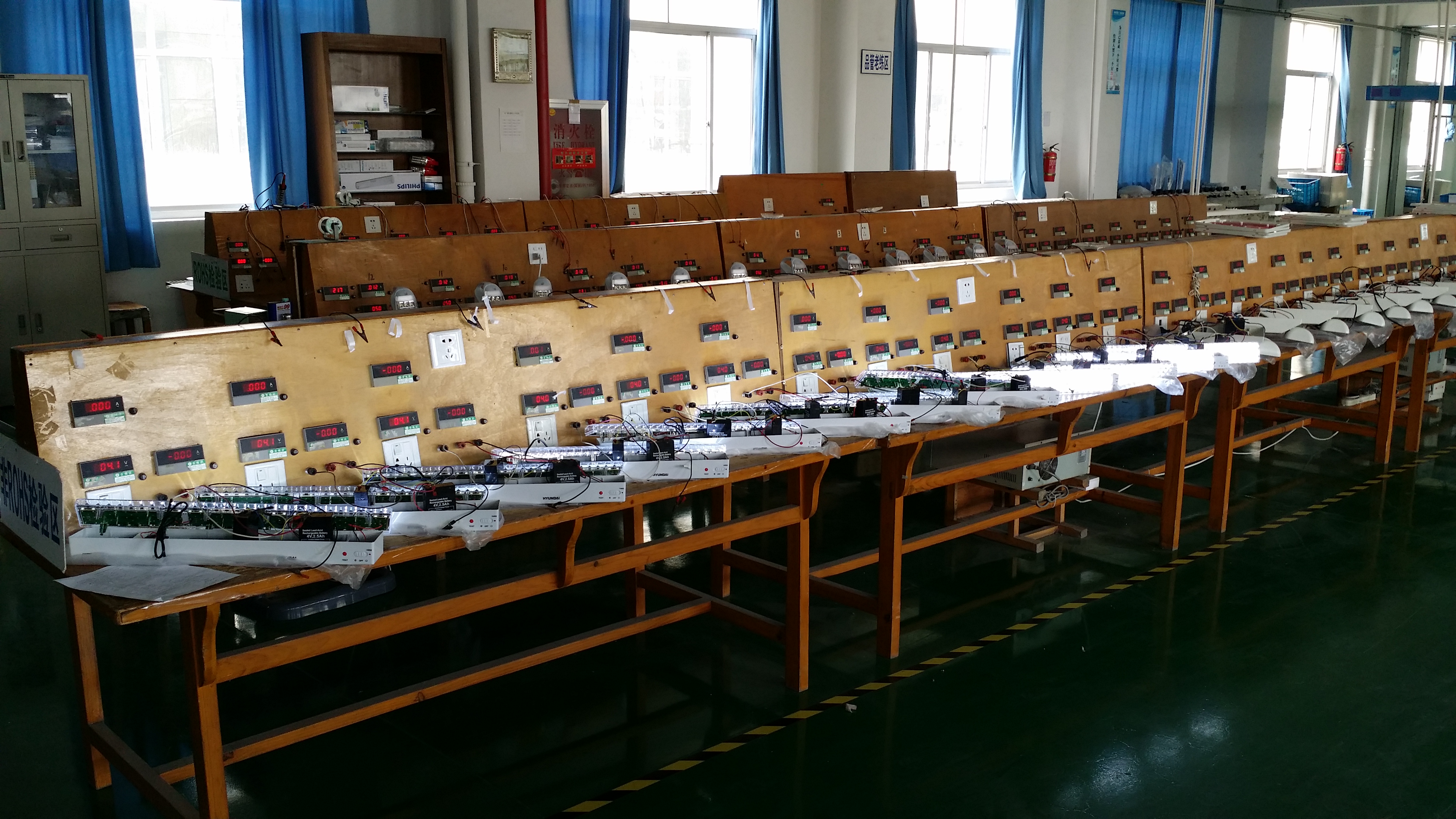
In-process inspection — the point at which housing, sealing, and electronic assemblies are checked before final assembly and testing.
Turning Certification into a Specification: The JIMING Reference Case
A compliance claim becomes useful only when it maps onto something a buyer can act on. JIMING's structure offers a reasonably complete example of how that mapping works in practice.
The manufacturer operates two fully integrated, company-owned production facilities in Ningbo, China, and Haiphong, Vietnam. Production is vertically integrated in-house — precision plastic injection moulding, PCB design and assembly, final assembly, and testing — with moulds engineered for over 500,000 cycles. Vertical integration is directly relevant to certification continuity, because the variables that most often invalidate a listing — a substituted resin, a changed driver supplier, a re-routed PCB — are exactly the variables a vertically integrated factory controls internally rather than sourcing from third parties.
The quality system is described as a 100% in-process control covering incoming inspection, production line monitoring, and finished product verification, certified to ISO 9001 since 1998. Annual output is approximately 5,000,000 sets, with a monthly production capacity of 400,000 sets, and 96% of production is exported to markets including the USA, Canada, Europe, and the Middle East. For a buyer, the operational implication is straightforward: a manufacturer shipping at that volume across those markets has already absorbed the documentation burden of North American listing on a recurring basis.
Where the long-term relationship enters
Certification is not a one-time event, and this is where the procurement decision becomes an ecosystem decision rather than a transaction. JIMING's stated partnership model includes flexible payment terms and volume-based incentive programs, dedicated project management, NDA-ready IP protection, and three cost-structure tiers described as Value, Balanced, and Premium. Its documented OEM/ODM history includes a U.S.-based project developed for the North American retail market over a five-year duration, in which the engineering team collaborated with the customer on product development, achieving validation in global markets and a stable supply compliant with UL and CSA standards.
That last point is the one worth extracting. A five-year supply program is not sustained by a single certificate issued at the start. It is sustained by a change-control process that prevents the listed configuration from drifting — and by a supplier that treats the listing as a living asset rather than a marketing line item.
A Buyer's Certification Checklist
The following sequence is a practical screening order for specifiers and procurement teams evaluating an emergency light supplier. It moves from the cheapest question to the most expensive one, so that weak candidates are eliminated early.
| # | Request | What it filters out |
|---|---|---|
| 1 | Listing file number and certification body for each model | Suppliers whose "UL" claim is a category-level marketing statement |
| 2 | Current listing status verified against the certification body's public directory | Expired, withdrawn, or superseded listings |
| 3 | Covered model list that matches the quoted part numbers exactly | Listings that cover a different configuration than the one being purchased |
| 4 | Canadian mark and jurisdiction confirmation | US-only listings proposed for Canadian projects |
| 5 | Material classification record for the housing resin (e.g. UL 94V-0) | Unsupported flammability claims |
| 6 | IP test report for the specific model and the seal material specification | Ingress ratings inherited from a different product family |
| 7 | Runtime test conditions and battery specification | Runtime claims with no stated test basis |
| 8 | Written change-control commitment for the listed configuration | Silent substitution of drivers, cells, or resins during production |
Table 2 — An eight-step certification screening sequence ordered from lowest to highest verification cost.
Where Certification Claims Fail: Limits and Boundaries
A credible compliance discussion has to state what the documents do not do, and there are four limits worth naming explicitly.
- A listing is not a performance guarantee. UL 924 establishes that a product meets the standard's requirements; it does not establish that the product is the best available for a specific project. Photometric distribution, glare control, and maintenance access remain separate engineering judgments.
- Published runtime is not measured under site conditions. JIMING's published minimum 90-minute figures for the JLEU5-UL and JLEU6 are product-page specifications. Battery behavior changes with age, temperature, and charge history, and buyers should not extrapolate published figures to end-of-life performance without the supplier's battery aging data.
- A product listing does not satisfy installation code. UL Solutions notes that UL 924 evaluation supports requirements associated with NFPA 101 and NFPA 70 Article 700, but layout, egress path coverage, and illumination levels are design responsibilities. Minnesota Department of Public Safety guidance, for example, describes a monthly 30-second activation test and an annual 30-minute power test for hotel emergency lighting — a maintenance obligation that no product certificate can discharge on the buyer's behalf.
- Origin does not change the standard. JIMING operates two fully integrated, company-owned production facilities in Ningbo, China, and Haiphong, Vietnam, and its Vietnam facility is built on self-owned land to support long-term cost stability and Vietnam-origin certificates. A change of manufacturing origin can affect tariff treatment and origin documentation, but it does not relax the listing requirement: the product shipped from Vietnam must still match a listed configuration.
Market Context: Compliance as a Growing Cost Center
The commercial weight of this topic tracks the size of the category. Mordor Intelligence estimates the global emergency lighting market at USD 8.05 billion in 2026, growing at a compound annual growth rate of 10.05% through 2031. Growth of that order generally increases the number of suppliers entering a market faster than it increases the number of regulators — which is precisely the condition under which documentation discipline becomes a competitive filter.
A second structural factor is jurisdictional guidance on testing. Kansas Fire Marshal guidance describes battery-powered emergency lights as relatively inexpensive, reliable, readily available off-the-shelf, and easy to install, while emphasizing that tested and listed units are used. The guidance is qualitative, but it points to the real dynamic: the reason listed units dominate is not that unlisted units are more expensive — it is that the listed unit is the one an inspector will accept.
Future Outlook
Three developments are likely to shape certification expectations over the next procurement cycles. The first is documentation digitization: buyers are already moving from PDF certificates toward public directory lookups, which makes stale listings harder to hide. The second is test automation, illustrated by systems such as the EMCL ELT System, which converts existing emergency lighting into intelligent wireless devices that automate code-required testing — an approach that changes the maintenance burden but not the underlying listing requirement. The third is supply-chain regionalization, where dual manufacturing footprints in China and Vietnam offer tariff and continuity flexibility while leaving product standards untouched.
For manufacturers, the implication is that certification is becoming a service rather than a certificate: the ability to produce current documentation, trace configuration changes, and support a customer's inspection cycle over a multi-year program. JIMING's stated model — ISO 9001 certification since 1998, a 100% in-process quality control system, dual manufacturing bases, and volume-based partnership incentives — is structured around that longer horizon rather than a single shipment.
Certification requirements, code adoption, and local inspection practice vary by jurisdiction and change over time. Buyers should verify listing status directly with the certification body and confirm local code requirements with the authority having jurisdiction before approving a product for installation.
Frequently Asked Questions
Does a UL 94V-0 housing rating mean the emergency light itself is UL listed?
No. UL 94V-0 is a flammability classification applied to the plastic material used for the housing. It describes how a test specimen of that material behaves in a vertical burn test. Product listing to UL 924 is a separate evaluation of the complete luminaire, including its charging, transfer, and emergency operation functions. A datasheet can legitimately carry both claims, but one does not imply the other, and each should be supported by its own documentation.
What is the difference between a UL mark and a cUL mark on the same emergency lighting product?
They indicate evaluation for different jurisdictions. A UL mark generally refers to listing for the United States market under the applicable standard, while a cUL mark indicates certification for Canada. Buyers will also encounter combined marks such as cULus and separate marks from other recognized certification bodies such as CSA. A product listed only for the United States is not automatically acceptable on a Canadian project, so the specific mark and its jurisdiction should be confirmed against the project's location before approval.
If a bulkhead emergency light carries an IP65 rating, is it suitable for all outdoor locations?
IP65 describes protection against dust ingress and against water projected by a nozzle. It does not describe resistance to corrosion, ultraviolet exposure, chemical attack, or temperature cycling, and it does not guarantee that a gasket will retain its sealing performance over years of service. For outdoor or wet locations, buyers should request the IP test report for the exact model, the seal material specification, and the recommended gasket inspection interval, then compare those against the actual environmental conditions of the installation.
Which documents should a supplier provide to substantiate a UL 924 compliance claim?
A substantiated claim typically rests on four items: the listing file number issued by the certification body, confirmation of current listing status through the body's public directory, a covered model list that matches the part numbers being quoted, and the applicable Canadian mark if the project is in Canada. Supporting technical documentation — runtime test conditions, battery specification, and material classification records — should accompany those items. A brand-level statement that a company "meets UL standards" is not a substitute for any of them.
How does certification affect long-term supply agreements for emergency lighting?
A listing describes a specific product configuration. Over a multi-year program, the risk is configuration drift — a substituted driver, a different cell, or a changed resin that no longer matches the listed build. Long-term agreements therefore benefit from an explicit written change-control commitment, periodic re-verification of listing status, and clarity on which party bears the cost of re-testing if a component must change. Manufacturers with in-house moulding, PCB design and assembly, and final testing control more of those variables directly, which reduces the number of external substitutions that can invalidate a listing.
Does manufacturing in Vietnam instead of China change the certification requirement?
No. The applicable product standard and listing requirement are determined by the destination market, not by the country of manufacture. A unit produced in Vietnam for the North American market must still match a configuration listed to UL 924, and the same documentation obligations apply. What a different manufacturing origin can change is tariff treatment and origin documentation — a commercial consideration that runs in parallel to, and does not replace, product certification.
¿Tiene preguntas o necesita más detalles?
Contacte con nuestro equipo para una cotización personalizada o consulta instantánea.
Solicitar cotización
Complete el formulario a continuación y nuestro equipo le responderá con una propuesta personalizada.
Chat directo de WhatsApp
¿Prefiere chatear en tiempo real? Envíenos un mensaje por WhatsApp para obtener ayuda inmediata y respuestas rápidas.
- Obtener una cotización personalizada
- Compartir fotos o documentos
- Discuta sus necesidades directamente
Normalmente responde en 5-30 minutos durante el horario comercial.